
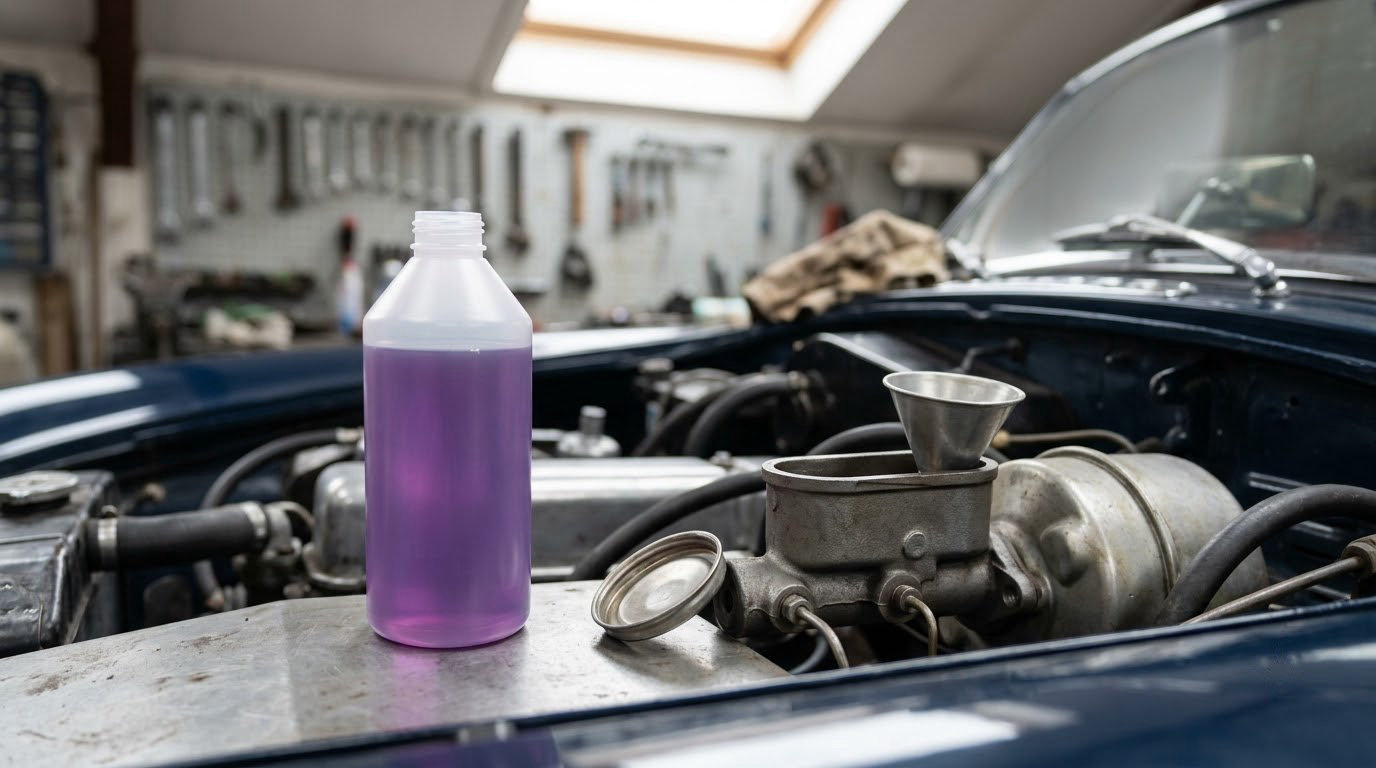
DOT 5 brake fluid is a silicone-based hydraulic fluid used in classic cars, vintage motorcycles, military vehicles and cars in long-term storage. It transmits pedal pressure through the brake lines and it does not absorb moisture the way glycol-based DOT 3, DOT 4 and DOT 5.1 fluids do. It belongs only in a system that was specified for it, and it is not a general-purpose upgrade.
I get asked this constantly, and the honest answer is short: DOT 5 is a specification, not an improvement. Put the wrong fluid in a system and the consequences range from a soft pedal to a seized caliper. In 2026 the correct fluid for any vehicle is the one named in the owner’s manual or on the reservoir, and every section below hangs off that rule.
BMW deserves a specific mention here, because a surprising number of owners assume the German marques have a private silicone variant. They largely do not. Most BMWs from the last few decades are glycol DOT 4, and older air-cooled cars in the vintagebmw.org community warn that silicone fluid has gummed internals in systems that were never fully rebuilt. If a BMW is yours, the manual decides, not the badge.
Table of Contents
- What Is DOT 5 Brake Fluid Used For?
- How DOT 5 Brake Fluid Works in a Hydraulic Braking System
- What Makes DOT 5 Different From DOT 3 and DOT 4?
- Why Moisture Control Matters for Brake Performance
- Can You Mix DOT 5 With DOT 3 or DOT 4?
- Does DOT 5 Work Better in Hot, Cold, or Wet Conditions?
- How to Check Whether Your Vehicle Can Use DOT 5
- How DOT 5 Is Serviced in a Compatible System
- DOT 5 Brake Fluid Misconceptions to Avoid
- Frequently Asked Questions
- Conclusion
What Is DOT 5 Brake Fluid Used For?
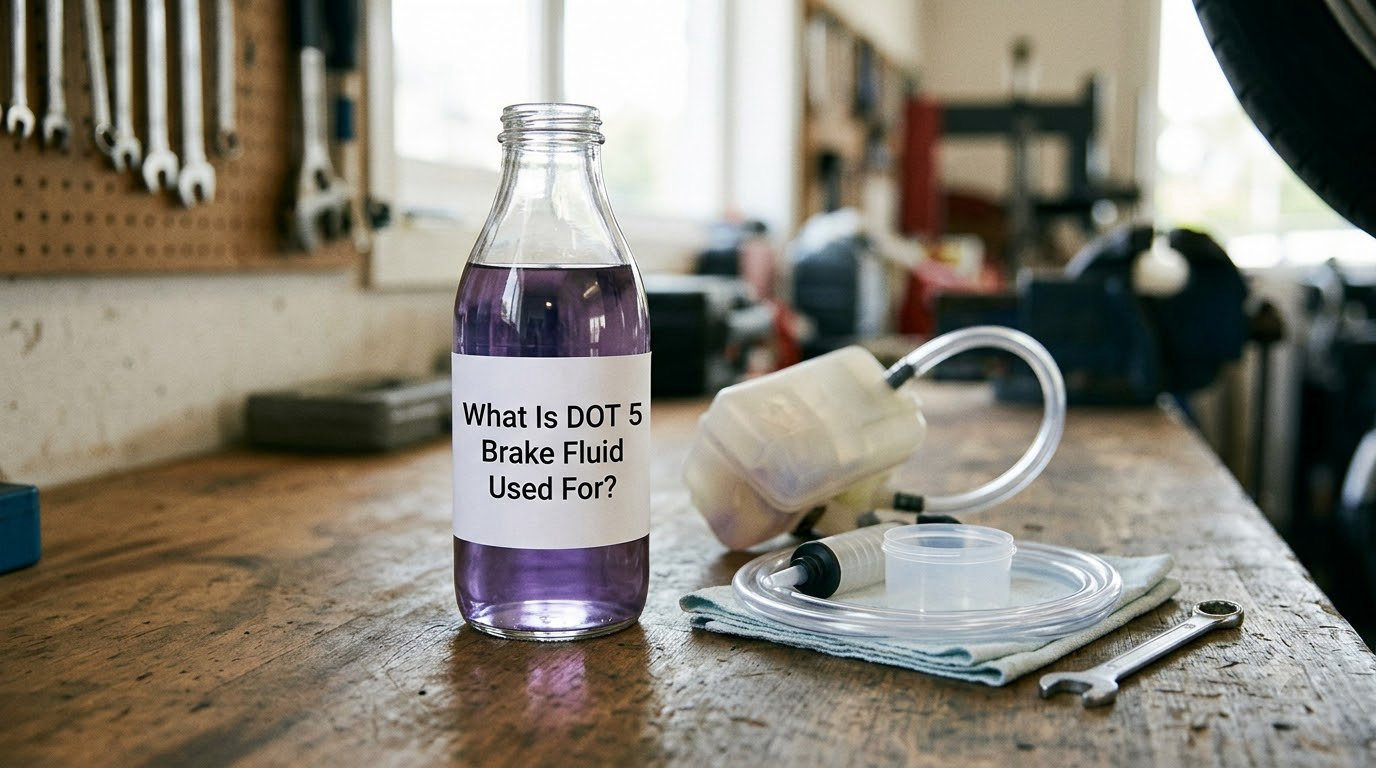
DOT 5 is a silicone-based hydraulic brake fluid rated under FMVSS 116, the US Department of Transportation standard that defines brake fluid grades. It is usually dyed purple so it cannot be confused with amber glycol fluid, and that colour is the single most useful check a driver can make at a parts counter or in their own garage.
In practice, DOT 5 turns up in four places:
- Classic and collector cars that were factory-filled with silicone fluid, or where the manufacturer approved a silicone changeover as part of a restoration.
- Vintage motorcycles, including some older Harley-Davidson touring models and many mid-century Japanese and British machines whose brake and clutch hydraulics were designed around it.
- Military and industrial vehicles that sit for long stretches between uses, where fluid that will not absorb water is worth the sourcing hassle.
- Vehicles in long-term or seasonal storage, for the same reason. DOT 5 is commonly chosen for a car that will be parked for months, because glycol fluid takes on moisture while it sits and that moisture corrods the inside of the lines and calipers.
Everything outside that list needs a specification to back it up. The colour of the fluid, the shape of the bottle, the price on the shelf and the confidence of whoever is handing you the jug are all irrelevant. Documentation is what matters.
How DOT 5 Brake Fluid Works in a Hydraulic Braking System
The fluid’s job is to pass force along, not to create it. When you press the pedal, the master cylinder converts that force into hydraulic pressure, and the fluid carries the pressure through the hard lines and flexible hoses to each wheel cylinder or caliper, where it pushes a piston that squeezes the pads or shoes against the rotor or drum.
Because the medium is incompressible, the pressure arrives almost instantly, which is why hydraulic brakes feel firm and repeatable. What the fluid cannot do is create pressure on its own, and what it cannot fix is a leaking hose, a worn caliper seal or a contaminated rotor.
Silicone fluid performs that transmission job differently from glycol fluid in one measurable way: it is more compressible at the low temperatures and pressures found in a cold system. That is the origin of the longer lever travel and slightly spongy pedal that DOT 5 owners report. Warmer, under load, the difference narrows, which is why the complaint tends to show up on cold mornings rather than on a hot drive home.
What Makes DOT 5 Different From DOT 3 and DOT 4?
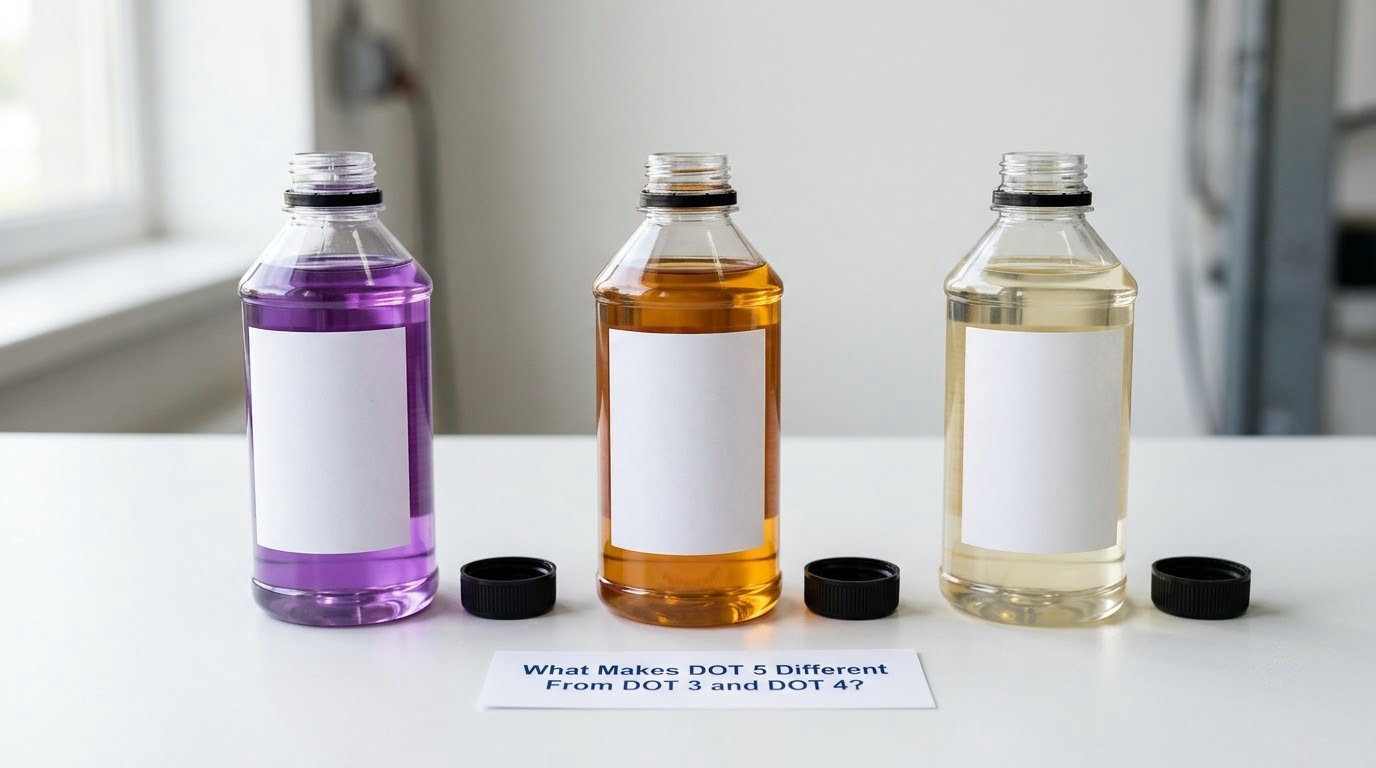
The single most important difference is the base chemistry. Everything else follows from it.
| Grade | Base fluid | Colour | Absorbs water | Min. dry boiling point | Min. wet boiling point | Mixable with DOT 5 |
|---|---|---|---|---|---|---|
| DOT 3 | Glycol ether | Clear to amber | Yes | 205 C / 401 F | 140 C / 284 F | No |
| DOT 4 | Glycol ether, borate ester | Amber to pale straw | Yes | 230 C / 446 F | 155 C / 311 F | No |
| DOT 5 | Silicone (polydimethylsiloxane) | Purple | No | 260 C / 500 F | 180 C / 356 F | Only with other DOT 5 |
| DOT 5.1 | Glycol ether, borate ester | Amber | Yes | 260 C / 500 F | 180 C / 356 F | No |
The numbers are the FMVSS 116 minimums, not typical laboratory results. A good DOT 4 will beat its minimum comfortably, and a cheap one may sit just above it. Note the wet column: that is the boiling point once the fluid has absorbed roughly 3.7 percent water by mass, which is the point at which conventional fluid has already absorbed enough water to matter.
One more row worth reading twice. DOT 5 and DOT 5.1 share identical boiling point figures and opposite chemistry. DOT 5.1 is a glycol fluid that borate esters make more stable at high temperature; it is not a dimmed-down DOT 5, and it is not interchangeable with one. Owners on hdforums.com describe the confusion regularly, and it is the single most expensive misunderstanding in this whole topic.
What Is DOT 5 Brake Fluid Used For?
In short: use DOT 5 when the vehicle, the axle, the brake component or a documented service procedure calls for silicone-based fluid of that grade. The representative uses are certain classic cars, some vintage motorcycles, military and industrial platforms, and vehicles that spend long periods unused. In every other case, a glycol DOT 4 fluid matched to the specification is the correct answer.
Why Moisture Control Matters for Brake Performance
Water is the enemy of any hydraulic brake system because of heat. Braking converts motion into heat, and lots of it. A fluid that has absorbed moisture boils at a much lower temperature than the same fluid dry, and once it boils it produces vapour bubbles instead of transmitting pressure. The pedal goes soft, fades begin, and in a long descent the pedal can travel to the floor.
Glycol-based fluid is hygroscopic. It draws water through rubber seals and permeable hose, slowly and constantly, and that is why a two-year replacement interval exists in the first place. DOT 5 is non-hygroscopic: silicone molecules repel water rather than absorbing it, so its wet boiling point stays close to its dry boiling point.
Here is the myth that gets repeated on every forum thread in this niche. Non-hygroscopic does not mean corrosion-proof. Water still gets into the system from condensation, from a wet parking garage, from driving in rain with a worn master cylinder seal, or from an open reservoir while the car sits. It cannot be absorbed by the fluid, so it settles. It pools at the low points, and it sits there against steel lines, wheel cylinders and the internal bores of the caliper. One Factory Five builder put it plainly on ffcars.com: silicone fluid will not absorb the water, it just lets it settle and rust the brake system from the inside.
So the correct reading is narrower than the marketing. DOT 5 removes one mechanism of water ingress, not the need to inspect the system. Water that pools in a DOT 5 line is arguably more dangerous precisely because nothing in the fluid tells you it is there.
Can You Mix DOT 5 With DOT 3 or DOT 4?
No. Do not mix silicone-based DOT 5 with conventional DOT 3 or DOT 4 unless the manufacturer explicitly documents that the combination is permitted in your model. That is not a cautious recommendation, it is the rule.
The two families are not miscible. Glycol and silicone separate, and a system containing both can end up with silicone in the calipers and glycol in the master cylinder, or with droplets suspended through the whole circuit. Neither fluid reaches the seals in an even film, and the rubber internals are the weak point: they can swell, distort and gum. Once the internals have been damaged, the fix is a full strip and rebuild of the master cylinder and every caliper, which is a very different afternoon from a fluid change.
If you have already topped DOT 3 or DOT 4 off with DOT 5, treat the whole system as contaminated. Drain it, remove the master cylinder reservoir and any plastic components, then flush with the correct single fluid until what comes out is uniformly that fluid. On vintagebmw.org, owners who made that mistake describe having to pull every caliper afterwards because the silicone had gummed the pistons. A flush costs far less than a rebuild, so if you are unsure what is in the system, flush it.
The other direction, going from DOT 5 back to glycol, carries the same requirement. You cannot convert by top-off either. It is a full flush and, in an older system, a careful look at the internal condition of every cylinder you touch.
Does DOT 5 Work Better in Hot, Cold, or Wet Conditions?
The honest answer is that DOT 5 is built for one thing: resisting water. For heat, it is simply adequate rather than superior. These are the FMVSS 116 minimums.
| Grade | Minimum dry boiling point | Minimum wet boiling point | Wet versus dry |
|---|---|---|---|
| DOT 3 | 205 C / 401 F | 140 C / 284 F | Loses 117 F once water-contaminated |
| DOT 4 | 230 C / 446 F | 155 C / 311 F | Loses 135 F once water-contaminated |
| DOT 5 | 260 C / 500 F | 180 C / 356 F | Holds on to its dry figure far better |
| DOT 5.1 | 260 C / 500 F | 180 C / 356 F | High dry figure, but from a borate ester glycol |
Read that fourth column carefully. A DOT 3 system with water in it can lose more than 100 F of boiling margin, and fade under repeated stops is a genuine safety issue, not a comfort complaint. DOT 5’s advantage is that its margin largely survives contamination.
Where DOT 5 is weaker is cold. It is more compressible, so lever travel lengthens, particularly on a cold start. Riders on hayabusa.org describe a slightly sponger feel that most of them accept without complaint; others call it a downgrade. Either way, that is the trade you are making.
None of this is a claim about stopping distance. Boiling point tells you when the fluid will fail, not how hard the car stops. Actual stopping performance is the pads, the rotors, the tires, the brake balance, your technique and the system design. Anyone who tells you a higher fluid grade means shorter stopping distances has misunderstood the physics.
How to Check Whether Your Vehicle Can Use DOT 5
Work through these in order, and stop at the first authoritative answer you find.
- Read the owner’s manual. Look in the maintenance or brake system section for the specified fluid. This is the definitive source and it costs nothing.
- Read the reservoir cap. Most caps are moulded with the required grade and the word DOT. A cap that says DOT 3 or DOT 4 is a direct instruction.
- Look for a DOT marking on the reservoir body or the master cylinder. A stamped or printed DOT number inside the reservoir is the factory spec in one word.
- Check for an axle, caliper or component marking. Some systems are approved for a specific grade only on part of the circuit, which is the case that catches people out. The plan calls this out because it is where a part-spec fluid and a system-spec fluid diverge.
- Consult the service documentation or the manufacturer. If the manual, the cap and the workshop manual disagree, the dealer and the written specification win, and it is worth the phone call.
Do not infer approval from the fluid colour, the viscosity on the label, or a marketing claim on the front of the bottle. In 2026 the grade printed on the container tells you what the fluid is, never what your vehicle wants.
How DOT 5 Is Serviced in a Compatible System
Because it does not absorb water, DOT 5 is not on the short-interval schedule that many glycol fluids run. That is a genuine advantage in a car that is stored for months, and it is the reason owners ask whether it ever needs changing at all.
It still does. The fluid can be contaminated from outside the system, degraded by age and heat cycling, or simply displaced by an open reservoir that collected dust. A reasonable practice is to inspect the fluid and the system at least every two years and change it on condition rather than on a fixed clock: cloudy or discoloured fluid, fluid that has taken on water, a system that has been open, or a leak that let air and moisture in. Sealed containers are commonly given a shelf life of about five years, which is a different thing entirely from service life in a car.
Whatever fluid goes in, the rest of the job does not change. Bleed the system properly, working from the farthest caliper back so the fluid and any air move toward the reservoir. Keep containers sealed and clean, and dispose of the old fluid through a proper oil collection point rather than down a drain.
DOT 5 Brake Fluid Misconceptions to Avoid
Misconception: DOT 5 is a better version of DOT 4. It is a different chemical family with a different set of trade-offs, not an upgrade ladder. A DOT 4 system designed around glycol seals should stay on glycol.
Misconception: because it does not absorb water, it never needs changing. As covered above, water still enters and pools. The absence of absorption removes one mechanism, not the need for inspection. One r/BMW owner with a 2014 F34 was told by a dealer that the silicone fluid in the car did not need changing, and could not work out whether that was right. It was a fair question with an unsatisfying answer: nothing in the fluid itself degrades the way glycol does, but pooled water still corrodes steel.
Misconception: DOT 5 improves stopping power. It does not. Fluid grade is a durability and water-management specification. Pedals, rotors, tires and technique set how a car stops.
Misconception: BMWs, or any modern car, can run it. Most contemporary BMWs are DOT 4. Air-cooled classics from the 60s and 70s are the group most likely to have a documented DOT 5 history, and even there the manual decides. A garage will also sometimes pour the wrong fluid into the wrong car unless you spell out the grade, so the conversation at the counter is worth having.
Misconception: DOT 5.1 is DOT 5 with a different label. It is glycol. The confusion causes real damage, because a system running silicone will be topped up with a completely incompatible family.
Frequently Asked Questions
Is DOT 5 brake fluid better than DOT 4?
Neither is better. They are different chemical families with different trade-offs. DOT 4 is a glycol fluid that absorbs water and needs regular changes. DOT 5 is silicone, does not absorb water, and suits classic cars, vintage motorcycles and stored vehicles. Use whichever grade your vehicle was specified for, which for most modern cars including most BMWs means DOT 4.
Can DOT 5 brake fluid be used in any BMW?
Only where the documentation says so. Most modern BMWs are specified for glycol DOT 4, and owners on vintagebmw.org report silicone fluid gumming internals in older systems that were never fully rebuilt. Some air-cooled classics and specific components have a documented DOT 5 history. Check the owner manual, the reservoir cap marking and the DOT stamp on the reservoir before buying anything.
What happens if silicone-based DOT 5 is mixed with DOT 4?
The two fluids are not miscible and will separate, so the system ends up with an uneven film of each family reaching the seals. Rubber internals in the master cylinder and calipers can swell, distort and gum. The repair is a full flush plus a strip and clean of every cylinder, not a top-off. If it has already happened, drain the system and flush completely with one fluid.
Does DOT 5 brake fluid need to be changed regularly?
Not on the short two-year schedule many glycol fluids follow, because silicone does not absorb moisture the same way. It still needs inspection, and it should be replaced when it is discoloured, contaminated, degraded by age and heat, or when the system has been opened or a leak let air and moisture in. A sealed container has a shelf life of roughly five years, which is separate from in-service life.
Can DOT 5 brake fluid absorb water and still brake safely?
DOT 5 does not absorb water, and that is its main advantage. But water still enters through condensation, a wet environment or worn seals, and because the fluid will not take it up, it settles at low points and corrodes steel lines and calipers from the inside. Non-hygroscopic means it resists one route of water ingress. It does not mean the system is protected from moisture.
Conclusion
Start with the documentation, not the bottle. Open the owner’s manual, find the specified brake fluid grade, then confirm it against the reservoir cap and any DOT stamp on the reservoir. If that grade is DOT 3 or DOT 4, buy glycol fluid of that grade and never add silicone to it.
If DOT 5 is what your vehicle calls for, buy the same grade consistently, keep the system sealed and clean, and inspect the fluid and lines on a schedule even though it will not absorb water. If silicone and glycol are already mixed in the system, flush the whole circuit with one fluid and expect to strip the cylinders before the job is finished.