
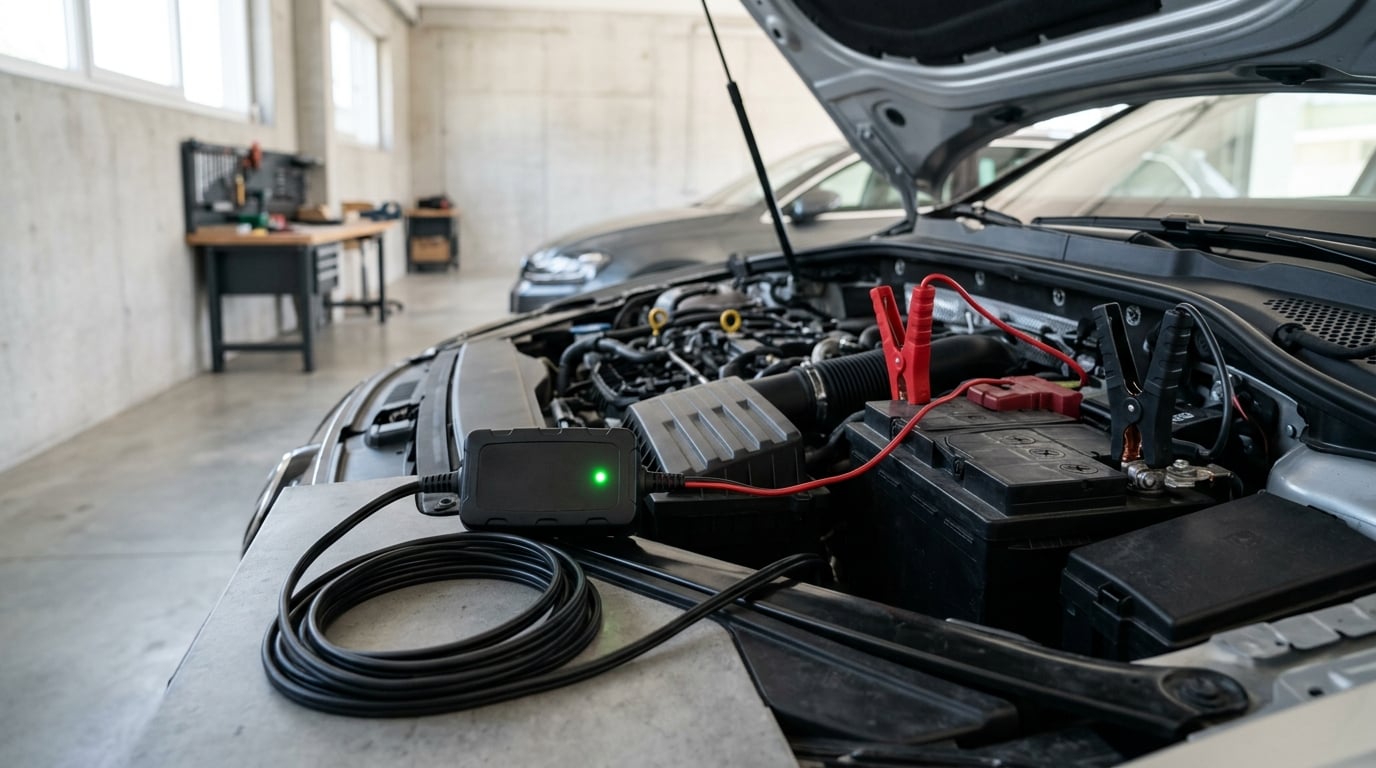
A battery tender, also sold as a battery maintainer or a smart trickle charger, is a small charger that plugs into a wall outlet and holds a 12V lead-acid battery at full charge while a vehicle sits unused. It is not a jump starter and it will not revive a dead battery, it prevents one. This guide covers what is a battery tender and how to use one, starting with the hookup order most people get backwards.
If your car starts on the first turn after three weeks parked, you probably do not need one. If it does not, read on.
Table of Contents
- What Is a Battery Tender?
- How Does a Battery Tender Work?
- Do I Need a Battery Tender for My Car?
- What Type of Battery Tender Should I Choose?
- How to Use a Battery Tender Safely
- Can You Leave a Battery Tender Connected?
- How Do You Know the Battery Tender Is Working?
- Frequently Asked Questions
- Can a battery tender charge a completely dead car battery?
- Is a battery tender the same as a jump starter?
- How long can I leave a battery tender connected?
- Are battery tenders safe for BMW cars and motorcycles?
- Why does my battery tender keep cycling on and off?
- How do I know if my car battery needs replacement instead of a tender?
- Conclusion
What Is a Battery Tender?
A battery tender is a low-amperage charger designed to stay connected to a vehicle battery for weeks or months. It delivers just enough current to replace what the battery loses sitting still, then backs off when the battery is full.
The three names mean the same thing. Battery tender is the old brand-flavoured term, battery maintainer is what most shops call it, and smart trickle charger describes what the current modern ones actually do. You will see all three on the shelf and in the manual.
Here is the split that matters, because these devices get confused constantly:
- What it is: a wall-powered, microprocessor-controlled charger that holds a healthy 12V lead-acid, AGM or gel battery at full charge during storage.
- What it is not: a jump starter, which delivers a burst of high current to turn a starter motor. A tender moves maybe one amp. A jump starter moves hundreds.
- What it is not: a full-size charger. Those push 10 to 50 amps to bring a deeply discharged battery back up. A tender assumes the battery starts out healthy and keeps it that way.
- What it cannot do: recover a battery that is already dead, sulfated, cracked or leaking. Holding a battery is a different job from rescuing one.
How Does a Battery Tender Work?
The tender measures battery voltage continuously and moves through programmed stages. On most units the first stage pushes roughly 14.4 volts until the battery reaches full, which is the charge stage. Then it drops to about 13.6 volts and holds there, which is the float or maintenance stage.
In float the tender is only offsetting two things: the battery’s own self-discharge, and the parasitic draw your car pulls with the ignition off. That is the clock, the alarm, the keyless entry receiver and the body control module sitting awake. On a healthy car that draw is small, and a tender topping it up is doing exactly its job.
One thing trips people up. A tender in maintenance mode means the battery is holding full voltage, not that it can crank. Cold cranking demands a lot more current than float voltage can restore, and a tender tops off rather than recharges. A battery that reads 12.7 volts and turns over slowly on a cold morning is telling you something the green light is not.
There is also a common rule of thumb worth knowing: about 80 percent of a battery’s charging happens in roughly the last 20 percent of the charge window. That is why a ride around the block does almost nothing to a battery that has been sitting, and why people end up stranded despite driving last week.
Do I Need a Battery Tender for My Car?
You need one if the vehicle will sit for more than a couple of weeks without being driven enough to put a real charge back in. That covers most classics and convertibles over winter, motorcycles, ATVs, boats, snowmobiles, RVs, tractors and lawn mowers, and any second car driven a few times a month.
It also helps short-trip commuters. If your drives are all under fifteen minutes, the alternator may never fully recharge what the starter pulled out, so the battery creeps downward week after week. A tender in the driveway between trips is a fair fix for that.
On the forum side of the internet, owners with stored vehicles report running a maintainer for six to eight weeks, and some run them for a full six to eight month winter without trouble. One owner on a 2006 GTO described a permanent eyelet setup used that way repeatedly. A BMW Z8 owner reported six weeks straight with no issues, and a Lexus owner who sat two weeks posted a battery reading 13.08 volts and happily in maintenance mode.
What a tender will not do is fix a battery that is already failing or fix a charging system that is broken. If your alternator is not putting out proper voltage, the tender is masking a problem rather than solving it, and you will be back to square one.
You do not need one if you drive the vehicle weekly and it starts cleanly. There is nothing for a maintainer to add in that situation.
What Type of Battery Tender Should I Choose?
Almost every quality unit on the shelf today is a smart multi-stage charger, so the meaningful differences are output, connectors and protection. The comparison below is the one that settles most arguments about this equipment.
| Device | Typical output | Safe to leave unattended | Can start a dead car | Built for |
|---|---|---|---|---|
| Battery tender / maintainer | About 1 to 1.25 amps | Yes, indefinitely | No | Long-term storage of a healthy battery |
| Old constant-current trickle charger | 1 to 3 amps, no regulation | No, unplug at full | No | Topping off while you watch it |
| Full-size smart charger | 10 to 50 amps | Yes, if it is multi-stage | No | Bringing a deeply discharged battery back up |
| Jump starter | Several hundred peak amps | No, self-discharges in storage | Yes | Emergency cranking, nothing else |
| Jump starter with built-in maintainer | Both a battery bank and a 2 to 4 amp charger | Yes, on the charger side | Yes, with caveats | One box for a collector with several vehicles |
That table also explains the recurring forum debate. On an E9Coupe thread the distinction was drawn clearly: an old fashioned charger should not stay connected long term, while devices built as tenders are designed for exactly that. Modern smart chargers, which reduce output as the battery fills, belong in the second category rather than the first.
On amperage, one to 1.25 amps is genuinely plenty. The job is replacing self-discharge, not refilling a battery. A rule of thumb is roughly a tenth of battery capacity in amps, so a 12 amp-hour motorcycle battery wants about 1.2 amps.
On connectors, ring terminal eyelet harnesses beat alligator clips for storage. Forum regulars treat a permanently wired eyelet pigtail as the professional setup, and longer extensions let you mount the tender itself somewhere sensible. Alligator clips are fine for a quick top-up on the driveway. For a battery in the trunk or under a seat, a ring harness paired with a length of cable keeps the unit out in the open where you can see it.
On safety features, look for reverse polarity protection, spark-proof clamps, short circuit protection, temperature compensation and an automatic shutoff or float at full. Weather resistance matters if the hookup lives outside. If you collect several vehicles, a multi-bank charger lets you maintain several batteries from one unit.
On chemistry, confirm the unit lists your battery type. Standard flooded, AGM, gel and enhanced flooded are all common. If your vehicle uses a lithium iron phosphate starter battery, you need a unit that explicitly supports it, because the charge voltages are different.
How to Use a Battery Tender Safely
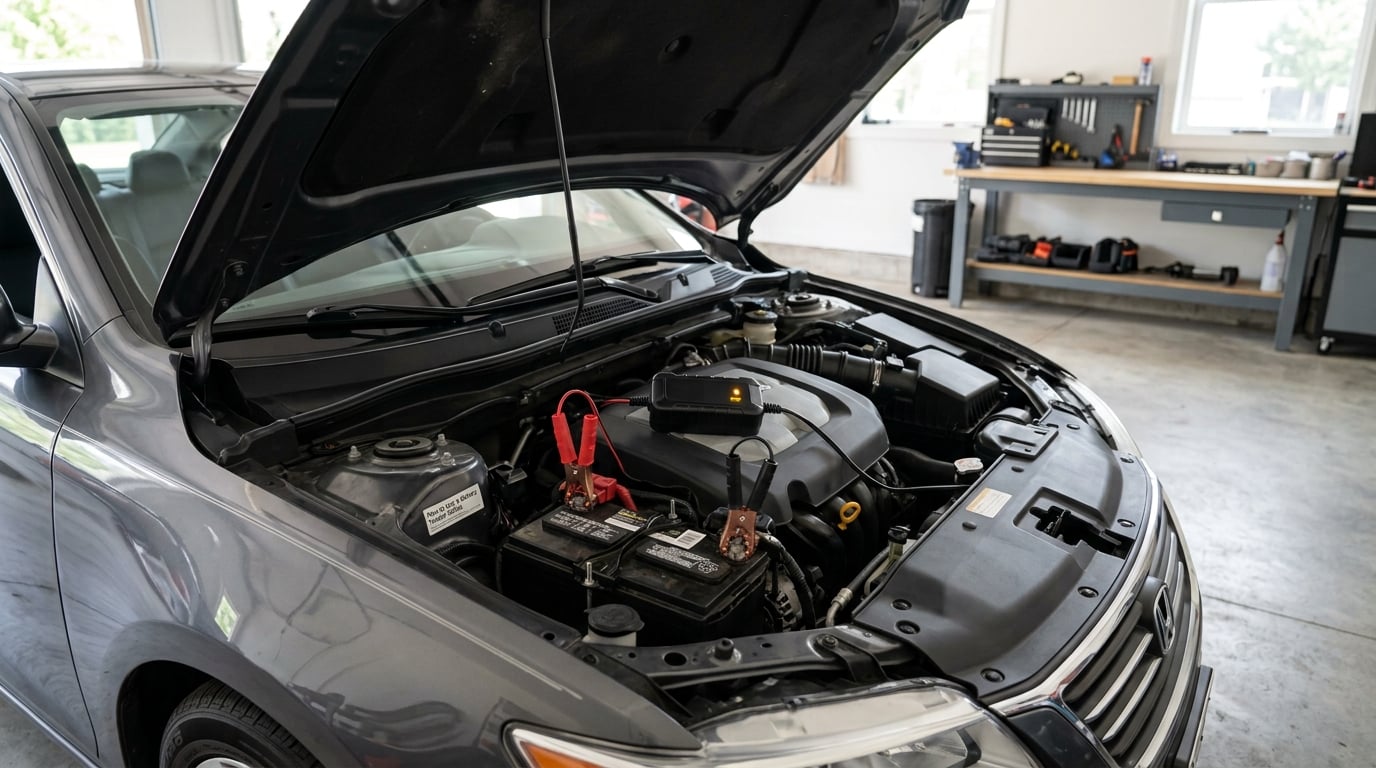
Connecting a tender takes about five minutes. The order matters, mostly because attaching the negative clamp first creates a spark path straight to the chassis if you slip.
- Read both manuals. The tender manual gives you the charge voltage, the float voltage and what each light means. The vehicle manual tells you where the battery lives and which ground point to use.
- Turn the ignition off and remove the key. Park on level ground, in park or in gear with the parking brake set.
- Work somewhere ventilated. A charging lead-acid battery gives off hydrogen gas. No sealed garage, no smoking, no flame, no sparks.
- Inspect the battery first. Look for a bulging case, a crack, a leak, heavy corrosion eating into the posts, or a rotten egg smell. Do not connect a tender to a damaged battery.
- Remove rings, watches and metal bracelets. A ring bridging both posts is a dead short, and it happens faster than you can react.
- Attach the red clamp to the positive post first. The positive post is marked with a plus sign.
- Attach the black clamp to the ground point your manual specifies. Usually that is the negative post, sometimes it is a chassis ground point. If the battery is in the trunk or under a seat, the manual typically points to a remote charging post in the engine bay or a dedicated terminal.
- Plug the tender into the wall, then read the indicator. A charging light means current is flowing. A full or maintenance state means it has backed off to float.
After that, glance at it every week or two while the vehicle is stored. That is the whole routine.
Safety stop list: never charge a battery that is bulging, cracked or leaking, never work in an enclosed space, never allow a spark near the battery, and never connect a tender to a lithium battery unless the unit specifically supports that chemistry. Wear eye protection and gloves. If anything on the battery looks wrong, take it to a shop for a test rather than hooking up.
Can You Leave a Battery Tender Connected?
Yes, and that is what the device is for. A smart battery tender can stay connected for weeks or months because it only adds current when voltage drops, then returns to a small float current. The consensus on owner forums is straightforward: leave it connected, and there is no need to disconnect the vehicle battery first.
The reports back this are the strongest practical argument for the equipment. Owners describe six to eight weeks, and a full winter of six to eight months, on maintained vehicles with nothing going wrong. One Porsche forum thread noted maintainers still working after eight to ten years, though the owner was quick to add that lifespan is a toss-up.
Two caveats. An old constant-current charger with no regulation must be supervised and unplugged once the battery is full, because it will keep pushing current and boil the electrolyte away. And a vehicle with two batteries needs either one tender per battery or a multi-bank unit, which is a question that comes up repeatedly and is rarely answered clearly.
On weather, the clamps and a sealed lead-acid battery tolerate being outside in rain and snow far better than the tender unit itself. Keep the unit dry, off bare concrete, and follow whatever its manual says about outdoor use. Coil the cord loosely rather than wrapping it tight around the body, and do not drop the clamps on the driveway, because that chips the jaw and makes a poor connection later.
How Do You Know the Battery Tender Is Working?
Read the light, then sanity check it with a meter if you want certainty. Here is the reference.
| What you see | What it means | What to do |
|---|---|---|
| Red or amber light on, steady | Charging stage, current is flowing | Nothing. Normal on a discharged battery. |
| Light alternates between charging and full | Float cycling to top up self-discharge | Nothing. This is the unit working as designed. |
| Green or steady full light | Maintenance mode, holding float | Nothing. This is the target state. |
| Flashing red or a fault code | Reverse polarity, bad connection, or a battery it will not accept | Unplug, check the clamp polarity, clean the posts, retry. |
| Fan or relay clicking | Normal internal cycling on many units | Nothing unless it runs hot or smells burnt. |
| Full light, then dark within a day or two, repeatedly | Battery is losing charge faster than 1 amp can replace it | Time for a load or conductance test. |
If you have a multimeter, resting voltage on a healthy 12V battery sits around 12.6 volts or higher, and a tender in float typically shows something in the 13.0 to 13.6 volt range. That matches what owners report, like the 13.08 volt reading from a Lexus sitting in maintenance mode.
The signs that mean the battery, not the tender, is finished are consistent. Slow cranking after a full night on the charger means surface charge and no real capacity. Dropping out of float every few days means the same thing. Losing charge immediately after you unplug means the battery will not hold a charge, which is a battery problem.
At that point a tender has done its job and no more. Get a load or conductance test, and while you are there have the alternator output and the parasitic draw checked, because a draw big enough to flatten a battery overnight will do it again.
Frequently Asked Questions
Can a battery tender charge a completely dead car battery?
Usually not, and this is the most common misunderstanding. A tender puts out roughly one amp, so a fully discharged battery would take days, and one that has sat flat for months has usually sulfated for good. Its job is to hold a healthy battery at full charge, not to recover a lost one. If your battery will not hold a charge, get a load test first, then use a real smart charger to bring it back.
Is a battery tender the same as a jump starter?
No, they are built for opposite problems. A jump starter stores a large burst of energy in a lithium bank and delivers several hundred amps to turn a starter motor once. A tender draws from a wall outlet and pushes about one amp back into the battery for hours or weeks. A jump starter is an emergency tool that slowly loses its own charge sitting in a trunk. A tender is a storage tool. Combo units do both, but neither half replaces the other.
How long can I leave a battery tender connected?
A smart maintainer can stay connected indefinitely, including through a full winter. It measures voltage and only supplies current when the battery drops, then holds about 13.6 volts. Owners report six to eight weeks and, in several cases, six to eight months with no issues. The exception is an old constant-current charger with no regulation, which must be supervised and unplugged when the battery is full or it will boil the electrolyte.
Are battery tenders safe for BMW cars and motorcycles?
Yes, on both, and motorcycles are the easier case because their small batteries discharge faster in storage. On a BMW or any modern car the only extra step is finding the battery, since it is often in the trunk or under a rear seat rather than the engine bay. The owner manual will point to a remote charging post or dedicated terminal. Use that post rather than guessing at a ground point. Check the tender lists your battery chemistry before connecting it.
Why does my battery tender keep cycling on and off?
That is normal operation, not a fault. Once the battery is full the tender drops into float, and every time self-discharge or your vehicle’s parasitic draw pulls the voltage down, it wakes up, charges, and sleeps again. You will see this more in cold weather and in vehicles with heavy keyless entry or alarm draws. It only becomes a problem if the unit never settles into a steady full state and keeps pulling power every day or two, which points at a battery that cannot hold a charge.
How do I know if my car battery needs replacement instead of a tender?
Watch what happens after a full night on the charger. If the engine cranks slowly, or the voltage drops fast once you unplug, the battery has lost its capacity and a maintainer cannot bring it back. Slow cranking on a cold morning after a night plugged in is the clearest signal. Take the battery in for a load or conductance test. If it fails, also have the alternator output and the parasitic draw checked before fitting a new one.
Conclusion
Start with the battery and the manuals, not with the tender. Check the battery for damage, find the ground point your vehicle manual specifies, and pick a smart maintainer that lists your battery chemistry and your connector type.
Then attach the red clamp first, the ground second, plug it in, and confirm the indicator. Leave it connected and check it every week or two. What a tender will not do is rescue a battery that is already flat, so treat slow cranking after a full night on the charger as a test result, not something the charger failed to fix.