
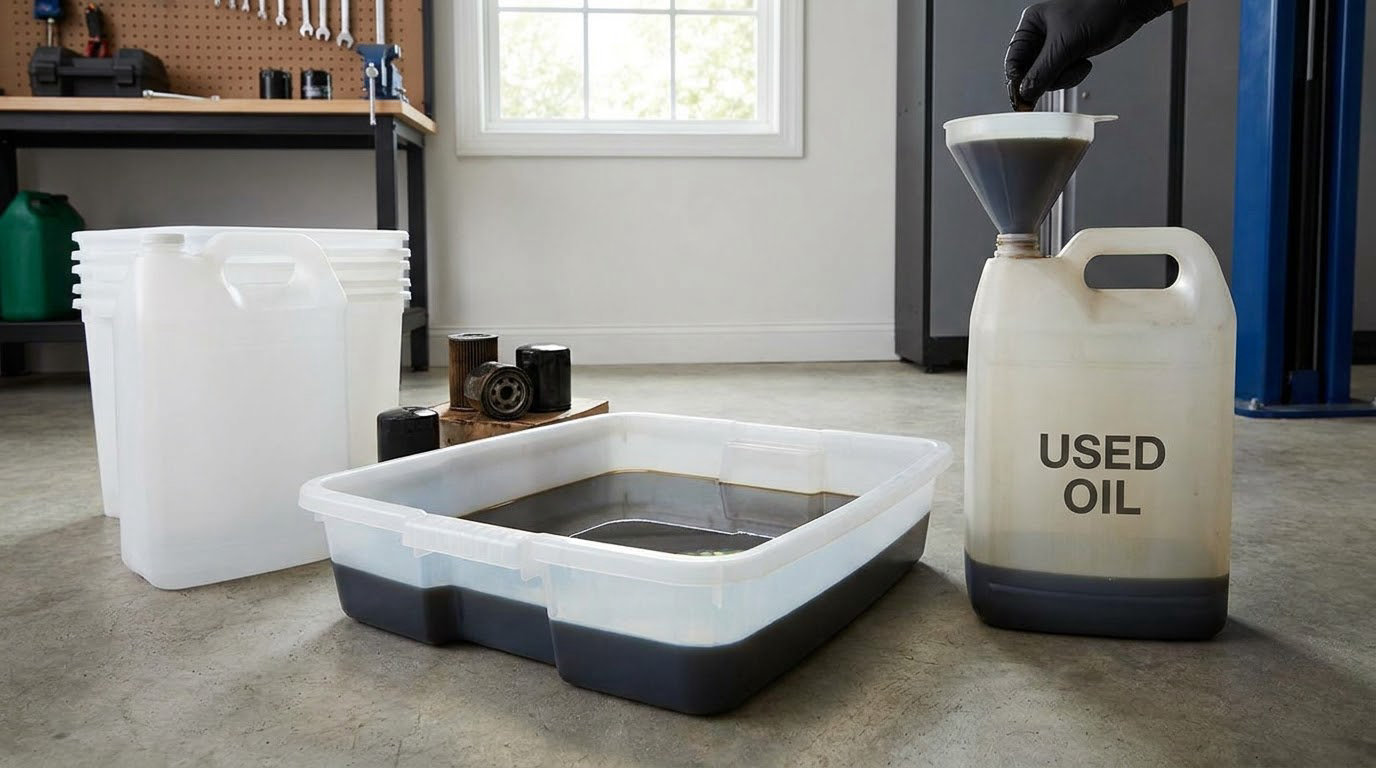
To dispose of used motor oil: drain it into a clean, sealed container, keep every other automotive fluid out of it, and hand it to an approved collection point such as an auto parts store, a household hazardous waste facility, or a used oil collection center. It costs nothing, it takes about an hour from drain to drop-off, and no special license is needed for a single car.
The reason people ask is usually one of two things. Either they have a jug sitting in the garage with no idea where it goes, or they already poured oil down a storm drain and want to know how bad it was. Both are fixable, and neither requires a trip to a hazardous waste site with an appointment and paperwork.
Motor oil is one of the most heavily recycled liquids in the world. It is also stubborn: a single gallon of it can contaminate enough soil and water to affect a town’s drinking water supply, and it will not biodegrade in any timeframe that matters to you. Getting it to a collection point is the whole job. Everything below is about doing that without a spill, a refusal, or a fine.
Table of Contents
- What You Need
- Step-by-Step: How to Dispose of Used Motor Oil
- Step 1: Warm the engine, then park on level ground
- Step 2: Drain into a pan and transfer to a sealed container
- Step 3: Keep the oil clean and keep other fluids out
- Step 4: Find an approved collection point
- Step 5: Transport it without spilling
- Step 6: Hand it over and ask what happens next
- How to dispose of used motor oil if you don’t drive a car
- Common Mistakes DIY Owners Make (and How to Fix Them)
- Frequently Asked Questions
- Conclusion
What You Need
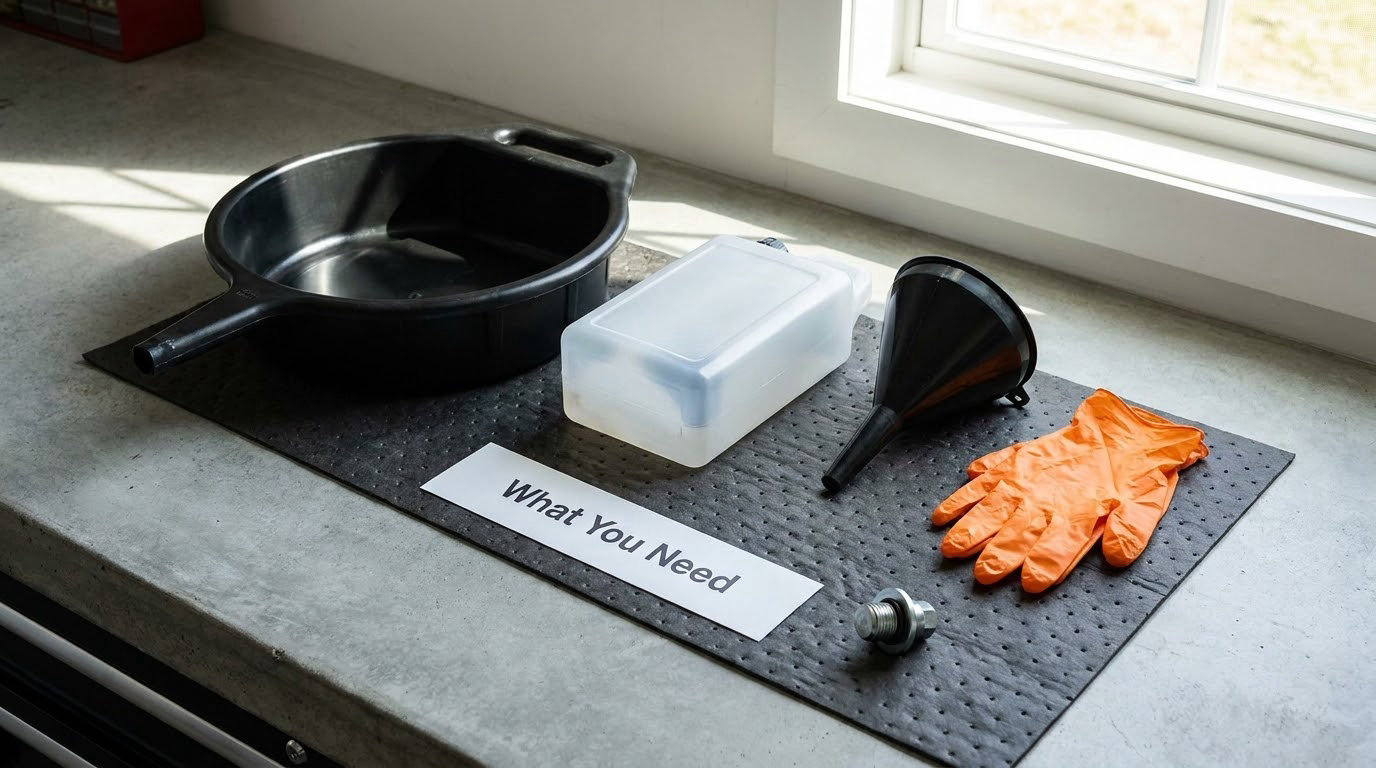
Gather these before you pull the plug, because half of them are easier to set out at the start than to go back for mid-job.
- A drain pan that fits. Most sedans take a shallow pan under the oil pan. Measure the clearance with a flashlight before you tip the car; a pan that is a fraction too wide will drip down the side.
- A funnel that fits the mouth of your container. A cheap plastic funnel with a narrow spout beats a wide one that needs a steady hand at exactly the wrong moment.
- A sealed container. Original oil jugs with caps still on, or a 5-gallon bucket with a screw-on lid and a gasket, are what most DIYers use. The 5-gallon bucket is the one people on car forums settle on because it fits flat in a trunk and has room for a full service.
- Disposable gloves and an absorbent mat. Nitrile gloves, plus a shop rag or a pad of cat litter within arm’s reach of the drain plug.
- A marker or tape and a piece of paper. Write down what the oil was: conventional, synthetic blend, or full synthetic, and the weight. It takes ten seconds and it settles questions at the counter.
- Your local rules. Your city or county environmental department website tells you which facilities are open, whether an appointment is required, and how much they take per visit. Check this before you fill a bucket, not after.
One thing worth sorting out in advance: some municipal facilities want proof that you live in their jurisdiction, and some charge a higher rate to non-residents. A driver’s license usually settles it. If you are not driving the oil in yourself, the person who does should carry ID.
Step-by-Step: How to Dispose of Used Motor Oil
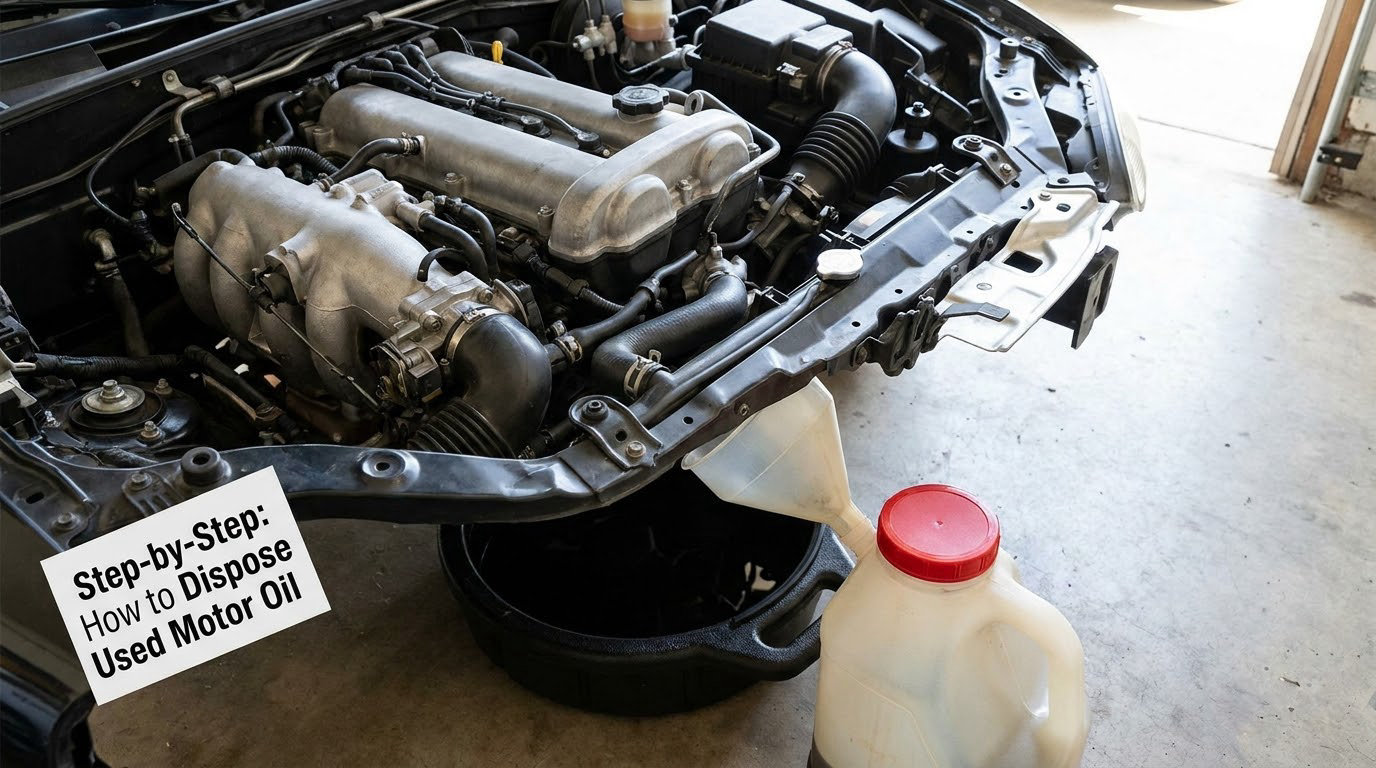
Six steps, in order. The first three decide whether the drop-off takes ninety seconds or turns into a conversation about contamination.
Step 1: Warm the engine, then park on level ground
Run the engine for ten minutes so the oil is warm enough to drain fast, then shut it off, wait a few minutes, and put the car on level pavement or a level driveway. A slope means the drain plug hole drains before the pan is under it, and that is how oil lands on your driveway instead of in the pan.
Step 2: Drain into a pan and transfer to a sealed container
Put the pan under the plug, remove the plug, and let it drain for ten to fifteen minutes. The last half inch clinging to the sump is normal and will not make a difference to the vehicle. When the flow slows to a drip, remove the pan, set it on cardboard, and pour the oil through the funnel into your container. Cap it immediately.
Replace the plug and the washer if the washer was crushed, and torque it the way the owner’s manual says. A stripped oil pan thread is an expensive and entirely avoidable way to end a simple job.
Step 3: Keep the oil clean and keep other fluids out
Empty oil is a commodity, and the difference between clean oil and dirty oil is whether the recycler can use it. Water in the bottom of the container, brake fluid, coolant, or a plastic jug that held antifreeze will get a load flagged or refused. The same goes for oil that has picked up grit from a failed engine.
Each of these gets its own trip. Brake fluid, coolant, and transmission fluid all have their own disposal paths, and no single jug should hold more than one of them.
Step 4: Find an approved collection point
These are the seven places that reliably take used motor oil from a household, in the order most people try them.
- Auto parts store drop-off. The chains including AutoZone, O’Reilly, and Advance Auto Parts take used oil at most locations, generally at no charge and with no purchase required. This is the first stop for nearly everyone. A smaller independent shop may have a waste oil tank and take yours too.
- Household hazardous waste facility. Your city or county HHW site accepts oil, filters, antifreeze, and solvents. You will probably pay a small facility fee, and some sites require an appointment or limit households to a certain volume per year.
- On-demand curbside pickup. A growing number of municipalities now let you book a household hazardous waste pickup online and leave sealed containers at the curb. Check whether oil is on the accepted list for curbside, because in a number of cities it still is not.
- Public works or transfer station used oil tank. Many county public works yards have a marked oil tank behind the scale house. Fewer people know about these than about the auto parts stores, and the hours are often shorter.
- A used oil collection center. Private recyclers, some of them run by waste haulers, take larger volumes and will come to you if you have several drums. This is the route for anyone with a lot of equipment: tractors, generators, a boat motor.
- An oil change service station. Fast oil change shops that do their own service have waste oil tanks. Many will take a customer container, though some only accept oil that came out of a car on their own ramp, so call first.
- A landfill or recycling center with a public oil tank. In rural counties this is often the only free option, and the tank is usually a simple steel drum behind the scale house. Call to check the hours and whether they require residency.
Chain store policies are set location by location, so the counter at your specific store is the final word. The national customer service line will tell you whether the store near you participates.
Step 5: Transport it without spilling
Stand the container upright in the trunk or truck bed, not on its side. Put a towel or cardboard under it, and strap it if it is a truck. Drive slowly on turns and speed bumps, and park level at your destination. Most ruined oil loads are a tipped container in a parking lot, not a bad drain.
In freezing weather, cold oil thickens and pours like syrup. Letting the container sit indoors for a few hours before you move it solves the problem without any special equipment.
Step 6: Hand it over and ask what happens next
At the counter, hand over the sealed container. The staff will usually tip it into their tank or forklift the jug into a drum. You do not need to pour it yourself, and letting them do it is one less chance for a spill on your side.
Two questions are worth asking while you are there: do you take oil filters, and do you take the plastic oil jug. Filter handling varies, and some sites take the jug for recycling while others want it back in your hand. Then keep your receipt, if there was a fee.
What you handed over gets hauled to a re-refinery, where vacuum distillation and hydrotreating strip out the contaminants and the leftover metals, and the base oil is brought back to a viscosity and additive package that meets the same standards as virgin oil. Recycling used motor oil takes roughly a third of the energy of pulling the equivalent amount of oil out of the ground, which is why the collection network exists in the first place.
How to dispose of used motor oil if you don’t drive a car
Plenty of people doing an oil change have no car to put the jug in: apartment residents, people whose car is at the shop, people hauling oil from a relative’s garage. A five-gallon bucket with a screw lid, seated upright in a wagon or on a hand cart, will get it there without incident. Never carry an open jug in a passenger footwell.
Some apartment and condo communities run a resident oil collection day, or keep a container in the maintenance area. Your property manager is the fastest way to find out. If none of that exists, the bucket on a cart is a complete solution, and it costs nothing.
Common Mistakes DIY Owners Make (and How to Fix Them)
Pouring it down the storm drain. This is the single worst option and the most common one people confess to on forums. A storm drain leads to a creek, a retention pond, or groundwater, and oil floats. It coats everything it touches and it does not sink or evaporate. If oil goes down a drain, report it to your city’s stormwater or public works department right away; they run pump trucks and absorbent crews for exactly this, and an early call keeps it from reaching water.
The fix: stop at step 4 above and pick up a bucket instead. If the drain is a floor drain inside a garage, treat it as a storm drain for the purposes of not pouring anything oily into it.
Pouring it into a toilet or the household sink. The plumbing trap and the sewer line are not a filter. It will reach the treatment system and can clog a pump somewhere along the way, which turns a small mistake into a bill.
Using a milk jug or a reused antifreeze container. Workers on DIY forums report being turned away for exactly this, and the reason is sound: a translucent jug with no proper cap cannot be stacked, sealed, or drained safely, and its prior contents are unknown. Original oil jugs and lidded 5-gallon buckets work. A milk jug is fine for a couple of quarts carried in from a small generator, but not for a full service.
Mixing fluids. One jug of motor oil with a splash of coolant or a pour of used transmission fluid is a contaminated load, and contamination is judged by proportion. Empty each fluid into its own labeled container. If you have mixed them already, ask the facility what they want to do with it rather than hoping nobody notices.
Bagging filters straight after the change. Oil filters hold a quart or more of oil, and dropping one into a trash bag soaks the bag and the truck bed. Set the filter on a rag or a plastic bag, face down, for 12 to 24 hours to drain, then bag it. Put the drained oil back into your container, and take the filter to the same place you take the oil, which most auto parts stores accept alongside it.
Storing oil for months. Oil left in a container in a hot garage goes off, thickens in winter, and slowly picks up whatever the container is made of from the inside. A few months is fine. A year is a container with a slow leak and a smell. If you do not know when you will be able to drop it off, do the oil change later.
For a spill on a driveway or in a garage: absorb it first with cat litter, dry sand, or oil-dry granules, working from the outside edge inward. Then sweep up the absorbent, bag it, and take it to a household hazardous waste facility as HHW. Do not hose it toward a drain, and do not let water dilute it and push it somewhere less visible.
Frequently Asked Questions
Where can I dispose of used engine oil for free?
Most auto parts stores take used motor oil at no charge with no purchase required, and that includes the large chains at most locations. Public works yards and some county landfill oil tanks are also free. Municipal household hazardous waste sites are often free for residents but may need an appointment or proof of address. Call the specific location before you drive over, because store policies are set by each store.
Can used motor oil be reused?
Yes, and that is the normal route. Used oil is collected at certified centers and sent to a re-refinery, where contaminants and worn metals are removed through vacuum distillation and hydrotreating. The resulting base oil is brought back to spec and sold as motor oil, often as part of a re-refined product line. Re-refining takes about a third of the energy of refining the same amount of crude, which is why it is heavily encouraged over disposal.
What container should I use for used motor oil?
A sealed container with a screw-on lid that will not leak. The two common choices are the original oil jugs with the caps still on, and a 5-gallon bucket with a proper lid and gasket, which most DIYers use because it fits flat in a trunk. Avoid milk jugs and reused antifreeze or chemical containers. Some collection points will refuse those, and they cannot be stacked or drained safely.
Do oil filters and oily rags need separate disposal?
The filter goes to the same place as the oil, and most auto parts stores take both. Drain it first, face down on a rag or bag, for 12 to 24 hours so the residual oil comes out, then bag it. Oily rags, gloves, and spill absorbent are a different category entirely. They have to go to a household hazardous waste facility, because the oil soaked into them cannot be recovered by a re-refiner.
What should I do if I spill used oil?
Stop the source first, then absorb rather than wash. Work cat litter, dry sand, or oil-dry granules into the spill from the outside edge inward until the area is dry to the touch. Sweep up the absorbent, bag it, and take it to a household hazardous waste facility as household hazardous waste. Never hose the area toward a storm drain, and never dilute it with water to make it disappear, since oil floats and the water simply carries it downstream.
Can I mix antifreeze or transmission fluid in with the motor oil?
No. Each fluid has its own accepted disposal path, and a contaminated jug can be refused at the counter. Coolant, brake fluid, transmission fluid, and motor oil do not belong in the same container even in small amounts. If you have already mixed them, call the collection point and describe what is in the container. Most facilities will tell you how they want it handled rather than turning you away on arrival.
Conclusion
Keep the oil in a sealed container, find the closest approved collection point before you drain anything, and transport it upright without a spill. That is the whole job, and learning how to dispose of used motor oil this way takes less time than the phone call to find out whether your city’s curbside program even takes it.
Everything else in this guide is detail on those three moves. Nothing about the container, the label, the filter, or the filter rag is difficult. The part that matters is that the oil leaves your garage by a route that ends with a re-refinery and not a storm drain.