
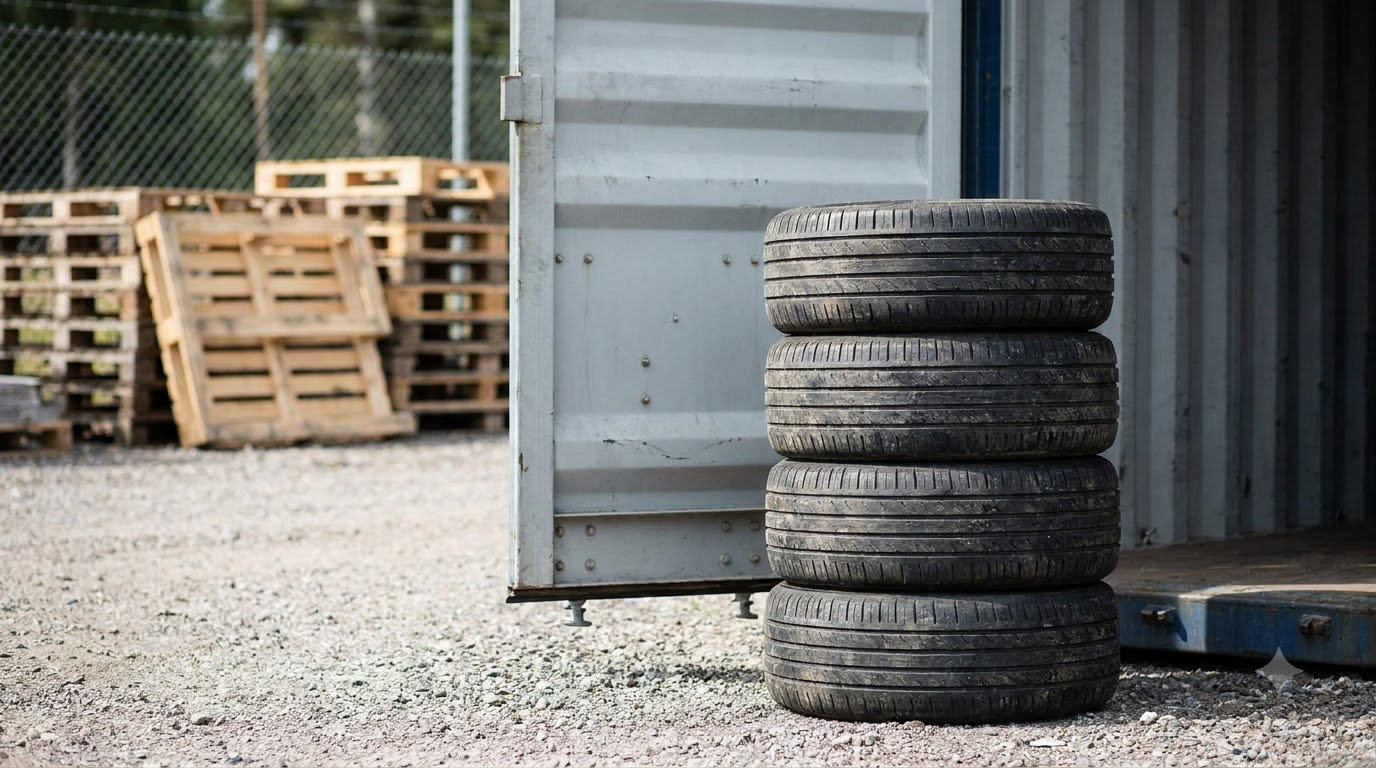
If you’re wondering how to dispose of old tires, you have four practical routes: hand them to a tire retailer, drop them at a county landfill or transfer station that accepts them, hire a scrap tire hauler or recycler, or give them away and put them to another use. For a single worn-out tire, the retailer drop-off is usually the fastest and the least hassle, and the whole job takes about an hour once you’ve confirmed the fee. Rules and fees are set county by county, so the local half of the question only your county waste authority can answer. The method below gets you that answer without wasting a Saturday.
About 290 million tires are discarded in the US every year. None of them belong in your household bin, and almost none belong in a landfill.
Table of Contents
- What You Need
- How to Dispose of Old Tires: Step by Step
- Common Mistakes
- Frequently Asked Questions
- Can I put old tires in my regular household trash?
- How much does it cost to dispose of old tires?
- Do tire stores take old tires that I did not buy there?
- What is the difference between tire recycling and tire retreading?
- Are old tires accepted at curbside collection or hazardous-waste sites?
- Can I reuse old tires in my garden or as a DIY project?
- Conclusion
What You Need
Two of the five items below are optional, but the other three decide whether the trip goes smoothly or turns into a wasted afternoon.
- Tire size and vehicle information. Write down the tire size code from the sidewall (something like P215/60R17), whether it’s a passenger, truck, trailer, tractor, or motorcycle tire, and the vehicle it came off. Facilities quote a different rate per category, and a farm or trailer tire often has to go somewhere else entirely.
- A vehicle with real cargo space. Four tires fit in the back of most SUVs, minivans, and pickup beds. They do not fit on a sedan seat without a roof rack, and a roof rack is a bad idea at highway speed.
- Work gloves and a broom or stiff brush. Old tires carry road grime, brake dust, and sometimes mold. Gloves also help when you’re pulling a tire off a rim.
- A tire wrench or socket set. Needed only if the rims are still on. Lug nuts on a 15-year-old steel wheel can seize.
- Contact details for your local waste authority. City public works, the county landfill, or your state department of environmental quality (DEQ). This is the one that saves time.
How to Dispose of Old Tires: Step by Step
1. Confirm the tires are ready for disposal
Look each tire over before you call anyone. Check the sidewall for cracking, bulges, exposed cords, and a separated bead, and look at the tread depth if the tire is still mounted on something. A tire that is cracked through the sidewall or shows a bubble is a liability in a pickup bed, and many facilities will reject it.
Count what you actually have, and note the vehicle each tire came from. Then pull the rims off if they’re attached. Most sites charge less for a bare tire and some refuse a mounted wheel outright, so separating them first removes a whole category of surprise.
A rusted or welded-on rim can be stubborn. Soak the lug holes with a penetrating oil a day ahead, hit the studs with the tire wrench and a lot of shoulder, and don’t force it. If a rim won’t come off, ask the facility whether they handle mounted wheels before you haul it in.
2. Decide how to dispose of old tires through a retailer
Call two or three tire retailers and installers near you and ask the same three questions: do you accept customer-owned tires, what do you charge per tire, and is a purchase or appointment required. This is the fastest, cheapest route for small quantities, and it’s what experienced car forum regulars recommend first.
Some chains will take a handful of tires for a small per-tire fee with no purchase at all. Others only handle tires that came off their own rack, and they keep them as part of the disposal obligation, so the question never reaches you. Get the fee in advance rather than at the counter.
One detail worth knowing: when you buy new tires, the retailer usually absorbs the old ones. Many drivers assume they’ll get the old set back and end up paying twice for the same disposal. Ask at purchase whether your old tires are being taken off your hands.
3. Compare recycling, retreading, and municipal drop-off options
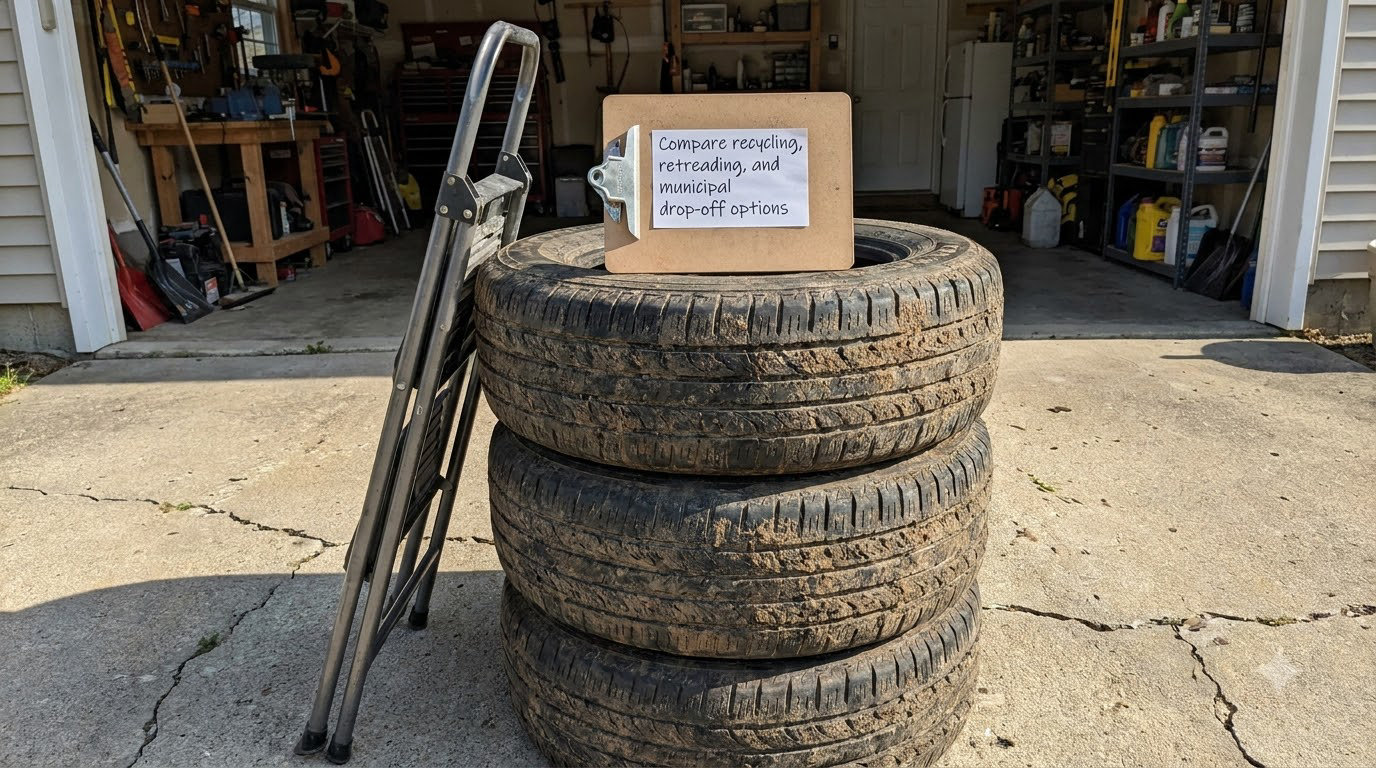
Certified tire recycling is the default destination. A scrap tire processor shreds or granulates the rubber, and the material becomes tire-derived fuel (TDF) burned in cement kilns and power plants, crumb rubber used in playground surfacing, athletic tracks, and rubber mulch, or civil engineering fill for road base, drainage, and erosion control. Steel and bead wire get recycled separately. In some states a small scrap tire fee is already built into the price of a new tire, which is why certain programs cost you nothing.
Retreading is a different thing, and it only applies to commercial truck and bus tires. A casing is inspected for remaining tread depth and structural condition, then a new tread is bonded on. A tire that fails inspection cannot be retreaded and goes to recycling instead, so an old casing is worth asking about but never a guarantee.
Municipal options are the wildcard. Some county landfills and transfer stations accept whole tires for a per-tire charge, some accept them only alongside other recyclables, and some refuse them outright. County recycling depots that also take electronics, motor oil, and paint frequently take tires as well, a fact that sits buried near the bottom of most facility pages. If you are still weighing options, the quickest way to settle how to dispose of old tires locally is to read your waste authority’s facility page from top to bottom, because the tire line is almost always the last entry on it.
For a genuinely large pile, a scrap tire hauler is the sensible call. Property purchases and farm use tend to produce 20 or more tires, haulers quote a flat rate for the load, and the fee usually works out per tire below what a facility charges at the counter. For one tire it never works, because the pickup minimum eats the entire cost.
Free routes exist, and people find them by searching county DEQ and public health department sites rather than general web search. Scheduled tire collection events, sometimes paired with household hazardous waste days, take tires at no charge on set dates. A free listing on a local buy-and-sell group also works surprisingly often; neighbors hauling away a seasonal set of wheels for free is a real outcome, not a joke.
4. Check the rules and total cost before transporting them
Before you load anything, ask the facility six questions: which tire types do you accept, is there a per-visit quantity limit, what is the per-tire fee by category, do you require proof of residency or ID, must tires be clean and dry, and must they be separated from wheels and from other waste. Nine times out of ten, the answer that surprises people is the quantity limit, and the second is the residency requirement.
Ask about certificates too. A facility that issues a certificate of recycling or a stamped disposal receipt is worth preferring, because it is the record you will need if a question comes up later. Search the facility name with the words “scrap tire” rather than “tire disposal”; that is how how to dispose of old tires is usually worded on county websites, and it surfaces the fee schedule instead of a general recycling page.
Watch for tire types that follow their own rulebook. Tractor, farm implement, trailer, and construction equipment tires are frequently refused by general passenger tire retailers, and the usual answer is a scrap yard or an equipment dealer. Studded snow tires can carry their own handling rule in some states, and motorcycle and aircraft tires are handled by a narrower set of processors. If your pile includes any of these, the first call should be to a scrap metal yard, not a tire shop.
5. Transport the tires and keep a record
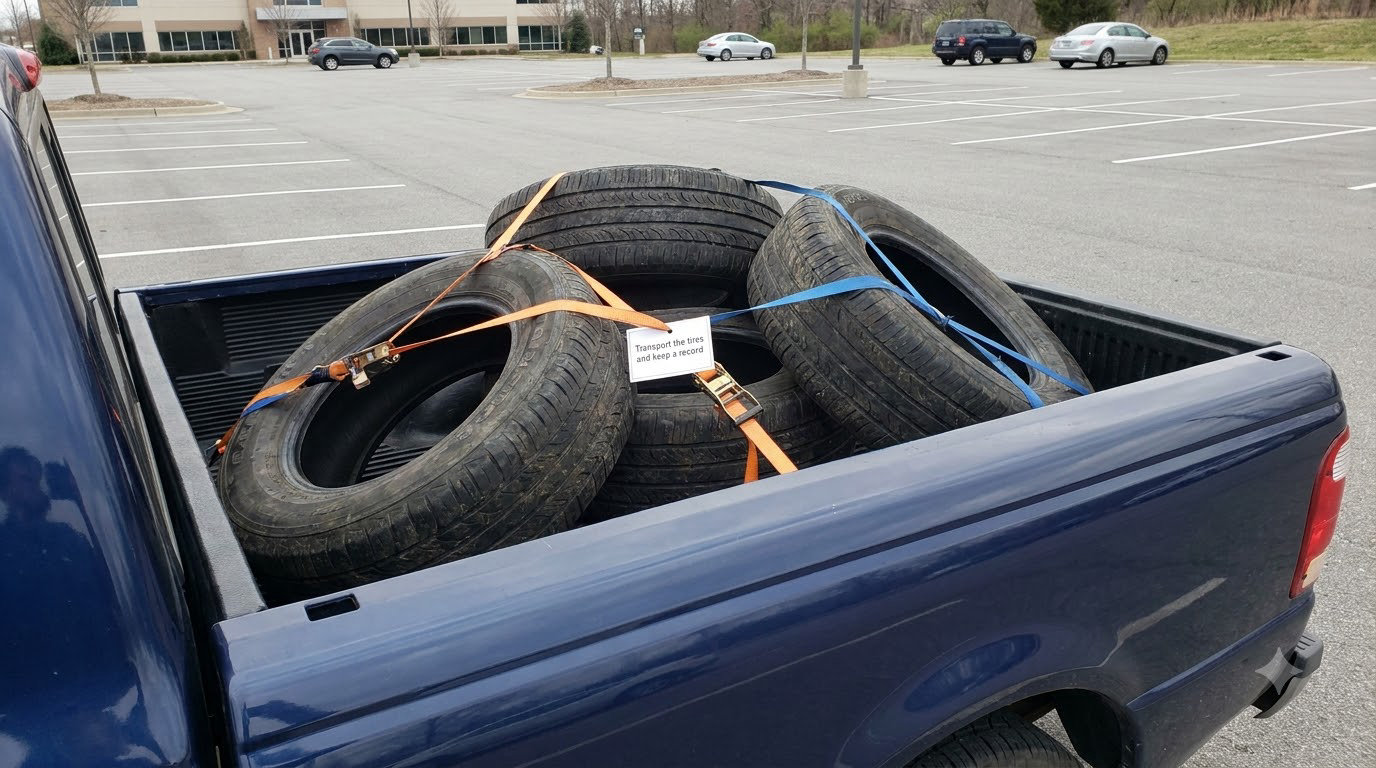
Load the tires so they cannot move. Lay them flat across the bed and strap them down, or stand them upright against the tailgate and tie them to the anchor points. Loose tires in a bed are a road hazard even at 35 mph, and one that shifts onto a highway is your problem and someone else’s.
Clear out the wheel wells and the bed liner first. Grit from the tire bed works into carpet and takes a while to find, and a damp tire in a sealed cabin can smell for weeks.
Keep the receipt, the confirmation number, or the signed drop-off slip. If you paid a scrap tire fee that was already built into your new tire purchase, hold onto that invoice too, because it is your proof that the old ones were handled.
Common Mistakes
Putting them at the curb. Tires left for collection are dumping in most jurisdictions. In a share of states that is a misdemeanor, and fines for illegal dumping run into thousands of dollars per day. Your regular trash may also be refused until the tires come back.
Burning them. A tire burns at extreme temperatures, gives off toxic fumes, and is very hard to extinguish. Firefighting runoff contaminates soil and groundwater. Don’t do it, in a fire pit, a burn barrel, or a field.
Storing the pile indefinitely. Tires collect rainwater and become mosquito breeding habitat, and health departments routinely cite homeowners for standing tire water. In several states a code officer can cite you for stored tires even on your own land. A stack of ten tires in a wet spring is the standard way people end up with a fine.
Assuming every retailer takes them. A chain tire shop will take tires off its own rack and often refuses tires you dragged in from elsewhere. Always ask first.
Leaving the rims on. A mounted wheel is a different item with a different rate, and many facilities will not take it. Pull the rims and ask a scrap metal yard about the steel, which usually has more value than the disposal costs.
Choosing an unverified hauler. If someone shows up offering to take tires for free and asks no questions, be careful. Credible haulers invoice you, name a facility, and hand back a receipt.
Hauling unsecured tires. A tire that bounces out of a bed at highway speed is a serious accident waiting for someone. Strap them down.
On reuse: a tire planter or a tire swing is fine, but skip anything that traps standing water near food gardens, and cap or cover a cut tire before a child plays near it.
Frequently Asked Questions
Can I put old tires in my regular household trash?
Usually no. Tires are prohibited in household trash and in most municipal landfills across the US because they do not compact, they trap methane as they break down, they collect rainwater that breeds mosquitoes, and they burn into fires that are nearly impossible to put out. A few very small communities still allow them at the transfer station for a fee, so check with your local waste authority before assuming either way.
How much does it cost to dispose of old tires?
It depends on the method, the tire type, and your county. Retailers and transfer stations usually charge a set per-tire amount, and heavy equipment, trailer, and tractor tires cost more than passenger tires. Scrap tire haulers quote a flat rate for the load, which often works out cheaper per tire once you are past about 20 tires. Some municipal collection events and manufacturer programs are free.
Do tire stores take old tires that I did not buy there?
Some do, some do not. Many retailers take customer-owned tires for a per-tire fee, particularly chains that handle high volume, while others only accept tires that came off their own rack. Call before you load the truck, ask whether an appointment or purchase is required, and get the fee confirmed at the same time. It is a two-minute call that saves a wasted trip.
What is the difference between tire recycling and tire retreading?
Recycling destroys the tire. A processor shreds or granulates the rubber into tire-derived fuel, crumb rubber for playground surfacing and athletic tracks, or civil engineering fill for road base and drainage, and the steel is recycled separately. Retreading preserves the casing. Commercial truck and bus casings with enough remaining tread depth get a new tread bonded on, and a casing that fails inspection is recycled instead.
Are old tires accepted at curbside collection or hazardous-waste sites?
Rarely. Tires are almost never part of regular curbside collection, and household hazardous waste sites focus on chemicals, paint, and electronics rather than rubber. Some counties accept tires at scheduled tire collection events or at recycling depots that also take motor oil and electronics, and a few transfer stations take them for a per-tire charge. Your county landfill or city public works office can tell you which of those you have.
Can I reuse old tires in my garden or as a DIY project?
Yes, with care. Cut tires work as planters, garden edging, and weed barriers, and whole tires make fine swing seats and dog beds. Avoid anything that holds standing water, which breeds mosquitoes, and keep cut tires away from edible crops because the rubber and any paint on them can contaminate soil. Cover sharp edges with caps before children or pets are around, and check local rules, since some places restrict tire use on food gardens.
Conclusion
Start with the phone, not the truck. Call the nearest tire retailer and your county landfill or public works office, compare what they accept and what they charge, and then load the tires once two of them agree on terms. Keep the receipt, and if you can, pull the rims off first and ask a scrap metal yard about the steel. Knowing how to dispose of old tires is mostly a research problem rather than a hauling problem, and an afternoon of reading beats a wasted trip with four tires in the bed.