
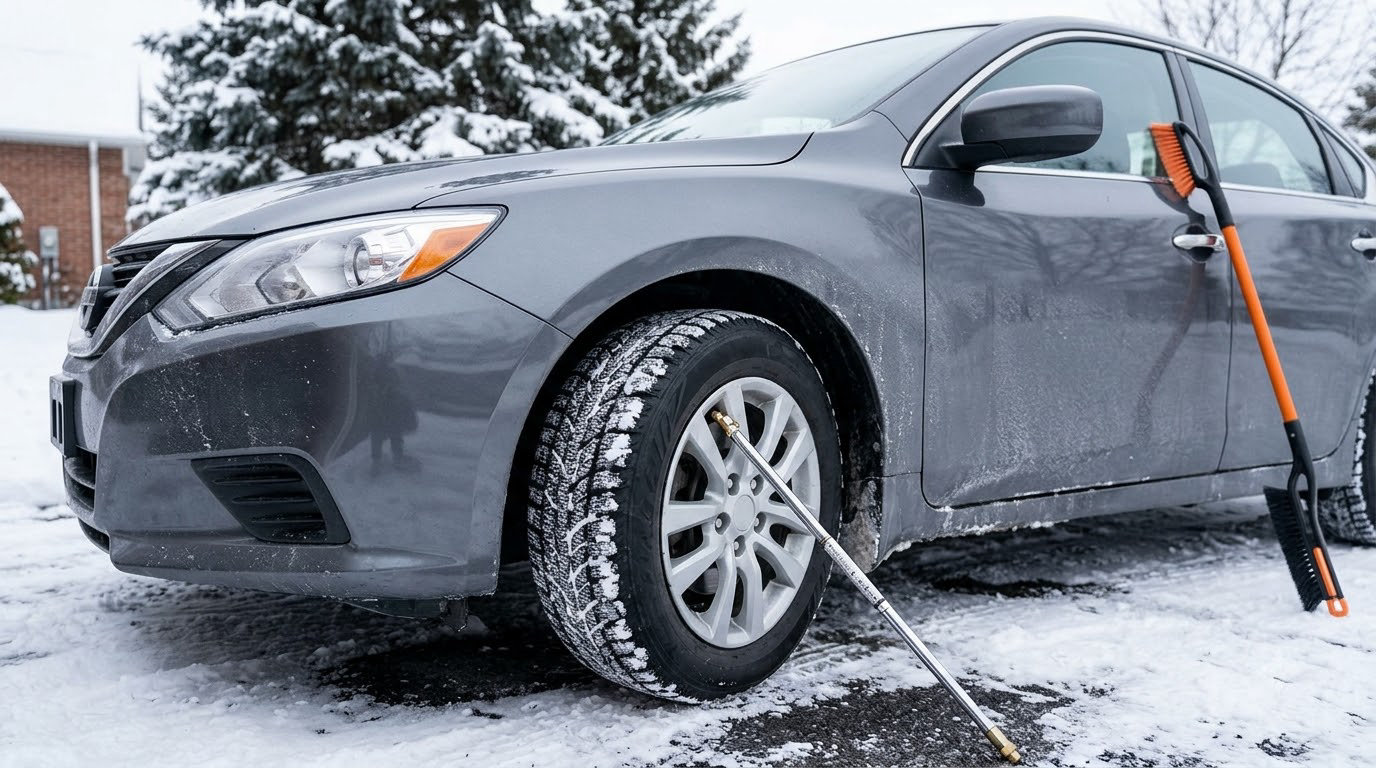
There is no separate winter pressure number. What PSI should car tires be in winter is answered by the cold inflation pressure on your driver-side door placard, and cold weather only changes what the gauge reads, not what the tire should be set to. Expect to see roughly 1 to 2 PSI lower for every 10°F the temperature falls, so a tire set at 35 PSI on a 70°F day can correctly read 30 or 31 PSI on a 0°F morning.
That last sentence trips up more drivers than any other tire fact. A lower reading after a hard cold snap usually means air did its job, not that a nail walked into your tread. The fix is not to add air on top of the placard value. The fix is to top each tire back up to that value and recheck it when the tire is cold again.
Everything below is what I tell customers at the shop, in the order they need it.
Table of Contents
- What PSI Should Car Tires Be in Winter?
- Where Do I Find the Correct Tire Pressure?
- Why Does Tire Pressure Drop in Winter?
- How Do I Check Tire Pressure Safely?
- Should I Increase Tire Pressure in Winter?
- How Much Tire Pressure Difference Is Normal?
- Myths That Cost Drivers Grip and Fuel Economy
- When Should I Recheck Tires During Winter?
- Frequently Asked Questions
- Conclusion
What PSI Should Car Tires Be in Winter?
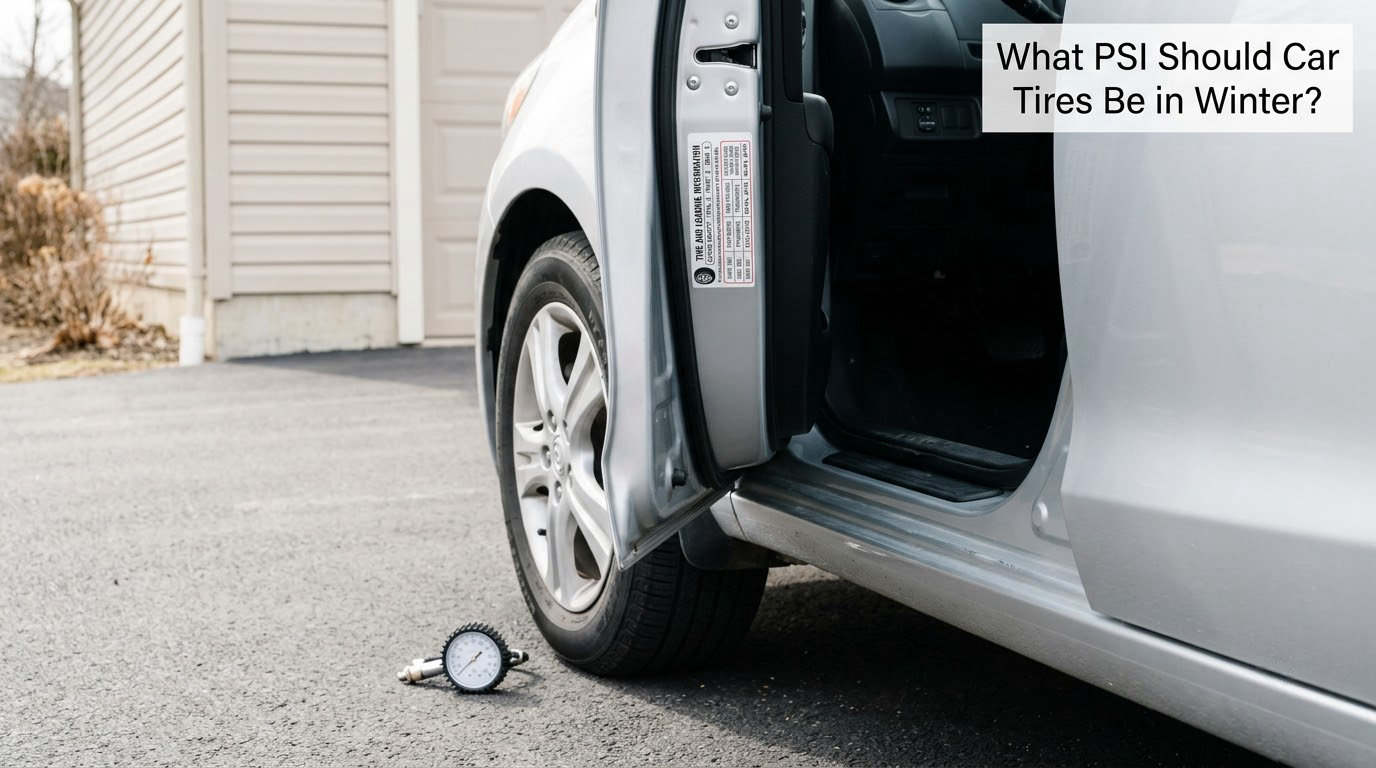
The target pressure does not change with the season. It is the number on the tire and loading information placard inside the driver-side door frame, and the owner’s manual repeats the same figure. Winter simply lowers the reading on that placard by whatever the temperature dropped.
Three things make this concrete.
- Cold inflation pressure is what the placard lists, measured before the car is driven and after it has been parked at least three hours.
- Pressure loss rate is about 1 to 2 PSI for every 10°F (5.6°C) of temperature drop, inside a tire and outside it alike.
- Typical placard ranges are 32 to 35 PSI for many sedans, 40 to 45 PSI for crossovers, light trucks and a good number of EVs, and around 60 PSI for a compact spare.
If your placard says 35 PSI cold, then 35 PSI cold is what you want to see on a winter morning, every winter morning. Setting the tire to 38 because it is January is a different thing entirely, and a bad one.
Where Do I Find the Correct Tire Pressure?
Three numbers show up on almost every car, and only one of them is your pressure. The door jamb placard wins every time, because the tire maker built the car around it and engineered the tire size, suspension and braking around that load.
Reading the door jamb placard
Open the driver’s door and look at the frame or the side of the door, not the visor or the glove box. The sticker lists the tire size, a cold pressure for the front axle, a cold pressure for the rear axle, and a spare tire pressure. On many vehicles the rear value is higher than the front.
Below the pressure numbers there is usually a small grid with tire size, load index, speed rating and cold pressure for the combination at full load. If you tow or carry heavy cargo, that lower row is the one that applies. Most of us never need it, but it is there.
Why the sidewall number is not your number
The sidewall lists a maximum cold pressure, and that figure exists for load capacity and rim strength, not for daily driving. On a typical passenger tire it reads somewhere around 36 to 44 PSI. A 44 PSI sidewall rating on a 35 PSI car means 35 is the pressure you want and 44 is the ceiling, not the goal.
This is the most common mistake I see, and it is the expensive one. An overinflated tire runs rounder, wears the center of the tread instead of the shoulders, rides harsher over expansion joints, and gives up contact area at the edges where the siping lives.
When the manual and the placard disagree
They rarely do, but if you find conflicting numbers, the placard in the door frame is the one installed on your specific vehicle with your specific engine and wheels. The manual is the fallback for cases the placard does not cover, such as load or towing limits.
Why Does Tire Pressure Drop in Winter?
Air is a gas, and gases shrink when they cool. A tire is a closed pressure vessel, so when the air inside it cools, the pressure falls. Nothing leaks, nothing is broken, and the same thing would happen to a bicycle tire left on a porch overnight.
The physics is simple enough that tire techs call it Gay-Lussac’s law: with the volume held constant, pressure is proportional to absolute temperature. That relationship is why the 1 to 2 PSI per 10°F rule exists, and why the same drop shows a smaller loss at low pressure than at high pressure.
Two situations make the drop look worse than it is.
A tire inflated indoors in a heated garage holds that pressure as you drive out, and the gauge reads beautifully all the way to the first cold morning. Then the reading collapses overnight and the owner decides the tire has a leak. It does not. It is just back to what physics asked for.
Driving heat changes the story in reverse. A tire that reads 28 PSI cold can climb to 35 or higher after twenty minutes on the highway, which is normal operating behavior and is not a reading you should adjust to.
Cold also stiffens the rubber. An underinflated winter tire is also a cold tire, and it flexes more with every bump, which is where the heat that lifts the sidewall off the rim comes from.
How Do I Check Tire Pressure Safely?
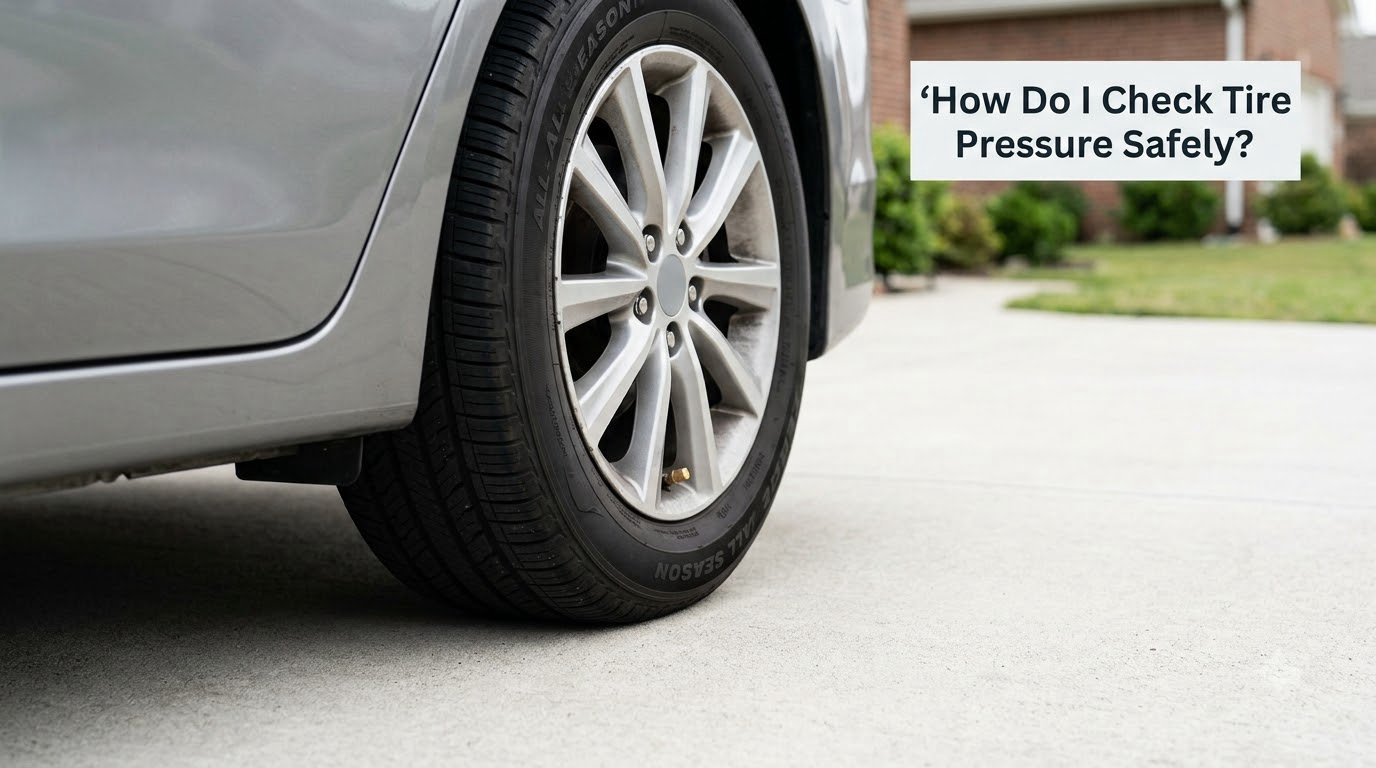
A cold reading takes about two minutes with a decent gauge. Do it before you start the car, on a surface where you are not worried about traffic, and check all four tires plus the spare if you have one.
Step by step
- Park and wait. Three hours parked, or under about 3 miles driven, is the standard definition of a cold tire. A short grocery run does not count.
- Look before you inflate. Walk around all four tires and look for cuts, bulges, exposed cords and anything wedged in the tread. A tire that lost pressure fast usually shows a reason.
- Check the valve stem. Make sure the cap is on, the stem is straight, and there is no dried rubber cement around the base. A slow leak often hides there.
- Use an accurate gauge. Stick gauges at service stations are frequently off by 2 or 3 PSI. A pencil-style gauge with a needle you can read and reset is worth buying.
- Read all four. Tire manufacturers set pressures by axle, not by corner, so do not average the readings. Inflate each to the value on the placard for its own axle.
- Let air out too. If a tire is over placard cold, bleed air rather than leaving it. Overinflation wears the middle of the tread fastest.
- Recheck after any warm fill. If you had to top up a tire that had been driven, add 3 PSI above the placard number, then come back and set it to placard once it is cold again.
That last rule trips people up in a parking lot in February. Adding to the placard value on a warm tire is a temporary correction, not a new setting, and if you leave it you have quietly overinflated all four tires.
On nitrogen-filled tires, take care. High-pressure service equipment can damage a nitrogen fill, and the extra cost buys you nothing in winter.
Should I Increase Tire Pressure in Winter?
No, not unless your vehicle manufacturer specifies a higher cold pressure for winter, which almost none do. The tire that was correct at 70°F is the same tire at 0°F, and the correct cold pressure for it has not changed.
The 3 to 5 PSI bump you hear about is not a winter rule. What it describes is a warm tire sitting on a warm car, and adding to the placard compensates for the extra pressure that driving has already created. Cold tires do not have that extra pressure to compensate for.
There are a few cases where a change is legitimate.
- Heavy loads and towing. The placard’s full-load row may specify a higher cold pressure than the normal row. If you are near the vehicle’s weight limit or towing, use that value.
- Spare tires. A compact spare is often specified around 60 PSI because it is a temporary, high-pressure design. Match the placard, not the road tires.
- Dedicated snow tires on a smaller wheel. A winter tire is often a smaller overall diameter than the factory summer tire. Follow the sidewall and the vehicle placard within the allowed range, and stay well clear of the sidewall maximum.
Now the opposite case, because a lot of drivers go too far the other way. Airing down in deep snow does widen the footprint, and owners running winter tires in the 30 to 35 PSI range report good behavior in snow and slush, with 32 PSI after a cold snap a common pick. A few people go far lower for deliberate deep-snow driving and report a big difference, but they also warn about de-beading, where the tire pulls off the rim on a hard turn and you hear it happen.
That is the point that matters most: overinflation rounds the carcass and lifts the edge siping off the road, which reduces snow grip. More pressure is not more bite. If your vehicle came with snow tires for traction, running them rock hard gives away the reason you bought them.
Snow grip is driven by tread pattern, compound and tire design long before it is driven by a pound or two of pressure. A summer tire at the perfect cold pressure will still be the wrong tire on an ice road.
How Much Tire Pressure Difference Is Normal?
Normal loss tracks the temperature drop, not the season. Use this table as a sanity check, not as an instruction. The target is still the placard value once the tire is cold at that temperature.
| Outside temperature | 32 PSI placard | 35 PSI placard | 40 PSI placard |
|---|---|---|---|
| 70°F (21°C) | 32 PSI | 35 PSI | 40 PSI |
| 50°F (10°C) | 29 to 30 PSI | 32 to 33 PSI | 37 to 38 PSI |
| 30°F (-1°C) | 27 to 28 PSI | 30 to 31 PSI | 35 to 36 PSI |
| 10°F (-12°C) | 24 to 26 PSI | 27 to 29 PSI | 32 to 34 PSI |
| 0°F (-18°C) | 22 to 25 PSI | 25 to 28 PSI | 30 to 33 PSI |
| -10°F (-23°C) | 21 to 23 PSI | 24 to 26 PSI | 28 to 31 PSI |
Electric vehicles parked outdoors in cold climates, where average temperatures sit near 2 to 5°C, split between the placard value and a 1 to 3 PSI bump. That is a reasonable personal range, and it is still within a few PSI of spec, which is a good sign.
Telling a leak from temperature loss
Cold loss comes back. Leak loss does not. Check the same tire at the same time of day over a few days, and a tire that keeps climbing back toward where it should be was never losing air. Take a tire set to 32 PSI that reads 26 after a sharp drop, drive it for twenty minutes, and most of those PSI return on their own.
A real leak shows as a steady decline with the tire warm, a wet or corroded valve stem, a fresh nail, or a bubble in the soapy water around the bead. If the number falls more than about 1 PSI per week under normal use, something is wrong and the tire comes off for a look.
What PSI Should Car Tires Be in Winter? The Five-Step Check
- Read the cold pressure for each axle on the driver-side door placard.
- Measure every tire cold, before driving, after at least three hours parked.
- Compare each reading to its own axle value, not to the tire next to it and not to the sidewall.
- Inspect for cuts, bulges, loose valve caps and objects in the tread before inflating.
- Inflate to the placard number and stop there, then recheck after any warm-weather top-off.
Myths That Cost Drivers Grip and Fuel Economy
Four pieces of advice come up constantly, and three of them are wrong in ways that cost you money or grip.
| The advice you will hear | What actually happens | What to do |
|---|---|---|
| Add 3 to 5 PSI in winter | That compensates for a warm tire, not a cold one. On cold tires it overinflates them. | Top cold tires back to the placard value only. |
| The 4 PSI rule for tires | There is no 4 PSI rule. Some shops use it loosely as a fudge for a tire checked after a short drive, which is a warm-tire adjustment dressed up as a standard. | Add 3 PSI to placard on a warm tire, then set to placard cold. |
| A lower PSI gives you more snow grip | A slightly wider footprint does help in deep snow, but too low causes de-beading, and too high lifts the edge siping off the road and cuts grip. | Stay at placard, or drop a pound or two deliberately for deep snow, never more. |
| The sidewall PSI is your PSI | The sidewall number is a maximum cold rating for load and rim strength. | Use the door placard, every time. |
There is also a rule of thumb about checking cold tires and adding 4 to 5 PSI that circulates as a winter recommendation. It is a warm-tire compensation rule, and treating it as a cold-weather target is how people end up chronically overinflated. A common pattern: someone runs 44 PSI to compensate for an earlier deep freeze, then finds noticeably worse traction after a 40° warm swing and better results again after dropping back to 34 or 35 PSI.
When Should I Recheck Tires During Winter?
Twice a month through the cold season is a reasonable habit, and a check before every long drive is better. The rule of thumb is that a tire is due for a look whenever the temperature has moved sharply since your last reading, regardless of the calendar.
Specific moments that matter.
- After a cold snap. A 30°F swing in a day can put three or four PSI into each tire overnight.
- After any tire repair, rotation or new tire. A shop may set pressure before the tire is fully seated or before it cools, so verify at home.
- Before a highway trip. Long cold highway runs are when an underinflated tire flexes the most and heats the sidewall.
- When loading up. Extra passengers, a full roof or a heavy tow pushes closer to the load row on the placard.
- When the TPMS light comes on in the cold. The system usually trips at about 25% below placard, roughly 2.9 PSI under a 35 PSI spec. In real weather, temperature alone can do that, and most of the time there is no leak. Inflate to placard, drive, and watch whether the light stays off. If it comes back on with a full set of tires, something is losing air.
- When a tire sits outside between short trips. Vehicles stored outdoors overnight reach a colder steady state than vehicles in a garage, so the same cold reading means more lost pressure.
Underinflation is what actually costs you. Braking distance on snow and ice grows, the steering goes vague, fuel economy drops by roughly 0.1 to 0.2% per missing PSI, the shoulders wear unevenly, and the risk of a blowout climbs. Overinflation is cheaper to fix, but it wears the center of the tread, sharpens the ride and removes edge contact.
Frequently Asked Questions
Should tire PSI be higher in winter?
No. Winter has no separate pressure number. The cold inflation pressure on your driver-side door placard is the target year-round, and cold weather only makes the gauge read lower. Adding 3 to 5 PSI on a cold tire simply overinflates it, which rounds the carcass, wears the center of the tread and lifts edge siping off the snow. Top cold tires back to the placard value instead.
How much PSI do tires lose in cold weather?
About 1 to 2 PSI for every 10u0026deg;F (5.6u0026deg;C) the temperature drops. A tire set to 35 PSI at 70u0026deg;F can correctly read 30 or 31 PSI at 0u0026deg;F, and a 40 PSI truck spec can sit near 35 in a deep freeze. That loss comes back when the tire warms up, which is how you tell it apart from a real leak.
Is 32 PSI a good tire pressure for cold weather?
Only if your placard says 32. Thirty-two is a normal cold pressure for many sedans, while crossovers, light trucks and many EVs are specified at 40 to 45. The number that is right for you is the one on the door jamb placard, and in winter your cold gauge reading will sit a few PSI under that value.
Is 40 PSI too high for tires?
It is exactly right for many crossovers, light trucks and EVs, and too high for a sedan whose placard says 35. Never inflate to the sidewall maximum, which is a load and rim strength rating rather than a daily target. On a 35 PSI car, running 40 wears the center of the tread and gives up edge contact on snow.
Can cold weather trigger the TPMS light?
Yes, and it usually is not a leak. The system trips at roughly 25% below placard, which is about 2.9 PSI under a 35 PSI specification, and a sharp cold snap can do that on its own. Inflate to the placard value, drive for a few minutes, and see whether the light stays off. If it returns, you have a leak worth finding.
Should I add air to my tires if they are cold?
Only up to the placard number, never past it. If the tires are warm from driving, add about 3 PSI above the placard value so the extra pressure is accounted for, then set them to placard once they are cold again. Cold tires need no warm-tire compensation, which is where the popular 3 to 5 PSI winter advice goes wrong.
Conclusion
Read the driver-side door placard first. That cold number is what PSI your tires should be in winter, and the colder the air gets the further below it the gauge will read.
Check all four tires cold, compare each to its own axle value, and add air only to reach the placard number. If a tire is warm, top it to 3 PSI over and recheck when it is cold. Ignore the sidewall maximum, ignore the add 3 to 5 PSI in winter advice, and recheck after every sharp temperature swing, tire repair and long cold drive.