
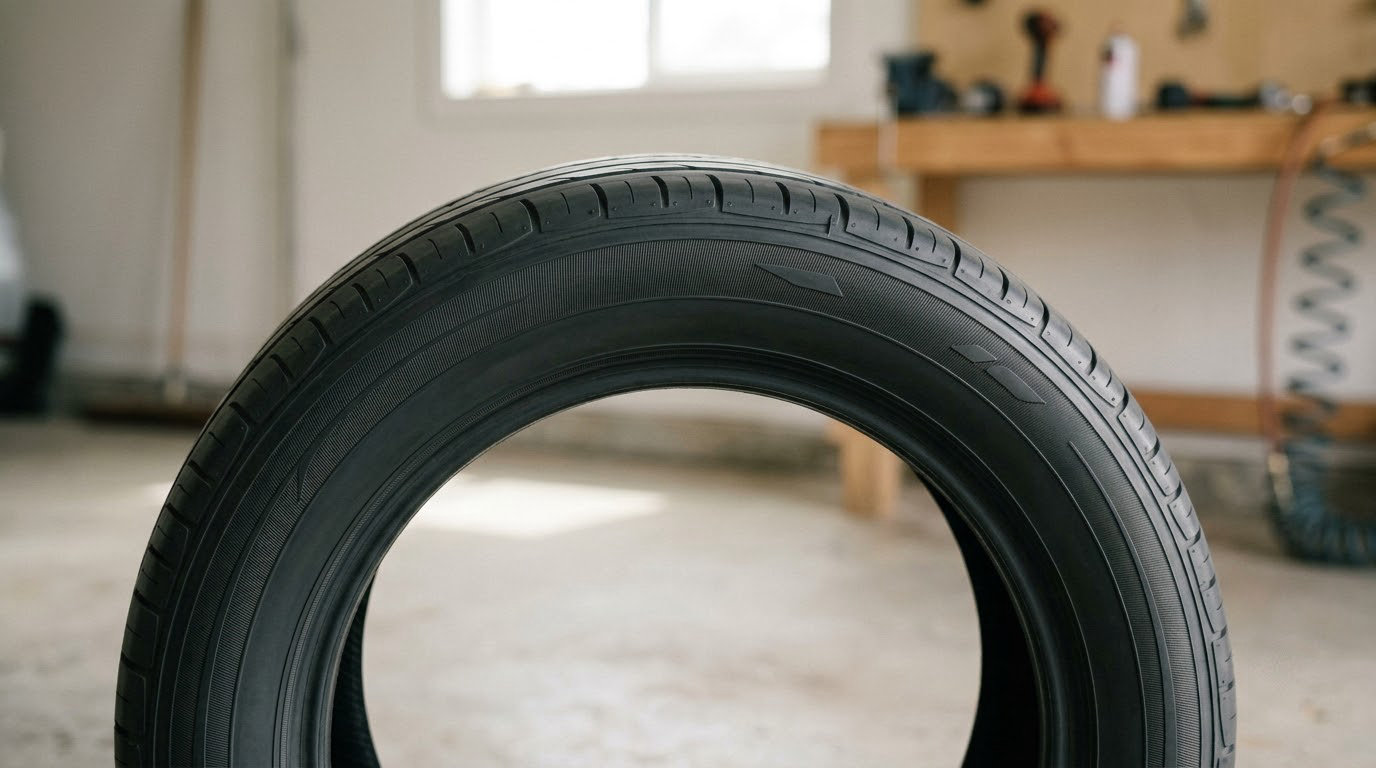
To tell how old a tire is, find the DOT code on the sidewall and read the last four digits: the first two are the week of manufacture (01-52) and the last two are the year. A code ending in 2419 means the tire was built in the 24th week of 2019. Tread depth tells you nothing about age, so the four digits matter more than what you can see.
The whole check takes about two minutes per tire, needs a flashlight and nothing else, and it works on any passenger car, SUV, motorcycle, trailer or RV tire. Four tires plus the spare means about ten minutes. I do it every time I look at a used car, and it has changed my mind about cars that looked perfect.
Age matters because rubber keeps aging whether the car moves or not. A tire with deep tread and 12 years on it has lost flexibility that a new tire still has, and the failure mode is a blowout at highway speed with no warning. Four checks tell you what you need: read the code, convert the week, compare the age, then look at the rubber.
Table of Contents
What You Need Before You Start
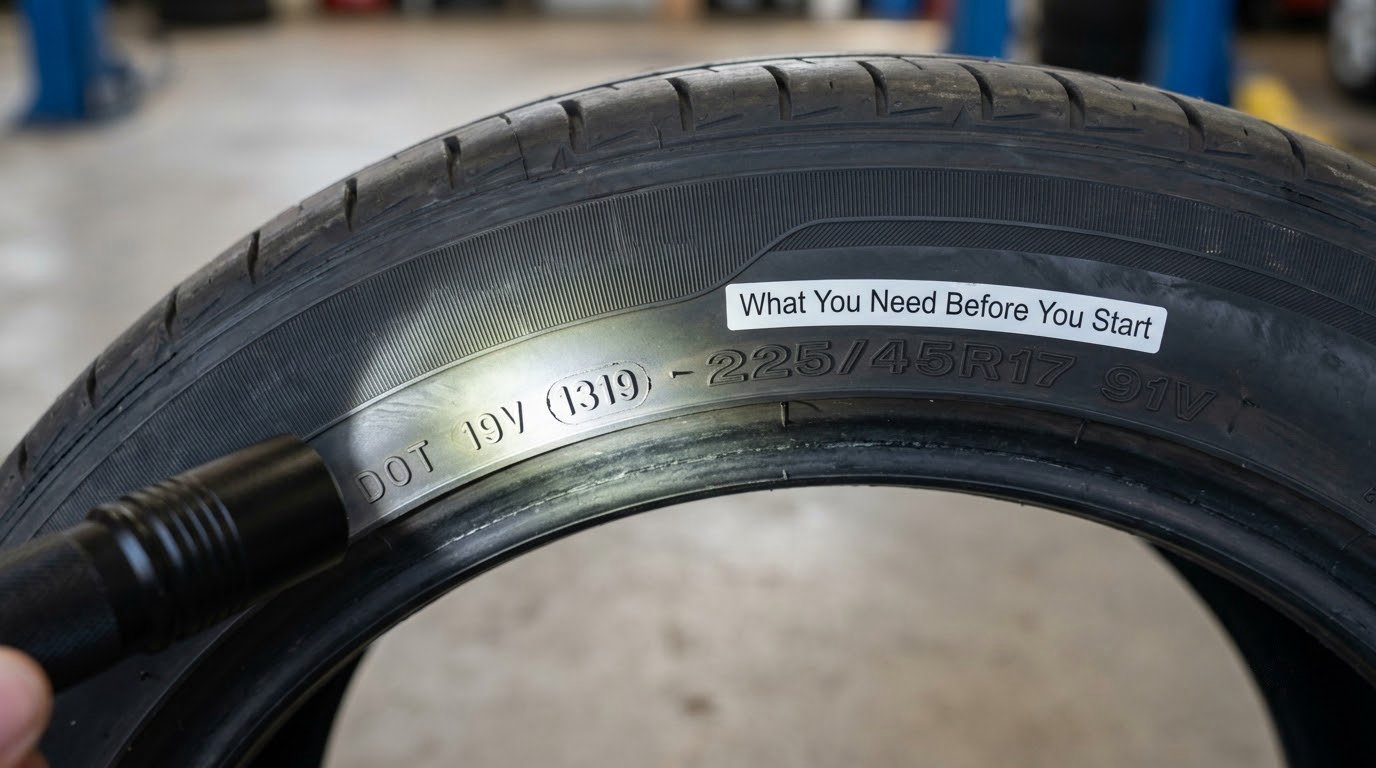
You need a flashlight or headlamp, because the DOT code is molded into rubber and vanishes in shade. The inboard sidewall of a front tire is exactly where light never reaches.
You also want your vehicle’s owner’s manual. It lists the tire size, the load and inflation requirements, and in most cases the replacement guidance for that specific tire. A tire rated for 10 years on your car is not the same as a general guideline, and the manual wins when the two disagree.
A tire manufacturer date-code chart is useful, though you barely need one. Any online DOT decoder does the same job, and several phone apps photograph the sidewall and read the code back to you. Bring your own flashlight anyway; the apps are unreliable on a chalky, sun-bleached sidewall.
A pen or your phone’s notes app is the last item. Write down all four dates and the spare before you close the trunk. This is the step people skip, and it is the reason they run the same check again two years later.
Step-by-Step: How to Tell How Old a Tire Is
Read the DOT Date Code
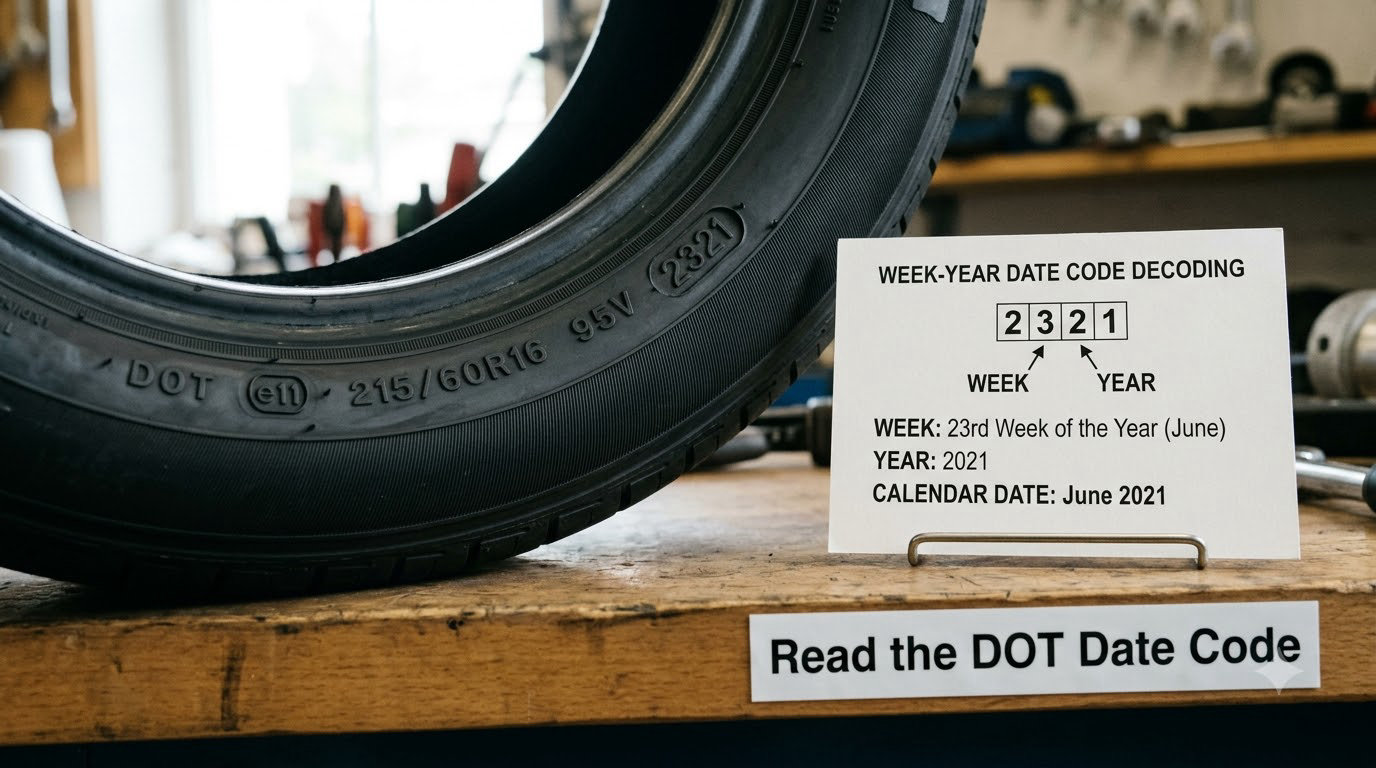
Look for the letters DOT on the sidewall. The full Tire Identification Number follows them, and the date is the last four digits of the number at the very end of that string.
A typical code reads something like DOT H4WR L9X0 2419, where 2419 is the date. The first two digits give the week of the year, from 01 through 52. The last two digits give the year of manufacture, and for anything made since 2000 that is the year itself, not a code pointing somewhere else.
Here is the part that trips people up: the complete DOT number, date included, is molded into only one sidewall. The other side carries a partial code without the date. On most cars that means you have to look at the inside of the tire, which on the front means crouching down and reaching behind the wheel. On duals and RVs the inboard sidewall can be physically inaccessible without removing a wheel.
So the check confirms itself this way: you find a full code ending in four digits on one tire, then notice the tire across the car shows DOT plus letters and no date. That is normal, not a worn-out stamp. It is also why tire shops get asked the same question constantly. iRV2 and BMW owner forum threads are full of people who swore the code was missing until someone told them to check the other sidewall.
Convert the Week Code Into a Calendar Date
Week numbers are counted from the start of the manufacturing year, so week 01 lands in early January and week 52 in late December. The useful anchors: week 01 is early January, week 13 is early April, week 26 is late June, week 39 is late September, and week 52 is the last week of December. Multiply the week by roughly 1.75 days to get a mid-point date, or just use the anchors.
Worked example: 2419 is week 24 of 2019. Week 24 sits about two thirds of the way through the year, so late June 2019. As of 2026 that tire is a little over seven years old. Now do the same math for your own code: count from the manufacture date to today, in years and months.
The DOT code cheat sheet below maps sample codes to a calendar month and an approximate age, so you can sanity-check what you are holding.
| Sample code | Week | Year | Approximate month | Approximate age |
|---|---|---|---|---|
| 0823 | 08 | 2023 | Late February 2023 | About 3 years |
| 2419 | 24 | 2019 | Late June 2019 | About 7 years |
| 3718 | 37 | 2018 | Mid-September 2018 | About 8 years |
| 1413 | 14 | 2013 | Early April 2013 | About 13 years |
| 2925 | 29 | 2025 | Mid-July 2025 | About 1 year |
One physical detail helps when the stamp is faint: the date digits are metal inserts in the mold rather than engraved letters, so a slightly oval flash or raised rim around the four digits is normal and confirms you are looking at the real date code.
Compare the Tire Age With Replacement Guidance
Tire manufacturers and federal safety guidance point the same direction: most passenger car and light truck tires are expected to last around 6 years of service and should be replaced no later than 10 years from the date of manufacture, regardless of remaining tread. Those are the two numbers to keep, and the second is a ceiling rather than a target.
| Tire age | What to do |
|---|---|
| Under 6 years | Keep them. Check pressure monthly and rotate roughly every 5,000 to 7,500 miles. Start your written log now. |
| 6 to 10 years | Judgment band. Replace if the budget allows, and inspect the sidewalls and tread grooves for cracking at least once a year. Do not run these on long highway trips without a close look. |
| Over 10 years | Replace them, even with deep tread and even on a trailer or spare that barely moves. |
Damage, serviceability and the vehicle or tire manufacturer’s instructions override the age numbers in both directions. A five-year-old tire with a sidewall cut is finished today, and a tire-specific instruction from the manufacturer beats any general rule.
One thing no inspection will catch: state safety inspections measure tread depth against a legal minimum of 2/32 inch, not age. A tire can pass inspection with 4/32 inch of tread left and be twelve years old. The tread rule and the age question are completely separate.
Check the Sidewall and Tread for Age-Related Problems
Now inspect the tire itself, because the code tells you when it was made and the rubber tells you how it survived. Run your fingers along the sidewall and look for the following.
- Dry rot or weather checking: fine spiderweb cracks across the sidewall that were not there a year ago. This is the clearest visual sign of age.
- Base-of-groove cracks: cracks forming inside the tread grooves near the shoulders, sometimes with a chalky grey surface. Some fine surface cracking in older compounds is normal; cracks that break through the rubber are not.
- Bulges or blisters: any local bulge on the sidewall or tread means the belt or carcass is damaged. Take the tire out of service that day. A bulge is a blowout waiting for highway speed, not a cosmetic issue.
- Exposed cord or smooth rubber: if you can see steel belt edges or the sidewall looks slicked and hard, the tire is at the end of its life regardless of the code.
- Uneven wear: feathering, cupping or one edge worn to the cord points to alignment, pressure or a worn shock rather than age, but it is worth a trip to a shop.
Find the TWI mark, the small triangle with a TWI arrow molded into the sidewall, and follow it to the groove that holds the tread wear indicator bar. When that bar is level with the surrounding tread you are at the legal minimum. That bar measures wear only. It says nothing about the tire’s age, which is why the DOT code is the number that matters.
Common Mistakes That Lead to the Wrong Answer
Reading the last two digits as the full year. Since 2000 those two digits are the year: 19 means 2019. Before 2000 the formats were different, which is covered below. If a tire is on a car today and the code reads 19, it was made in 2019, not 1919.
Assuming no visible DOT code means the tire is too old. The full code exists on one sidewall only. The date is on the opposite side from what you may have looked at, and the part you found without four digits is normal.
Judging by tread depth alone. This is the most expensive mistake on the list. Tread measures how much rubber touched the road. Age is about how the rubber itself has changed, and a garage-kept tire with 8/32 inch of tread and cracks in the sidewall is more dangerous than a 3/32 inch tire with supple rubber.
Checking only the two front tires. Age-related cracking usually shows up on tires that see the least sun and stay damp, which often means the rear. Check all four and the spare, every time.
Ignoring light-colored or chalky rubber. A tire that was chalky white when new and is now a different shade of faded grey has been losing its surface compounds. That is aging, and it does not improve.
Treating all four tires as the same age. They usually are not. A car that lost two tires to a curb strike and had only a pair replaced now has a four-year gap between the front and rear. Mismatched dates are not automatically dangerous, but you should know they exist and aim to replace them as a set once the older ones reach the 6-to-10-year band.
A few habits that help. Ask the installer to mount the dated sidewall outboard on the front tires so you can read it from a crouch instead of from your back. Tires that sit in a shop or a seasonal storage spot are aging on the same clock as tires in use, so pull seasonal or trailer tires forward by a year. And remember the least-driven car is the most at risk: low mileage protects the tread, not the compound, which is exactly why an eight-year-old car with 11,000 miles can have a tire older than one on a daily driver with 90,000.
Frequently Asked Questions
How do I read a tire date code?
Find the letters DOT on the sidewall and read the four digits at the end of the number that follows. The first two digits are the week of the year, from 01 to 52, and the last two are the year of manufacture. A code ending in 2419 means the 24th week of 2019, roughly late June. The full code, date included, is molded into one sidewall only, so check the inboard side if the outboard one ends in letters.
How can I decode the DOT tire code?
Write the four digits down as a pair. Treat the first pair as a week number between 01 and 52, and the second pair as the year. Convert the week with a few anchors: 01 is early January, 13 is early April, 26 is late June, 39 is late September. Then count from that month and year to today to get the tire’s age in years and months. The DOT Code Cheat Sheet above shows the same method on five sample codes.
How do you read a 3 digit DOT code?
Three-digit codes are pre-2000 tires, and they are common on older motorcycles, RVs and classic cars. The number is the week of manufacture, and the year is inferred from context: a code ending in 3 means 1983, 1993 or 2003 depending on the vehicle. Older tires sometimes carry a delta suffix, a small raised triangle after the digits, which shifts the assumed year back one decade. With a 3-digit code, confirm the year with the vehicle’s build date.
Are 10 year old tires still safe to use?
Ten years from the date of manufacture is the ceiling tire manufacturers and federal safety guidance describe, not a target. A 10-year-old tire with 8/32 inch of tread, supple rubber and no cracking may still work, but it is past the point where the manufacturer supports it. If you are at or near that mark, replace the tire. Continuing on a tire past its supported life is a gamble on a failure you get no warning about.
Are 7 year old tires with good tread still good to use?
Usually yes, but inspect them. Seven years puts a tire in the band where manufacturers recommend starting to think about replacement, and deep tread says nothing about how the rubber has hardened. Feel the sidewalls for dry rot, look inside the tread grooves for cracking, and check for bulges. If the rubber still feels supple and there is no cracking, drive it and plan to replace within a year or two.
Are 20 year old tires safe on a spare or trailer?
No. A tire that rarely rolls still ages, because rubber loses its oils and flexibility through heat, sunlight and ozone whether the car moves or not. A 20-year-old spare is the classic time bomb: it looks perfect, it holds air, and it can fail catastrophically when you finally need it. Replace spare and trailer tires on the same 6-to-10-year guidance as road tires, and check the spare’s date at the same time as the other four.
Conclusion
Start with the four digits. Read the DOT code on the inner sidewall of each tire, split it into a week and a year, convert the week into a month, and write the manufacture date down next to the tire position. Then compare that date with the 6-year and 10-year guidance and look for dry rot, groove cracks or bulges.
Any tire over 10 years old, or any tire with cracking or a bulge, comes off regardless of what the tread depth gauge says. If you have a tire older than about 5 years and you are shopping for used tires or a used car, walk away and spend the money on something you can date.