
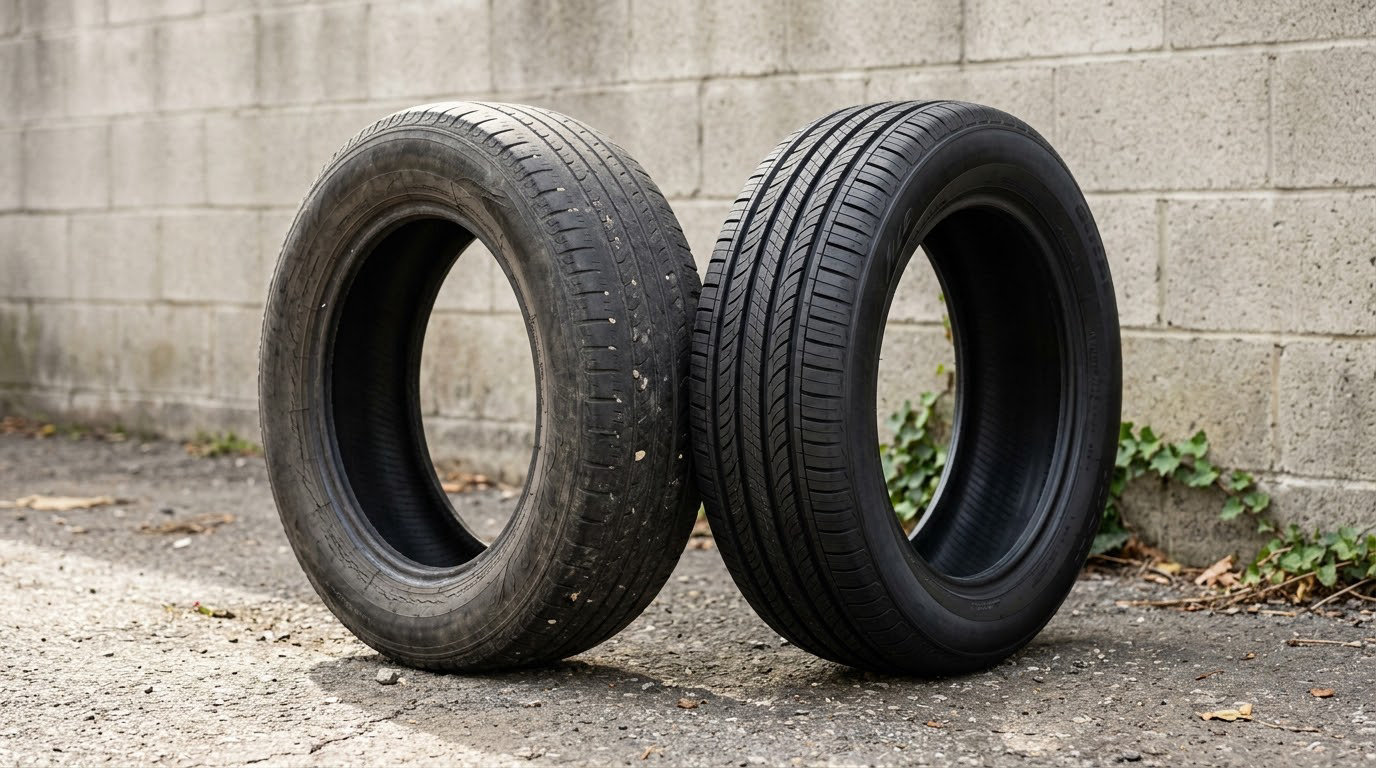
If you want the plain number: most passenger car tires last about three to five years, stretching to five to seven when the car is driven gently, kept inflated and rotated on schedule. Ten years from the date of manufacture is the hard limit that brands like Michelin and Bridgestone put on their own products. Mileage normally runs out well before that clock, but not always. A tire that sits on a trailer for six summers can crack before it ever turns a mile.
Two separate clocks run on a tire, and they rarely hit zero at the same time. The first is tread wear, counted in miles. The second is calendar aging, where the rubber compound hardens, loses elasticity and starts cracking no matter how carefully the car is driven. Understanding how long do tires last in years really means watching both.
Table of Contents
How Long Do Tires Last in Years?
Most drivers land somewhere between three and five years on a normal all-season tire, and five to seven if the car is driven gently, kept properly inflated and rotated on schedule. Bridgestone puts the typical all-season tire at three to five years, and Michelin states that its tires should come out of service ten years from the date of manufacture regardless of how much tread is left. Those two numbers are not in conflict. One describes what usually happens. The other describes the ceiling that cannot be exceeded.
Here is how the age bands break down.
- 1 to 5 years: Tires are usually in good shape. Check the DOT code each year, and expect a replacement when tread runs low or around the four to five year mark for most drivers.
- 6 to 10 years: This is the gray zone. Shops in practice start flagging tires at six to eight years while manufacturers allow up to ten. Inspect carefully and plan on replacing them, especially if the sidewalls show cracking.
- Over 10 years: Retire them. Full tread does not rescue a tire that has passed the manufacturer’s limit, and aged casings fail suddenly rather than gradually.
The reason this matters is not vague. NHTSA reports that a driver is three times more likely to be involved in a crash when tire condition is poor, and insurers do examine tire condition and age after an accident. A ten-year-old tire with good tread can complicate a claim.
What Determines How Long Your Tires Last
Mileage numbers get quoted constantly, but they are the least interesting variable on the list. A tire wears out because of how it was built, how it was mounted and how the car is used.
- Starting tread depth and compound. A soft compound that grips well in the wet wears faster. The UTQG treadwear rating printed on the sidewall compares one tire to a reference standard, so a 180-rated tire is expected to outlast a 120-rated one under matching conditions.
- Pressure. Under-inflation flexes the sidewall on every trip. It overheats, wears the shoulders faster and is the single most common reason a tire ages badly. Over-inflation wears the center rib instead.
- Alignment. A small amount of toe or camber error chews one shoulder edge. Uneven inner-versus-outer wear is a classic alignment symptom, and cupping patches spaced around the tread usually mean a wheel or suspension problem.
- Wheel balance. A heavy spot at the rim creates a rhythmic thump that wears the tread in scallops.
- Load and towing. Running near or over the tire’s load rating generates heat. Trailers that weigh heavily on the tongue wear the same rubber far faster than their mileage suggests.
- Speed, heat and road surface. Sustained highway speeds and hot pavement harden compounds. Rough roads, potholes and repeated curb impacts damage the internal structure long before the tread looks thin.
- Storage. UV light, ozone and temperature swings attack tires that sit outside or in an unheated garage. This is the whole problem with spare tires and seasonal sets.
Add to that a car’s alignment history and whether the tires were rotated, and the gap between a 25,000-mile tire and a 60,000-mile tire of the same model comes down to how it was treated, not luck.
How Long Do Tires Last in Years by Mileage?
US drivers put roughly 11,000 to 12,000 miles on a car per year on average, so mileage and calendar age line up closely for a daily commuter. A tire that dies at 40,000 miles on a 12,000-mile-a-year driver is about three and a half years old. The same tire on someone driving 5,000 miles a year is eight years old and probably still has usable tread, which is exactly the situation the ten-year limit exists to catch.
Is 30,000 miles on a set of tires good? For a car driven mostly around town, that is closer to four years of normal use, and it is a reasonable point to start planning a replacement rather than a number that means the tire is finished.
A 50,000-mile warranty is a treadwear coverage figure, not a promise the tire will still be safe at 50,000. It also says nothing about age. A tire that sat in a warehouse for two years before it went on your car has already spent time aging, and the warranty clock usually starts on your purchase date rather than the manufacture date printed on the sidewall.
| Tire type | Typical mileage | Expected years |
|---|---|---|
| Touring all-season | 60,000 to 80,000 miles | 5 to 7 years |
| Standard all-season | 40,000 to 60,000 miles | 3 to 5 years |
| Performance summer | 30,000 to 50,000 miles | 3 to 5 years |
| Winter (non-studded) | 4 to 6 seasons | 3 to 5 years of storage aging |
| Winter (studded) | 3 to 4 seasons | 2 to 4 years |
| All-terrain light truck | 50,000 to 75,000 miles | 4 to 6 years |
| Mud-terrain | 40,000 to 60,000 miles | 3 to 5 years |
| Trailer and boat trailer (ST) | 6,000 to 10,000 miles | 3 to 5 years, mostly sitting |
| Spare tire | Almost none | Replace past 6 to 10 years by date alone |
RV and trailer owners point this out constantly on forums, and they are right. A boat trailer tire can age out having covered a few thousand miles, because the harm comes from sunlight and temperature while it sits in the driveway, not from road wear.
How Old Is Too Old for Tires?
Worn and aged are two different failure modes. A worn tire is one that ran out of tread while the rubber underneath stayed flexible. An aged tire still has grooves but has turned hard and brittle, and it can fail suddenly. Owners on Reddit and the iRV2 boards describe the same pattern repeatedly: a slow leak that never holds air, then a blowout on the way home, with nothing on the tread to explain it.
The industry position, which the Rubber Manufacturers Association repeats, is that calendar age alone cannot predict a specific tire’s service life. That is true in the sense that no one can date the exact day a casing gives out. It is not a reason to ignore the ten-year figure, because every major manufacturer publishes one and they all land in the same place.
Tire shops lean earlier, commonly warning at six to eight years, and that gap is where most of the confusion lives. A tire at seven years with even tread, no cracking and a clean sidewall is not automatically scrap. A tire at seven years with dry rot in the rubber is done, mileage be damned.
Low-mileage owners deserve their own warning. Spare tires, classic cars, seasonal tire sets and anything that sits still all age on the calendar. Inspect them the same way you would an active tire, because tread depth tells you nothing about the casing.
How to Read Your Tire’s DOT Date Code
The manufacture date sits on the sidewall as part of the DOT number, molded into the rubber near the rim. Find the letters and digits and look at the last four characters before the tire size code.
Those four digits are a week number followed by a year. A code ending in 2217 means the tire was made in the 22nd week of 2017, roughly late May of that year. A code ending in 0508 is the first week of 2008. Anything ending before 00 in the year digits means the tire predates 2000 and is far past any service life.
Two things trip people up. First, tires made before 2000 carried a three-digit week code with no year, and that format is routinely misread as a recent date. Second, the DOT number is also your recall lookup key, so running the same number through the NHTSA recall database tells you whether that tire line has an open recall.
And the warranty, if there is one, generally starts when you buy the tire. The date stamped on the sidewall is not the start of coverage, and it is not the start of the replacement clock either, though it is the start of the ten-year retirement guideline.
How to Tell When Tires Need Replacement
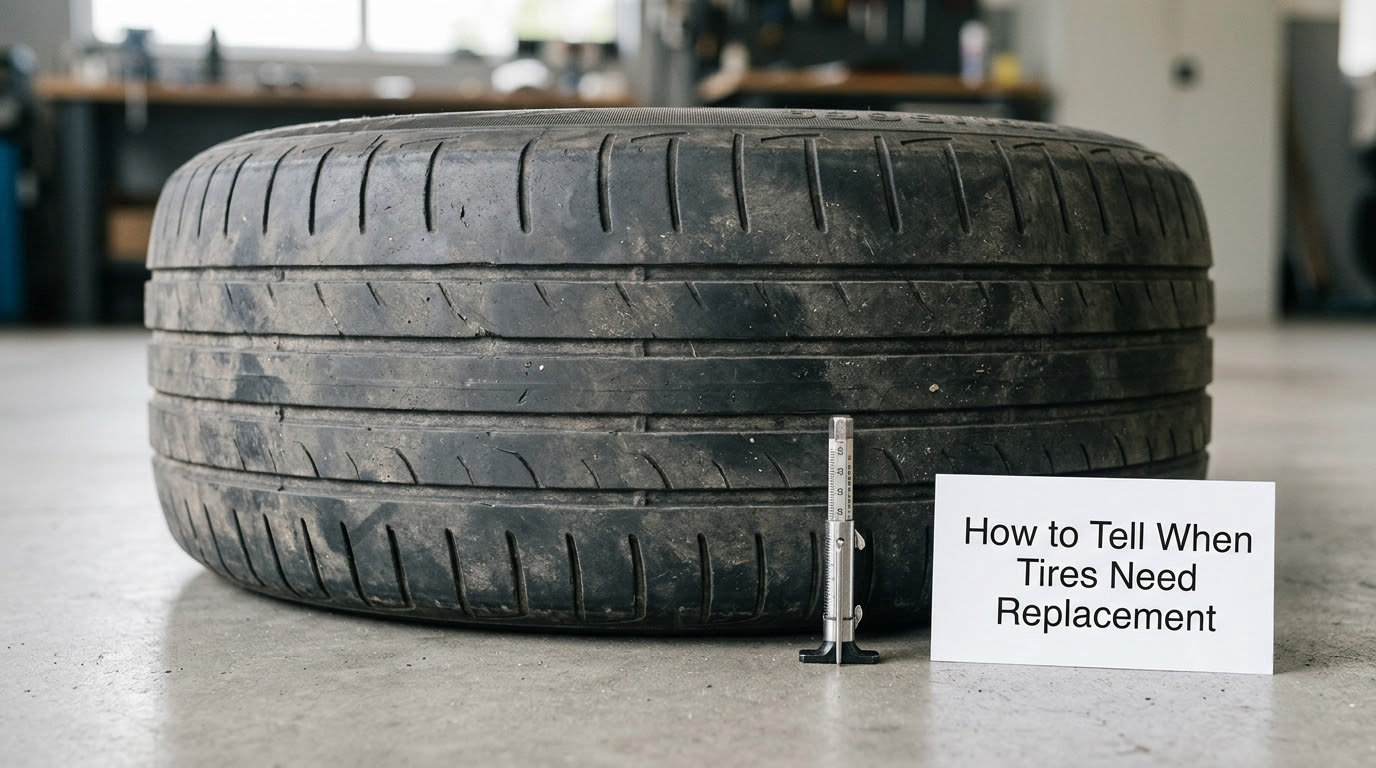
A tire can be legal and still be wrong for your car. Run through these checks in order.
- Measure the tread. A tread depth gauge is the accurate tool. The federal minimum is 1/32 inch, but most shops and tire guides treat 2/32 inch as the practical replacement point, and 4/32 inch is the better call for frequent wet-weather driving.
- Check the wear bars. Small raised bars sit in the main grooves. When tread reaches them, the tire is finished. Not every tread pattern has them, so a gauge still matters.
- Run the penny or quarter test. A penny works for 2/32 inch. A quarter is deeper than 2/32 inch, so if the quarter’s shoulder disappears into the groove you still have usable tread; if it floats on top, you do not.
- Look at the sidewall. Fine horizontal spiderweb cracks in the grooves of the sidewall are common and usually cosmetic. Cracks that run across the sidewall, cuts reaching the cords, or a stiff chalky surface mean dry rot and mean the tire comes off.
- Check the shape. Bulges, exposed steel cords, a visible bead or a bubble in the sidewall are retire-immediately defects, no matter the tread depth.
- Read the wear pattern. One shoulder worn flat points to alignment. Cupped or scalloped tread points to balance or suspension. A tire losing pressure repeatedly needs a full leak check, not another patch.
If a tire is at 2/32 inch, over ten years old, or shows sidewall cracking, have a shop look at it. That is a five-minute conversation and cheaper than a blowout on the interstate.
Should You Replace All Four Tires at Once?
Ideally, yes, in matched pairs or as a full set. Tires on the same axle should be the same type, size, load rating and roughly the same condition, because that axle carries most of the braking and steering work. A grippy new tire next to a bald one makes the car handle unpredictably, and on a wet road the difference in stopping distance is the part that matters.
Where the budget only covers two, put them on the rear for a front-wheel-drive car and on the front for a rear-wheel-drive or all-wheel-drive car. That is the opposite of what most people assume, but it is where the traction and stability benefit is. Staggered patterns on some vehicles exist for a reason, so follow the placard on the door jamb rather than guessing.
Mixing a temporary spare with road tires is a different situation entirely. A space-saver is designed for a short trip at reduced speed, not for a pattern of normal driving. Fit the full-size spare as soon as you can and keep the temporary one out of service.
How to Make Tires Last Longer
Most premature wear comes from five things, and all five are cheap to fix.
- Check cold pressure monthly. Use the number on the door jamb placard or the owner’s manual, not the maximum molded on the sidewall. A tire loses roughly a pound a month in air pressure, and cold readings are the only accurate ones.
- Rotate every 5,000 to 7,000 miles. Most manufacturers list this interval. Rotating moves the same wear duty across different positions and is the cheapest way to even out tread depth.
- Correct alignment and balance. If the car pulls to one side, vibrates above a certain speed, or the tread is visibly uneven, fix that before buying rubber.
- Drive normally. Hard acceleration, fast cornering and repeated pothole hits all chew structure that the tread depth does not reveal.
- Store seasonal and spare tires properly. Keep them indoors, out of direct sun, laid flat or hung, and off concrete if you can. Do not leave a spare mounted on a car for years without looking at it.
Most importantly, replace before you reach the threshold rather than after. A tire at 3/32 inch is still gripping, which is exactly when people decide they can wait until winter.
Frequently Asked Questions
Are 5-year-old tires too old to keep?
Five years is inside the normal window for a passenger car tire, not a red flag on its own. Most manufacturers allow up to 10 years from manufacture, and shops tend to start flagging tires between 6 and 8 years. At five, check the DOT code, confirm pressure is right, and inspect the sidewalls for cracking. Replace sooner if the tread is near 2/32 inch, if the rubber feels hard and chalky, or if the tire is not the matching type and size for the axle it sits on.
Can new tires last 10 years if the mileage is low?
Reaching ten years with low mileage is possible, but ten years is the limit rather than a target. A tire that has been driven 8,000 miles over a decade still aged through ten summers and winters of UV, ozone and heat cycles, and dry rot develops on a schedule set by storage conditions. Low mileage increases the risk of aging damage rather than reducing it. Inspect an aging tire the way you would a worn one, and plan on replacing it at the ten-year mark.
Why are my tires wearing out faster than the mileage estimate?
The usual culprits are under-inflation, misalignment, and driving habits, in that order. Low pressure flexes the sidewall and generates heat on every trip. A toe or camber setting slightly off chews one shoulder. Wheel imbalance causes cupped patches. Heavy loads, towing, and sustained highway speeds add heat as well. Look at the wear pattern for a clue: one shoulder flat means alignment, a bald center strip means overinflation, and evenly scalloped tread points to balance or a suspension issue.
Does rotating tires make them last longer?
Rotation usually adds mileage rather than years, but it also spreads wear evenly across the set so the whole set wears out at the same time instead of one tire going bald early. Most manufacturers suggest rotating every 5,000 to 7,000 miles, and the pattern depends on whether your vehicle is front-wheel drive, all-wheel drive, or has directional or asymmetric tread. Check the placard in the door jamb or the tire sidewall, since running a directional tire backwards is its own kind of problem.
Can I replace only two tires on my car?
You can, and many owners do it on a budget, but the two tires on the same axle should match in type, size, load rating and condition. Where only two are replaced, the new pair goes on the rear for front-wheel-drive cars and on the front for rear-wheel or all-wheel-drive cars, which is the opposite of the usual instinct. A temporary space-saver spare belongs on the car only for a short trip at reduced speed, then comes off once the full-size spare is fitted.
How do I find the manufacture date on a tire?
The date is molded into the sidewall as part of the DOT number, usually on the inner half opposite the tire size code. Read the last four digits: the first two are the week of manufacture, the last two are the year, so 2217 means the 22nd week of 2017. Tires made before 2000 use a three-digit week code with no year, and those are well past any service life. The same DOT number also works as a recall lookup key in the NHTSA recall database.
Conclusion
Read the DOT code on all four tires first. That single number decides whether you are shopping for a full set or just planning a rotation, and it takes about a minute per tire.
Then do the other three things: gauge the tread, look hard at the sidewalls for cracking or bulges, and verify cold pressure against the door jamb placard. When age, wear or damage reaches the limit, replace the full set rather than the one tire that started the problem.
For anything specific to your vehicle, the owner’s manual and the placard on the door frame have the final word, and a tire shop can check the ones you are unsure about. This guide was updated for 2026.