
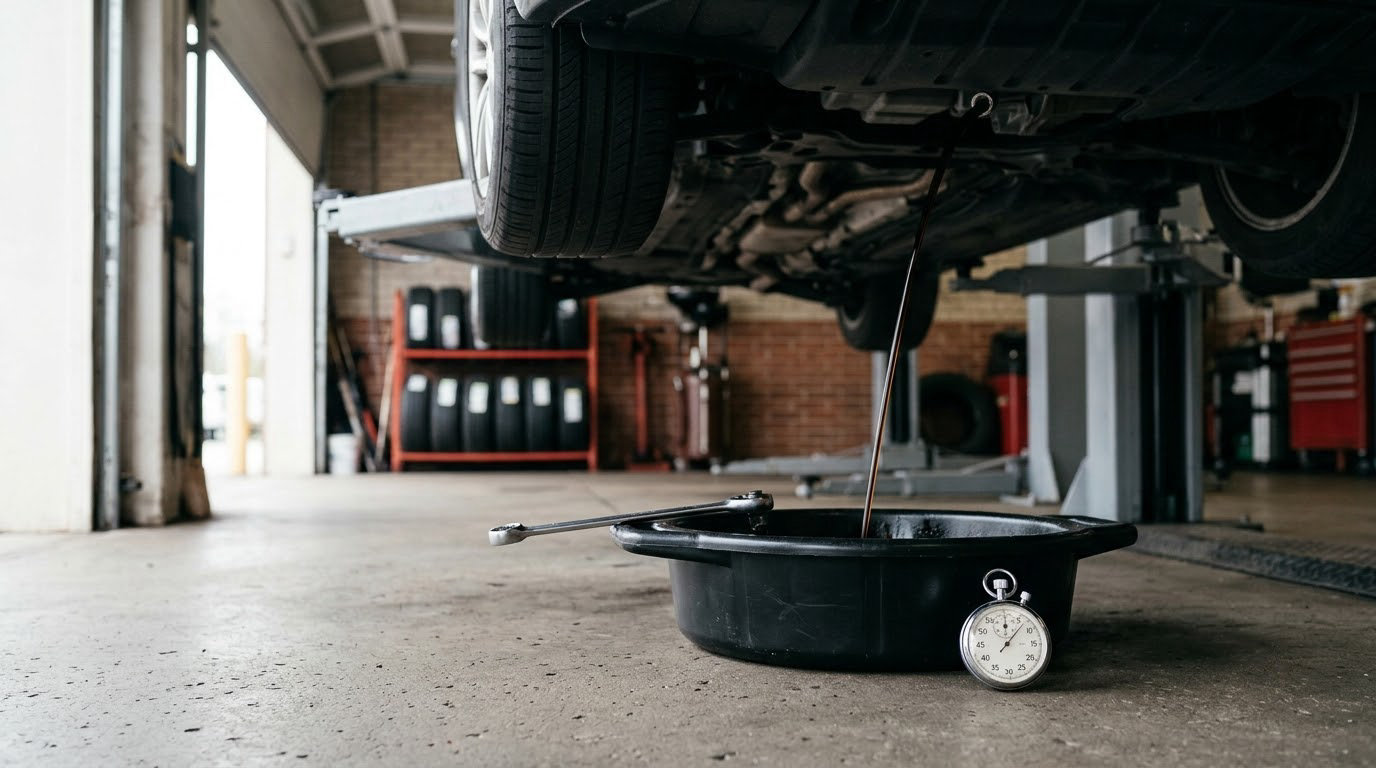
If you are wondering how long does an oil change take, the honest answer is somewhere between 15 minutes and 90 minutes for most cars. A quick-lube express service usually runs 15 to 30 minutes, a dealership appointment typically takes 45 to 90 minutes door to door, and doing it yourself at home takes 30 to 60 minutes including setup and cleanup. Two hours is not the oil change. That is queue time.
That distinction trips up more people than anything else in car maintenance. A drain-and-filter job is genuinely quick work. Almost all of the clock time people complain about happens before the car reaches a bay.
Owner write-ups and shop service pages agree pretty closely on where the variance comes from. Here is the breakdown, with the numbers you can plan around.
Table of Contents
How Long Does an Oil Change Take?
Plan on 15 to 30 minutes at a quick-lube shop, 45 to 90 minutes at a dealership, and 30 to 60 minutes for a home change including cleanup. Add another 20 to 30 minutes if you are bundling a tire rotation, and expect the clock to stretch on any weekend when the shop is busy.
Here is the range broken out by where the work happens, plus what usually adds time at each.
| Service type | Typical time | Can you wait in the car? | What commonly adds time |
|---|---|---|---|
| Quick lube, express bay | 15 to 30 minutes | Usually, yes | Saturday queue, undertray or splash guard, filter housing that is not a cartridge spin-on |
| Dealership service | 45 to 90 minutes | Often not, check ahead | Multi-point inspection, parts delivery, waiting on a bay or a specific technician |
| Independent full-service shop | 60 to 120 minutes | Sometimes, ask | Full-service bays that do several jobs at once, no express crew |
| Mobile or in-home service | 45 to 90 minutes | Yes, in the driveway | Travel time to you, setup on a sloped driveway, no shop hoist for some vehicles |
| DIY at home | 30 to 60 minutes | Yes, that is the point | Ramp setup, cleanup, oil recycling run, first-time tool gathering |
One more split matters more than any other number here: bay time versus door-to-door time. Bay time is the hands-on work, usually 15 to 30 minutes. Door-to-door time is everything around it, which is why an appointment at 9 means you might drive out at 10:15.
Owners report the same split on the forums. Someone on a Toyota 4Runner forum put dealer visits at 45 minutes to an hour, and added that the shop does all the extra steps during that window. A poster on a BMW forum said an oil change should take about an hour once you factor in waiting, and longer if you want the car washed afterward.
What Factors Affect the Time?
Queue position is the biggest one. The actual job is short and boring, so almost anything that adds delay comes from something around it.
- Walk-in vs appointment. An appointment time is usually a drop-off position in the queue, not the moment a technician unbolts anything. Owners describe this as the single most common complaint they have about service visits.
- Time of day. Mid-morning on a weekday is the quietest slot. Saturdays, lunch hours, the days after a cold snap, and the week before a holiday are the slowest.
- Add-on services. A multi-point inspection, fluid top-off, tire rotation, state inspection, or car wash can each add 10 to 30 minutes, and they stack.
- Vehicle type. Trucks and SUVs with an engine splash guard or undertray need the guard removed, and the fasteners are never one-handed. Some V8s take 6 to 8 quarts, and a filter that sits in a cartridge housing rather than a spin-on canister adds real minutes.
- Oil specification. Low-viscosity oils such as 0W-16 and 0W-20 are common on newer engines. A few extra ounces beyond the stated capacity is normal on some of them, so the fill takes an extra pass rather than a single pour.
- Access to the car. If the drain plug is tucked behind a shield, or the filter is mounted at an awkward angle, expect the low end of the range to slip.
- Shop workload. A shop that does brake jobs and transmissions alongside quick lube will never hold to a 10-minute promise.
One habit costs time without adding any safety. Letting the pan drain for an extra hour or two gets you a few tablespoons of oil that would have fallen off the plug threads anyway. The drain happens under gravity the whole time, and a stop of an extra 30 seconds is enough. Several owners on Subaru and BMW forums mentioned doing this deliberately, and the general response was that it changes nothing.
DIY Oil-Change Timelines
A careful home change runs about an hour, and the work itself is a small part of it. A Hellcat owner on hellcat.org described the routine as roughly an hour: pulling on ramps, setting up, and cleaning up, with no rush involved. A Jeep forum poster put the same job at under 15 minutes of actual work and closer to an hour once cleanup was counted. Both are honest; they are measuring different halves of the clock.
Here is where the minutes go for a first-timer on a typical front-wheel-drive car with a spin-on filter.
| Step | First timer | Experienced | Notes |
|---|---|---|---|
| Gather tools, oil, filter, drain pan | 15 to 20 min | 5 min | Most of the first-run time is a trip to the parts store |
| Warm the engine, position the car, jack and set ramps | 10 to 15 min | 5 min | Do not get under a car held by a jack alone |
| Pull the plug and let the oil drain | 10 min | 5 to 10 min | Longer if the engine is cold and thick |
| Swap the oil filter | 10 min | 5 min | Cartridge-style filters add 5 to 10 minutes |
| Refill with new oil | 10 min | 5 min | Buy a quart extra; 0W-20 engines can take a bit more |
| Check level, reset the monitor, reinstall plug | 5 to 10 min | 5 min | Check the level warm, then again after a short drive |
| Clean up, bag the old oil, dispose of it | 10 to 15 min | 5 min | Paper towels and a coffee can add up |
An experienced DIYer with a helper can genuinely finish in 15 minutes of work. Bob at bobistheoilguy.com put it that way and also noted a tire rotation runs about 30 minutes on top, which is worth remembering before you plan an afternoon.
A few honest notes. If you are on ramps, stay off the ramps while the car is supported only by them, jack stands carry the weight, and the oil should be warm but not hot enough to burn you. Some cars need the oil life reset done with a scan tool or a hold-button sequence in the dash, and if you skip it the car may keep reminding you. Your owner’s manual has both the oil spec and the interval; follow it rather than a forum post.
How Long Does a Professional Oil Change Take?
Quick lube: 15 to 30 minutes
Express chains run a dedicated crew on express bays, so the car is never waiting behind a brake job. Most advertise a 10 to 15 minute service, and the honest range is 15 to 30 minutes from arrival to the bay to driving out. You normally stay in the car. The catch is the Saturday queue, which can be brutal enough that the 10-minute promise becomes an hour of waiting in the parking lot.
How long does an oil change take at a dealership?
Budget 45 to 90 minutes door to door, even though the hands-on work is the same 20 minutes a quick lube would charge for. A lot of that window is the multi-point inspection, the parts counter handoff, and the wait for a bay. Forum owners across several brands land in the same 45-minute-to-an-hour range and assume the extra steps are why.
The honest way to think about it: a dealership oil change is not slower to do. It is slower to get into. If you already have other work due, a tire rotation or a fluid service, bundling it into the same visit is often the fastest total time you can get, because you are already paying for the queue.
Independent full-service shop: 60 to 120 minutes
These shops do general repair alongside maintenance, so a bay can be occupied by a longer job while your car waits. That is the honest explanation for a two-hour visit, and it is not a sign of anything wrong.
Mobile and in-home service: 45 to 90 minutes
A technician comes to the driveway, which removes the drive there and the queue. The trade is setup: service on a slope is messier, not every vehicle fits a portable lift, and travel time is part of your window. Useful if you cannot leave the car, less useful if speed is the whole point.
Why does an oil change sometimes take 2 hours?
Because most of that two hours is waiting, not working. The familiar case is a r/mechanic thread titled “The 30 min oil change took 2.5 hours,” which is the template for a lot of online complaints. The realistic causes are:
- You are parked behind three other vehicles in a queue.
- Your car arrived without the part, so the filter or the specified oil had to be fetched.
- The service advisor sold a multi-point inspection and a fluid service while the car was up.
- It is a busy day, and the shop has no express crew to keep things moving.
- Something needs a second look, such as a seep at the drain plug or a crushed filter gasket, and the tech goes to find a supervisor.
- The car is on a lift that is not free yet.
How long is reasonable to wait? At a quick lube, more than about 45 minutes means you are in a queue. At a dealer, more than about two hours is worth a question, but a routine visit can still land there. What is not reasonable is nobody telling you where your car is. Ask the advisor one thing on arrival: is the car in the bay now, or still waiting? That single question resolves most of the frustration, because at least you know which clock you are on.
Which Oil-Change Service Do You Need?
Most people need the cheapest correct job and nothing else. A few situations justify more, or less, than that.
A basic oil and filter change is the right call for a car that is otherwise healthy, has no warning lights, and is being serviced roughly on its stated interval. That is a 15 to 30 minute job at a quick lube, and nothing beyond oil and filter is required. A dealership will likely hand you a multi-point inspection anyway, which is not a problem, but it is the main thing stretching the visit past an hour.
A DIY drain and refill makes sense if you have a driveway, a set of ramps or jack stands, basic tools, and a place to store the old oil. It is fastest on a car with a spin-on filter and an exposed drain plug, and most awkward on a truck with a splash guard and a cartridge filter. If the car is under warranty or covered by a maintenance plan, do your own work only after checking the terms, because some plans void on out-of-network service.
Inspection and add-on work is worth bundling when something is already overdue. A tire rotation on a front-wheel-drive car belongs with an oil change because the car is on the lift and the tires are off the ground anyway; plan 20 to 30 extra minutes. A fluid top-off and tire pressure check are nearly free in time. A state inspection is a separate visit unless the shop is certified for it, and a car wash is 5 to 10 minutes at most, unless you are the kind of person who wants it done, in which case it is a fine trade for the wait.
Red flags that deserve more than a basic change: a burning smell, an oil pressure light, visible leaks under the car, a knocking engine on startup, or a message saying the oil life monitor has run out well before the interval. Those turn a 20-minute job into a diagnosis, and any shop that rushes past them is not doing the job.
Tips for a Faster and Safer Oil Change
For a shop visit, a few habits cut the clock. Book the first slot of the morning on a Tuesday, or mid-morning midweek, and skip Saturday entirely if you can. Bundle the tire rotation with the oil change instead of making it a second trip. Ask when you book whether the shop does express service, whether you can wait in the car, and whether a loaner or shuttle is available, so the wait is planned rather than improvised. Bring your own oil and filter if the shop allows it, which shortens the parts hunt, though you should confirm the spec matches your manual first.
On arrival, ask where the car is in the queue. Then keep your phone on, because a shop that texts you when it is ready removes most of the perceived wait.
For a home change, get the oil, filter, drain pan, wrench set, ramps or stands, and a box of rags before the engine is warm, because a cold engine draining oil slowly is how an hour turns into two. Buy one quart more than the manual states, and check the level twice: once after the pour and again after a five-minute drive. A sticky drain plug washer costs almost nothing and prevents one of the most common causes of a repeat visit. Do not run the engine to speed up draining, and do not use a jack alone as a support. Wear gloves, keep the drain pan wide, and take the old oil to a recycling point rather than leaving it in a container in the garage.
Two last pieces of accuracy. Use the viscosity and capacity in your owner’s manual, not the label on whatever bottle is on sale, and 0W-16, 0W-20, and 5W-30 are not interchangeable on modern engines. And if your car has an oil life monitor, reset it as part of the service. Forgetting to reset it is a good way to get reminded about an oil change you already paid for next week.
Frequently Asked Questions
How long should a basic oil-and-filter change take?
Twenty to thirty minutes of actual work, start to finish, on most cars with a spin-on filter and an accessible drain plug. That is the number that should not change. Door-to-door time is different, though: a quick-lube visit runs 15 to 30 minutes including the wait, and a dealership appointment runs 45 to 90 minutes because of the queue and the multi-point inspection. Cars with engine splash guards, cartridge-style filters, or 8-quart engines can add another 15 to 20 minutes to the hands-on time.
Is a 30-minute oil change reasonable?
Yes, and at a quick-lube shop it is closer to a good result than a bad one. A 30-minute oil change means the shop had a bay available, a technician free, and the parts on the shelf. If you got a 30-minute service from a dealership, that is a genuinely good visit, because those usually run 45 to 90 minutes. The one exception is if you booked at peak time and still got in and out in 30 minutes, which means the shop was quiet and you got lucky.
Why does my oil change take longer than expected?
Usually because you are waiting rather than working. Common reasons: a queue of cars ahead of you, parts that were not in stock and had to be fetched, add-on services like a multi-point inspection or fluid top-off, a busy day with no express crew, or a second look at something on the car that the tech wants a supervisor to check. A vehicle needing a splash guard removed or a cartridge filter swapped also adds genuine minutes to the work itself.
Do BMWs take longer to get an oil change?
The oil change itself does not. Many BMWs use cartridge-style oil filter housings rather than a simple spin-on canister, and some sit with underbody shields that need removing, which can add 15 to 20 minutes of hands-on time. The bigger factor is the service setting. Owners on BMW forums generally report about an hour for a dealer visit once waiting is counted, and longer if you add a car wash. At a dealer or independent shop the job is routine; it is the queue that sets the pace.
How much time should I allow for an oil change at a shop?
Allow 15 to 30 minutes at a quick lube and 45 to 90 minutes at a dealership, and add 20 to 30 minutes if you are bundling a tire rotation. If you have to be somewhere, book the first morning slot on a weekday, ask whether you can wait in the car, and bring something to do. Walking in on a Saturday with no appointment is the single most reliable way to turn a 20-minute job into a two-hour afternoon.
Can I do an oil change myself if I do not have a lift?
Yes, with ramps or jack stands and a flat driveway. Jack stands or ramps carry the weight of the car, never the jack alone, and you stay clear of the car while it is supported by them only. Expect 30 to 60 minutes for a careful first attempt, mostly setup and cleanup rather than draining. Keep the engine warm but not scalding, and check the oil level again after a short drive. If the car is still under warranty or a maintenance plan, check the terms first.
Conclusion
The short version: 15 to 30 minutes at a quick lube, 45 to 90 minutes at a dealership, 30 to 60 minutes at home, and add 20 to 30 minutes for a tire rotation. Anything past two hours is queue, not oil. Before you start or book, confirm three things: the oil viscosity and capacity from your owner’s manual, whether your car has a splash guard or cartridge filter that adds time, and whether the shop offers express service with a real appointment instead of a walk-in. Ask on arrival whether the car is in the bay or still waiting, and you will have a much better afternoon than most people do.