
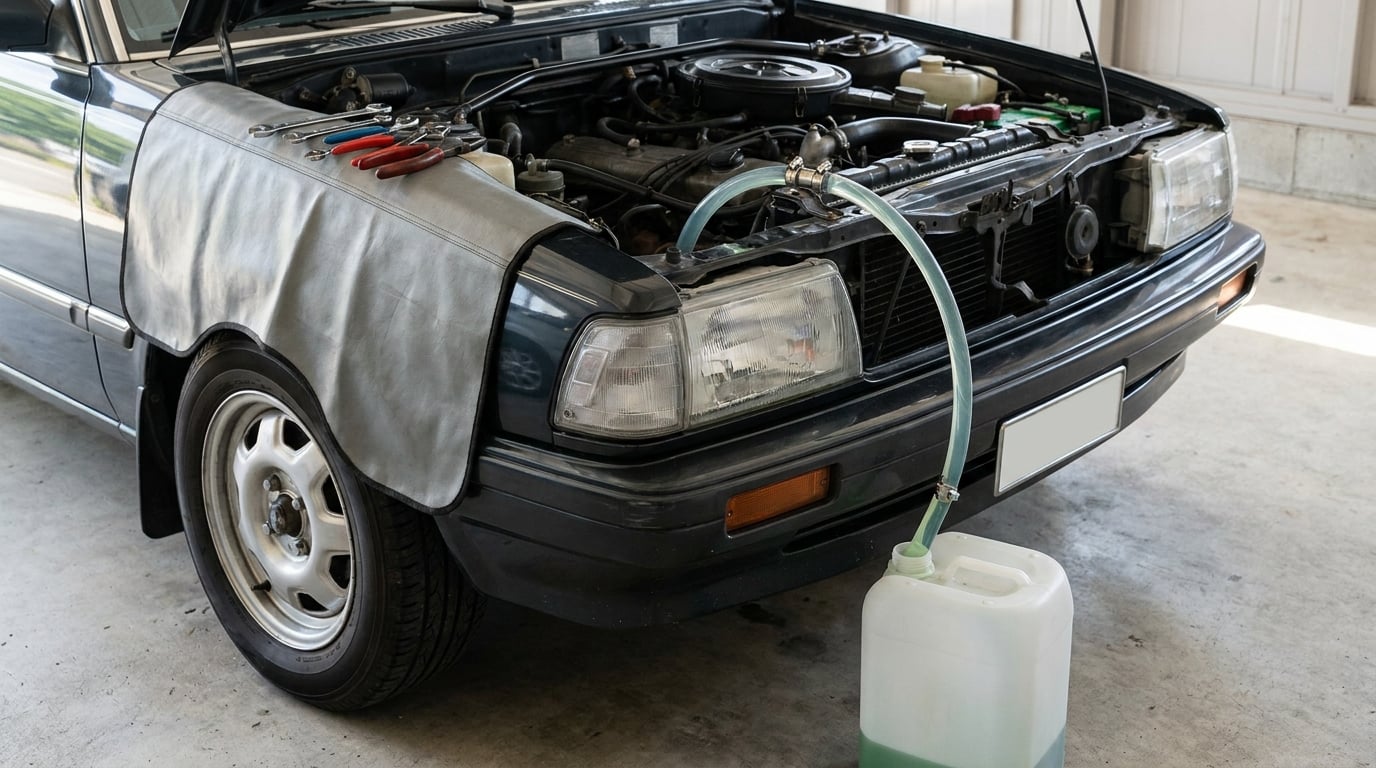
Burping air out of a cooling system means circulating coolant until no air reaches the filler neck: engine at operating temperature, heater on full blast, cap off, and a steady feed going in. On a car with a conventional radiator, a clear hose clamped to the neck does most of the work. On a BMW-style expansion tank, you fill and bleed at the tank.
Budget 30 to 90 minutes for most cars, and expect longer on a boxer engine or anything with a stubborn heater core. You only need to do this after the system has been drained (radiator, thermostat, water pump, heater core, hoses) or when a car overheats with no visible leak and blows cold air.
The physics has not changed since carburetors, so a 2026 car and a 1990s coupe bleed by the same rules. Air rises. Coolant expands when hot. Heat on maximum pulls fluid through the heater core, which is the easiest place on the whole car to trap a pocket.
Where people go wrong is the order. Filling a cold system to the top, capping it, and hoping is how the same problem comes back in a week. The thermostat has to open and the heater core has to fill before the system can hold pressure at all.
Table of Contents
- What You Need
- Step-by-Step: How to Burp Air Out of a Cooling System
- Frequently Asked Questions
- Does the engine need to be warm to burp a cooling system?
- How long does it take to burp a cooling system?
- Can I use the radiator hose method on a BMW?
- Why does the coolant level keep dropping after I bleed the system?
- Can air trapped in the cooling system cause overheating?
- Do I need a vacuum bleeder, or will a funnel work?
What You Need
Work on a cold engine, always. A sealed cooling system at operating temperature holds pressure well past the boiling point of water, and the cap is built to release it violently. Let the car sit overnight, crack the cap with a rag rather than bare hands, and keep drained coolant away from pets and storm drains. It is genuinely toxic to animals, and sweet-tasting antifreeze is one of the most common poisoning cases vets see.
Beyond that, gather the following before you start. The owner’s manual matters more than any other item here, because fill points and bleed procedures moved around a lot across model years.
- The owner’s manual for your model. It names the coolant specification, the fill line, and any model-specific bleed routine.
- The correct coolant, premixed or concentrate at a 50/50 mix with distilled water. Most BMWs want a specific blue coolant; GM-style universal mixes and Asian silicate blends are not interchangeable, and mixing chemistries can gel into sludge in the radiator passages.
- A large funnel or a spill-free funnel kit. The spill-free style has a shutoff at the bottom and fits over the filler neck, which matters when you are topping up while the engine idles.
- Basic hand tools: pliers, the correct cap removal tool or a flat screwdriver, a ratchet for hose clamps, and a shop rag.
- Optional but useful: a short clear hose and a hose clamp to feed coolant straight into the radiator neck, and a drain pan big enough to catch what comes back out.
- A vacuum bleeder if you expect to do this more than once, or if the car has a cooling system with no accessible bleed point at all.
Step-by-Step: How to Burp Air Out of a Cooling System
Follow the order below. Each step depends on the one before it, and skipping ahead is what produces a system that looks full on the bench and starves the engine on the road.
How to Burp Air Out of a Cooling System With a Standard Radiator
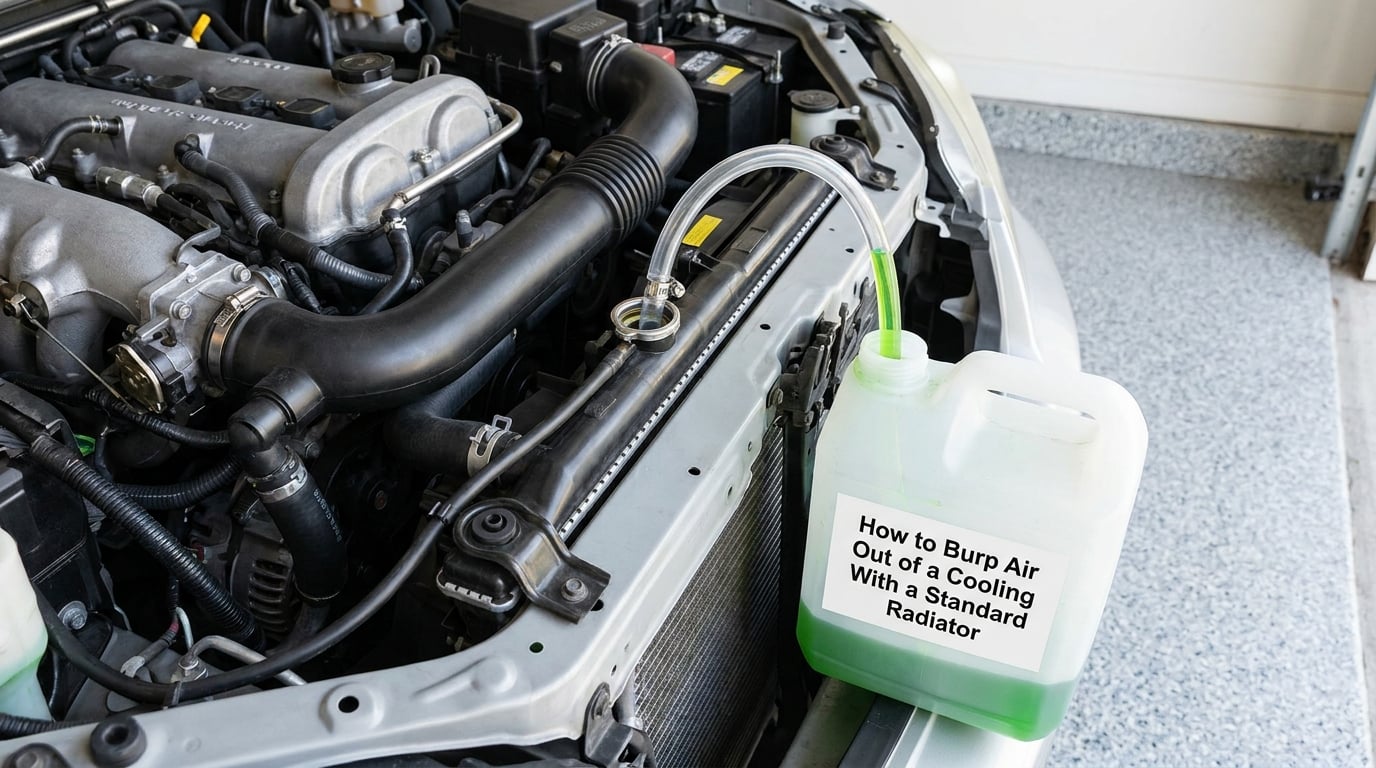
This is the method for older cars and many non-BMW builds, and it also works on BMW models with a conventional radiator cap.
- Start completely cold. Park on level ground, engine off for several hours. Open the radiator cap. If it is warm to the touch or the coolant is anywhere near the fill line, wait longer.
- Drain and refill to the base of the neck. Bleed from the bottom, not the top, whenever you can. That way air exits the fill point instead of collecting under the cap.
- Fit your bleed point. Remove the upper radiator hose and clamp a short clear hose over the radiator neck, or screw a radiator bleed petcock into the neck if the radiator has one. Secure the free end in a container low enough that it drains away from the filler.
- Fill slowly to the bottom of the neck and let it settle. Pour in thin streams with the engine off. Squeeze the upper and lower radiator hoses firmly to shift big pockets toward the opening. A steady stream of bubbles here is normal and is the air you came for.
- Warm the engine with the hose open. Set the heater to maximum heat (not defrost) and fan to low, start the engine, and idle. The heater setting is the part most people skip: it is what pulls coolant through the heater core and pushes the trapped bubble out toward the open filler.
- Hold the engine at operating temperature. Watch the upper hose. The moment it goes hard and hot, the thermostat has opened and circulation is finally real. Ten to twenty minutes of idling with heat on max covers most cars.
- Top up in small amounts as the level drops. Coolant expands when hot, so the tank reading climbs and falls. Add slowly, and only while the surface is still, so you are pouring liquid and not chasing foam.
- Stop when the hose flow is steady and bubble-free. Let the engine idle another five minutes to catch late pockets, then shut it off. Wait for it to cool fully before you cap anything.
One thing I would not skip: the 20-minute idle with heat on maximum that gets repeated a few times over several days for stubborn cars is not a magic trick, it is just giving the heater core enough circulation time to let go of a bubble. If you only give it three minutes, you have not tested it, you have just started.
How to Burp Air Out of a BMW Cooling System With an Expansion Tank
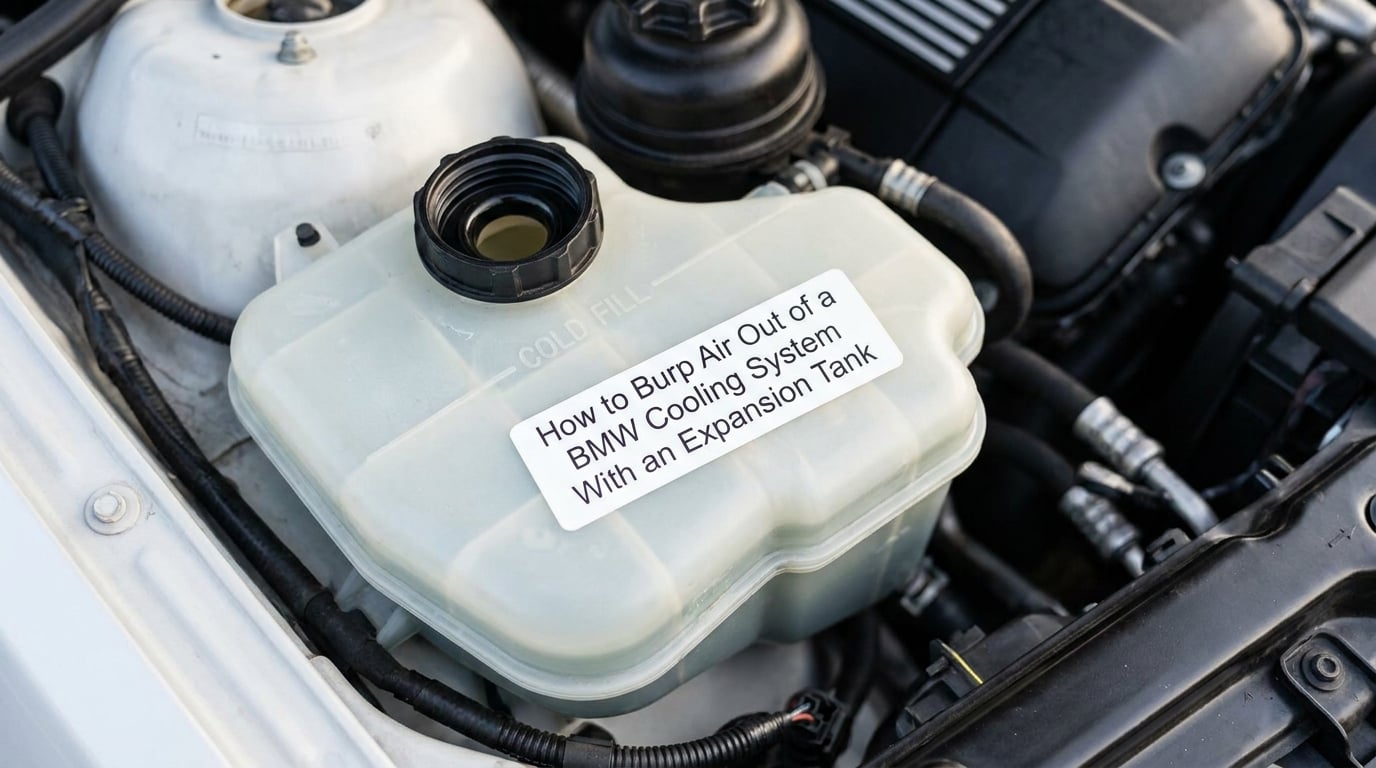
Many BMWs use a low-pressure expansion tank as the fill point instead of the radiator. The procedure is similar but the tank rules are stricter, and a few models will fight you without the right step.
- Park on dead level ground. Slope makes the cold-level reading meaningless, and an inaccurate reading is the single most common reason a tank-filled system stays airlocked.
- Let the engine go cold and open the tank cap. BMW tanks are usually non-pressurized, but the coolant inside is still hot enough to burn, so the same overnight wait applies.
- Fill to the specified cold line. Some tanks have separate COLD and MAX marks. On a fully cold engine you want the level between them, closer to COLD than MAX. Filling a BMW tank to the top is the classic overfill mistake.
- Set the heater to maximum heat and the blower to low or medium. Not defrost. Defrost sends blended air; maximum heat sends the coldest coolant straight out of the heater core.
- Run the engine until the upper radiator hose is hot and firm. That is the thermostat opening, and on a BMW the electric water pump will not move coolant properly until it is commanded to. If the hose stays soft and cold after 10 minutes at idle, stop and read the manual rather than pouring more coolant in.
- Top off the tank slowly in small pours, engine idling. Watch the neck. Bubbles streaming up mean keep going; a smooth, still surface that barely moves means the air is out.
- On models with an electric water pump, run the factory bleed routine. Newer BMWs, plus many VW, Audi and hybrid platforms, require a scan tool or a dealer menu to command a full pump cycle and vent mode. This is one of the most cited pieces of advice on r/BmwTech and r/E90: on those cars, the manual bleed procedure alone often will not move the last pocket, and a scan-tool cycle finishes the job in minutes.
- Shut off, let the car cool completely, then recheck the level cold. Add to the cold line, not above it. Cap it, then repeat one full heat-and-cool cycle and check again.
Subaru boxer engines are the other notorious case. Owners on the Subaru forums almost universally report needing a vacuum bleeder, because the crossflow layout buries high points where bubbles sit with nowhere to go.
How to Know the Air Is Out
You are done when all of these are true, not when the tank looks full while the engine is running.
- The cold level stays put. Check the tank or reservoir on level ground with the engine cold, twice, a week apart. If the line does not move, the system holds what you put in.
- No foaming at the neck. A still, clear surface with no bubbles or white foam is the strongest visual confirmation you can get.
- The upper radiator hose is hot and firm within a few minutes of reaching operating temperature, and stays hot through a full warm-up.
- The temperature gauge settles and holds. Fluctuating needles or a gauge that climbs and drops repeatedly mean air still moving through the sensor.
- The heater blows hot air at medium fan speed within a few minutes of starting.
- No gurgling from the dash at idle or on turns.
Then take a 15 to 20 minute drive and recheck the cold level again. A recheck at around 100 miles is standard professional practice for a good reason: it is when a small remaining leak or a stubborn pocket usually shows itself.
Common Mistakes
These are the errors that come up again and again, and each has a straight correction.
- Opening a hot system. Correction: a closed cooling system at temperature will spray scalding coolant the moment the cap comes off. Wait until everything is cold to the touch, every time, even for a quick top-up.
- Using the wrong coolant. Correction: check the manual for the specified chemistry. OAT, HOAT and IAT mixes are not compatible, and mixing them can form gel that blocks the small passages in a radiator or heater core.
- Filling too quickly. Correction: pour thin streams and let each one settle. Fast fills trap air rather than displacing it, which is the opposite of the goal.
- Driving with the cap or hose off. Correction: a capless system is an open system. It can run for a short while but loses coolant fast and can let air back in. Cap it and recheck the level every few miles until it is stable.
- Overfilling the expansion tank. Correction: a BMW tank is set for a working fluid volume, and a full-to-the-max cold tank leaves nowhere for the coolant to expand. Target the cold line.
- Ignoring a model-specific bleed procedure. Correction: if the car has an electric water pump or a scan-tool vent mode, follow the manual’s routine. Generic advice is where people get stuck for weeks.
- Forgetting the heater. Correction: maximum heat, not defrost, and do it on every cycle. The heater core is the last place a bubble hides.
Two more worth knowing. Drilling small bleed holes in a thermostat flange does work and shows up in a lot of older guides, but on a new thermostat it can void the warranty, and drilling into a casting is a bad bet. And never fit a pressure cap with a rating different from the one specified for the car: a system that cannot hold its designed pressure will show you a false low-pressure reading at the wrong moment.
Frequently Asked Questions
Does the engine need to be warm to burp a cooling system?
No, you start cold and warm it up as part of the process. Fill the system cold so the thermostat is closed, then run the engine until the upper radiator hose is hot and firm, which means the thermostat has opened and coolant is actually circulating. Topping up with a cold engine and capping it is how air stays trapped.
How long does it take to burp a cooling system?
Most cars finish in 30 to 90 minutes. A straightforward radiator job takes about 20 minutes of idling with the heater on maximum, plus time to cool down fully and recheck. Allow longer for a BMW expansion-tank bleed, a Subaru boxer engine, or a car with a difficult heater core. Several heat-and-cool cycles over a day is normal for stubborn cases.
Can I use the radiator hose method on a BMW?
Only if your model fills at the radiator. Many BMWs fill through the expansion tank, so there is no radiator neck to fit a hose to, and on some the radiator is not the fill point at all. Check the manual for the fill location. If it is a tank-fill car, use the tank procedure and the correct cold level line instead of forcing coolant into the radiator.
Why does the coolant level keep dropping after I bleed the system?
First check whether you are reading it cold and on level ground, because hot coolant expands and reads high. If the level still falls between cold checks, something is actually leaving the system: a slow external leak at a hose clamp, a failing radiator cap that is not sealing, a weep from a water pump weep hole, or combustion gases entering the coolant from a head gasket. A block test can tell you.
Can air trapped in the cooling system cause overheating?
Yes. Air is a poor conductor of heat and it does not carry heat away from the engine, so a trapped pocket creates hot spots that can warp cylinder heads or crack a gasket if it goes on. It also makes the temperature gauge lie, because the sensor sits in moving air or coolant. That is why the gauge can read normal right up until the damage is already done.
Do I need a vacuum bleeder, or will a funnel work?
A funnel works on most cars once you get the order right: cold fill, open bleed point, heat on maximum, slow top-ups, and enough idle time. A vacuum bleeder earns its keep on cars with no accessible bleed point, on electric-pump vehicles, on boxer engines, and on anything where the heater core refuses to let go. If two careful attempts with a funnel fail, the tool is the next step, not more patience.
Start with the basics: find the real fill point for your model, get the specified coolant mixed properly, and set aside a cold-engine afternoon. Fill low, warm it fully with the heater on maximum, top up slowly, then confirm with two cold level checks a week apart before you cap it and call it finished.