
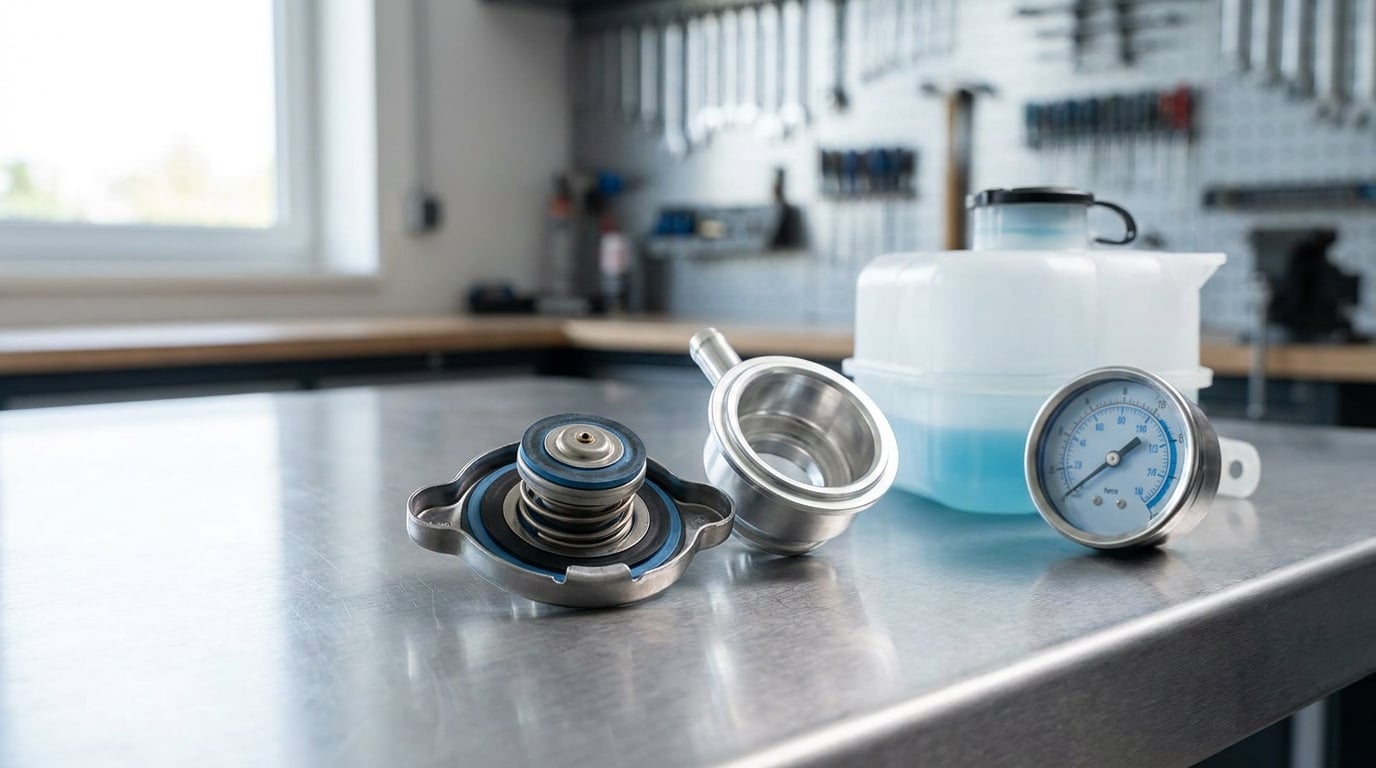
A radiator cap is the pressure valve that seals your engine’s cooling system and holds it at a set pressure, usually 13 to 16 PSI. That pressure raises the boiling point of the coolant, and the cap also holds a vacuum on cooldown so the system stays full and free of air. When pressure climbs past the cap’s rating, the extra coolant goes to the overflow reservoir instead of out onto the road.
It is a cheap part doing a job most owners never think about. On a BMW that has spent a couple of decades on the road, it is also one of the first things worth suspecting when the coolant level keeps dropping.
Here are the four jobs the cap handles, in the order they matter.
- Pressurizes the system: a spring-loaded valve rated between 13 and 16 PSI keeps coolant circulating under mild pressure so it can absorb more heat than it could at atmospheric pressure.
- Raises the boiling point: that extra pressure stops the coolant from boiling at normal engine temperatures, which is what allows a hot engine to shed heat without flashing to steam.
- Manages coolant flow: as coolant heats up and expands, the pressure valve cracks open and pushes the surplus into the overflow reservoir where it sits until the engine cools.
- Prevents a vacuum: as the engine cools and the coolant contracts, a second valve opens and draws coolant back out of the reservoir without letting air in.
Table of Contents
How Does a Radiator Cap Control Coolant Pressure?
The cap does not pump anything. It is a passive valve that reacts to whatever pressure is already in the system, which makes the whole cycle easy to follow once you see it in order.
| System condition | What the cap is doing | Where the coolant goes |
|---|---|---|
| Engine cold, everything is at rest | Seated and sealed, no movement | Stays in the radiator and block |
| Engine warming up | Held closed by the spring, pressure is building | Circulating through the engine |
| Pressure reaches the rated release point | The sealing washer lifts off its seat | Surplus moves up the filler neck |
| Pressure above the rating | Valve stays open and bleeds excess | Overflow reservoir stores the extra |
| Engine cooling down | Vacuum valve cracks open as coolant contracts | Reservoir draws back into the radiator |
That last row is the one that confuses people. On a healthy system the reservoir level is expected to rise when the engine is warm and drop again once it cools. If it stays high all the time, the system may not be returning coolant properly, and if it keeps dropping, something is losing it.
What Does a Radiator Cap Do During Pressure Changes?
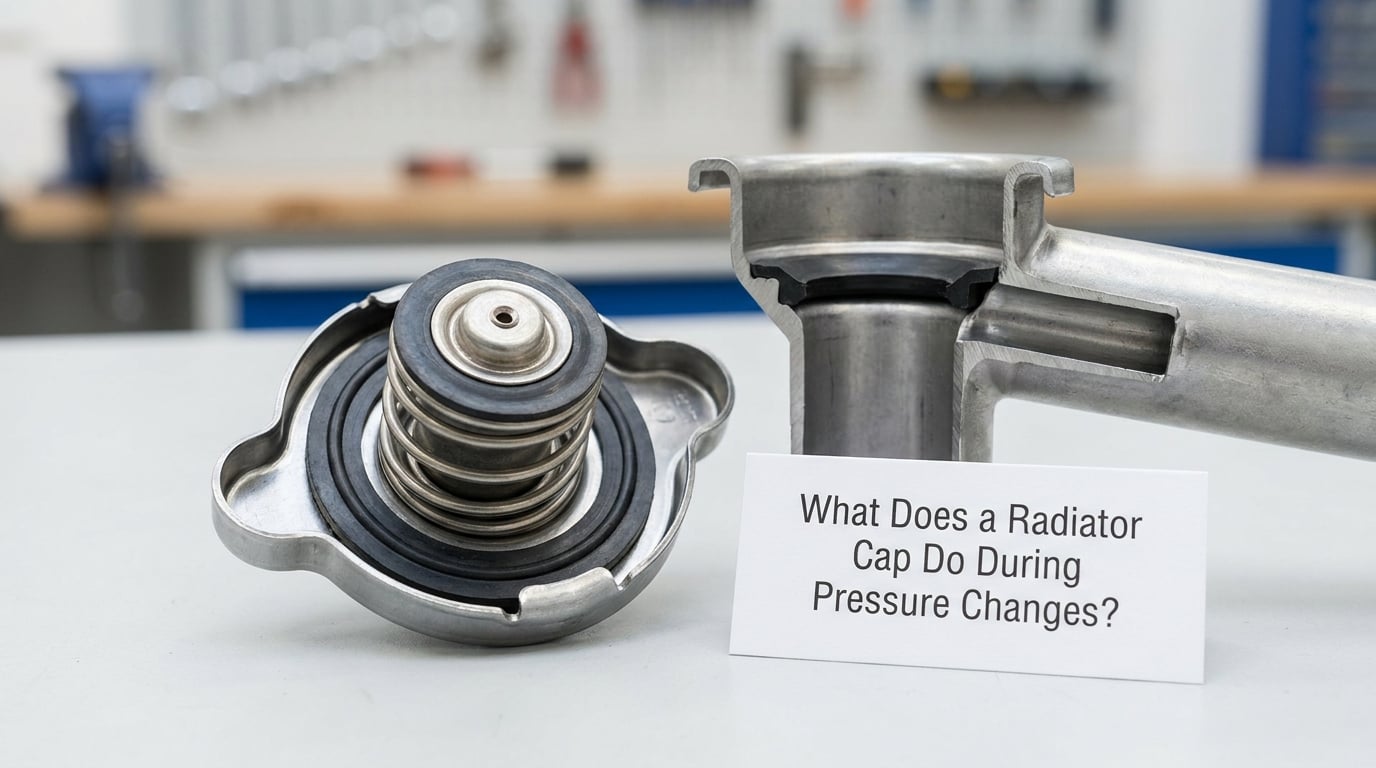
Inside a typical cap you will find a spring pressing a sealing washer against a seat, plus a small secondary valve that only opens under vacuum. The spring sets the release pressure, and that rating is stamped on the cap body, usually something like 15 PSI.
Two rubber seals do the actual sealing, and they fail in different ways. The upper seal that presses against the filler neck loses its shape with age and heat cycles, which lets coolant weep past the cap. The lower seal controls the pressure valve, and when it hardens or tears the cap either pops off early or refuses to seal at all.
Fit a cap rated too high and the whole system runs above what the radiator, hoses and plastic tank were designed for, which is how you end up with a burst hose or a cracked reservoir. Fit one rated too low and the system is barely pressurised, so the coolant boils earlier than the design assumed and the engine overheats under load with plenty of fluid still in the radiator.
Neither failure is dramatic in the moment. They are slow failures that show up as an unexplained coolant loss months later.
Why Is the Radiator Cap Important on BMWs?
BMW cooling layouts vary a lot across the range, but the principles are consistent. The cap sits on the radiator or on the coolant expansion tank, and it sets the pressure the whole sealed circuit runs at. On models where the expansion tank is a separate plastic bottle, that tank is also a common failure point, and it is usually a part of the cap’s job to keep the pressure balanced across both vessels.
On an older car, three things tend to go wrong at once. The plastic expansion tank embrittles and starts weeping, the cap seals stiffen, and the small bleed passages around the cap and neck silt up with corrosion debris. Any one of those can look like a coolant loss problem.
Trapped air is the other BMW-specific headache. Air pockets that never purge out of the system cause what looks like a temperature problem when it is really a coolant-flow problem, and the gauge can still read normal for a while. A cap that will not seal properly makes this worse, because it stops drawing coolant back from the tank and the level keeps sagging.
One more detail worth getting right: match the cap to the coolant your car specifies. BMW coolant is a specific glycol mix with a particular boiling and corrosion specification, and a cap pressure rating is only meaningful when paired with the coolant the manufacturer intended.
What Signs Point to a Bad Radiator Cap?
Symptoms are not a diagnosis, so treat this list as a reason to look rather than a verdict. The most common signals are these.
- Coolant loss with no visible puddle: the level walks down over weeks and the reservoir never refills.
- Residue around the cap or filler neck: white, green or pink crust on the neck or the plastic tank means coolant is escaping there or has been escaping there.
- Overheating only under load: stop-and-go traffic, long climbs or towing push the temperature up, while a casual drive looks fine.
- A cap that will not hold a seal: it rocks loose, sits proud of the neck, or the rubber has gone hard, cracked or flattened.
- Unexpected behaviour at the cap: hissing or gurgling as the system is opened, or a cap that pops off the neck far too easily.
- An odd pressure reading: a tester that shows the system holding far less or far more than the rating printed on the cap.
Hissing and gurgling when the cap comes off, paired with coolant that keeps vanishing, is the combination that sends most owners straight to the cap. It is a sensible first suspect, because it is cheap to replace and easy to test. Just as common, though, is fitting a new cap and finding the behaviour completely unchanged. That is your cue to stop and pressure test the system rather than keep swapping parts.
Some owners are reassured by a brown film inside the cap. That residue is normal anti-corrosion additive and coolant colouring, not a defect on its own. What matters is whether the rubber is supple and the spring still has a strong push.
How Do You Check a Radiator Cap Safely?
Start with the safety part, because it is the one that matters. Never remove a radiator cap from a warm engine. Pressurised coolant venting through a narrow gap under a cap is how people get burned badly, and a towel over the cap is not a real barrier. Wait until the system is cold to the touch, then turn the cap slowly and let the pressure bleed off before lifting it.
Once it is out and the system is cold, work through this sequence.
- Look at the seals. Both rubber seals should be dark, flexible and free of cracks, flattening or stretching. A seal that no longer springs back gets replaced regardless of anything else.
- Shake it. A cap with a healthy spring gives a clear, consistent clatter as the internal valve moves. A rattle with no spring tension at all means a cap that will not hold pressure.
- Check the body. Look for rust pitting, corrosion or a cracked plastic shell, and confirm the pressure rating is stamped on it and matches what your car needs.
- Test it if you can. A radiator cap tester or pressure tester with the right adapter is the only method that measures the release pressure against the rating. Mount the cap, bring the gauge up gradually, and check whether it holds to the rating and pops at the right pressure.
- Test the system if the cap is fine. A pressure test of the whole sealed system, or a vacuum test, tells you whether the loss is coming from the cap or from somewhere else in the circuit.
Follow the service manual for your specific model. It will list the cap pressure rating, the coolant specification and the bleed procedure, and skipping the bleed step is how air gets trapped in the system after a refill.
When Should You Replace the Radiator Cap?
Replace the cap when the seals are hardened or cracked, when the spring has lost its tension, when the cap has been overtightened or dropped, or as a matter of course with any cooling system service. It is a low-cost part and the job itself takes minutes with a pliers, so there is very little argument for reusing an old one.
Match the rating stamped on your original cap, and check the tank or radiator neck for damage at the same time. A cap that seats badly on a distorted plastic neck will keep leaking no matter how good the new cap is, so inspect the sealing surface rather than assuming the part was fault.
Also replace the cap after a significant overheat, because the spring and seals get heat-cycled hard and the coolant is often contaminated with combustion gases at that point.
The honest warning: a new cap does not always fix coolant loss. If the level still drops after a fresh cap, a weak new cap, a cracked radiator core, a tired cap on another plastic tank, or a failed head gasket are all still in play. That is the moment to stop swapping cheap parts and get the system pressure tested properly.
Frequently Asked Questions
Can you open the radiator cap when the engine is hot?
No. Pressurised coolant can escape through the gap under the cap at temperatures high enough to cause serious burns, and a rag over the cap will not reliably stop it. Let the system cool until the upper radiator hose and the cap itself are cold to the touch before turning it. If the engine has just overheated, treat the system as hot and leave it alone until it has been sitting for hours.
What happens if the radiator cap has the wrong pressure rating?
A cap rated too high runs the entire cooling system above what the radiator, hoses and plastic tank were built for, and that pressure can burst a hose or crack a reservoir. A cap rated too low barely pressurises the system, so the coolant boils earlier than the design assumed and the engine can overheat under load with fluid still visible in the radiator. Either way, match the rating stamped on your original cap.
Does a bad radiator cap cause coolant to disappear?
It can, and it is one of the cheapest explanations to rule out first. A hardened upper seal lets coolant weep past the cap, and coolant in the reservoir can also evaporate through a cap that will not seal, which is why the level falls with no puddle underneath. That said, a new cap does not always solve it. A cracked radiator core, a tired expansion tank or a failed head gasket can all produce the same disappearing coolant.
How can I test whether my radiator cap holds pressure?
With a cap tester or radiator pressure tester and the correct adapter, mount the cap, raise the gauge slowly and confirm it holds to the pressure stamped on the cap body before the valve opens. Without a tester, shake the cap to feel for a solid spring and check that both rubber seals are flexible and free of cracks, though neither tells you the exact release pressure. A pressure test of the whole system is the next step if the cap looks and sounds fine.
Can a bad radiator cap be the only reason my BMW is overheating?
Rarely on its own. A cap that will not hold pressure is a real cause of overheating under load, but a stuck thermostat, a failing water pump, a trapped air pocket or a weak radiator fan can produce the same readings. Overheating when idling is a classic clue that points away from the cap and toward coolant circulation, including air that never purged out of the system. Get the cooling system pressure tested rather than guessing between parts.
Conclusion: Start with a Pressure and Safety Check
A radiator cap does three things: it holds the cooling system at a rated pressure, it raises the coolant’s boiling point so the engine can shed heat safely, and it moves coolant to the overflow reservoir and back again without letting air in. Everything about diagnosing a cooling complaint starts there.
So check four things first, on a cold engine. Confirm the pressure rating is correct for your car, confirm the cap seals properly and the springs feel firm, confirm the filler neck and reservoir are free of crust and damage, and confirm you actually have a leak rather than a reservoir that is simply rising and falling as it always does. Never open a hot system, whatever the reason.
If the coolant keeps disappearing after a fresh cap, or the pressure reading is far off the rating, stop swapping parts and have the cooling system pressure tested by a qualified mechanic. Persistent overheating is not something to keep driving around and hoping resolves.
Last reviewed for 2026. Follow the service manual for your specific model whenever it differs from the general guidance here.