
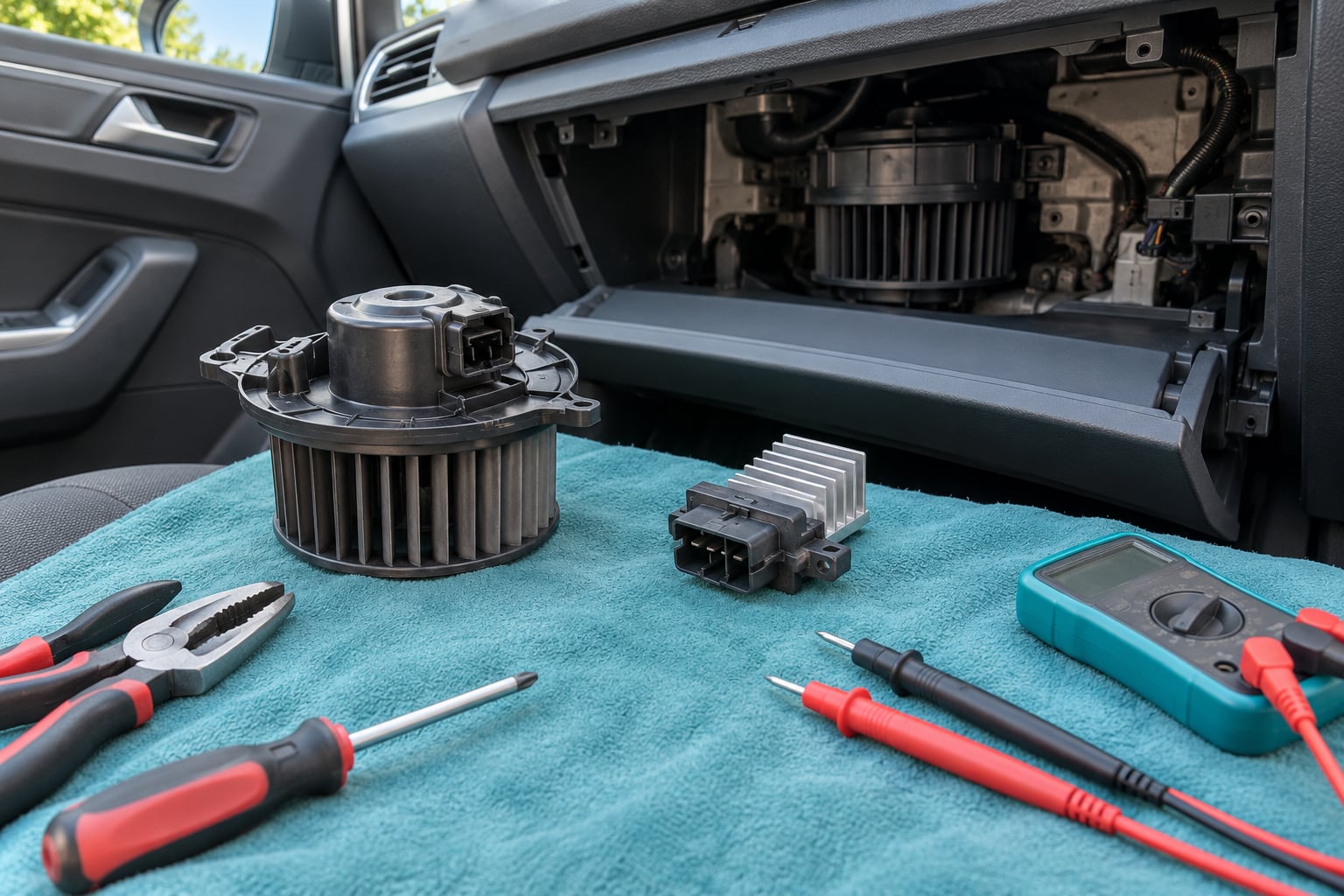
If your blower motor only works on high, the part that controls the lower fan speeds has failed, and on most cars that part is the blower motor resistor. High speed is fed straight from the relay to the motor, so it keeps working even when the resistor pack is cooked open. On a BMW of that era, the same symptom often comes from the blower control unit instead, which does the same job with electronics rather than coils.
Budget 30 to 90 minutes for the resistor-based diagnosis, longer if the fan is buried under the dash on an E90 or E91. The order matters: fuse, connector, control circuit, then motor. Skip ahead to the motor and you will end up with a new motor and the same complaint.
Table of Contents
- What You Need Before You Start
- Step-by-Step: Fixing a Blower Motor That Only Works on High
- Common Mistakes That Wreck the Diagnosis
- Frequently Asked Questions
- Can a blower motor resistor make the fan only work on high?
- Is it safe to replace a car blower motor yourself?
- What does a blower motor that works on high but not low usually mean?
- How much voltage should the blower motor receive?
- Why does the blower motor work for a few seconds and then stop?
- Do I need to replace the HVAC control head if the blower only works on high?
- What to Do First
What You Need Before You Start
Start with the paperwork, not the parts. The owner manual tells you which fuse feeds the heater blower on your specific car, and the wiring diagram shows whether that car uses a resistor pack or an electronic control unit.
- Owner’s manual and the vehicle-specific wiring diagram
- Basic hand tools, trim tools, and a Torx or spline set for the dash screws
- Multimeter, or a 12-volt test light if you do not own one
- Fused jumper lead for powering the motor directly
- Contact cleaner, heat-shrink, and a repair kit or new pigtail if the connector is damaged
- The correct replacement part, matched to your VIN or part number
Budget an evening if the blower assembly sits behind the glove box on your model, because the housing is fiddly. If you have a fused jumper lead and a test light, you can cover most of the tests without a multimeter at all.
On the electrical side, the same back-probing and voltage-drop thinking applies well beyond HVAC, so it is worth pairing with how to test a starter motor with five simple checks.
Step-by-Step: Fixing a Blower Motor That Only Works on High
Step 1: Confirm the blower motor only works on high
Run the fan through every position and write down exactly what happens. Note airflow strength, noise, and whether the fan quits after a few seconds. That record separates a failed resistor from a control head, a switch, or damaged wiring.
High-only on every low and medium setting, with the same noise and no shutoff, points at the speed control circuit. A fan that runs on high and then dies after a few seconds is a different problem, usually current draw or a loose ground.
Step 2: Check the HVAC fuse and circuit protection
Use the manual and the fuse box diagram to find the cabin or heater blower fuse, then pull and inspect it visually and test it for continuity. Look at the socket too, because a fuse that gets hot leaves discoloration and melted plastic around it.
Confirm the relay or control circuit is receiving power at the fuse. Never bridge a fuse or fit one with a higher rating than the factory spec to make the fan run. If a correctly rated fuse blows again, the fault is downstream and you keep looking.
Step 3: Inspect the blower motor and connector
Trace the motor wiring to the accessible connector, unplug it with the key off, and study the terminals. Melted terminals, browned plastic, corrosion, or pins pushed back into the housing all produce high-only operation or nothing at all.
Clean light corrosion with automotive contact cleaner and dry it fully. A browned or deformed housing needs a pigtail repair or a new connector, not a quick clean. Reconnect with a click and tug test so you know it is seated.
This connector is the single most overlooked failure point in the whole job. On forums, owners who replaced the resistor and still had high-only fans almost always found a melted connector behind the glove box. Replacing the resistor and leaving that plug alone is how you end up back at square one in a month.
Step 4: Test voltage at the blower connector
Back-probe the connector with the fan commanded to high. A healthy high-speed circuit shows close to battery voltage across the blower power and ground terminals, typically around 12.6 volts with the engine running and not much below 12 volts key-on. Keep in mind battery voltage is a reference, not a rule, so a weak battery will drag every reading down.
What the numbers mean: near battery voltage on both sides of the motor means the motor gets its power and the fault is upstream in the speed control. Good power but weak return means a bad ground on the housing or harness. Near zero on the power leg while high is selected means the control circuit, relay, or control head never commands high.
For a proper voltage drop test, back-probe the ground at the motor while it runs on high and compare it to battery negative. Anything past a few tenths of a volt is a corroded or heated connection you need to fix.
Step 5: Test the motor directly
Disconnect the motor and power it from a properly fused temporary source, following the service manual procedure, with the vehicle battery and wiring protected. A healthy motor spins smoothly and draws within the service manual limit.
Replace the motor if it will not run, stalls, runs only intermittently, or grinds badly. A motor with excessive current draw is worth replacing even if it spins, because that draw is what cooks the resistor pack over and over.
On an amp clamp, most blower motors land somewhere in the 4 to 12 amp range depending on the vehicle and speed. Read the service manual value for your motor and judge against it, not against a generic number.
Step 6: Replace the failed motor or control component
On a resistor car, unplug the old pack, note the connector orientation, and fit the new one with the factory thermal fuse intact. Keep every screw and its clip, since a loose screw inside the housing rattles until it finds the blower wheel.
On a BMW with an electronic blower control unit, the unit sits near the motor or in the electronics bay depending on model. Disconnect it, install the replacement, and clear faults in the diagnostic tool so the new unit is recognised.
Reconnect the harness and secure it clear of the blower wheel, sharp edges, and the heater core. Then verify: low, medium, and high should all sound and move as intended, and the fan should keep running at low for several minutes without cutting out.
If air is moving but the cabin never cools, that is a different problem entirely, and why the AC blows cold only when driving covers the temperature side.
Common Mistakes That Wreck the Diagnosis
- Replacing the motor first. If the motor already runs fine on high, it is not the fault. The speed control circuit is.
- Leaving a melted connector in place. Heat-damaged terminals cause repeat failures even with a brand-new resistor.
- Skipping the amp draw check. A worn motor drawing too much current melts a good resistor in weeks. Owners on r/MechanicAdvice report resistors dying twice for exactly this reason.
- Fitting the wrong fuse rating. A higher rating lets a fault cook the harness instead of protecting the circuit.
- Leaving a bypass jumper permanently installed. A temporary jumper that becomes permanent hides the fault and puts the whole circuit on the motor at full speed.
- Ignoring ground-side and control head problems. Corroded grounds and a failed climate control panel produce the same symptom, which is why the 2carpros crowd keeps pointing at ground circuits and control heads first.
One last habit: disconnect the negative battery cable before unplugging or handling any electrical connector, and follow the service information for your specific vehicle rather than a generic video.
Frequently Asked Questions
Can a blower motor resistor make the fan only work on high?
Yes. The resistor pack drops voltage to create the lower speeds, and the high setting bypasses it entirely and sends full battery power straight to the motor. Once the pack fails open, only high works. A blown thermal fuse inside the pack causes the same result, and so does a melted connector on the same circuit.
Is it safe to replace a car blower motor yourself?
For most owners, yes. The electrical side is low current and the real risk is the dash, not the wiring. Use a fuse with the correct rating, disconnect the negative battery cable before handling connectors, and support the blower housing so it does not drop while the screws are out. If the housing is buried deep in the dash, a shop may be faster.
What does a blower motor that works on high but not low usually mean?
It usually means the low and medium speed path is broken, so the blower motor resistor pack or the electronic blower control unit has failed. It can also be a melted connector, a bad ground, or a failing climate control head. Since high is fed directly to the motor, a fan that works there proves the motor itself is alive.
How much voltage should the blower motor receive?
On high, expect close to battery voltage at the blower connector, roughly 12.6 volts with the engine running. At lower speeds the reading drops by design, because that drop is the resistor doing its job. Treat battery voltage as a reference rather than a fixed number, since a weak battery pulls every reading down with it.
Why does the blower motor work for a few seconds and then stop?
That pattern usually means the motor is drawing too much current, so a thermal fuse inside the resistor pack opens and cuts the circuit. A worn motor, restricted airflow, or debris packed into the blower wheel are common culprits. Check amp draw against the service manual limit before replacing parts, or the failure will repeat.
Do I need to replace the HVAC control head if the blower only works on high?
Not usually. Check the fuse, connector, and resistor or control unit first, because those fail far more often. Replace the climate control head only if the speed commands never reach the blower circuit and the wiring, grounds, and control unit all test good. Several owners on forums were sent straight for a new head and found a melted plug instead.
What to Do First
Record which speeds fail, then check the fuse, the connector, and the voltage at the motor with the fan on high. If power and ground are solid and the motor spins on a fused jumper, replace the resistor pack or blower control unit, not the motor.
On a BMW, remember the control unit is doing the resistor’s job, so parts ordered for a resistor-based car will not fit. If the dash work is more than you want to take on, our E90 high mileage reliability guide covers which HVAC parts tend to give up first and which repairs are worth doing yourself.