
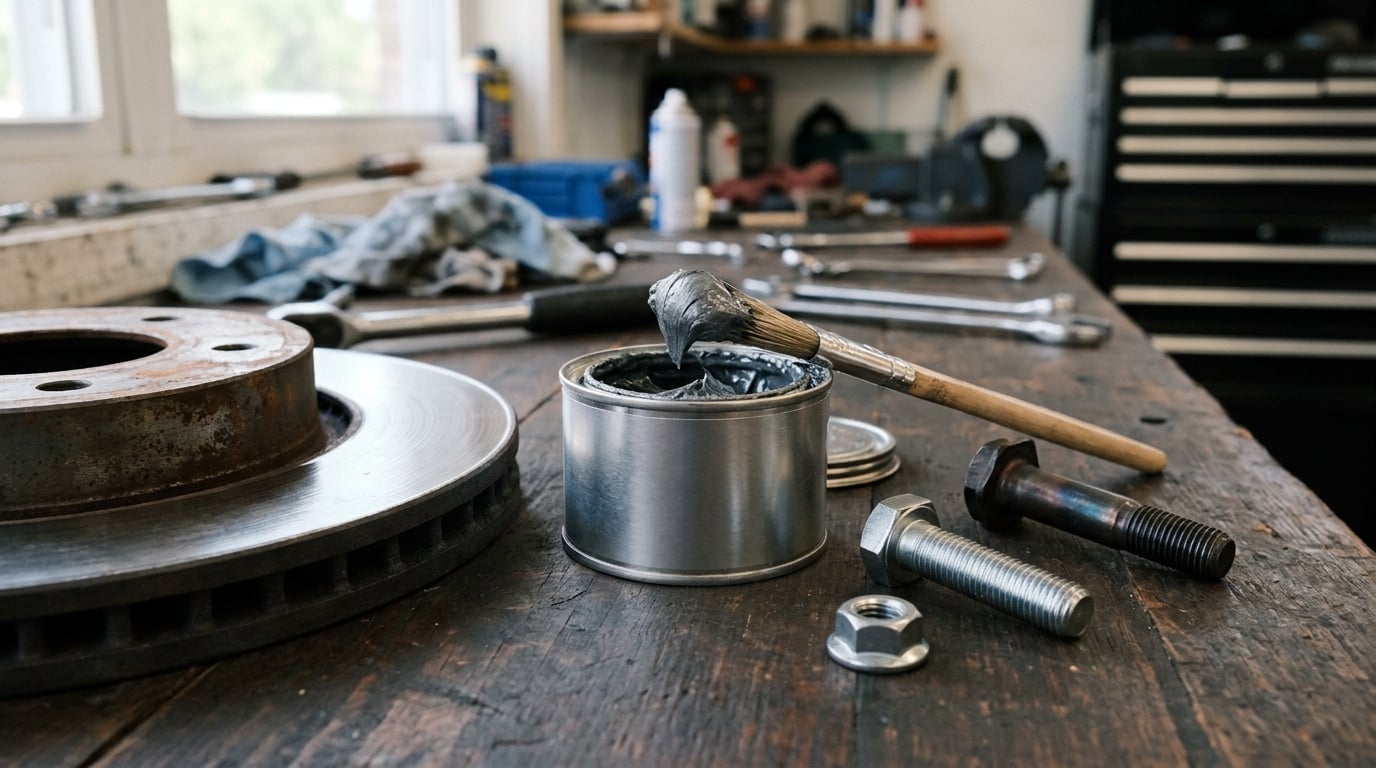
Anti-seize is a paste that stops threaded fasteners from galling and seizing, and you put it on heat-exposed hardware, stainless steel bolts, and any fastener that screws into aluminum. The whole decision comes down to one question: will this bolt ever come apart again? If yes, anti-seize usually belongs there. If it is a friction surface, a bearing, or a joint the factory meant to stay put, it does not.
That is the short version. The rest of this guide is the longer, more useful version: what the compound actually is, why bolts seize in the first place, which specific hardware deserves it, which hardware it will quietly ruin, and what to do when the bolt has already fused itself to the part.
I have cleaned enough heat-soaked exhaust studs and snapped enough of my own to be opinionated about this. The people who get into trouble are not the ones who use too little anti-seize. They are the ones who smeared it on a brake pad backing plate or a torque-spec’d wheel stud because the internet told them it works everywhere.
Table of Contents
- What Is Anti-Seize and What Does It Do?
- How Does Anti-Seize Prevent Corrosion and Seizing?
- When Should You Use Anti-Seize on Automotive Parts?
- Where Should You Not Use Anti-Seize?
- How to Apply Anti-Seize Correctly
- What Type of Anti-Seize Should You Choose?
- How Do You Remove a Bolt That Has Already Seized?
- Frequently Asked Questions
- Conclusion: Start With the Manufacturer’s Guidance
What Is Anti-Seize and What Does It Do?
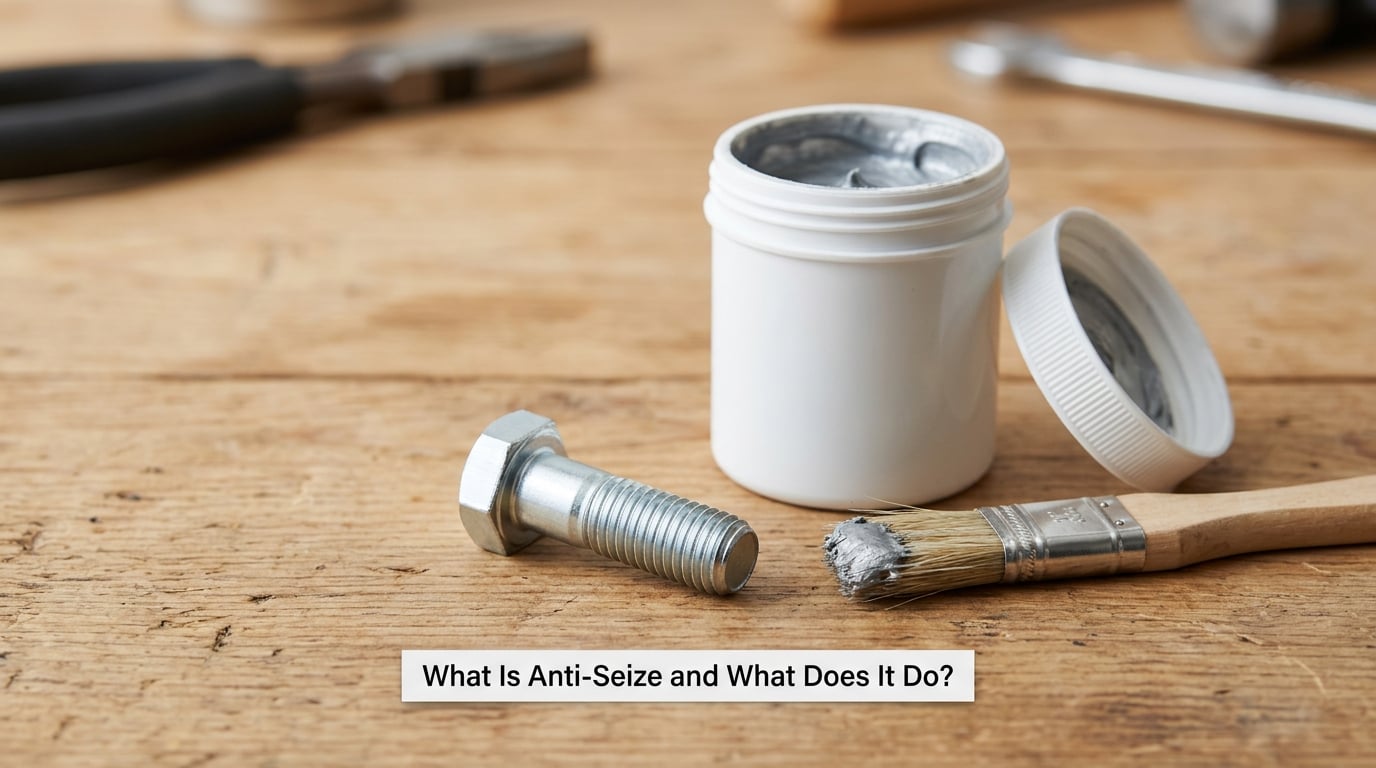
Anti-seize is a paste-like assembly compound made of a grease or oil carrier loaded with solid lubricating particles, typically copper, nickel, aluminum, graphite, or ceramic, that coats threaded metal so the two surfaces cannot gall or bond together. That is its one job: keep bolts, studs, and plugs removable years later instead of fused to the hole.
Two parts, and both parts matter. The carrier is a grease or oil base that holds everything in place and carries it into the microscopic gaps between thread flanks. The solid particles are the actual anti-seize: soft metal flakes, powders, or ceramic solids that smear across the mating surfaces and act as sacrificial layers that wear away instead of your threads.
Most automotive anti-seize is sold as a copper-colored paste. High-temperature versions swap the copper for nickel or ceramic solids so they survive exhaust and turbo temperatures, and plenty of newer cans are metal-free.
What anti-seize is not
Anti-seize is a thread compound, not a general-purpose lubricant. It is not a structural adhesive like Loctite 271 or 601, and it is not designed to hold a joint together against vibration. It is also not a substitute for grease on something that slides or rotates.
It will not fix a stripped hole, a cracked bolt, or threads that are already pitted with rust. Once metal is gone, a coating of copper flake does not bring it back. The compound protects the threads that are still healthy and does nothing at all for the ones that are not.
One rule that covers most of it
If the joint has to be serviceable later, use anti-seize. If the joint is meant to be permanent, or if the surface is supposed to grip rather than glide, leave it clean. Every exception below is a detail hanging off that sentence.
How Does Anti-Seize Prevent Corrosion and Seizing?
Every machined metal surface, no matter how fine the finish, is covered in microscopic peaks and valleys. When two threaded surfaces are tightened together, those peaks press into each other at enormous local pressure. Add heat, moisture, vibration, and two different metals touching, and the peaks deform and bond to each other.
That bonding is what mechanics call cold welding. It happens far below the melting point of the metal, which is why an exhaust stud that cycles from cold to glowing can weld itself into the head while a cold bolt in the same engine never seizes at all.
What the compound actually does
Anti-seize deposits a soft, low-shear film in the gaps where the peaks would touch. Two things follow from that. The metal never makes metal-to-metal contact, so there is nothing to cold weld. And water and oxygen are kept off the surface, which slows rust and the galvanic corrosion that comes from bolting two dissimilar metals together in a damp environment.
The film is sacrificial by design. It is expected to smear, darken, and wear off over the life of the joint while the fastener keeps turning freely underneath it. That is the whole reason anti-seize beats a general grease on exhaust hardware, where an ordinary grease simply runs down and out of the thread when the metal gets hot.
Dissimilar metals and the copper problem
Bolt steel into aluminum and you have two metals with different electrochemical potentials sharing an electrolyte. The less noble metal, aluminum, corrodes faster, which is why marine and road-salt environments are where anti-seize earns its keep.
But copper is itself a metal, and a copper-laden film is electrically conductive. On aluminum or stainless hardware where galvanic action is the concern, a copper product can be the wrong answer. Nickel and metal-free ceramic versions exist for exactly those jobs, and builders working in salt water or on aluminum trailers tend to reach for them by default.
What it cannot repair
Anti-seize prevents new corrosion and new seizing. It does not remove existing rust, it does not rebuild a damaged thread, and it will not free a bolt that has already bonded. Once a stud is fused, the compound is a lesson for the next assembly, not a fix for this one.
When Should You Use Anti-Seize on Automotive Parts?
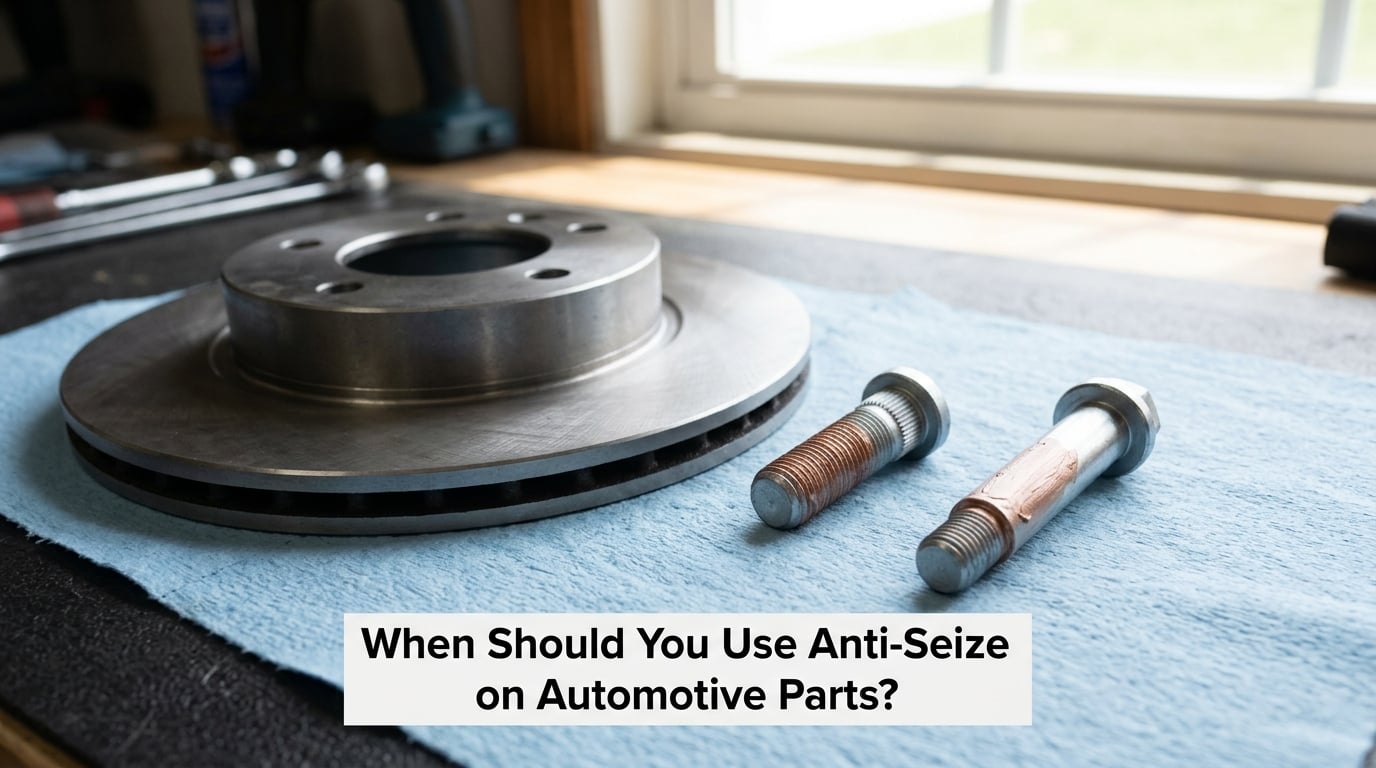
Use anti-seize on fasteners that see heat, that join two different metals, that sit in water or salt, or that you know you will be removing again. Named hardware beats vague advice here, so here is the garage list.
Exhaust and turbo hardware
Exhaust manifold studs, manifold bolts, turbocharger fasteners, and anything near a catalytic converter run hot enough to bake out an ordinary lubricant. This is where copper or nickel high-temperature anti-seize has always been the answer, and where the age of the joint is the whole point. A manifold you will want off again in five years is worth the ten seconds of brushing now.
Threadlocker is the wrong tool here for a different reason than heat. Adhesive threadlockers are rated for a service temperature, and an exhaust stud spends much of its life above the range where the adhesive stays elastic. Shops reach for anti-seize on exhaust fasteners unless the manufacturer specifically says otherwise.
Bolts that screw into aluminum
This is the most consistent yes in every enthusiast forum I read while putting this together. The line that comes up over and over is simple: any bolt that screws into aluminum and is exposed to weather gets anti-seize. Suspension hardware, bracket bolts, engine and transmission mounts, trailer frame bolts, and trim clips all qualify.
Aluminum threads are softer than steel, they gall more readily, and a bolt that galled on the way in can strip on the way out. A thin film is cheap insurance against turning a bolt removal into an aluminum repair.
Stainless steel fasteners
Stainless steel galls against itself and against other stainless steel parts under load and vibration. It is not a theoretical risk; galling shows up as a smeared, torn fastener head and a thread that will not start true. Anti-seize on stainless steel fasteners is close to mandatory unless the fastener manufacturer says the threads are coated and pre-lubricated.
If the fastener is the factory-coated kind, a nylon patch or a bonded coating, leave it alone or use only what the documentation allows. A slippery coated thread torqued to a dry value is a loose fastener waiting to happen.
Wheel hub and hardware areas
The flat face of a wheel hub that the rotor or wheel seats against is a classic application. It is a slip surface, not a threaded one, and a thin film of anti-seize there stops the rotor from rust-welding itself to the hub during a wet winter. Threads and mating faces are different problems, so treat them differently.
Wheel studs and lug nuts
Here the forums genuinely split, and the split is worth explaining rather than papering over. Plenty of DIYers put anti-seize on studs because it stopped their rotors from rusting and their studs from freezing. Plenty of manufacturers say to install stud threads dry because the published torque value assumes exactly that.
The reasoning on the manufacturer side is clamp load, which we cover below. The reasoning on the DIY side is that a corroded wheel is a safety problem. If your service documentation says dry, follow it and address rust on the mating face and the rotor edge instead. If it explicitly calls for anti-seize on the studs, use a high-temperature or nickel type so the torque is done on a warm hub, the way it was in the first place.
Brake hardware
Brakes are the area where people most often guess, and the answer differs by part. Caliper slide pins take a specific brake or silicone lubricant, never anti-seize, because those pins are meant to slide under pressure and a copper paste turns them into a wedge. Pad contact surfaces and rotor friction faces stay absolutely clean.
The caliper mounting bolt itself is a different question. A great many service manuals allow a light film of anti-seize or synthetic assembly lube on the bolt threads and head contact face, because it is a bolted joint that may need to come off. Check your manual for the specific caliper, and never assume the pin and the bolt take the same compound.
Sensors, plugs, and grounding threads
Many oxygen sensor and temperature sensor instructions call for anti-seize on the threads to keep the sensor from fusing into the exhaust manifold. Spark plug threads in an aluminum head have their own convention, which is usually the manufacturer-specified anti-seize or a thread sealer rather than a general copper paste.
Be careful with sensors that seal against a port or a gasket. Anti-seize on the thread is not anti-seize on the sealing face, and copper smeared into an O-ring or a sealing cone can cause a leak or an intermittent fault that is miserable to chase.
Trailer, hitch, and outdoor hardware
Trailer frame bolts, hitch hardware, deck screws, mailbox posts, and anything on a boat live in water or salt. They also get removed. This is the clearest case for a non-copper, high-temperature product, because copper and aluminum in a salt environment is a poor pairing.
A quick yes list
- Exhaust manifold studs and turbo hardware
- Any steel bolt threading into aluminum
- Stainless steel fasteners at risk of galling
- Wheel hub mating faces
- Threaded pipe fittings and pipe plugs
- Outdoor, marine, and road-salt-exposed hardware
- Sensor threads when the manufacturer specifies it
- Anything you know you will take apart again
Where Should You Not Use Anti-Seize?
This is the list that actually saves you money. If a compound can be smeared where it does not belong, it will be, usually by someone trying to solve a seized-bolt problem. Read this part twice.
- Brake pad friction material and rotor friction surfaces. Copper between a pad and a rotor is a brake performance problem, full stop.
- Brake caliper slide pins. Those take a brake or silicone lubricant so they can slide. Anti-seize makes them stick and generates heat.
- Wheel studs and lug nuts unless your service documentation says so. Many torque values assume dry threads.
- High-speed and spindle bearings, gearboxes, and any oil-circulated assembly. Solid particles are abrasive to rolling and gear contact surfaces.
- Belts, pulleys, chains, and any surface that has to grip. Friction material and drive surfaces need to be clean.
- Electrical contacts, ground straps, and terminals. A conductive copper film is not a connection you want to design around.
- Oxygen and oxygen-service systems. Standard anti-seize is not approved for oxygen service, and hydrocarbon contamination there is a hazard.
- Any bolt specified to install dry, or specified with a particular lubricant or threadlocker. The service manual wins, every time.
- Pre-coated or factory-lubricated fasteners. Adding anti-seize to a coated thread changes the friction the torque value was calculated for.
Anti-seize vs grease vs brake grease vs threadlocker vs WD-40
| Product | Primary job | Best on | Does not replace | Common mistake |
|---|---|---|---|---|
| Anti-seize | Stops threaded metal from galling, seizing, and corroding | Heat-exposed studs, stainless steel, steel into aluminum, salty outdoor hardware | Grease on sliding parts, threadlocker on vibration joints, brake lubricant | Packing the whole bolt and squeezing excess onto nearby surfaces |
| Grease | Lubricates a sliding or rolling surface and holds it against wear | Chassis bushings, slip joints, hinge pins, general hardware | Anti-seize on a hot threaded joint, brake grease on a caliper pin | Using chassis grease on exhaust studs, where it bakes out |
| Brake grease or silicone lubricant | Stops corrosion and squeal on sliding brake hardware | Caliper slide pins, pad hardware, slide plates at the caliper ears | Anti-seize, which is a paste and will not slide under pressure | Assuming the caliper bolt and the slide pin take the same compound |
| Threadlocker | Resists loosening from vibration and can seal threads | Non-critical fasteners in a vibration environment, studs where specified | Anti-seize on exhaust or high-temperature joints | Putting adhesive threadlocker on a fastener the manual says to install dry |
| WD-40 and penetrating oil | Light water displacement and freeing a stuck fastener | Freeing a seized bolt, displacing moisture before a short dry period | High-temperature protection or any lasting anti-seize service | Treating it as anti-seize and having it wash out of a hot threaded joint |
Can I use WD-40 instead of anti-seize? Short answer, no. WD-40 is a light water displacer with a thin film. It will help you free a bolt today, and on a hot exhaust stud it will be gone before the next cold start. Use it to get a fastener apart, then put proper anti-seize on before you reassemble.
Regular grease is closer, and on a cool threaded fastener in a dry environment it will do no harm. It still has no solid lubricant film, it will squeeze out under pressure, and it will not survive exhaust temperature. For anything hot, wet, or stainless, use actual anti-seize.
How to Apply Anti-Seize Correctly
The technique is unremarkable and most mistakes come from skipping steps one and five. A thin film on the threads that actually engage, and nothing anywhere else.
1. Clean the threads first
Brush off old compound, rust, and grime with a stiff nylon or brass brush. Anti-seize over a rusty thread sits on top of the corrosion and does nothing for it. Wipe the male threads and the female threads clean before you start.
2. Apply a thin, even film to the engaged threads
A translucent film, roughly the thickness of a coat of grease and no more. A little is fine, a lot is bad. The goal is a film between the metal surfaces, not a packed collar of paste.
On most fasteners, the engaged length is the threaded portion. The first thread often sits above the mating surface, so a light coat on the fastener head or the flange face is usually unnecessary and can contaminate whatever it butts against.
3. Keep it off mating faces you need clean
One exception worth learning: the flat face of a wheel hub under the rotor is a slip surface, and a thin film there is exactly right. The general rule is that thread equals yes, friction face equals no, unless the design intends that face to slide.
4. Assemble without cross-threading
Start the bolt by hand and turn it smoothly until it is fully engaged before you put a wrench on it. A coating of anti-seize makes a bolt start more easily, which means it will happily cross a thread without you noticing.
5. Wipe off the excess
Once the joint is torqued, wipe the exposed threads and the surrounding surface. Squeezed-out compound carries copper and graphite to brake rotors, sensor ports, and electrical connectors, and it attracts grit.
6. Torque it to the specification
Use a torque wrench and the value in the service documentation. If that documentation accounts for lubricated threads, follow it. If it does not, treat the value as a dry figure and know that the actual clamp load will be higher than you intended.
What Type of Anti-Seize Should You Choose?
Match the product to the job instead of grabbing whatever is in the drawer. The variables that matter are service temperature, the metals involved, whether the joint sees water or oxygen, and whether you need the compound to be electrically non-conductive.
Copper anti-seize
The classic copper-colored general purpose paste and the one most people picture. It suits stainless steel galling prevention, steel into aluminum, and ordinary hot hardware. Check the label for a maximum service temperature, and remember it is conductive and not appropriate for oxygen service or some sensitive aluminum applications.
Nickel anti-seize
The high-temperature workhorse. Nickel resists oxidation better than copper and holds up on exhaust, turbo, and furnace-class hardware. It is also the common answer for marine and stainless work where a copper film is unwanted.
Ceramic and metal-free anti-seize
Ceramic solids or graphite in a synthetic carrier, with no heavy metal content. They handle very high temperatures and do not carry the galvanic risk that copper does. This is a sensible default for aluminum, marine hardware, and any application where a conductive film is a concern.
Aluminum anti-seize
Made with aluminum particles for aluminum fasteners and aluminum threads, where a copper film against a soft aluminum surface is not a good pairing. It is generally a milder-temperature product, so check the rating before using it near an exhaust.
Food-grade anti-seize
Registered for food-contact equipment and washdown environments. Look for the NSF registration on the label rather than the word food-safe printed on the front. The rating refers to the lubricant base, so it is often a lower-temperature product.
How to read the can
Four things on the label decide the answer. The carrier metal tells you what the product is for and whether it is conductive. The maximum service temperature tells you whether it survives the job. The metal-free or copper-free claim tells you it is safe on sensitive alloys. The NSF registration tells you it is approved for food contact.
Anything rated only for oxygen service should be used only on oxygen service, never as a general compound. And check whether the fastener you are using came with its own coating, because a factory-lubricated thread already has a friction coefficient you cannot add to.
How Do You Remove a Bolt That Has Already Seized?
A seized bolt is a symptom, not a project. Work up this sequence and stop the moment it breaks free rather than escalating out of stubbornness.
1. Work the sequence in the right order
Confirm the fastener is not the only thing holding a heavy part up. A heat-soaked exhaust manifold or a brake rotor on a hub will come down on you the second the last stud lets go, so support it first.
2. Soak it and wait
Apply penetrating oil to the fastener, leave it for several hours or overnight, then apply it again and wait again. Most seized hardware gives up after one cycle and a surprising number give up after two. Warm, thin penetrating oil works better than cold, thick oil.
3. Use the right tool, on the fastener, correctly
A six-point socket or the correct open-end or box wrench engages the flats properly. A damaged or rounded head is the fastest way to guarantee failure, and an adjustable wrench on a hex head will round it. Fit the tool before you add force, not after.
4. Add controlled impact or taps
Break the static bond with light taps from a dead-blow hammer on the fastener head, working the tool a few degrees back and forth each time. A socket and impact driver, used gently, breaks the bond far better than a long lever. Set the impact to its lowest setting.
5. Use heat where it is allowed
Heat expands the surrounding metal faster than the fastener and can free it. On an exhaust component this is usually fine. Near fuel lines, oxygen sensors, plastic, brake fluid, painted surfaces, or anything with a seal nearby, do not. Heat also ruins what is left of any oil film.
6. Run a thread chaser or re-tap before giving up
A correct-size thread chaser or tap will cut a new clean path through the damaged threads and often frees a bolt that was only ever distorted. Run it by hand, backed off frequently to clear chips.
7. Know when to stop
If the fastener head is rounding off, if the bolt is twisting against significant resistance, or if you are about to heat something near a fuel system, stop. At that point the fastener has become a cutting tool, a drill, or a broken stud extractor. Replacing a wheel stud or a manifold stud is a weekend job. Extracting a snapped stud out of an aluminum head is a different and much worse weekend.
Frequently Asked Questions
When should you not use anti-seize?
Keep it off brake pad friction material, rotor friction surfaces, caliper slide pins, bearings, gearboxes, drive belts, electrical contacts, and oxygen systems. Also skip it on wheel studs and lug nuts when the service documentation calls for dry threads, on any fastener specified with a particular lubricant or threadlocker, and on factory-coated or pre-lubricated fasteners. In all of those cases the service manual overrides general advice.
Can I use WD-40 instead of anti-seize?
Not for a threaded joint that needs lasting protection. WD-40 is a thin water displacer that helps free a stuck fastener, and it will wash out of a hot exhaust stud or a wet outdoor bolt in a short time. Use penetrating oil to get a seized bolt out, then clean the threads and apply real anti-seize before you reassemble so the next person, or you in five years, can remove it again.
Can I use regular grease instead of anti-seize?
Sometimes, and it will not hurt you. On a cool threaded fastener in a dry environment, ordinary grease keeps the threads from binding. It has no solid lubricant film, so it will not prevent galling on stainless steel, it squeezes out under heavy pressure, and it bakes out of hot exhaust threads. For heat, corrosion, dissimilar metals, or galling risk, anti-seize is the right product.
Does anti-seize mess with torque?
It changes clamp load, because roughly half of the torque you apply is consumed by friction in the threads. A lubricated thread reaches the same tension with less torque, so a dry torque value on an anti-seized bolt can over-tension the fastener or crush the joint. There is no universal reduction figure for anti-seize specifically. Use the torque value in the service documentation, and treat any general reduction rule of thumb as a convention rather than a specification.
Is it okay to put anti-seize on brake caliper bolts?
On the caliper mounting bolt, often yes, because many service manuals allow a light film on the threads and the head contact face. On the slide pins, never. Those pins exist to slide under hydraulic pressure, and a copper paste turns them into a wedge that causes dragging, heat, and uneven pad wear. Pad friction material and rotor friction surfaces stay completely clean, and the manual for your specific caliper decides the rest.
How do I get a seized bolt out?
Support the part first, then work up the sequence: penetrating oil and a long wait, a second soaking, light taps and gentle impact with the correct six-point tool, controlled heat where nothing nearby is damaged by it, and a thread chaser to recut the path. Stop as soon as it breaks free. If the head is already rounding off, replace the fastener instead of turning it into a broken stud.
Conclusion: Start With the Manufacturer’s Guidance
Anti-seize belongs on threaded fasteners that run hot, join different metals, sit in salt or water, or will be removed again. It does not belong on friction surfaces, bearings, slide pins, or anywhere the service documentation says to install a bolt dry.
Apply a thin film to clean engaged threads, wipe the excess off, and torque to the value in the manual. When a torque value and an anti-seize recommendation seem to conflict, the manual wins and the joint gets a clean dry bolt. And if the joint is safety-critical and the documentation is unclear, hand it to a qualified mechanic rather than guessing with a copper paste in your hand.
Most of the compound you need for a whole car is the cost of a single can, and it is the cheapest insurance in the garage. Used on the right fasteners in 2026, it means the job comes apart exactly when you planned for it to.