
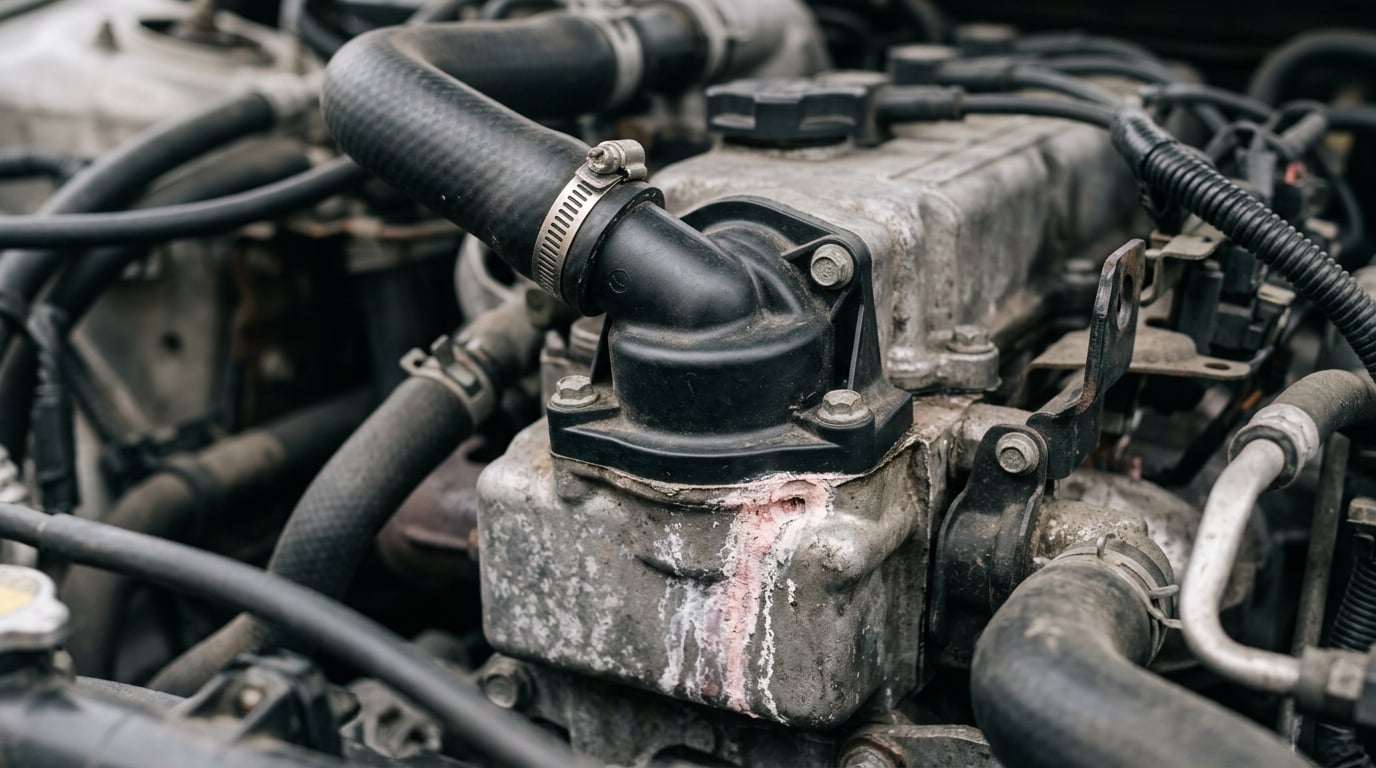
A thermostat housing leak is engine coolant escaping from the housing that bolts to the top of the engine and holds the thermostat and the upper radiator hose. It happens when the gasket, O-ring, plastic housing or bolt seal fails, and on a BMW the coolant shows it quickly as a crusty stain, a low reservoir, or a puddle under the car.
On most BMWs the thermostat housing sits at the front of the engine, right where the upper radiator hose comes off, tucked close to the engine block. It is also called the water inlet housing or the coolant crossover, depending on which engine you have. That last detail matters more than it sounds: on several engines the thermostat, the coolant temperature sensor and part of the intake side all live in or next to that one plastic casting.
Because the housing is a plastic part pressed against hot metal, the leak is usually not a hole. It is a seam that no longer seals. And on a BMW that seam matters twice, because many of these engines lose coolant slowly enough that you never catch it until the temperature needle starts climbing.
Table of Contents
- What Is a Thermostat Housing Leak?
- How Can You Tell If the Thermostat Housing Is Leaking?
- What Causes a Thermostat Housing Leak?
- Is a Thermostat Housing Leak an Emergency?
- How Do You Inspect a Thermostat Housing for a Leak?
- Can You Fix a Thermostat Housing Leak Yourself?
- What Happens If You Keep Driving With a Thermostat Housing Leak?
- Thermostat Housing Leak Repair: What to Expect
- Frequently Asked Questions
- Conclusion
What Is a Thermostat Housing Leak?
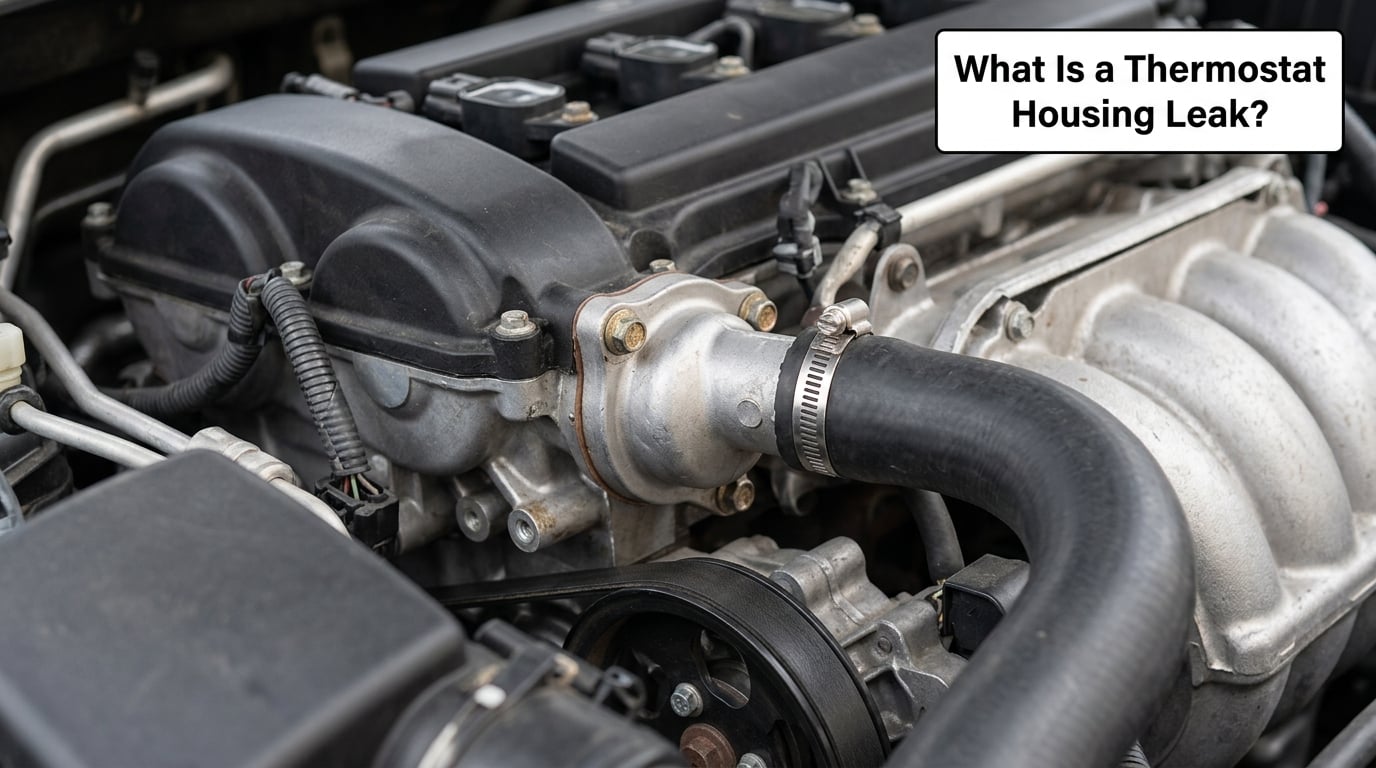
Short version: the thermostat housing is the plastic or aluminum block that seals the coolant passage at the top of the engine. The thermostat lives inside it, the upper radiator hose clamps onto it, and the coolant temperature sensor often screws into it. A leak is coolant escaping from any of those joints.
There are four ways that happens, and knowing which one you have decides how the repair goes. The gasket or O-ring that seals the thermostat to the housing fails. The housing itself cracks, usually in plastic that has gone brittle. A bolt loosens or was tightened too far. Or the housing was installed onto a damaged or dirty sealing surface on the engine, and it never had a chance.
A JustAnswer thread on a Dodge Avenger with a fresh coolant leak after alternator work names those same three mechanical causes: improper bolt torque, a missing gasket, and damaged sealing surfaces. That answer holds up on a BMW too. Under the hood, a seal fails and pressurized coolant weeps out of the seam instead of staying in the passage.
It is worth separating the housing from the thermostat, because people mix the two up constantly. A thermostat is the wax-valve puck that opens and closes coolant flow to regulate engine temperature. A stuck-open thermostat lets the engine run cold and can set a P0128 code, but it does not drip coolant on your driveway. A leaking housing is a seal problem. Bad thermostat, different repair.
Where the housing sits also varies across the BMW range. Inline six-cylinder engines usually have the housing high on the intake side where the upper hose attaches. Some four-cylinder engines tuck it at the side of the block behind the engine, which turns a simple seal swap into a long awkward reach. Check your model year and engine before you plan the job.
How Can You Tell If the Thermostat Housing Is Leaking?
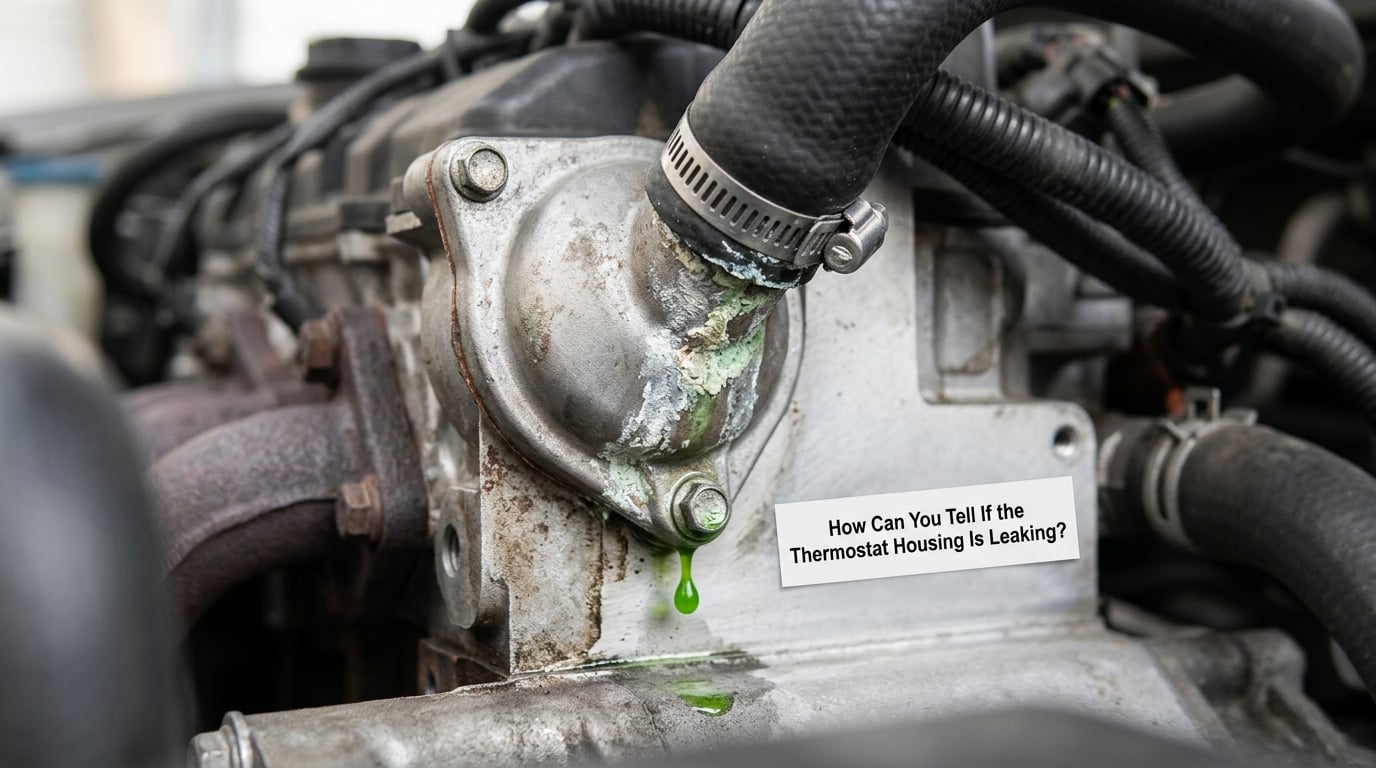
The clearest sign is coolant where coolant should not be: a damp patch or a dried crust on the housing, on the block below it, or pooled on a tray under the car. Beyond that, the warning signs stack up in a predictable order.
- Colored residue. A crusty green, blue, pink or orange stain on or under the housing, or a fan of dried coolant sprayed down the front of the block.
- Reservoir level dropping. The coolant tank sits between the MIN and MAX marks when the car is cold and level, then reads low after a drive or two.
- A puddle under the car. Small spot on the driveway that reappears after a drive is the version most owners notice first.
- Drips on a hot engine. A slow drip onto the exhaust or down the block, sometimes with a faint hiss when the engine is under load.
- Sweet smell in the cabin or at the front of the car. That is exactly the question our guide to a sweet smell in the car covers. Ethylene glycol vapor is the giveaway.
- Weak cabin heat. A hose that stays cool longer than it should, or a blower that pushes cold air at full temperature.
- Overheating or a warning light. A rising temperature gauge, a coolant temperature warning, or a check engine light with a stored cooling system code.
One behavior trips up almost everybody: the leak is usually invisible when the engine is cold and obvious once it is hot. System pressure rises with temperature, so a seep that beads up overnight may be a slow drip within twenty minutes of a drive. Owners on r/MechanicAdvice describe popping the hood the next morning, seeing nothing, and then finding a coolant splash the following evening. One cold inspection proves nothing.
That is also why leaks get mistaken for self-healing. Nothing has actually stopped. The seal still fails, it just fails harder when the system is pressurized and the plastic has expanded with heat.
A second trap: repeated top-ups. Owners who keep topping the reservoir up to keep the light off end up with coolant sprayed everywhere around the housing, which makes the true source much harder to see. If that sounds like your car, let the reservoir drain down, drive briefly to bring the system up to pressure, then look at the housing cold-but-warm. One clean look beats a month of guessing.
What Does a Thermostat Housing Leak Look Like?
Color and texture tell you what you are looking at before you take anything apart. Fresh coolant is a bright, syrupy liquid that leaves a glossy wet film. As it dries it turns chalky and crusty, and it flings outward in an arc that follows the pressure direction of the leak.
- Green, blue, pink or orange crust with a gritty texture: coolant. This is your leak.
- Clear or water-like droplets on cold metal: condensation from humid air, which is normal and harmless.
- Dark brown or black oily film, usually on the underside of a cover or the belly of the car: engine oil, and a different problem entirely.
- Milky or chalky sludge in the coolant reservoir: contamination from a failed gasket letting combustion gases into the cooling system, which means the head gasket is suspect.
- White or gray powder residue spreading from a crack: an old leak that has been evaporating for a long time, often a covered-up problem.
Location narrows it down further. A stain directly under the housing bolt pattern points at the housing-to-block seal. A stain centered on the hose clamp points at the hose seal or a cracked hose nipple. A trail running down the front of the block is usually the housing spraying outward and running down, not a separate leak at the bottom.
Follow the trail to its highest point. Coolant travels down and outward, so the origin of a long stain is the top of the damp area, not the bottom. A dried line that stops at a hose or a bolt is telling you where the pressure pushed the coolant out.
What Causes a Thermostat Housing Leak?
Most housing leaks come down to one of seven causes, and they are listed here roughly in order of how often they show up.
Aged gasket or failed O-ring
The rubber seal takes thousands of heat cycles and eventually stops springing back. It compresses, hardens, or splits. This is the most common cause on a high-mileage car and the cheapest to fix, because you replace a small cheap part and leave the housing in place.
Brittle or cracked plastic housing
Nylon and glass-filled plastic lose flexibility with age and heat. They also crack when they are clamped between a hot engine and a tight bolt pattern. A housing that looked fine at removal can crack on the way back in. This is the single most common complaint on r/RSX and r/AcuraTSX threads about recurring leaks after a replacement, and it applies to plenty of BMW four-cylinder engines with plastic housings.
Loose bolts or overtightened bolts
Under-tightened bolts let the joint weep. Over-tightened bolts do something worse: on plastic they cause the housing to distort or crack at the bolt hole, which produces a leak that shows up days later and looks like a bad part. Our piece on what happens when you overtighten a bolt goes into the mechanics. The short version is that plastic does not respond the way a steel head bolt does, and torque matters.
A dirty or damaged sealing surface
The flat face where the housing bolts to the engine has to be clean, flat and free of casting flash. Old gasket material, a burr, scale or a slightly warped surface will stop a brand-new housing from sealing at all. This is the answer to the most common question in the forums: why does it still leak after I replaced the housing, the gasket and the thermostat? Often the part was never the problem.
A missing or reused gasket
Skipping the gasket or reusing an old one that has been stretched and relaxed is a straightforward cause. Always install a new seal with a new housing.
Coolant contamination or debris
Sludge, rust particles or a piece of failed gasket circulating through the passage can hold the housing off its sealing face just enough to leak. Old coolant that has been mixed with the wrong fluid does the same thing. If the system is full of gunk, a flush belongs in the plan, not after the next failure.
Damage from an unrelated cooling job
After alternator, water pump, thermostat or ECT sensor service, a housing that was removed and reinstalled can start leaking immediately. The mechanic may have missed a gasket, over-torqued a bolt or nicked the sealing face. A new leak that appears days after service is a strong clue that something was disturbed rather than that the part aged out.
Is a Thermostat Housing Leak an Emergency?
It depends entirely on the rate. Slow seepage with a steady reservoir level and no temperature rise is a scheduling problem. Steady puddling, an empty reservoir, or a climbing temperature gauge is an emergency, and the correct answer in that case is to stop driving and arrange transport.
You can probably keep driving it when all of the following are true. The reservoir stays between the marks over several drives. The temperature gauge sits where it always has. The coolant is clear in the tank, with no sludge or oil. The puddle is a damp patch that dries up rather than a spreading pool. In that situation, top up, keep the car in reserve for trips, and get it repaired within the week.
Stop driving and get it transported when any one of these applies. The reservoir drops to empty or near empty on a single drive. The temperature needle climbs past its normal resting point, or a coolant temperature warning comes on. Coolant is disappearing faster than a top-up replaces it. There is foam, a strong sweet smell with visible steam, or white exhaust. Or the puddle under the car is large enough to be visible in a photo you took the next morning.
Owners on forum threads describe the point of no return as roughly a gallon of coolant over a year, with no overheating. The same owners describe a sudden hot leak that took them from fine to overheating in one drive. Both are real. The deciding variable is whether you are topping up because you are being careful or because you are chasing a runaway.
Two hard rules, whatever the severity. Never open the radiator cap, the reservoir cap or any cooling fitting while the system is hot. Pressurized coolant at operating temperature is genuinely dangerous, and it will burn you badly. And never drive a car that is overheating to see if it settles down. A warped cylinder head is a far worse day than a tow truck. If you want to understand the pressure side of the system, our radiator cap guide explains how the cap controls it.
How Do You Inspect a Thermostat Housing for a Leak?
Inspection is straightforward and mostly free, but the order matters. You are trying to catch the leak at the moment of maximum pressure, and the temptation is always to look too early.
- Let the engine cool completely. Cold metal hides a seep. A warm housing that has never reached operating temperature is almost as useless as a cold one. Start the inspection with the engine cold and finish it warm.
- Check the coolant reservoir cold. The level should sit between the marks on a level car. Note the reading, then re-check it after a drive. A drop that does not recover is a leak until proven otherwise.
- Read the owner’s manual for access. On several BMW engines the housing sits behind other components, and the removal order matters. The manual tells you what has to come off first, and skipping it is how people crack a plastic housing or lose a washer.
- Look at the housing and the hose joint. Fresh wetness, a glossy film, or a crusty edge where the housing meets the block. Check the hose clamp area too, since a hose that has slipped or hardened can weep right next to the housing and get blamed on the housing.
- Warm the engine to operating temperature and look again. This is the step people skip. Watch the joint while the engine idles and again under a load like a gentle drive around the block. A leak that shows up hot but not cold is a thermostat housing leak in the majority of cases.
- Check the rest of the cooling system while you are there. Pop the hood and look at the water pump area, the radiator and lower hose, the cap and the visible engine block. Finding a second problem on the same inspection is far cheaper than finding it after the repair.
If a slow leak will not show itself, a pressure test on the cooling system will find it. A shop fills the system with a dye or plain water and watches for the drip. Some drivers buy a cheap pressure tester for this. Either way, the pressure test also tells you whether the leak is at the housing or somewhere else entirely, which saves guessing.
For any BMW, the hard part is usually visibility, not diagnosis. Reach the housing, get good light onto the seam, and the leak is obvious. If you cannot see it, that is a reason to hand the car to a shop, not a reason to keep driving and hoping.
Can You Fix a Thermostat Housing Leak Yourself?
For many BMW engines, yes, and it is a satisfying job. Replacing a gasket or an O-ring is straightforward. Replacing the whole housing is the same job with one more part and more care around the old plastic.
The job itself: work only on a cold engine. Drain the coolant the way your manual describes, remove the upper radiator hose, unbolt the housing, lift it off the engine, and note how the thermostat, sensor and any gaskets are arranged. Fit the new seal or the new housing, clean the sealing face on the engine down to bare metal, and reinstall to the specified torque in a cross pattern. Refill with the coolant your manual specifies, then bleed the system properly.
Where it stops being a garage job: several things. The housing is buried behind the intake manifold or under a brace on your engine, and the access is measured in hours. The leak turned out to be at the head gasket rather than the housing, which is a very different repair. The system is full of sludge and needs a flush. The ECT sensor is integrated into the housing and the wiring is taped into the loom in a way you do not want to fight. Or you do not have a torque wrench and a way to bleed the system, because getting either wrong causes a second failure.
Torque is the thing people skip. The housing needs the specified torque in a pattern so the gasket compresses evenly, and on a plastic housing that means snug, not crushed. Torque specifications differ between BMW engines, so take the number from the manual for your model rather than from a forum post about a different car. If your engine has an aluminum housing, it is more forgiving about the sealing face but still needs clean metal.
Bleeding the system is the step owners get wrong, and the most common post-repair complaint across the BMW and enthusiast forums is overheating that continues until the system is bled repeatedly. Trapped air does not act like coolant. It blocks circulation, so the engine overheats and the gauge climbs, which convinces people the new housing is bad. It usually is not. Bleed the system as your manual describes, and do the bleed with the heater on full blast and the thermostat opening.
If you are taking it to a shop, ask for the written reason the housing failed, ask them to show you the old gasket if it was a seal, and ask whether the housing and the thermostat are being replaced together. On a high-mileage engine, replacing the thermostat while the housing is already off is cheap additional insurance. If the price quote has no parts and labor separated, ask for both.
What Happens If You Keep Driving With a Thermostat Housing Leak?
The leak itself is slow. The consequences are not linear. A small visible drip becomes serious as the system loses pressure, and the failure point arrives faster than most owners expect.
Coolant loss, then air. Once the level drops below what the system needs, the pump draws air into the coolant passages. Air does not carry heat the way coolant does, so the engine runs hot at the same time the reservoir shows no coolant. That combination confuses people because a low coolant light and a high temperature gauge feel contradictory.
Weak or no cabin heat. Air pockets block flow through the heater core. The blower still works, so it feels like a heater problem, but the temperature is wrong because the coolant that should be carrying heat is partly gone.
Overheating. The gauge climbs, then the warning comes on, then the engine goes into reduced-power mode. This is the stage where the daily driver stops being drivable.
Damage that turns a modest repair into an expensive one. Continued overheating warps the cylinder head, and a warped head can fail a head gasket, crack the head, or damage the catalytic converter sitting right next to it. The engine block is right there as well. The repair that started as a gasket swap becomes a head replacement or an engine, and that is the outcome worth avoiding.
Damage to the housing itself and its neighbors. A plastic housing that keeps dripping onto the exhaust manifold hardens and cracks further. A housing that has been topped up repeatedly can be impossible to clean well enough to seal. If the housing is dripping on the alternator, expect the alternator to go with it.
A false fix that costs you twice. If the leak was actually at the water pump weep hole behind or below the housing, replacing the housing does nothing and the car overheats again. On 7.3L Power Stroke and other diesels, owners on ford-trucks.com report exactly this. On BMWs the equivalent confusion is the water pump sitting behind the housing, and it is why a pressure test is worth doing before buying a housing.
Thermostat Housing Leak Repair: What to Expect
A thermostat housing leak repair is a short, well-defined job. What varies between cars is access, part price and how much of the cooling system needs flushing, and BMW configurations differ substantially across the range.
- Inspection and confirmation. A pressure test or a careful warm-up to prove the leak is at the housing and not at the water pump, radiator or head.
- Draining the coolant. Done cold, following the manual’s procedure, with a drain pan and a plan for disposal. On some engines a partial drain is enough to reach the housing.
- Removing the upper hose and housing. With access parts moved out of the way as your engine requires, and the thermostat and sensor noted for correct orientation.
- Replacing the failed part. New gasket or new housing with a new seal. The sealing face on the engine cleaned to clean metal, checked for flatness and cracks.
- Reinstalling to specification. Correct torque, cross pattern, new washers and O-rings where specified. A housing is not a bolt you snug down by feel.
- Refilling and bleeding. The coolant your manual specifies, bled until the gauge is steady and the heater runs hot, then rechecked for leaks hot and cold.
- Final verification. Level checked after a full warm-up cycle and a drive, and a scan for stored cooling system codes like P0128 or the P0117 and P0118 temperature sensor faults that mimic thermostat problems.
Two ownership notes. On a car with a history of top-ups and no flush, ask about flushing the cooling system at the same time, because a fresh gasket in a dirty system can fail again. And if the engine has a history of overheating already, have the head gasket checked before assuming a fresh housing will fix everything. A thermostat housing leak and a head gasket failure can look similar from the driver’s seat, and the second one is the reason to not keep driving.
On a time estimate, a straightforward gasket or housing swap on an accessible BMW engine is an afternoon project for someone comfortable with tools. The same repair on an engine where the housing is buried can take most of a day, and some configurations are a straightforward shop job.
Frequently Asked Questions
How serious is a thermostat housing leak?
Severity depends on the rate, not the size of the drip. If the reservoir stays between the marks over several drives, the temperature gauge is normal, and the coolant is clean, you can drive it briefly and schedule the repair. If the level drops fast, the gauge climbs, or the coolant foams, stop driving and arrange transport. A leak that runs out of coolant and overheats the engine can warp a cylinder head and turn a modest repair into a very expensive one.
Can I drive without a thermostat housing?
Not really, and you will not get the choice. The housing seals the coolant passage and holds the thermostat, so a missing housing means open coolant, no circulation, and an engine that will overheat or stall almost immediately. What people usually mean is whether they can drive with a leaking one. Occasionally, yes, if the level is stable and the temperature is normal. Any sign of falling coolant or climbing temperature means stop.
Will a leaking thermostat housing cause overheating?
Yes, and that is the main risk. The leak lets coolant escape, which drops the level until the pump draws air into the passages. Air does not transfer heat like coolant, so the engine runs hot while the reservoir still shows fluid, and the gauge climbs with it. A weak cabin heater on the same car is a related symptom, since air pockets block flow through the heater core.
Is it normal for a thermostat housing to leak coolant?
On an aging car, it is common rather than abnormal. The gasket or O-ring takes thousands of heat cycles and eventually stops sealing, plastic housings get brittle and crack, and bolts loosen or were over-tightened. A new leak appearing days after alternator, water pump or thermostat service points at a disturbed or damaged sealing surface rather than age. A brand-new housing that still leaks is usually a torque, cleanliness or flatness problem.
Will a bad thermostat cause my coolant to leak?
Not usually. A stuck-open or stuck-closed thermostat is a temperature regulation fault, and a stuck-open thermostat often sets a P0128 code while the engine runs cold. It does not drip coolant outside the engine. Coolant on the driveway comes from a seal, a crack or a hose. Checking the coolant temperature sensor first is worthwhile, because a failed sensor can mimic thermostat symptoms and is far cheaper to replace.
Why does my car keep overheating and leaking coolant?
If both happen together, treat it as more serious than a small hose weep. Running low on coolant lets air into the system, air blocks circulation, and blocked circulation causes the overheating. The other common combination is an internal leak, where combustion gases enter the cooling system, which shows as foaming in the reservoir, a sweet exhaust smell and sometimes white smoke. Do not keep topping up and driving. Let the engine cool and have it inspected before the head gasket becomes a problem.
Conclusion
Let the engine cool, check the reservoir level cold against the marks, and inspect the housing and the upper hose for fresh wetness or a dried crust. Look again once the engine is fully warm, because a thermostat housing leak is usually invisible until the system is under pressure.
If the level is stable and the temperature is normal, you have time to book the repair. If coolant is disappearing, the gauge is climbing, or a puddle is spreading under the car, stop driving and get the car transported. And never open a cap or a fitting on a hot cooling system.