
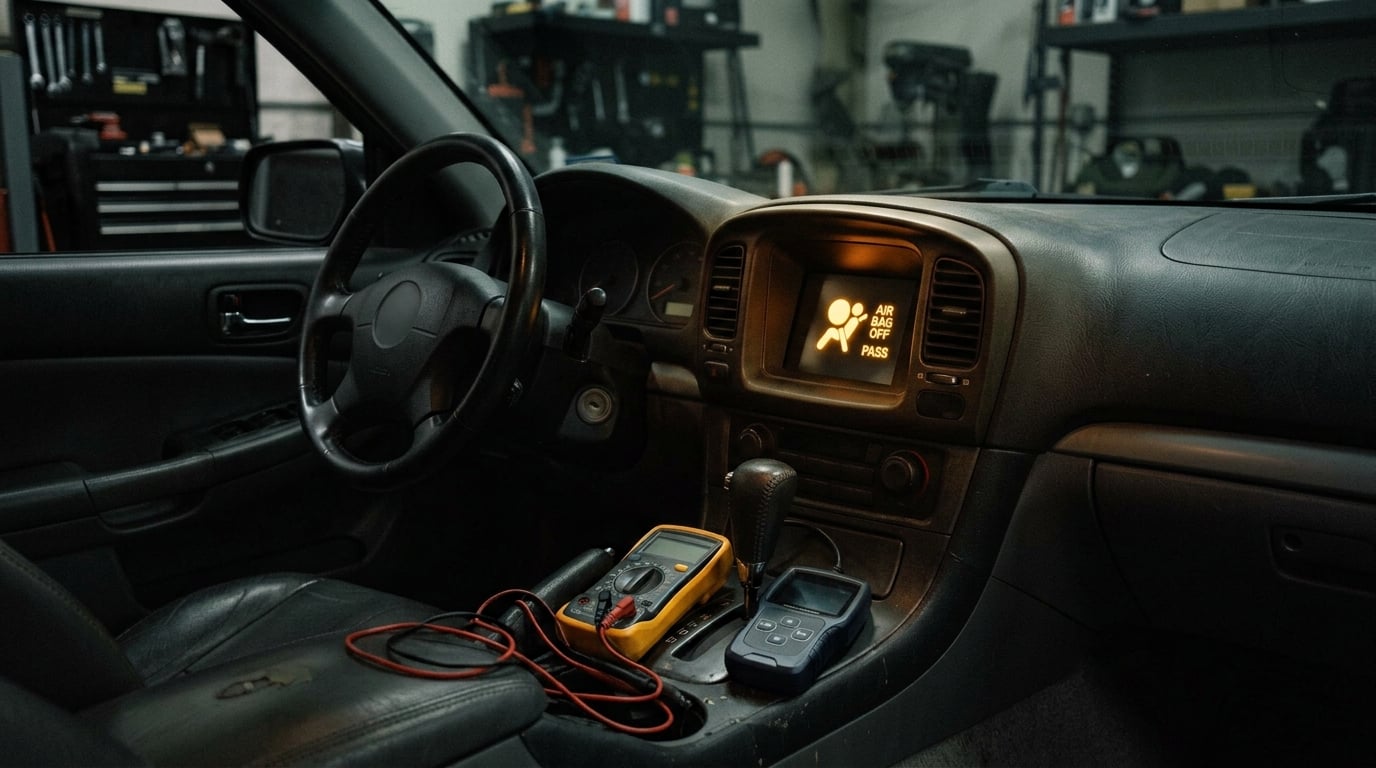
An airbag light that stays on means the Supplemental Restraint System (SRS) has found a fault, and the part of the system that raised it has usually been switched off as a precaution. Every time you start the car, the SRS control module runs a self-check: the warning appears for a few seconds and then goes out. If it stays lit, flashes, or comes on while you are driving, something in the sensors, wiring, or the module itself is not passing that check.
The uncomfortable part is that nothing else changes. The engine runs, the brakes feel normal, the check engine light stays off, and the car drives exactly as it did the day before. That silence is why so many people end up ignoring this warning for months.
Understanding what does an airbag light mean comes down to three things: telling a temporary warning from a real fault, knowing which components the light is talking about, and getting the stored code read before anyone starts replacing parts. This guide walks through each one. It was last checked for October 2026.
Table of Contents
- What Does an Airbag Light Mean?
- Is It Safe to Drive With the Airbag Light On?
- What Commonly Causes the Airbag Warning to Stay On?
- 1. Battery voltage or a disconnected battery
- 2. Seat belt buckle switch or pretensioner fault
- 3. Seat weight or passenger occupancy sensor
- 4. Clock spring in the steering wheel
- 5. Crash sensor or side impact sensor fault
- 6. Wiring, connectors, or a bad ground
- 7. Airbag control module fault
- 8. Aftermarket equipment
- 9. Prior deployment never fully restored
- How Can You Check an Airbag Light Safely?
- How Do You Fix an Airbag Light?
- What BMW Drivers Should Know About This Warning
- When Should You Stop Driving and Arrange Service?
- Frequently Asked Questions
- Does an airbag light mean the airbags are completely disabled?
- Can a dead car battery cause the airbag warning light to stay on?
- Is it safe to drive with the airbag light on?
- Should I clear the airbag code after replacing the battery?
- Can a seat belt buckle or passenger sensor trigger the warning?
- Do I need to replace the airbag module to fix the light?
- Conclusion
What Does an Airbag Light Mean?
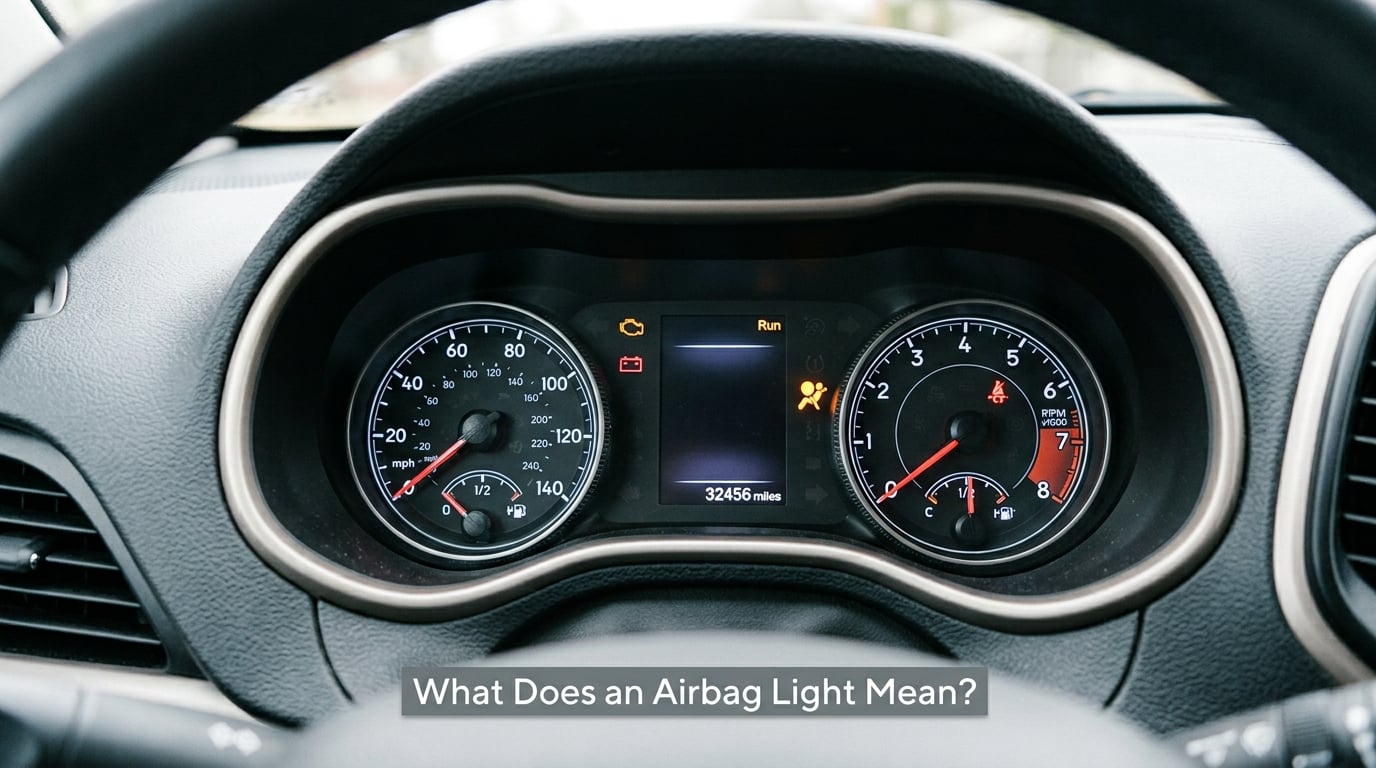
The short answer: the SRS module detected a fault and disabled the part of the restraint system that produced it. Depending on the car, that could be one airbag, the passenger airbag, the seat belt pretensioners, or the whole system.
Normal behavior versus warning behavior
Every car with SRS is designed to show you the light briefly, every single start. That is the bulb check, and it is the system confirming it can talk to the dash. It should be dark before the engine even catches.
Here is the difference that actually matters day to day:
| What you see | What it means | Action |
|---|---|---|
| Light comes on for 5 to 10 seconds at key-on, then goes out | Normal startup self-check | Nothing |
| Light stays on solid after startup | A stored fault the module has switched off | Read the code, then repair |
| Light flashes on and off while driving | Intermittent connection, poor ground, or a failing sensor | Read the code before it becomes solid |
| Light appears with a message like Airbag Fault or Service Airbag | The same fault, reported as text on some vehicles | Read the code, then repair |
| Passenger Airbag Off light stays on with a passenger seated | The occupant sensor is not detecting them | Check the seat, then the sensor |
| Light only shows in a dark garage or at night | Often a voltage drop or grounding problem that shows when the cluster backlighting loads the circuit | Test battery voltage and grounds |
Two things the light does not tell you. It does not say which part failed, because the module only knows that a circuit did not check out, not why. And it does not mean the car is about to deploy an airbag by mistake, which is the fear most people have and the least likely outcome.
Is It Safe to Drive With the Airbag Light On?
Yes, in the sense that the car will not suddenly become undrivable or lose its brakes. No, in the sense that you have quietly removed a layer of protection in a crash. Those are different claims and both are true.
What a solid warning usually costs you is the specific system named in the fault. If it is the passenger airbag, the driver airbag and the pretensioners may still work normally. If the module has lost communication with a whole circuit, more of the system may be off than the label suggests. That is one reason guessing is a bad idea.
| Situation | Real risk | Drive it? |
|---|---|---|
| Light on after a recent collision, even a minor one | Airbags are single-use and may have deployed part-way; pretensioners may be fired | Arrange service before relying on protection |
| Light on after battery replacement or a long layup | Often a stored code rather than damage | Fine to drive, fix it this week |
| Light on after seat, steering wheel, or dash work | Connector unplugged, wrong part fitted, or clock spring disturbed | Fine to drive, but verify the work |
| Flashing light on rough roads | A connector is working loose somewhere it moves | Fine short term, get it looked at |
| Light plus ABS, brake, or check engine warning | Shared wiring or module involvement | Do not drive it |
The honest version: you can keep driving to the shop. What you should not do is keep driving to work for another six months calling it a nuisance light.
What Commonly Causes the Airbag Warning to Stay On?
Causes run from five-minute fixes to the kind of job that eats a weekend. The list below is roughly ordered by how often each one shows up.
1. Battery voltage or a disconnected battery
The SRS module is extremely sensitive to voltage dips. A weak battery, a corroded terminal, or a battery disconnected for a service can set a fault and sometimes prevent the light from ever clearing afterward, even once voltage is restored. A cheap battery voltage test at the terminals is worth doing before anything else.
2. Seat belt buckle switch or pretensioner fault
The buckle has a switch in it that reports latched or unlatched, and some pretensioners carry their own monitoring. A buckle that was mashed, a seatbelt retensioned after being cut, or a connector pushed back on halfway can keep the light on.
3. Seat weight or passenger occupancy sensor
That sensor is how the car decides whether to arm the passenger airbag. On some vehicles the sensor is integrated into the seat cushion, which means the whole seat assembly gets replaced rather than a small part. A light that only appears with an empty front passenger seat, or only when someone heavy sits down, points straight here.
4. Clock spring in the steering wheel
The clock spring is a coiled ribbon that carries the connection between the steering wheel and the column, which lets the horn and steering wheel buttons work while still letting the driver airbag deploy. It is a wear item. On a car with a horn that works intermittently, or after any steering wheel or trim disassembly, it is a prime suspect.
5. Crash sensor or side impact sensor fault
These sit near the front rails and along the B-pillars. A hard knock from a kerb, a pothole, or a minor impact can trip one. Corroded side airbag connectors under the carpet near the seats are a well-known offender on older trucks and SUVs, where water and road salt get in.
6. Wiring, connectors, or a bad ground
Yellow connectors are the universal marker for SRS wiring, and they are there so nobody disconnects one by accident. A connector under a seat that gets crushed when the seat slides, chafed wiring at the seat hinge, or a ground point that has corroded can all raise this light without any part being physically broken. This is often the cheapest real fix, and it is the one most often misdiagnosed as a module failure.
7. Airbag control module fault
The module itself is the last thing to suspect, not the first. It is the component reporting the problem, and a workshop that quotes a full module replacement before reading the code is guessing. Modules do fail, including from water damage, but the code has to point at them.
8. Aftermarket equipment
Aftermarket alarms, remote start modules, stereo installs, and radar detectors routed near SRS wiring can introduce a fault or interfere with the circuit. On a car that recently got electronics installed and immediately threw the light, this belongs at the top of the list.
9. Prior deployment never fully restored
If the car has been in a crash that deployed an airbag and the system was never put back properly, the light stays on by design. Airbags, pretensioners, and sensors that have fired are single-use parts, and the car cannot know a replacement was fitted unless the system is reset with the right tool.
How Can You Check an Airbag Light Safely?
Work through this in order. The whole sequence takes about twenty minutes and it stops you paying for parts you do not need.
Step 1: Write down the pattern
Note whether the light is solid or flashing, whether it appears immediately at startup or after a few minutes of driving, and whether it is on every start or just sometimes. An intermittent light that only shows in the dark or only on rough roads tells a technician most of what he needs before he even turns a wrench.
Step 2: Read the owner’s manual page for the light
Your manual lists what that specific lamp means on your car and what the module does when it detects a fault. Some vehicles disable only one circuit, others disable everything. Ten minutes here sets the expectation for the repair.
Step 3: Look at the obvious things
Check that nothing is sitting on or pinning the seat belt buckle, that the passenger seat is fully latched into its rails, and that nobody left a tool or a charger cable under a seat. If the interior has been worked on recently, look at the yellow connectors under the seats and confirm they are fully seated and not bent.
Step 4: Test the battery and the grounds
Set a multimeter to about 12.6 volts with the engine off and check again with the engine running. A reading that sags far below normal, or a battery that is more than a few years old, makes the electrical side of this much more likely. Clean any terminal you find crusted.
Step 5: Get the code read
Most auto parts stores will read stored codes on your car at no charge, and many will print the SRS-specific code rather than the generic engine ones. The code is not a diagnosis on its own, but it tells you which circuit the module is unhappy about. Photograph it before anyone clears it.
What not to do
Do not probe, jumper, or test SRS wiring with a multimeter probe. Do not unplug yellow connectors to see what happens. Do not clear codes repeatedly and treat a light that stays off for a day as a repair. These airbags carry stored energy and can fire without a crash, and a cleared code destroys the evidence of what was actually wrong.
How Do You Fix an Airbag Light?
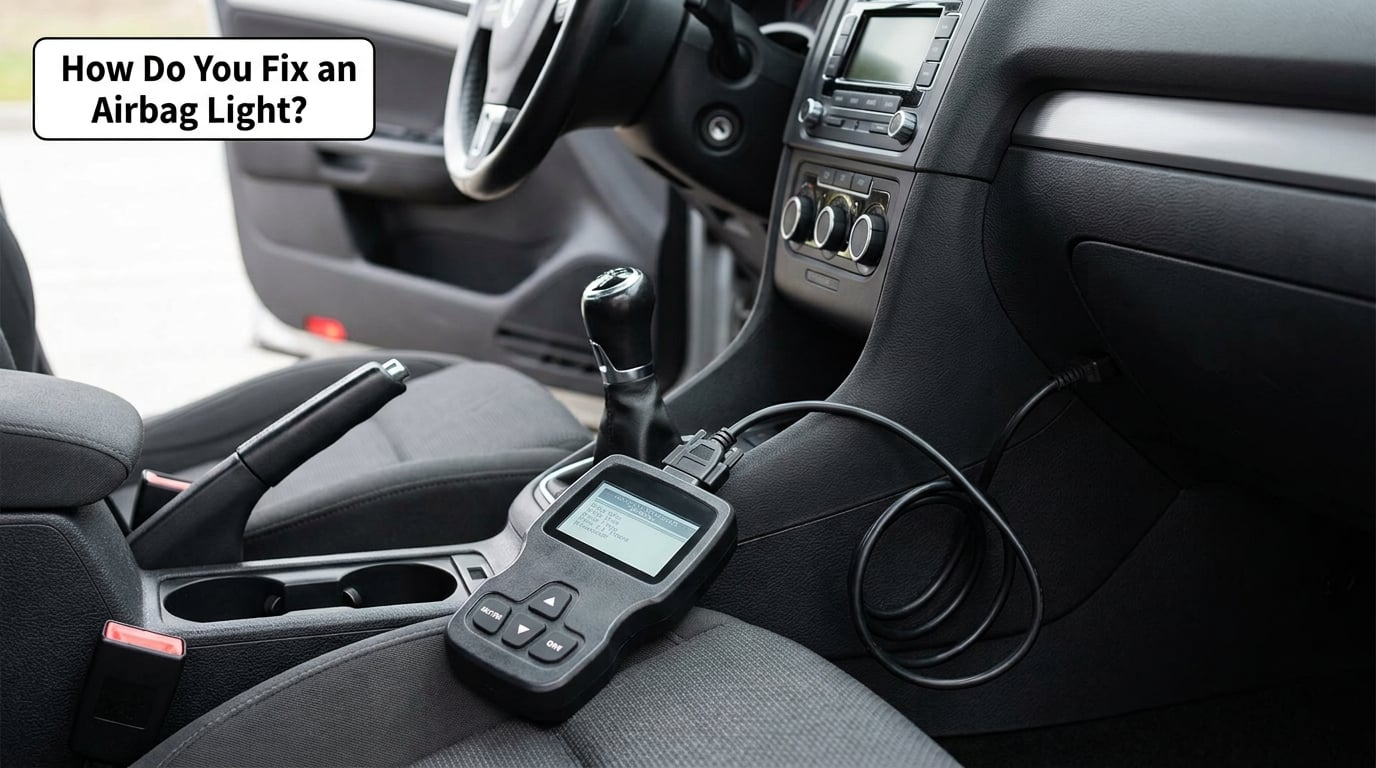
The stored fault code decides the repair, not the light. A module does not know a connector is corroded, it only knows a circuit failed, so the code narrows the search and a technician confirms the part.
Reconnecting a battery terminal or fully seating a loose buckle connector is the whole fix in the easy cases. Replacing a seat belt buckle or pretensioner is a contained job once the seat is out. A seat weight or occupancy sensor is usually a seat assembly replacement on vehicles that build it into the cushion. A clock spring means removing the steering wheel, and it is a repair worth having done properly rather than by anyone guessing with the wheel off.
Damaged harness wiring under a seat can often be repaired with a proper splice and the correct sealed connector, which is a fraction of the cost of replacing the run. Crash and side impact sensors are individually replaceable in most cases.
Control module replacement comes last. It also comes with a follow-up step most people do not know about: on a lot of cars, a replaced SRS module will not clear the light or deploy properly until the seat occupant and seat belt buckle sensors are re-zeroed with the manufacturer’s tool. Ask who is going to do that before you agree to the work.
If airbags actually deployed, the job is bigger than one part. Deployed airbags, pretensioners, and any sensors that fired are all replaced, and the module has to be reset afterward. That is a conversation to have with a shop that works on restraint systems, not a quick parts-store errand.
What BMW Drivers Should Know About This Warning
BMW cars package the SRS tightly, which means a single fault can knock out more protection than the light’s wording suggests. Seat belt buckle switches, occupant detection in the front seats, side sensors in the B-pillars, and the driver’s airbag with its clock spring are all monitored separately, and the module keeps a record of each one.
Two things catch owners out. First, the codes live in the restraint module rather than the engine computer, so a general code reader may show you nothing useful at all. A scan tool that can read BMW diagnostic information is worth the detour. Second, the manual states plainly that a system fault can stop the airbag from deploying, so a light that looks cosmetic on a car that drives beautifully is still the safety system reporting a problem.
If a BMW dealer or independent shop quotes a module replacement, ask to see the code that points at the module first. Follow the BMW service information for the specific vehicle rather than assuming the module is the failed part, because the number of restraint components that can raise a fault is high and most of them are far cheaper to replace.
When Should You Stop Driving and Arrange Service?
Book the car in, and stop driving it, when any of these are true.
- Any airbag or pretensioner has deployed. The system is telling you it fired and cannot tell you what state it is in.
- You were in a collision that pushed the front rails, cracked a pillar, or left wiring visibly damaged near a crash area.
- The light came with another restraint or safety warning, such as ABS, brake, or a stability control message, since shared wiring or a common module may be involved.
- The light is solid and the car has been driven that way for a long time. Some faults also stop the seat belt pretensioners, and pretensioners do most of the work in a hard stop at low speed.
- Someone recently worked on the seats, steering wheel, or dash and the light appeared afterward. A connector left partly connected or a wheel fitted without the original SRS part looks exactly like this.
- You are about to rely on the protection in a long or high-risk drive, especially a highway trip or one carrying passengers.
A used car is the other case. If the airbag light is on during a test drive, treat it as a negotiation point rather than a detail, and ask whether the codes can be read before you commit.
Frequently Asked Questions
Does an airbag light mean the airbags are completely disabled?
Not always. The SRS module switches off the circuit that reported the fault, which on many cars is one airbag or the pretensioners, while the rest stay armed. On other vehicles a communication loss takes the whole system down. The light’s wording is not precise enough to tell you which, so the stored code is the only reliable way to find out.
Can a dead car battery cause the airbag warning light to stay on?
Yes, and it is more common than most people expect. The restraint module monitors voltage closely, and a weak battery, a corroded terminal, or a long period disconnected can set a fault or stop the light from clearing even after the battery is replaced. Test the voltage at the terminals before paying for any other repair.
Is it safe to drive with the airbag light on?
You can drive to a shop. Brakes, steering, and the engine are unaffected, and the light is not a sign the airbag will fire by itself. But the part of the restraint system that raised the fault has been switched off, so in a crash you have less protection than you think you do. Treat it as a repair to schedule, not a light to ignore.
Should I clear the airbag code after replacing the battery?
Only after the battery and connections are sound, and only with the cause understood. Clearing a code does not fix anything; it just erases the evidence. On many cars the module will not clear an SRS fault at all until the voltage has been stable and the seat buckle and occupant sensors have been reset, so take the code and the reading to a shop.
Can a seat belt buckle or passenger sensor trigger the warning?
Yes, both of them. The buckle contains a switch that reports whether it is latched, and some retractors have their own monitoring. The passenger seat uses a weight or occupancy sensor to decide whether to arm that airbag, so a fault there can stop the passenger airbag or keep the Passenger Airbag Off indicator lit. On many vehicles the sensor is built into the seat cushion.
Do I need to replace the airbag module to fix the light?
Rarely as a first step. The module is usually the part reporting the fault rather than the part causing it, and codes regularly point at a corroded connector, a buckle switch, an occupancy sensor, or a clock spring instead. Ask for the code that identifies the module as the failed component before agreeing to replace it, and ask who will re-zero the seat sensors afterward.
Conclusion
Start by deciding whether the light is a brief startup check or a fault that stayed on. If it stayed on, write down the pattern, photograph the stored code before anyone clears it, and have the identified circuit repaired rather than the module guessed at. Until that is done, treat the restraint system as reduced and plan your driving around it.