
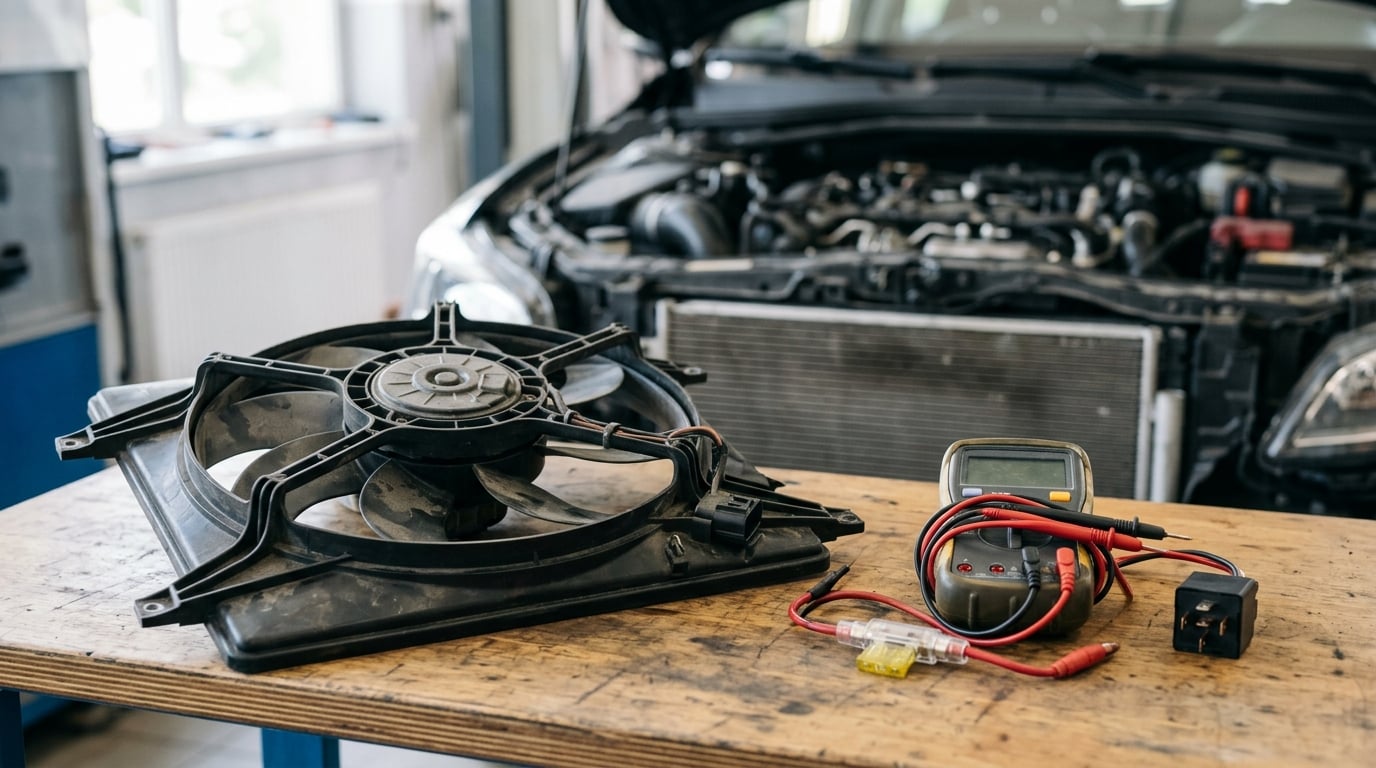
The pattern that usually gives it away: your car runs hot in stop-and-go traffic or at a stoplight, then the temperature gauge drops the moment you get on the highway. That points straight at the radiator fan, because at highway speed airflow through the radiator is high enough on its own. At idle it is not, so the fan is doing all the work.
Learning how to tell if a radiator fan is not working takes about an hour for the basic checks, and most of it is listening, looking, and probing two fuses. You can get through the whole sequence in a driveway with a multimeter and your owner’s manual.
One warning before anything else. If the needle is already in the red, stop the car in a safe place, switch the engine off, and let it cool. Diagnosis happens on a cold engine. Diagnosing a hot one is how people get burned.
Table of Contents
What You Need
Most of the diagnostic work is electrical, so the tool that matters most is a digital multimeter. A cheap one reads 12V DC well enough to tell you whether the fan connector is getting power, and continuity mode will check a fuse or a relay in seconds.
A test light is a useful backup. It is faster than a meter for confirming power at a fuse or relay socket, and on older vehicles it is all you need for the first few checks.
You also want your vehicle’s owner’s manual, mostly for two things. The first is the fuse and relay box layout, which is usually printed right on the inside of the box cover. The second is the cooling fan specifications, which tell you the fan speed or duty cycle you should see when the fan is running.
A wiring diagram for your year, model, and trim closes the gap. Without one you are guessing at which pin is power, which is ground, and which is the control signal, and that guessing is where a lot of afternoons disappear.
Basic hand tools round it out: a socket set for the connector and shroud fasteners, needle-nose pliers, a flashlight, and a phone to photograph connector pins before you back anything out. Connector pins are numbered, and it is much easier to remember pin 3 than pin 4 when everything is apart on a concrete driveway.
Some checks need the engine running and the ignition on, which means the fan can start without warning. Keep fingers, tools, loose clothing, and the multimeter leads clear of the fan shroud and blades. Never work with the engine hot, and if the vehicle sits under anything you would not want to fall on you, do the work somewhere level and open.
Know when to stop, too. A new driver should not be back-probing a connector in traffic. If the checks below point to something you do not understand, or you keep getting readings that make no sense, stop there and hand it to a qualified mechanic. Nothing about an overheating engine is worth a burn or a damaged wiring harness.
Step-by-Step
1. Listen for the Fan After the Engine Starts
Start with a cold engine and open the hood. Most cars run a fast idle for a few seconds after start, and the fan should kick in within that window. You are listening for a steady rush of air, not a squeal. A healthy electric fan sounds like a steady whoosh that comes and goes with engine temperature.
Some vehicles are quiet by design, so check the layout first. Belt-driven fans on older trucks spin whenever the engine runs, which tells you nothing. Electric fans on most modern cars are silent at idle until the coolant gets hot, then step up through one or more speeds.
Automatic climate control cars usually command the fan as soon as you press the air conditioning button, because the condenser needs airflow even when the engine is cold. So turn the air conditioning on at idle and listen. If you hear nothing from under the hood, you have your first real symptom.
Intermittent fans deserve attention. A fan that works on some days and not others often points to a connector that heats up and cools down, or wiring that moves against a bracket. A grinding or rasping sound that changes with engine speed usually means bearing wear instead of an electrical fault, and a fan that wobbles has bent blades that reduce airflow even while spinning.
2. Check for Overheating or Uneven Cooling
Symptoms tell you how urgently to move. The classic one is a temperature gauge that climbs in traffic and settles on the open road. Another is air conditioning that blows warm at a stoplight and turns cold once you are moving, because the fan never came on to cool the condenser.
Watch the needle, not the air conditioning. It can climb faster than you expect during a long climb with a stop at the top, and the gauge sitting higher than usual on the highway hints that the fan is not moving enough air even at speed.
Look for steam, coolant residue, or a sweet smell under the hood. A dry or crusty residue on the filler neck means a slow leak has been losing coolant, and coolant level affects how the temperature sensor behaves and how much heat the radiator can shed.
If the gauge enters the warning zone, pull over and shut the engine down. Do not open the radiator cap on a hot system; pressurised coolant releases as steam and will scald you. Let the car sit until things are cool enough to work on by hand, then start the checks.
3. Inspect the Fan Blades, Connector, and Wiring
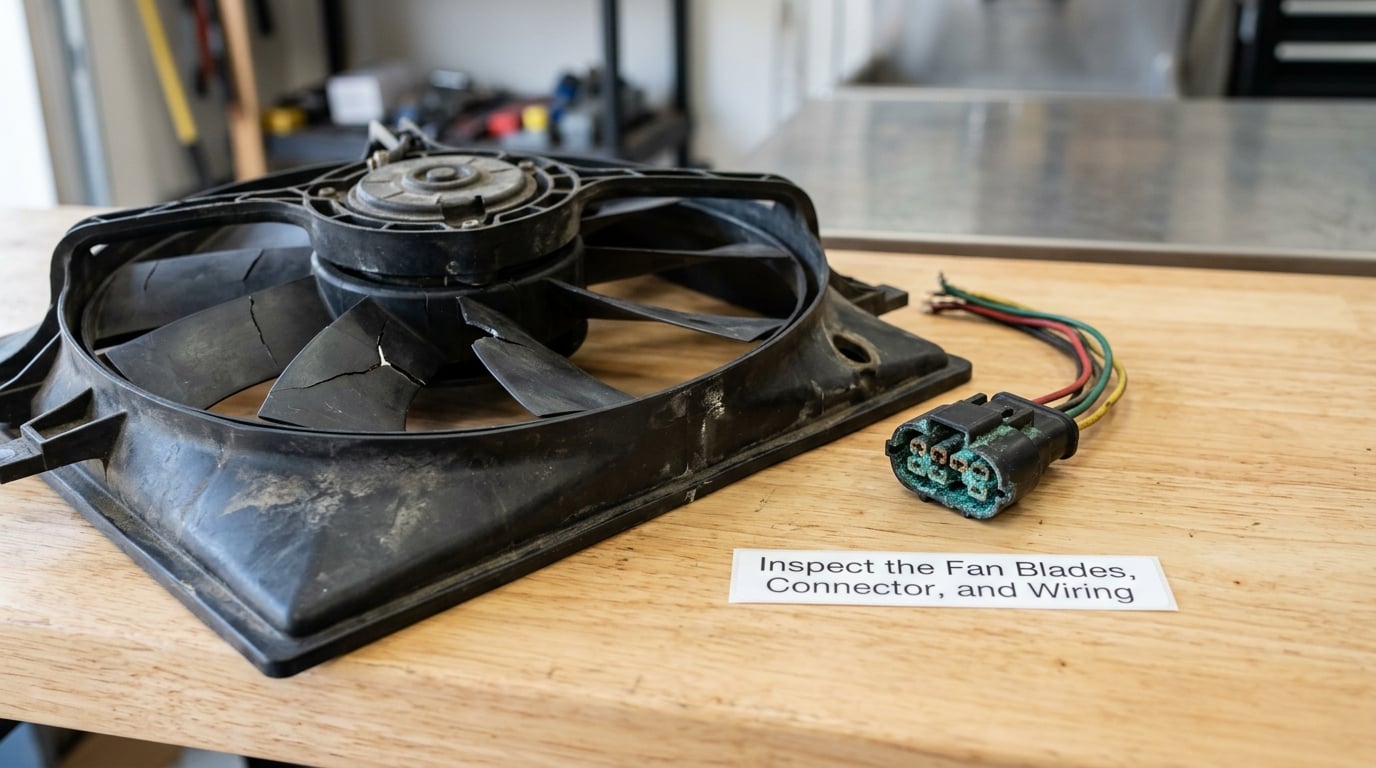
Get your eyes on the fan itself while the engine is off. Cracked, curled, or missing blades move less air even at full speed, and a blade touching the shroud will make a chirping or scraping noise that changes with rpm.
Debris matters too. Paper, leaves, plastic bags, and cottonwood fluff pack into the radiator fins and block airflow. If the fins look matted, that restriction alone can produce every symptom of a dead fan.
The connector is the most common failure point on a car of any age. Unplug it with the ignition off and look at it in good light. Green or white corrosion on the terminals, brown discoloration from heat, plastic that is soft, cracked, or has a smell like burnt toast all mean the connector has been working too hard.
Check whether it is fully seated. Many connectors have a secondary lock that snaps into the housing, and one that was never fully clicked will let moisture in. Follow the loom back toward the fuse box and the body, looking for frayed strands, a shiny scraped section where the harness rubs on a bracket, or a chewed section near the front of the bay.
4. Test the Radiator Fan Fuse and Relay
Find the cooling fan fuse using the diagram on the fuse box cover or in the owner’s manual. Many cars have two fan fuses, sometimes one for each motor on a dual-fan setup. Look for a blown element, a darkened or bubbled housing, or a fuse that tests open with your meter.
A multimeter is more reliable than your eye here. Set it to continuity, touch one probe to each side of the fuse with the fuse still in place; a good fuse beeps, a bad one reads open. If you pull the fuse to look at it, put it back in the exact same slot and orientation.
If the fuse keeps blowing after you replace it, you have a short somewhere in the circuit. Do not keep swapping fuses. Each one you install is another part of the wiring that melted for no reason, and the real problem is still waiting.
Relays are the cheap test that catches a lot of faults. Find the cooling fan relay in the underhood or interior relay box, pull it, and swap it with a relay of the same type that handles something you can live without, commonly the horn. Then turn the air conditioning on and see whether the fan runs. If it does, the fan relay was the fault and you just saved yourself from buying a motor.
You can also check a relay on the bench, and you should never jumper around one to force the fan to run. The relay is part of a control circuit that includes the engine control unit, and bridging it skips the protection built in.
5. Check Fan Command Signal and Power
Now you measure at the fan connector. With the engine cold and the ignition on, set the meter to DC volts and back-probe the connector pins. Work from the wiring diagram and identify three things: the constant or switched 12V supply, the ground, and the control line the engine control unit uses to command the fan.
Turn the air conditioning on and watch the voltage. If the fan should be running now and you have no supply voltage, the fault is upstream in the fuse, relay, or engine control unit. Power at the connector with the fan doing nothing means the problem is downstream, in the motor itself.
Here is what the readings mean in practice.
| Reading at the fan connector | What it usually means | Next action |
|---|---|---|
| About 12V when the fan should run | Power is reaching the fan, motor is dead or seized | Test the motor directly in step 6 |
| 0V when the fan should run | No command, or an open circuit upstream | Verify the fuse and relay, then follow the control circuit |
| Below about 10V, or voltage that sags when the fan runs | High resistance in the wiring, a corroded terminal, or a weak ground | Back-probe while running and measure the drop across each section |
| Good 12V on the low-speed wire only | High-speed circuit open | Check the second fuse, relay, or the high-speed winding in the motor |
Voltage drop is the step that finds faults a plain voltage check misses. With the fan running, measure between the power source and the connector pin. A healthy circuit shows very little difference. A volt or more across a stretch of wire means the wire or a terminal is corroded, and that is where the heat and melting connector came from.
On dual-speed and PWM fans the readings get less obvious. A PWM-controlled fan may show an average voltage well under 12V that pulses rapidly, and a meter with a frequency or duty-cycle function makes the pulsing easy to see. On a two-speed motor, one wire runs the low speed and a second wire runs the high speed, and one circuit can work while the other stays open.
6. Test the Fan Motor and Check the Cooling System
If power reaches the fan and nothing spins, test the motor directly only where the vehicle manufacturer allows it. On many cars the fan is fed straight from the fuse and relay, so you can disconnect the connector and feed the motor from a fused 12V source with the engine off, using the manual’s diagram as your reference. Some vehicles use a fan control module or a smart power distribution system, and on those the motor cannot be fed directly.
A motor that spins freely on direct power is fine, which means the fault is in the control circuit rather than the fan. A motor that hums, gets hot, or sits still has a seized or shorted winding and needs replacing. A multimeter in resistance mode across the motor leads adds detail: a very low reading points to shorted windings, and an open reading points to a broken winding.
Before you condemn the motor, rule out the rest of the cooling system, because symptoms overlap. Low coolant from a slow leak, a clogged radiator, or a stuck coolant-flow control can all leave you with an overheating car and a perfectly good fan. A coolant temperature sensor that reports cooler than reality keeps the engine control unit from commanding the fan on, and a thermostat stuck closed holds coolant back so it never gets hot enough at the sensor. While you are down there, it pays to know what a radiator cap does, since a failed cap is one of the cheapest faults on the whole list.
If the fan turns, spins fast, and the car still overheats, the fan was never the problem. Leave it to a mechanic at that point. Anything beyond this involves pressure testing the system, checking for combustion gases in the coolant, or running scan-tool data and air conditioning load tests that need equipment you probably do not have.
Common Mistakes
Jumping straight to the motor. A failed fan motor is one of the more expensive outcomes, and the cheapest faults are a corroded connector or a relay. Work down the list before you buy anything.
Replacing a fuse and moving on. A fuse that blows again is telling you there is a short. Find it, or you are buying fuses and burned wire for as long as you own the car.
Testing wires without the diagram. Back-probing the wrong pin gives you a number that means nothing. Confirm pin function and pin numbering before you trust a reading.
Ignoring airflow restrictions. A radiator packed with debris moves less air with a good fan than a clean one with a weak fan. Clean the fins before you condemn anything.
Treating a seized relay as a motor failure. If power sits at the connector and the motor is silent, the motor is the fault. If there is no power, the motor is not the fault. That one distinction saves the most money.
Continuing to drive an overheating engine. Stop when the needle enters the warning zone. Head gaskets fail and cylinders warp, and neither is worth the diagnostic time you would save.
Frequently Asked Questions
Can I still drive if my radiator fans are not working?
Only if the temperature stays flat. If the gauge climbs in traffic or sits higher than normal, pull over and shut the engine down before you continue. Airflow at road speed often keeps a healthy radiator ahead of trouble, so a short trip home may be fine, but the failure margin disappears the moment you sit in a queue with the air conditioning running. Tow it if the gauge moves.
How long can a car run without a radiator fan?
Minutes at a standstill, not hours. With no airflow through the radiator, coolant temperature climbs quickly at idle and the risk is a warped cylinder head or a failed head gasket. Many drivers get a warning from a shop before it becomes serious, and a car that cools fine on the highway can still overheat in a single long traffic jam.
What happens if only one radiator fan works?
On most dual-fan setups the engine control unit treats the pair as one circuit, so a single failed fan is usually enough to lose most of your high-speed airflow. You will notice the air conditioning struggling under load and the gauge climbing more slowly than before. Replacing just one motor on a pair that is the same age is a gamble, and many owners replace both at once.
What happens if a radiator fan relay is bad?
Usually nothing at all. An open relay never sends power to the fan and a shorted or seized relay never closes, so the fan stays silent until temperature climbs. It is the cheapest fault on the list to find and often the cheapest to fix, which is exactly why you should test it before the motor. Swapping in a relay of the same type takes under a minute.
Why is my radiator fan not turning on when I turn the air conditioning on?
On most modern cars the air conditioning button is supposed to command the fan immediately, because the condenser needs airflow. If the fan stays quiet, the fault sits upstream of the motor: a blown fuse, a bad relay, a melted connector, or an engine control unit not seeing the request. That request makes the air conditioning test a fast way to separate a dead motor from a dead circuit.
Start at step 1 and work down in order, because the sequence goes from free observations to the most expensive part on the list. Listen, look, test the fuse and relay, then measure at the connector. Power at the connector with a silent fan points to the motor; no power points upstream of it. Whatever you find, do not open a hot cooling system, and stop driving the moment the gauge climbs.
The same rule applies to the rest of the car. Every quick check you can do yourself in ten minutes saves guessing later, whether you are working on cooling or on something like how to tell if brake fluid is contaminated.