
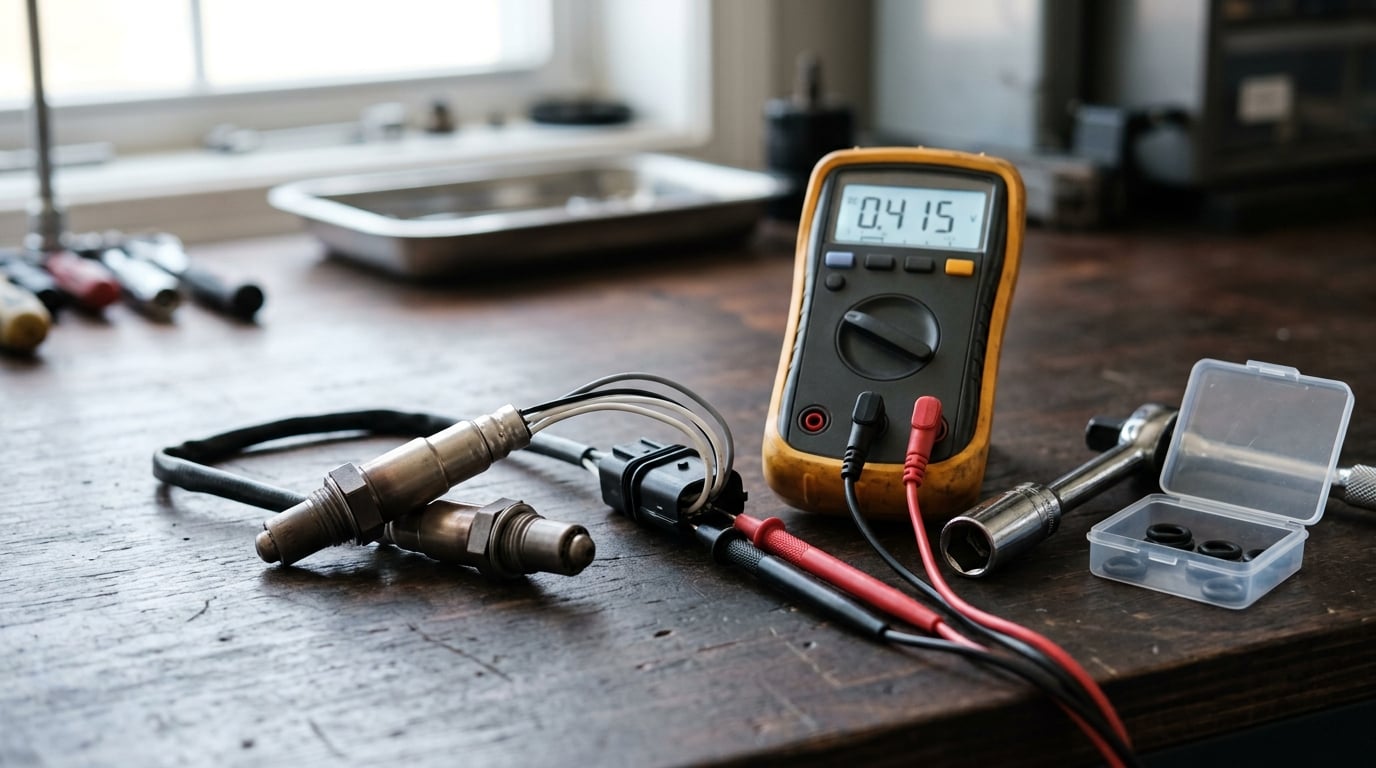
A bad oxygen sensor usually costs you 10 to 30 percent of your fuel economy. The sensor reports how much oxygen is passing through the exhaust, and when that reading goes stale the engine control unit falls back on a fuel-heavy baseline to protect itself. You end up burning noticeably more gasoline than the same car used before the fault appeared.
Here’s the part most guides leave out: many failing sensors never set a code and never light the check engine light. The engine just runs a little rich, the trip computer reads low, and you notice it because you stopped getting the range you used to get. On BMWs, where the engine runs lean in closed loop and the turbo has little tolerance for a wrong mixture, that loss tends to show up sooner and harder than it does on an older naturally aspirated car.
Below is what actually happens mechanically, the symptoms that are genuinely diagnostic, and how to test a sensor before you pay for one.
Table of Contents
- How a Bad Oxygen Sensor Affects Gas Mileage
- How the Engine Uses Oxygen Sensor Data
- Bad Oxygen Sensor Symptoms to Watch For
- Why Replacing the Sensor May Not Improve Mileage
- How to Test an Oxygen Sensor Before Buying One
- How to Replace a Bad Oxygen Sensor
- BMW Oxygen Sensor Tips and Common Mistakes
- Frequently Asked Questions
- What to Do First
How a Bad Oxygen Sensor Affects Gas Mileage
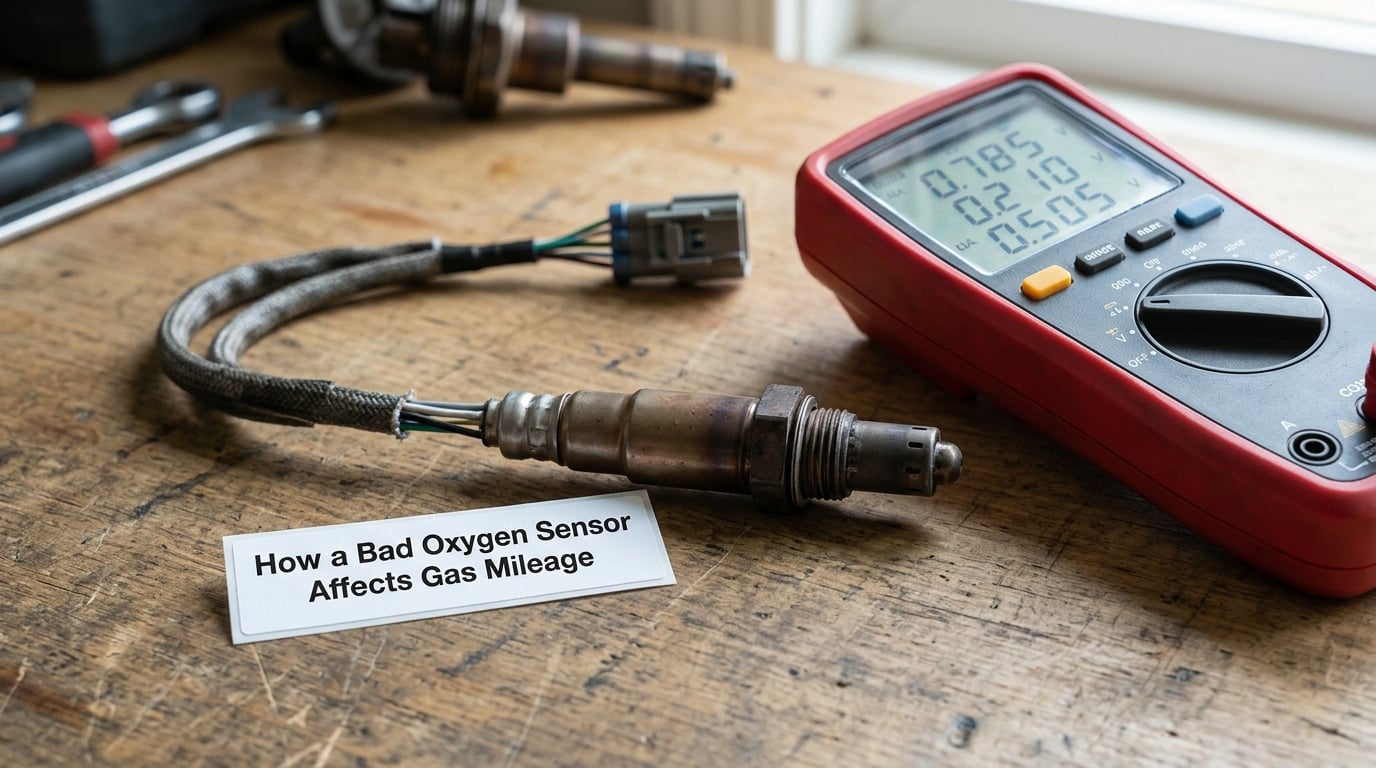
The direct answer: a faulty sensor starves the ECU of accurate mixture data, so the ECU leans on a conservative baseline rather than a real-time reading, and the engine runs richer than the design intent. More fuel goes in for the same amount of combustion, and that difference shows up directly at the pump.
Which sensor fails changes how much you lose. The upstream, or pre-catalyst, sensor is the one the ECU uses for closed-loop control, so its failure costs you real fuel economy. The downstream, or post-catalyst, sensor mainly measures how well the catalytic converter is cleaning the exhaust, and its failure usually triggers a code without a noticeable economy drop. That’s the single most common misdiagnosis in the BMW forums: someone replaces the post-cat sensor, the code comes back, and the real fault was upstream all along.
| Failure type | What the ECU does | Expected MPG effect |
|---|---|---|
| Upstream sensor slow or lazy | Corrections get mushier, mixture drifts slightly rich | Small loss, often 3 to 10 percent, usually no code |
| Upstream sensor dead or stuck | Open or frozen signal, falls back to baseline fueling | 10 to 30 percent loss, usually a P0130-series or lean code |
| Upstream heater circuit open | Cold sensor stays sluggish, slow to enter closed loop | Mixed driving loses more, steady highway loses little |
| Downstream sensor failed | Converter efficiency treated as unknown, fuel control largely intact | Usually none, sometimes slight under boost on older setups |
| Lean condition with a working sensor | Correctly adds fuel to compensate for a real leak | Loss scales with how much air is sneaking in |
The second consequence is heat. Running rich for a long stretch sends unburned fuel into the catalytic converter, and that fuel ignites inside it. The converter is designed to work at a specific temperature, not as a combustion chamber, and enough of this abuse cooks the ceramic substrate and melts the washcoat. A converter is one of the most expensive parts on the car, so if your car has been running rich for months, that is a real risk, not a theoretical one.
What Does a Bad Oxygen Sensor Do to Gas Mileage in Practice?
On the road you notice it in stages. First is the trip computer: a number you know by heart that quietly moves down by a few percent over a few weeks. Then the idle gets slightly restless at a stop light, hunting a little instead of sitting still. Then acceleration from a stop feels softer, like the engine is thinking about something before it answers.
An owner on r/MechanicAdvice described a healthy baseline of about 25 MPG on their car, with the number moving between roughly 24 and 26 MPG across fill-ups depending on weather and driving. That drift is normal, and it is worth knowing what normal looks like before you decide something is broken. When a sensor starts to fail, the trend stops being noise and becomes a slow slide in one direction.
There are owner reports on the other end of the scale too. A 2007 Honda Odyssey owner saw fuel economy jump from about 10 MPG to about 25 MPG after a battery disconnect cleared the ECU’s long-term fuel maps, which suggests the air/fuel adaptation had been fighting something and had settled on a bad set of values. Another owner replaced several sensors and a mass airflow sensor at once and went from 14 MPG highway to better than 20 MPG, though with that many parts changed nobody can say which one did the work.
Those two cases are the honest picture of this fault. It is easy to fix when the sensor really is the problem, and frustrating when it is only one of several things holding the mixture off target.
How the Engine Uses Oxygen Sensor Data
An oxygen sensor measures the oxygen content of exhaust gas so the engine control unit can adjust the air/fuel mixture and keep it at the ideal ratio. That ideal is called stoichiometric, and for gasoline it is about 14.7 parts air to one part fuel by mass.
The sensor is a galvanic cell. It compares the oxygen in the exhaust to the oxygen in the air outside it and generates a voltage from the difference. Lean exhaust with extra oxygen pushes the reading high, rich exhaust starves the cell and the reading drops. A healthy narrowband sensor sits somewhere between 0.1 and 0.9 volts and swings between those points many times per second at idle.
The ECU watches that voltage and its job is to hunt. Too lean means more fuel, too rich means less, and it makes the correction continuously rather than in one lump. That hunting is the switching waveform you see on a scan tool or a meter, and on a healthy car it should look like a fast, dense oscillation around the midpoint rather than a slow drift or a flat line.
Upstream sensors have a built-in heater for a reason. They reach operating temperature far faster than a cold sensor ever could, which means the engine spends less time in open-loop mode with its pre-programmed fueling guesses and gets back to real feedback sooner. That is why an open heater circuit on a cold morning hurts mixed driving far more than a steady highway cruise.
The downstream sensor sits behind the catalytic converter. It sees nearly no oxygen once the converter is working, because the converter is removing the oxygen and hydrocarbons. Its reading staying low and steady is how the ECU confirms the converter is doing its job, which is a diagnostic signal rather than a fuel control signal.
Everything the ECU does with this data shows up in fuel trim, and this is where a diagnosis becomes concrete. Short-term trim is the immediate correction, changing with every bit of sensor input. Long-term trim is what the ECU learned from driving and uses as its starting point. Healthy long-term trims sit within about 10 percent of zero.
| Reading | Short-term trim | Long-term trim | What it points to |
|---|---|---|---|
| Normal | Minus 10 to plus 10 percent | Minus 10 to plus 10 percent | Mixture control is working, look elsewhere for an economy loss |
| Suspect, sensor side | Large swings, often beyond plus 25 percent | Slowly walking to a limit | Slow upstream sensor or a wiring fault feeding it |
| Lean condition | Stuck high positive, both banks | Positive and climbing | Vacuum leak, exhaust leak before the sensor, low fuel pressure |
| Rich condition | Stuck low negative, both banks | Negative and climbing | Rich injector, air leak after the MAF, fuel pressure too high |
| One bank different from the other | Bank 1 and Bank 2 trims split | Bank 1 and Bank 2 diverge | Check the opposite bank’s sensor, exhaust or injector first |
Bad Oxygen Sensor Symptoms to Watch For
The trouble with this fault is that most of its symptoms have other causes. Here are the ones worth taking seriously, roughly in the order they tend to show up.
- A sudden drop in fuel economy with no change in driving. The clearest signal, especially if the drop is gradual rather than instant. This is the one that sends people looking for the sensor in the first place.
- Check engine light with a stored or pending code. Common ones are P0130 through P0135 for sensor circuit, heater, or performance faults, and P0171 or P0172 for a fuel trim that ran too lean or too rich.
- Rough or hunting idle with no lamp on. This is the lazy sensor case. The corrections are too slow to hold the mixture steady, so the idle wanders, and nothing dramatic enough happens to set a code.
- Hesitation or misfire-like behavior off idle. On a turbocharged BMW the symptom shows up harder, since a mixture problem takes real boost away from you and the car feels like it is bailing out of the pedal.
- A sulfur or rotten egg smell from the tailpipe. Unburned fuel reaching the exhaust, which is the same rich mixture causing the fuel economy loss.
- Failed emissions inspection. Post-cat sensor failures and uncorrected fuel trims are the usual reason a car that runs fine fails the test.
- Fuel trims pinned at a limit. The most reliable sign, and only visible on a scan tool. A long-term trim sitting at plus 25 or minus 25 percent while the other bank reads normal is pointing straight at one side of the exhaust.
Now the confusion. A contaminated sensor tip reads like a lazy sensor but is a different problem, and oil or coolant that reaches the tip will do it. Dark metal particles in your oil are worth a look on their own, and we covered what they mean in what metal in engine oil means. Separately, an exhaust leak between the engine and the upstream sensor sends the sensor fresh air, so it reports lean when the mixture is actually fine, and a vacuum leak does the same thing on the intake side.
A strong gas smell at startup is usually not the sensor either. If that is your main symptom, start with why a car smells like gas after starting, because a rich running condition and an actual fuel leak feel and sound different under different conditions.
Why Replacing the Sensor May Not Improve Mileage
Replacing a sensor is the most common recommendation in these threads and the most commonly wasted part. Before you buy one, work through the reasons a new sensor would not change your fuel economy.
- The tip is contaminated. Oil, coolant, or exhaust gasket material coating the sensing element slows it down. A new sensor fixes that, but only if contamination was the cause.
- The harness or connector is damaged. A broken wire inside the loom, corroded pins, or a connector not fully seated reads exactly like a bad sensor. The pigtail is part of the sensor on many cars, so replacing it can fix a wiring problem as a side effect.
- There is an exhaust leak ahead of the sensor. Fresh air bypasses the exhaust and fools the sensor into adding fuel that is not needed.
- There is an intake or vacuum leak. Unmetered air after the mass airflow sensor makes the mixture genuinely lean, and the oxygen sensor is correctly reporting a real problem.
- Injectors are leaking or worn. A leaking injector never fully closes, and a lean-to-rich swing shows up as a trims problem plus an economy loss that no sensor change will fix.
- The ignition is weak. A misfiring cylinder wastes fuel on its own and can dirty a sensor tip fast enough to make it look like the root cause.
- Adaptations have to be relearned. Long-term trims learned while the fault was present have to be cleared, or the engine may keep running the old fuel map for a while.
The order in that list is deliberate. The cheap checks come before the expensive ones on purpose, and most of them cost nothing but a scan tool and an afternoon.
How to Test an Oxygen Sensor Before Buying One
You can confirm or rule out an oxygen sensor without removing anything, if you have a scan tool that reads live data and a multimeter. Run the checks in this order and stop as soon as one of them explains the fault.
- Scan for stored and pending codes. Pending codes matter here, since a sensor that is degrading often sets a pending code before it sets a stored one. That pending code is usually the cheapest evidence you will ever get.
- Read live data for Bank 1 Sensor 1 voltage. Warm the engine fully first, then let it idle. A healthy narrowband sensor should switch between roughly 0.1 and 0.9 volts several times per second, with a rising edge signal about once per second.
- Compare against the scan tool spec. Some tools give a switching frequency and a live voltage. If the signal crawls up slowly or sits pinned near 0.8 volts, the sensor is not tracking the mixture.
- Watch the short-term and long-term trims. If the trims look healthy and the voltage waveform looks healthy, the sensor is doing its job and the economy loss is coming from somewhere else.
- Backprobe the connector with a meter if the live readings look odd. A sensor that tests fine out of the socket has a wiring problem, not a sensor problem. Our basic tools needed for basic car maintenance list covers what a scan tool and a meter need to be.
- Inspect the connector, the harness, and the exhaust around the sensor. Look for green corrosion on the pins, a connector that does not latch, heat-damaged insulation near the manifold, and rust or a broken gasket at the sensor bung.
- Run leak tests last if trims are stuck lean. Smoke test the intake tract, check the exhaust ahead of the sensor, and do an injector leakdown test. Those three checks explain a lot of lean codes that get misdiagnosed as sensors.
On a diesel, the rules change. There is no narrowband switching sensor in the same sense; you will be looking at a wideband sensor with a current reading in milliamps, where the fuel controller is commanding a specific value. If you are chasing a diesel misfire or a regeneration problem, interpretation gets technical fast and a scan tool with live graphing is worth more than any generic advice.
How to Replace a Bad Oxygen Sensor
Replacing one is a straightforward job on most BMW engines, mostly because you can reach the sensor from underneath without pulling the intake apart. The risk is not mechanical skill, it is heat and coolant.
- Let the engine cool completely. Many BMW engines route coolant through a crossover pipe very close to the upstream sensor bung. Working on a hot crossover is how people crack a cylinder head.
- Confirm the correct bank and position. Bank 1 is the side with cylinder one. Sensor 1 is upstream of the converter, sensor 2 is downstream. On V engines, bank 2 sensors are often reached from inside the engine bay rather than below.
- Use a 22 mm oxygen sensor socket and a breaker bar if it is tight. A sensor seized in the bung will usually break or round off instead of coming out, and a replacement bung is a separate job.
- Plug in the new connector before you unbolt anything where access allows, so you do not have to work the harness blind behind the exhaust.
- Handle the new sensor by its connector and body, never the thread. The thread and the tip are easy to damage and the tip is the part doing the measuring.
- Install it with the sealant specified by the service manual, not an assumption about how many threads to engage. Torque matters too, because overtightening cracks the bung.
- Clear the adaptive memory with your scan tool, including long-term trims, then road test and re-read the trims.
If a code comes back within a few miles, or the trims return to the same pattern, the sensor was not the fault. That is normal and it is not a failed repair, so go back to the list of other causes rather than ordering a second sensor.
BMW Oxygen Sensor Tips and Common Mistakes
BMW engines add a few specific traps that are worth knowing before you start.
Bank and position identification matters more here. A V8 or V6 has four sensors and the wrong one costs you a part and an afternoon. Bank 1 is where cylinder one lives, and on most modern N-c engines that is the driver’s side. Sensor 1 sits ahead of the converter, sensor 2 behind it. Read the wiring diagram rather than trusting which bolt looks accessible.
A connector that is not fully seated reads as a cooling failure. This is the most common mistake on these cars. The internal contacts can back out slightly while the latch clicks, which makes the heater element look dead and sets a heater circuit code. Always hear or feel the click, and never force a connector home with pliers.
Protect the harness. The loom near the manifold and the heat shields gets brittle, and on older cars it often fails right where the engine is hottest. If you are in there, support the harness and check it while you can see it, because a new sensor with an old broken wire still gives you a dead sensor.
Sensor specifications changed over the years. On many older BMWs the part number and connector changed mid-production, so a sensor that fits the physical bung may not plug in or may have a different pinout. Match by the part number on your vehicle, not by thread size.
Clear and code through the DME where required. On models with a digital motor electronics unit that manages emissions adaptations, the unit has to see the repair. A scan tool that can clear codes and adaptive values is not optional for finishing the job properly.
Do not chase a downstream sensor for a fuel economy complaint. This is the expensive mistake. If fuel economy is the symptom, verify the upstream sensor’s live data and the fuel trims first.
Frequently Asked Questions
Can a bad oxygen sensor make an engine run rough?
Yes. A slow upstream sensor cannot track the mixture fast enough, so short-term fuel trim overshoots and undershoots and the idle hunts or surges. On a turbocharged BMW the same fault shows up as hesitation or reduced boost response off the line. The distinguishing detail is that the roughness is tied to a lean or rich correction rather than to load, and a scan tool will usually show large, fast short-term trim swings alongside the rough running.
Can I clean an oxygen sensor instead of replacing it?
Sometimes, and only when the tip is dirty from a leak or the wrong sealant. A dedicated oxygen sensor cleaner, a low-abrasive green pad, and a light scrub can restore a mildly slow sensor, and plenty of owners report good results that way. It will not fix a damaged element, a broken heater circuit, or a sensor contaminated with oil or coolant. If the live voltage still will not switch at idle after cleaning, the sensor has served its time.
How many oxygen sensors does a car have?
Most gasoline cars have two: an upstream sensor before the catalytic converter that controls fuel delivery, and a downstream sensor after it that monitors converter efficiency. Four-cylinder engines usually have two. Inline six and V8 engines typically have two per bank, so four in total. Diesels often add a wideband sensor in the exhaust plus one behind the diesel particulate filter. Some older or turbocharged designs add an extra pre-catalyst sensor upstream of the turbo.
Can a bad oxygen sensor damage the catalytic converter?
It can, and this is the expensive outcome to watch for. A sensor stuck reporting rich or a failure that pushes the ECU to add fuel sends unburned gasoline into the converter, where it ignites instead of being burned in the cylinder. The converter is not built for combustion, so sustained abuse melts the washcoat and eventually the ceramic substrate. The risk is highest when a lean or rich code has been present and ignored for many thousands of miles.
Is a universal oxygen sensor safe to use?
It works on many vehicles, but it is not a default choice. Universal sensors have no application-specific calibration, so they are slower to heat and less accurate than the factory part, which can cost you fuel economy and even fail an emissions test. They also frequently need a new connector and wires spliced in, and a bad connection in that area causes the exact fault you were trying to fix. Use one when the correct part is discontinued or unavailable, not as a first attempt.
What to Do First
Start with a scan, not a part. Read your stored and pending codes, then look at live Bank 1 Sensor 1 voltage and your long-term fuel trims before anyone orders anything. Those two pieces of data tell you in a few minutes whether a bad oxygen sensor is really what is costing you the miles, or whether the sensor is simply the most obvious suspect on a longer list.