
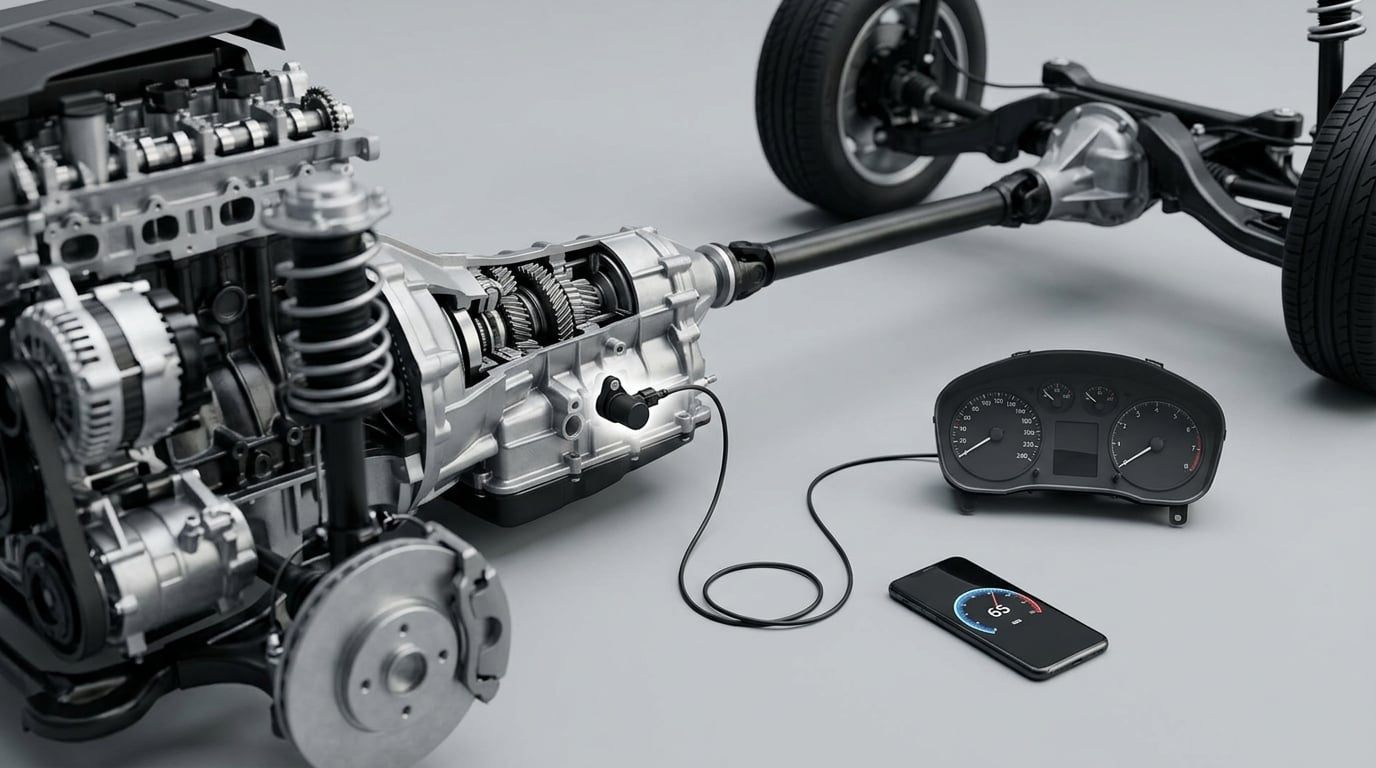
Why is my speedometer not working? Usually one of three things: the vehicle speed sensor (VSS) on the transmission has died, the wiring or connector carrying that signal is open or corroded, or the instrument cluster itself has given up. On older cars with a cable-driven gauge, a broken or seized speedometer cable is the suspect instead.
That short list is where most people start, and it is also where they go wrong, because they start buying parts instead of narrowing the fault. A cluster is an expensive last resort, while the sensor and the wire feeding it are cheap. Get the order right and you can usually find the problem in an afternoon with a multimeter and a scan tool.
What makes this odd is how quiet a dead speedometer can be. No check engine light, no stored code, no drama. One Car Talk user with a 1998 Acura had a vehicle speed sensor fail with nothing but a dead speedometer, odometer and cruise control, and no codes at all. So let’s walk the diagnosis in the order that saves parts, starting with the question the gauge is actually asking.
Table of Contents
- How Does a Car Speedometer Work?
- Why Is My Speedometer Not Working? Common Causes
- What Symptoms Appear Before the Needle or Display Stops?
- How to Diagnose a Speedometer Problem Safely
- How to Test a Wheel Speed Sensor
- How to Tell Whether You Need a Repair or Replacement
- Can You Drive with a Broken Speedometer?
- Frequently Asked Questions
- Can I reset a speedometer by disconnecting the battery?
- Why is my speedometer not working but the ABS light is on?
- What OBD-II codes point to a speedometer or wheel speed sensor problem?
- Can a wrong tire size make the speedometer inaccurate?
- What should I check on a BMW when the speedometer stops working?
- Conclusion: Start with the Scan and Sensor Checks
How Does a Car Speedometer Work?
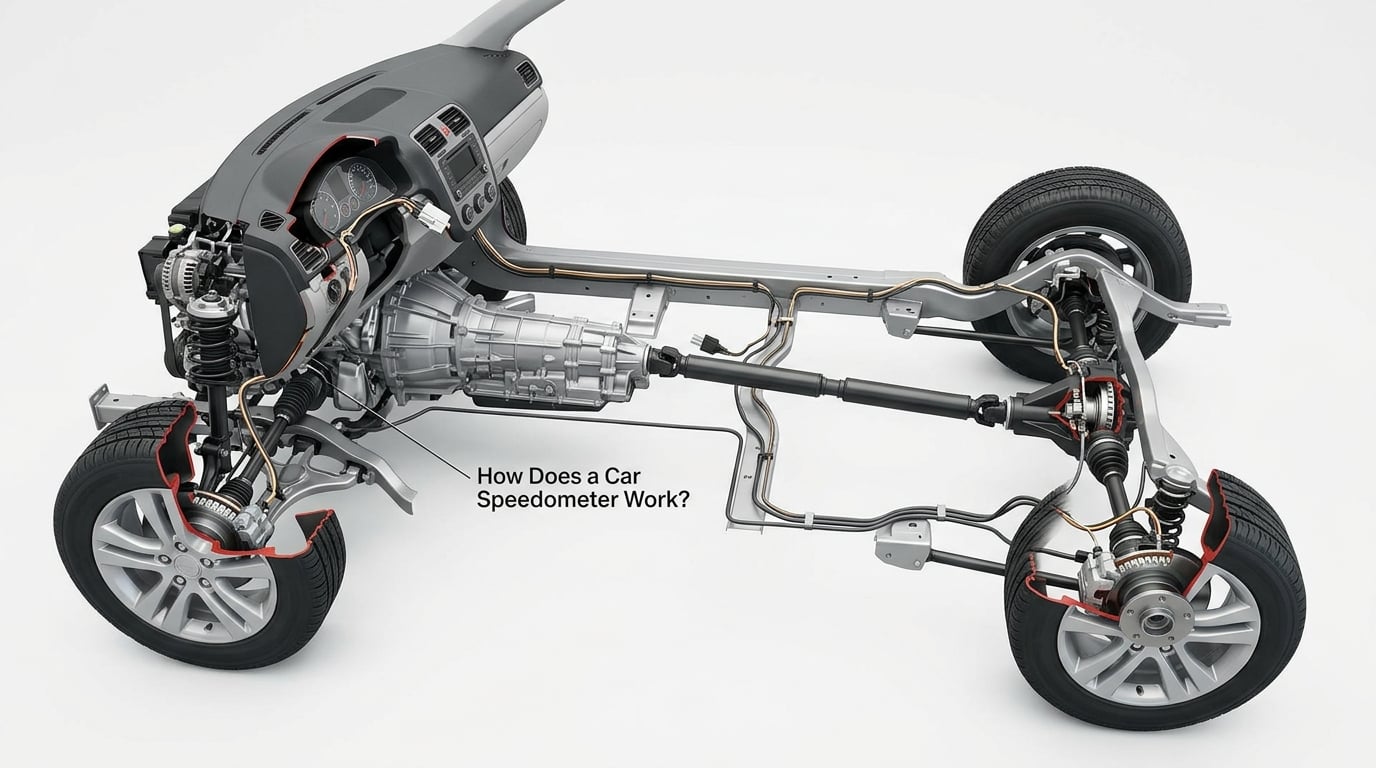
The speedometer is the last stop on a chain, not a self-contained part. A sensor on the transmission measures how fast the output shaft is turning and sends an electrical signal whose frequency matches that rotation. The cluster receives it, moves the needle, and steps the odometer.
Two different actuators sit behind the gauge. The needle is moved by a gauge driver, while the odometer is driven by a stepper motor on the back of the speedometer, and both take their signal from the same vehicle speed sensor. That is why a dead odometer alongside a dead speedometer points at one shared fault rather than two broken parts.
On a cable-driven car the chain is mechanical instead. A spinning cable runs from the transmission up to the back of the gauge and physically turns it, which is why those cars need periodic lubrication and why a snapped cable stops the needle completely.
Checking which system you have takes about a minute. Look under the centre of the dash or at the transmission for a cable. If you find a VSS on the transmission instead, you have an electronic speedometer, and the sensor, its wiring and the cluster are the only things that can stop it.
One more link in the chain deserves attention because owners confuse it constantly. The transmission-mounted VSS that feeds the speedometer is a different sensor from the ABS wheel speed sensors at each corner. DSMtuners posters describe the classic layout clearly: the VSS sits on top of the transmission, reached on some cars through the rear motor mount, while the reed or wheel sensors live in the cluster and at the hubs. A reader on r/MechanicAdvice replaced a rear ABS wheel speed sensor on a 1998 Ford Ranger and the speedometer and odometer still refused to work, because the two signals are not interchangeable.
Why Is My Speedometer Not Working? Common Causes
These are the faults that account for nearly every dead speedometer, ordered roughly by how often they turn out to be the culprit.
| Cause | What it looks like | Next move |
|---|---|---|
| Failed vehicle speed sensor (VSS) | Needle dead at zero, odometer dead too, often no warning light or code | Test the sensor, then clean or replace it |
| Damaged wiring or connector | Failure comes and goes over bumps or in the rain; dying shortly after a stereo install | Trace the harness, check the connector pins and the grommet |
| ABS or traction control fault | ABS light on, stability control warning, traction control disabled | Scan for wheel speed sensor codes before touching the gauge |
| Incorrect tire size | Reading is off by a consistent amount rather than dead or erratic | Confirm all four tires and the spare match the placard |
| Low battery or poor ground | Several warning lamps, gauges drifting or resetting at once | Check battery state of charge and cluster ground points |
| Instrument cluster failure | Speed signal confirmed healthy at the cluster connector, gauge still dead | Repair or replace the cluster, and program it to the car |
| Vehicle speed signal fault | Speedometer, odometer and cruise control all dead at the same time | Look for an open circuit in the shared signal path |
Why an Odometer That Still Counts Is a Useful Clue
If the odometer keeps counting while the needle sits still, the signal is reaching the cluster. That points away from the sensor and the harness and toward the gauge driver, the stepper motor, or a cracked solder joint on the cluster board. It is a small thing, but it saves you from replacing a perfectly good sensor.
What Symptoms Appear Before the Needle or Display Stops?
Most speedometers telegraph the failure first. Watch for a needle that jitters at idle and then settles once you are moving, which is usually debris on a sensor or a connector losing contact.
A needle pegged at maximum or frozen at one reading points at a gauge driver or a stepper motor problem inside the cluster rather than the signal. An intermittent fault that appears over bumps or in cold, damp weather almost always means wiring or a connector, not a failed sensor.
The dashboard symptoms matter too. Other gauges dropping out, backlight flicker, or an airbag light blinking on and off point at a shared power or ground problem, which is exactly what a reader on r/MechanicAdvice saw on a 1997 Ford Expedition when the speedometer died alongside a low-wash indicator. And if the ABS light comes on at the same time, the same missing speed signal is the reason.
How to Diagnose a Speedometer Problem Safely
Work through this in order and stop as soon as the fault explains the symptom. Doing the cheap checks first is what keeps a sensor swap from becoming a cluster replacement.
1. Park on level ground with the parking brake set. Do this first, not as an afterthought. Chock the wheels if the car sits on any slope, and if you are in a detached garage make sure it is warm enough to work in rather than freezing your hands off, which is worth reading up on if you have not seen our guide to the best way to heat a detached garage for working on cars.
2. Confirm the tire situation. Check all four tires and the spare against the placard on the door jamb. A mismatched tire size makes the speed reading wrong rather than dead, and it also throws off the transmission shift strategy and the trip computer.
3. Read every warning message before touching a tool. Note the check engine light, ABS, stability control and traction control lamps, and whether the odometer and trip meter are still counting.
4. Scan the car with an OBD-II reader. Even a basic code reader will pull stored and pending codes from the ABS module and the powertrain module. This takes two minutes and tells you whether a wheel speed sensor is reporting itself before you have touched anything.
5. Inspect the wiring you can reach. Look at the sensor connector, the harness near the transmission, and anywhere the loom passes through a body panel. Check for chewed insulation, a connector pushed half off, green corrosion inside the plug, or a grommet that has fallen out.
6. Compare the sensors. On cars with ABS, a scan tool can show live per-wheel speed data. One wheel reading zero or wildly out of line with the other three localises the fault to that corner.
7. Road test only if the car is controllable. If the brakes, steering and engine all behave normally, a slow loop around the block is reasonable. If the car is braking oddly, shifting badly or running rough, stop and get it diagnosed instead.
How to Test a Wheel Speed Sensor
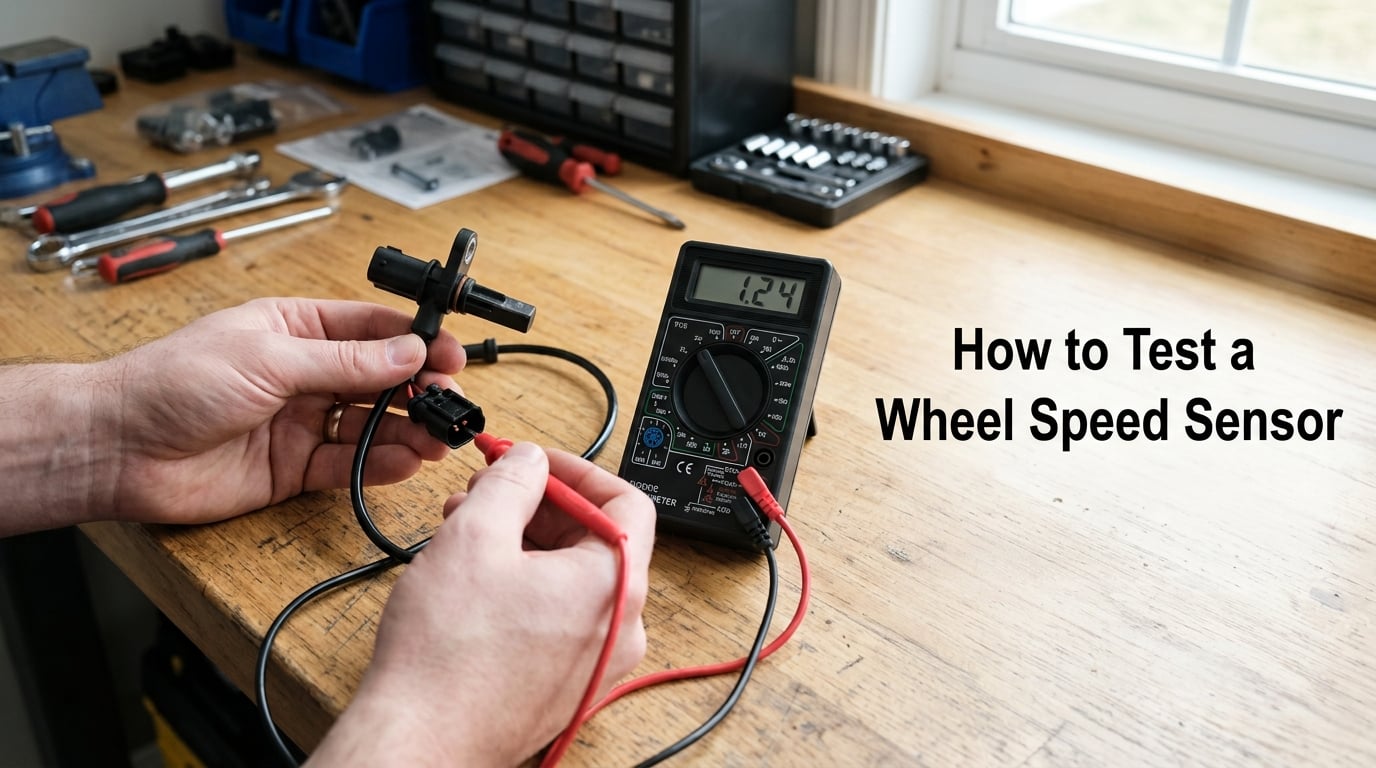
This is the test worth knowing because it separates a real sensor fault from a fault somewhere else in the circuit. A technician answering on JustAnswer described it neatly: detach the sensor, rotate the drive, and measure the AC voltage across the sensor while it turns.
Start with the visual pass. Unplug the connector and look at the pins for bent or green terminals, and check the harness for damage within about a foot of the sensor, where it flexes most. On some vehicles the VSS is reached through the rear motor mount, so budget extra time for access on a transverse-engine layout.
Then set your multimeter to AC volts and back the probes into the sensor terminals. Turn the wheel or spin the transmission drive and watch the reading. A working sensor produces an AC voltage that climbs and falls as it rotates, typically under a volt at a standstill and climbing as the speed increases. Steady zero while something is definitely turning means the sensor is open internally.
Next, check for reference voltage at the connector with the sensor unplugged. The sensor needs a supply and a ground from the module; a supply of about 5 volts with a good ground and a dead sensor output usually means the sensor itself is finished, while no supply at all points upstream to the module or its wiring.
Interpreting the numbers is the part people skip. A tiny voltage that flickers with the wheel turning usually means a weak or dirty sensor, and cleaning the tip with electronic cleaner or a lint-free wipe on a light oil film fixes a surprising share of them. A clean sensor that still reads dead deserves the replacement, and so does a brand new sensor that reads dead, which happens more than anyone would like.
When you put it back, refit the protective grommet and bracket properly. A sensor hanging by its wires will work today and fail again in a month, and the new break will look like a sensor fault rather than the damage it actually is.
How to Tell Whether You Need a Repair or Replacement
Once you know what failed, the job itself is usually simple. Sorting the diagnosis from the repair keeps you from replacing a working part.
Wiring repair. A corroded connector or a chafed section of loom is a repair, not a component swap. Clean the terminals with contact cleaner, replace the terminal or the connector shell, and sleeve the repair. Beginner-friendly if you have crimps and a heat-shrink gun, and it is the fix that gets skipped when someone buys a sensor instead.
Connector or grommet. If the pins are green or the plug is brittle, replace the connector and the grommet while you are in there. Very easy work, and leaving the old grommet out is the single most common reason a repaired harness fails again.
Sensor replacement. Usually a single sensor, a couple of bolts and a connector. Moderate difficulty, and awkward on some layouts. The catch worth knowing: cheap aftermarket sensors are a known source of repeat failures, so buy one you can return.
Software or configuration. Sometimes the sensor and the harness are fine and the car simply lost the signal in a module. That is common after a battery disconnect, a swap of a control module, or a cluster from a different car. A scan tool or a dealer-grade tool can reconfigure it, and a cluster from a same-model year usually still has to be programmed to your vehicle.
Cluster or control module failure. The most expensive and least likely answer. The gauge driver, stepper motor, reed switch or the board itself can fail, but do not buy one until the signal is confirmed healthy right at the cluster connector. On older cars there is also a purely mechanical possibility: a stripped or chipped tooth on the driven gear inside the transmission, or a seized speedometer cable, which produces a dead or erratic needle with an electrical fault that does not exist.
On a cable car, start there rather than with a multimeter. Disconnect the cable at the transmission, spin the inner end by hand, and see whether it turns smoothly. If it binds, a shot of cable lubricant is often the whole repair. If the drive gear on the transmission looks chewed or has bright metal where the teeth should be, that is a transmission job, not a gauge job.
Can You Drive with a Broken Speedometer?
It is worth slowing down before you decide, because the speedometer is often the least important thing affected. The same signal feeds cruise control, ABS, traction and stability control, the transmission shift strategy and the trip computer. A vehicle that fails only the gauge and nothing else is one of the more benign versions of this problem.
That is the test. If ABS, stability control and the transmission all behave normally and only the gauge is dead, the car is usually driveable. If any of those are also compromised, the fault has moved from a display problem into a safety one, and driving it on the road is not worth the gamble.
If you do drive it, keep the trip short and local, stay off the highway where a lost speed signal is more dangerous, and obey posted limits strictly rather than by feel. A phone running a speedometer app is a reasonable backup reference, but it is not a legal substitute in most jurisdictions and it is a distraction you do not need at highway speed.
Legality varies by state and country, and a failed speedometer is a common pull-apart reason at inspection. A professional diagnosis is the right call whenever braking behaviour, stability control or drivability is involved. Those faults do not get better with time, and a cluster replacement is a lot less painful to pay for than a collision.
Frequently Asked Questions
Can I reset a speedometer by disconnecting the battery?
Sometimes, and it is worth trying because it costs nothing. Disconnecting the battery for several minutes resets the memory in many clusters, which restores a gauge that lost its signal after a battery disconnect or a module swap. If the fault is a failed sensor or an open circuit, the needle comes back dead exactly as it was. Disconnecting the battery also wipes stored codes and radio presets, so read the codes before you do it.
Why is my speedometer not working but the ABS light is on?
Both are usually reading the same missing signal. A failed wheel speed sensor takes out the speedometer, the odometer and the anti-lock brakes at the same time, because all of them need to know how fast the car is going. Scan the car first and the stored code will usually name the corner or the sensor. A reader on r/MechanicAdvice replaced a rear ABS sensor on a Ranger and the speedometer stayed dead, so read the codes rather than guessing which sensor to buy.
What OBD-II codes point to a speedometer or wheel speed sensor problem?
Codes beginning C0031, C0032, C0035 and C0040 relate to individual wheel speed sensors or their circuits, and a code beginning C0045 points at a vehicle speed sensor circuit. A code beginning C00C covers the wheel speed sensor input circuit itself. U0100-style communication codes and any code mentioning the cluster or speed signal are worth noting too. The powertrain side matters as well, since a failed VSS commonly stores a speed-related code even when the check engine light stays off.
Can a wrong tire size make the speedometer inaccurate?
Yes, though inaccurate rather than dead. A larger tire than the one the speedometer was calibrated for makes the gauge read low, and a smaller tire makes it read high. All four tires and the spare should match the size and load rating on the door-jamb placard, and mixing all-season and winter tires on the same car is a common way people end up with a speedometer that seems to be lying. Mismatched sizes also upset shift strategy and the trip computer.
What should I check on a BMW when the speedometer stops working?
Check the driveshaft angle sensor first, since many BMW models report a speed signal through that sensor and its wiring where it passes by the exhaust and centre driveline, which is a known chafing spot. Then check the wheel speed sensor connectors at each hub, the transmission output shaft sensor on automatic models, and the wiring in the left engine bay harness. A code scan tells you which of these is complaining. Keep the factory coding in mind, since cluster programming is required after some sensor work.
Conclusion: Start with the Scan and Sensor Checks
The fastest path through why is my speedometer not working takes about twenty minutes of checking and no parts at all. Confirm exactly what died, including whether the odometer still counts and whether the ABS light is on, then check the tire size and read the wiring and connector you can reach.
Scan the car next. A code reader costs less than a wrong sensor and it tells you whether a wheel speed sensor is announcing itself, which is often the whole diagnosis in thirty seconds. Test the sensor properly after that, and keep the protective grommet on when you put it back.
Only once the signal is confirmed healthy at the cluster should a cluster be on the table. That single habit, fixing the cheap thing before the expensive one, is what keeps a dead gauge from becoming an expensive weekend.
Follow the owner manual for your specific vehicle, and get a qualified technician involved whenever braking, stability control or drivability behaviour is part of the problem. Those are different faults wearing the same dead needle, and they are the ones worth not guessing at.