
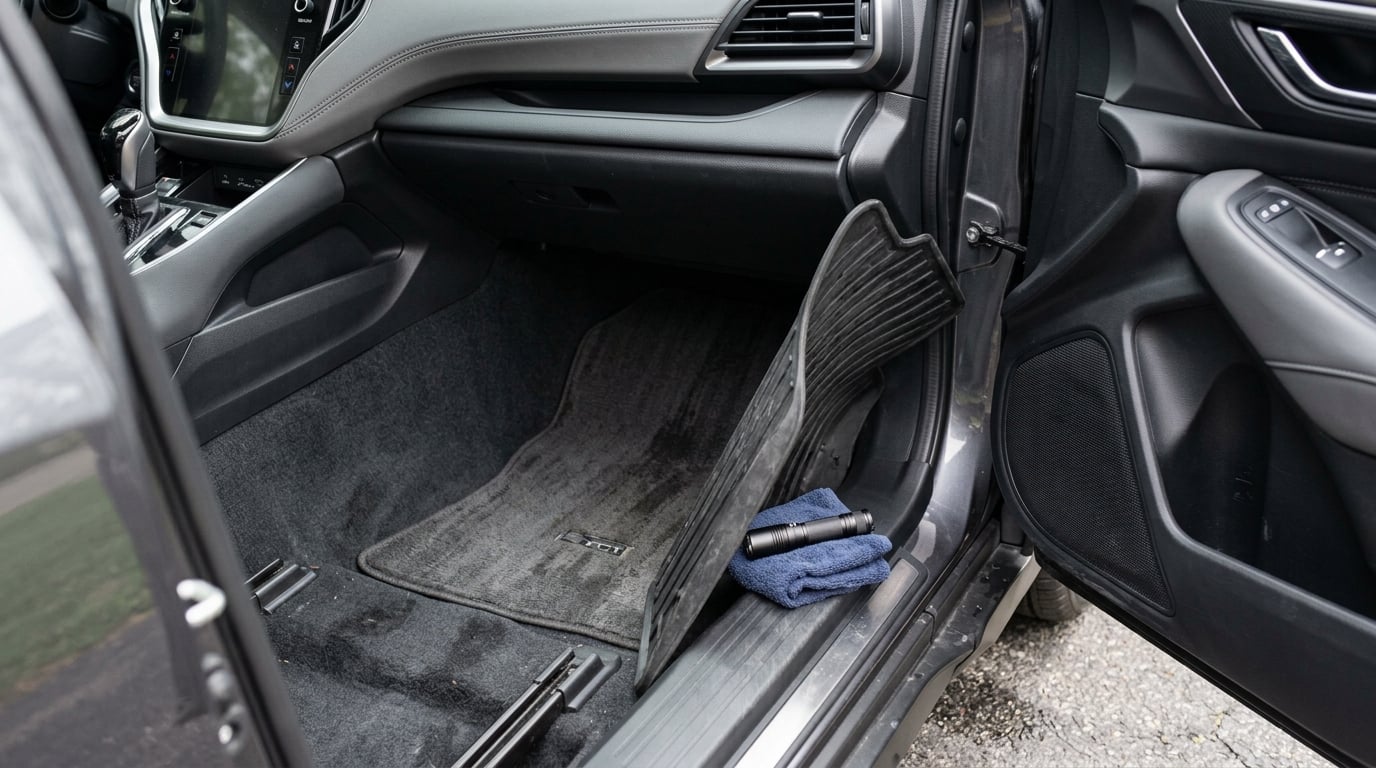
A wet passenger floor mat is almost always one of three things: condensation from the air conditioning with a blocked drain hose, water coming in from outside through seals or body drains, or a coolant leak from the heater core or heater hoses running down the firewall. Start by pulling the mat out, because the carpet underneath tells you which of the three you have.
That step takes two minutes and it decides the rest of your afternoon. A soaked carpet with a dry mat top means the water is arriving from underneath and is pooling where the floor pan is lowest. Nobody has ever traced a leak by looking at the mat.
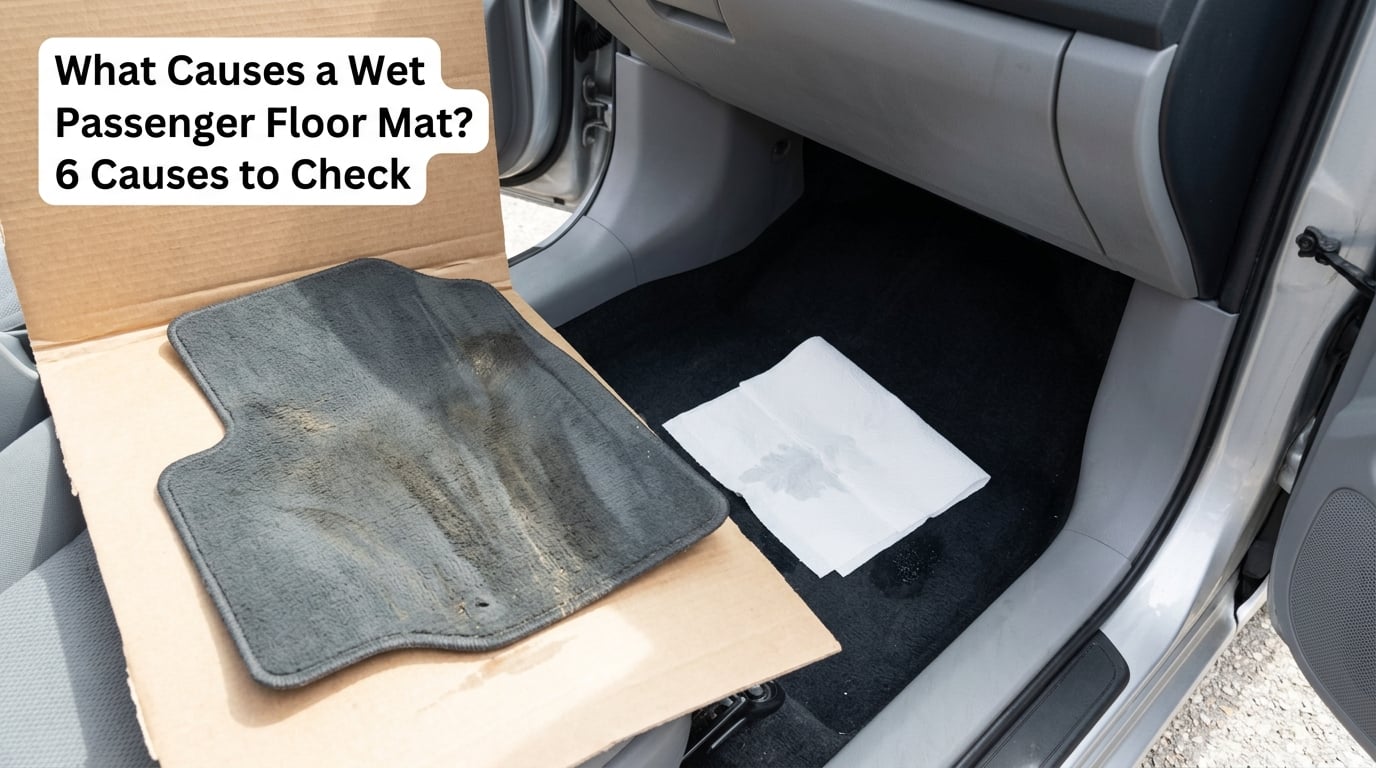
Table of Contents
- What causes a wet passenger floor mat?
- How can I tell whether the mat or the carpet is wet?
- What are the most common causes?
- How do I locate the leak?
- What should I check on a BMW or other car?
- Can a wet floor mat cause mold or damage?
- Frequently Asked Questions
- Why is my car floor wet when I turn the A/C on?
- Why is my passenger footwell wet after rain or a car wash?
- Why are my car floor mats wet underneath when the top is dry?
- How do I find where moisture is getting in my car?
- Is a leaking heater core an emergency?
- The shop cleared my A/C drain and the water came back. What now?
- Conclusion
What causes a wet passenger floor mat?
The short version is that something is putting liquid on your floor that the car was never designed to hold there. The usual suspects fall into four groups: plain water from condensation or rain, washer fluid from a reservoir or hose, coolant from a heater circuit, and other fluids from a mechanical leak.
Water is by far the most common. The air conditioning evaporator sheds moisture as it cools humid air, and that water is meant to run out through a small hose. When the hose blocks, the water backs up inside the HVAC case and spills over the edge onto the passenger carpet, which is the most frequent single answer for a wet passenger floor mat.
Rainwater and car wash water come next. They get in through door weatherstrips, the cowl and fresh air intake at the base of the windshield, sunroof drain channels, or a failed windshield seal, then run downhill to the lowest point in the cabin. Coolant is rarer but worth ruling out, because it is sweet smelling and it will eventually cost you an engine flush if you keep driving on it.
One more thing worth knowing up front: the mat hides the evidence. A rubber all-weather mat with deep channels traps water underneath and keeps the top surface dry, and a thick carpet mat drinks up a small leak and looks fine while the carpet below it rots. Both are common reasons a leak goes unnoticed for months.
How can I tell whether the mat or the carpet is wet?
Pull the mat out and press a folded paper towel into the carpet where the mat was sitting. If the towel comes away wet, the water is coming from below the carpet line, which narrows your search to the HVAC case, the firewall, or a body drain. If the carpet is dry and only the mat is damp, suspect a spill, a mat that has absorbed condensation from the air above it, or a leak that only wets the mat as it sits.
Texture tells you a lot. Water from the air conditioning is thin and clear, and it often leaves a chalky or slightly slimy film as the dissolved minerals in the condensate dry. Coolant is thicker, often faintly colored, and smears rather than soaks. Washer fluid has a sharp, soapy smell and feels slippery.
Smell is the fastest shortcut. A musty or sour smell means standing water and mold starting to grow in the jute backing under the carpet. A sweet smell means coolant. A sharp solvent smell means washer fluid. Never taste the liquid to test it, whatever you may have read on a forum.
Timing and spread narrow it further. Water that shows up only after you run the air conditioning points at the condensate drain. Water that appears only after rain, a car wash, or pressure washing points at a seal or a body drain. Water that spreads all the way to the rear seat usually comes from a roof channel, a sunroof drain, or a rear window seal, not from the footwell.
Listen for sloshing when you turn a corner or pull away from a stop. That means water is moving inside the HVAC case, which is a strong hint that the drain is blocked rather than that something is leaking in from outside.
What are the most common causes?
The table below is the fastest way to sort the candidates before you start taking anything apart. Match what you see, what you smell, and when it happens against one row, and you usually have your answer in a minute.
| What you see | Smell | When it shows up | Where it pools | Likely cause |
|---|---|---|---|---|
| Clear, thin, slightly slimy | Musty or none | After running the A/C or defrost | Passenger footwell | Blocked A/C condensate drain |
| Clear, thin, no residue | None or faint musty | Humid weather, car sat unused | Both sides | Condensation under the carpet |
| Clear, dirty, gritty | Damp carpet smell | After rain, car wash or pressure wash | Passenger side, sometimes rear seat | Weatherstrips, cowl or windshield seal |
| Thick, faintly colored, smears | Sweet | Worsens with heat or driving | Passenger side, sometimes carpet edge | Heater core or heater hose leak |
| Sharp and slippery | Soapy, solvent | Random, often after a fill | Passenger or driver side | Washer fluid reservoir or hose |
| Oily film, colored | Burning or sweet | Constant, worsens with idling | Driver side usually | Engine oil or transmission fluid leak |
1. A blocked A/C condensate drain hose
This is the single most common cause of a wet passenger floor mat. Air that passes through the evaporator sheds water, and that water collects in a pan under the evaporator and drains through a hose that exits through the passenger side of the firewall. Mold, dust, dead leaves, or a cabin filter that has been installed wrong can plug it.
When the hose blocks, water backs up inside the HVAC case and spills out over the case edge or out of the case seams onto the carpet. The tell is that the puddle appears or grows after you run the air conditioning, and that the carpet is cool and damp near the firewall. If the puddle is deepest at the front of the footwell and thins out toward the door, you are looking at the drain.
2. Condensation and humidity in the cabin
Sometimes there is no defect at all. Warm humid air meets a cold floor pan and the carpet underlayment, moisture forms on those surfaces, and it has nowhere to go because the floor is enclosed by carpet, padding, and jute backing. This is more common in humid summer weather, in cars that sit for days without being driven, and in vehicles with aftermarket all-weather mats that seal the footwell like a tray.
The signature is that both sides are equally damp, there is no single trail or source, and the water reappears when the weather turns humid. It is harmless in small amounts and it becomes a mold problem when it repeats.
3. Water coming in through door and window weatherstrips
Rubber seals harden with age and UV exposure, and a door that was slammed or a window that was rolled up against a wet seal can warp slightly and start passing water. A car wash or a pressure washer aimed at the door edges will find the gap fast. Look for a wet band of carpet that runs along the door sill and up the kick panel, and check the factory drain holes in the bottom of each door, which are supposed to send water back outside and are commonly painted shut.
Replacing a weatherstrip is inexpensive and usually something you can do yourself. Seating compound on the rubber can buy you a season or two, but the seal still needs replacing eventually.
4. Blocked cowl drains, a fresh air intake leak, or firewall plenum overflow
The cowl panel is the plastic grille at the base of the windshield, and its job is to catch water off the glass and funnel it into drains that empty outside the cabin. A cowl packed with leaves, a drain hose that has come loose, or a firewall plenum that has overflowed during a storm will all deliver water straight down the passenger side of the footwell. This is a very common finding on trucks and SUVs with cab-forward glass, where the intake sits more directly above the passenger floor.
Check that the fresh air intake door opens and closes fully, and that the cabin air filter is seated correctly. A filter installed backwards or out of its track can block the intake path and send water into the case rather than out through the drain.
5. Sunroof and moonroof drain channels
If your car has a sunroof, the water has to go somewhere, and the answer is a set of troughs along the roof rails with small hoses at each corner. The most common sunroof and panoramic roof leak is a clogged trough, not a bad seal. Look above the headliner for a damp or stained patch above the rear doors, and check the headliner edge near the front doors for a swollen or darkened seam.
Owners of vehicles with panoramic roofs frequently deal with drain hoses that detach or kink after a roof service. If the water only shows up on one side and travels toward the rear seat, this is where you should look.
6. Mechanical fluid leaks
A leaking heater core or heater hose shows up on the passenger side because that is where the heater circuit runs through the firewall, and coolant follows gravity to the carpet. It is real, and it is much rarer than people guess, so do not start here. But if the liquid is thick, smells sweet, and leaves a colored film on the jute backing, treat it seriously. Washer fluid leaks from a reservoir or a cracked hose, and engine oil or transmission fluid show up more often on the driver side. A milky film on the dipstick is a different problem entirely, and what milky engine oil means covers that one.
If the wet floor smells like fuel, do not drive the car. Park it away from structures and get it towed. A fuel smell right after starting has its own short list of causes, and why a car smells like gas after starting walks through them before you assume the carpet is the problem.
How do I locate the leak?
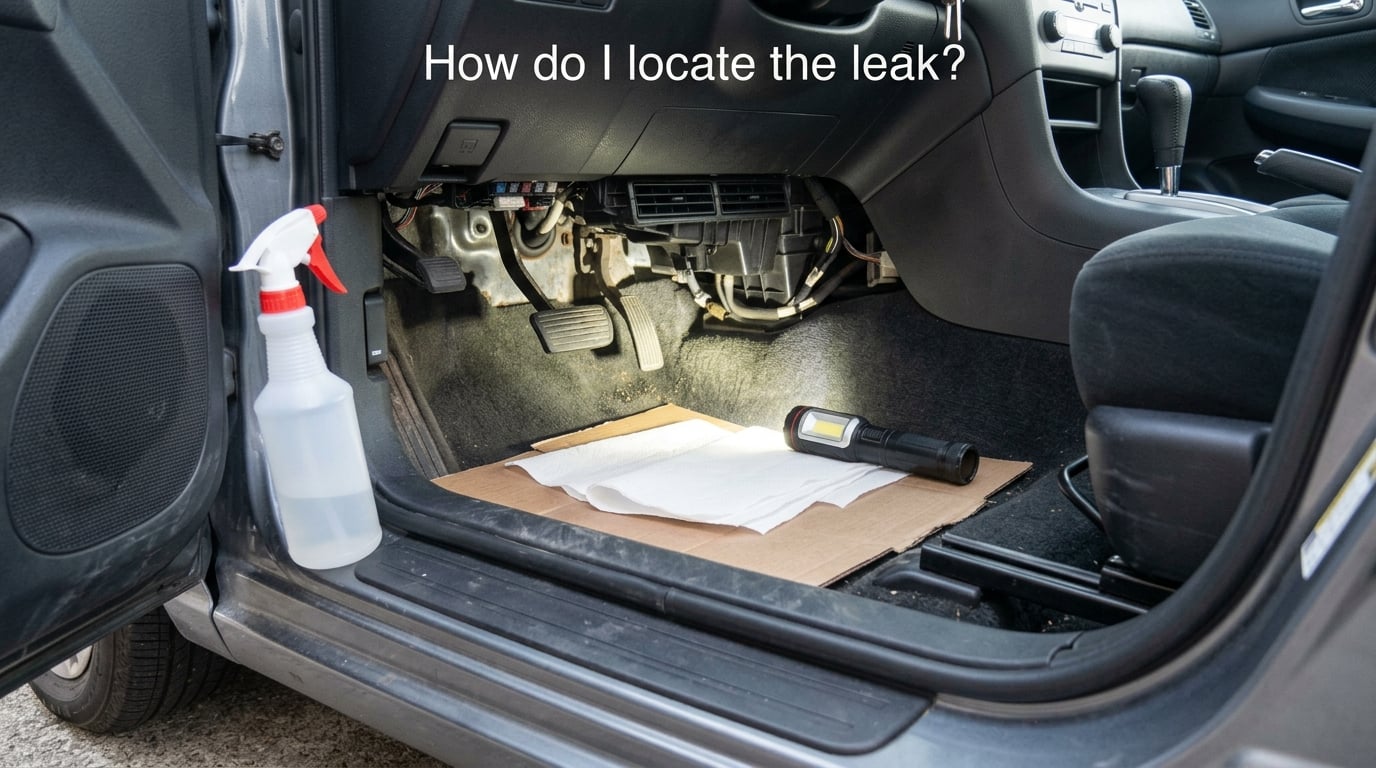
Work outside, on a dry day, and give yourself an hour. You will need a flashlight, a few folded paper towels, a piece of cardboard about the size of a baking sheet, a small flashlight or phone light, and a spray bottle of water. If you are starting from scratch on your toolkit, what tools you need for basic car maintenance covers the basics worth having on hand.
- Park on level ground, remove the passenger mat, and pull the sill plate and kick panel trim off so you can see the carpet edge and the firewall area.
- Dry the carpet completely with towels, then run the heater on high for ten minutes to evaporate whatever is left. The floor should be bone dry before you start.
- Lay the cardboard under the HVAC case and the firewall, then drape paper towels across the case, the case seams, and the carpet edge. A fresh wet spot on the cardboard within minutes tells you the water is coming from above the case.
- Run the air conditioning on cold, fan on high, and watch the towels for half an hour. A drip from the case edge or the drain outlet means the drain is blocked, and a drip through the carpet edge is often a failed case seam seal.
- Spray the roof drain troughs, the cowl drains, the door sill seals, and the windshield edge with water, one area at a time, and watch the cardboard after each. Isolate one leak at a time rather than spraying everything at once.
- Check the fluid side. With the engine cold, press the upper radiator hose and look for wetness, then compare coolant in the overflow tank cold versus hot. A dropping level points to a heater core or radiator leak rather than a hose, which is much more involved.
- Once you have found it, dry the carpet fully before you reassemble anything. A floor that looks dry with damp padding under it will smell within a week.
Stop and use a shop if the source is a fuel smell, if the wet area is large, if the fluid is coolant and the reservoir is dropping, or if the water keeps coming back after a drain cleaning. My rule is simple: if the towel under the case does not explain it in an hour, book a proper diagnosis rather than keep replacing parts.
What should I check on a BMW or other car?
On a BMW or any other European car with a panoramic roof, the same six causes apply, but two of them deserve extra attention. The panoramic roof runs long drain channels behind the headliner, and a blockage there sends water toward the rear seats before it ever reaches the front footwell. The cowl and plenum area on these cars is also tightly packaged, so an overflow during heavy rain tends to show up on the passenger side of the carpet.
Second, if the car is still under factory warranty or has a service history with a dealer, ask the dealer to check for open campaigns covering the evaporator drain hose and panoramic roof drains. Owners have reported repeat visits on newer vehicles where a drain hose detached under the dash and dripped onto the floor, and a body sealer or hose issue that shows up repeatedly is exactly the kind of thing a bulletin covers.
Do not assume every wet mat is a brand defect. Most are a plugged drain hose and a twenty-minute clean. But if the car is young, the carpet is pristine, and the water is brand new to the vehicle, check the warranty side before you pay for anything yourself.
One more BMW and luxury-brand note: the interior is carpeted wall to wall with more wiring and modules under it than a mainstream car, including seat, door, and climate control modules. That makes a small recurring leak more expensive than the mat or the hose, which is the argument for fixing it early.
Can a wet floor mat cause mold or damage?
Yes, and the mold is the part that lingers. Carpet is not a sealed surface. Under it is padding and often a jute or foam backing that wicks water and holds it for weeks, which is the perfect environment for mildew. Once mold has set into jute backing it is very hard to remove, and the musty smell often returns every humid day even after the leak is fixed.
Below that, water reaches the wiring harnesses, seat and door modules, and climate control electronics. Corroded connectors cause intermittent faults that get blamed on something else entirely, a window that works one day and not the next, or a seat heater that cuts out. Those repairs run far beyond the cost of a drain hose.
To dry it out properly: pull the mat, remove the trim, towel off everything, then run the heater on high with the fan on low and the recirculate button OFF so outside air flows through the cabin. Open the doors for a few hours after. A rented carpet extractor or a steamer does more than a hair dryer, and if the jute backing stays damp for more than a day or two, the carpet section under it is worth replacing rather than drying.
Use a shop rather than DIY work when the fluid is fuel, brake fluid, or coolant in any quantity, when the water is coming from a body seam or roof channel you cannot reach, or when the carpet has already molded.
Frequently Asked Questions
Why is my car floor wet when I turn the A/C on?
Because the air conditioning evaporator makes water, and that water has to drain out through a hose on the passenger side of the firewall. If the hose is blocked with mold, dust, or debris, the water backs up inside the HVAC case and spills over the edge onto the passenger carpet. The puddle appears after you run the A/C, the carpet is cool and damp near the firewall, and you may hear sloshing when turning a corner.
Why is my passenger footwell wet after rain or a car wash?
Water coming from outside is getting into the cabin rather than condensing inside it. Common paths are door weatherstrips that have hardened or warped, factory drain holes in the bottom of the door that were painted shut, the cowl and fresh air intake at the base of the windshield, a clogged sunroof drain channel, and a failed windshield seal. The carpet shows a wet band along the door sill, and pressure washing the suspect area one piece at a time will find it fast.
Why are my car floor mats wet underneath when the top is dry?
That combination tells you the water is arriving from below the carpet line, which rules out spills and mat failure. The mat is sitting in a puddle, and a rubber all-weather mat with deep channels will keep the top surface dry while hiding water underneath. Lift the mat, check the carpet with a paper towel, and look at the HVAC case, the firewall, and the door sill drains. Deep-channel mats are also why many leaks go unnoticed for months.
How do I find where moisture is getting in my car?
Dry the carpet fully, then run the heater on high for ten minutes so the floor is bone dry. Lay cardboard under the HVAC case and firewall and drape paper towels across the case seams and carpet edge. Run the A/C on cold and watch for a drip from the case or drain outlet. Then spray one area at a time with water, the roof drain troughs, cowl, door seals, and windshield edge, and watch the cardboard after each spray.
Is a leaking heater core an emergency?
It is not a drive-it-tomorrow emergency, but it is not something to keep ignoring either. Coolant on the carpet is easy to confirm: the liquid is thick rather than watery, faintly colored, smells sweet, and leaves a film on the carpet backing. Compare the coolant level in the overflow tank cold and hot, since a heater core leak usually shows up as a dropping level. If the reservoir is low, top it up and get the car looked at before the trip gets longer.
The shop cleared my A/C drain and the water came back. What now?
A drain cleaning only fixes the symptom if the drain was the source. Often the hose gets cleared, the cowl or fresh air intake above it is still blocked, or the same debris falls back in within days. Ask specifically whether the cowl drains, the cabin filter seating, and the sunroof channels were checked. If the carpet is wet in the same spot every time, demand they find the source with a water test rather than blow the drain again.
Conclusion
Start the same way every time. Pull the passenger mat out and check whether the carpet underneath is actually wet. Identify the liquid by smell and texture, so you know whether you are chasing water or coolant. If it is water, work the six causes in order, starting with the A/C condensate drain, then the weatherstrips, cowl, and any sunroof channel, and only then the heater core.
Do not replace the mat until the carpet beneath it is dry and the source is fixed, or you will be back at square one in a few weeks. If the fluid smells like fuel, stop driving and get the car towed.