
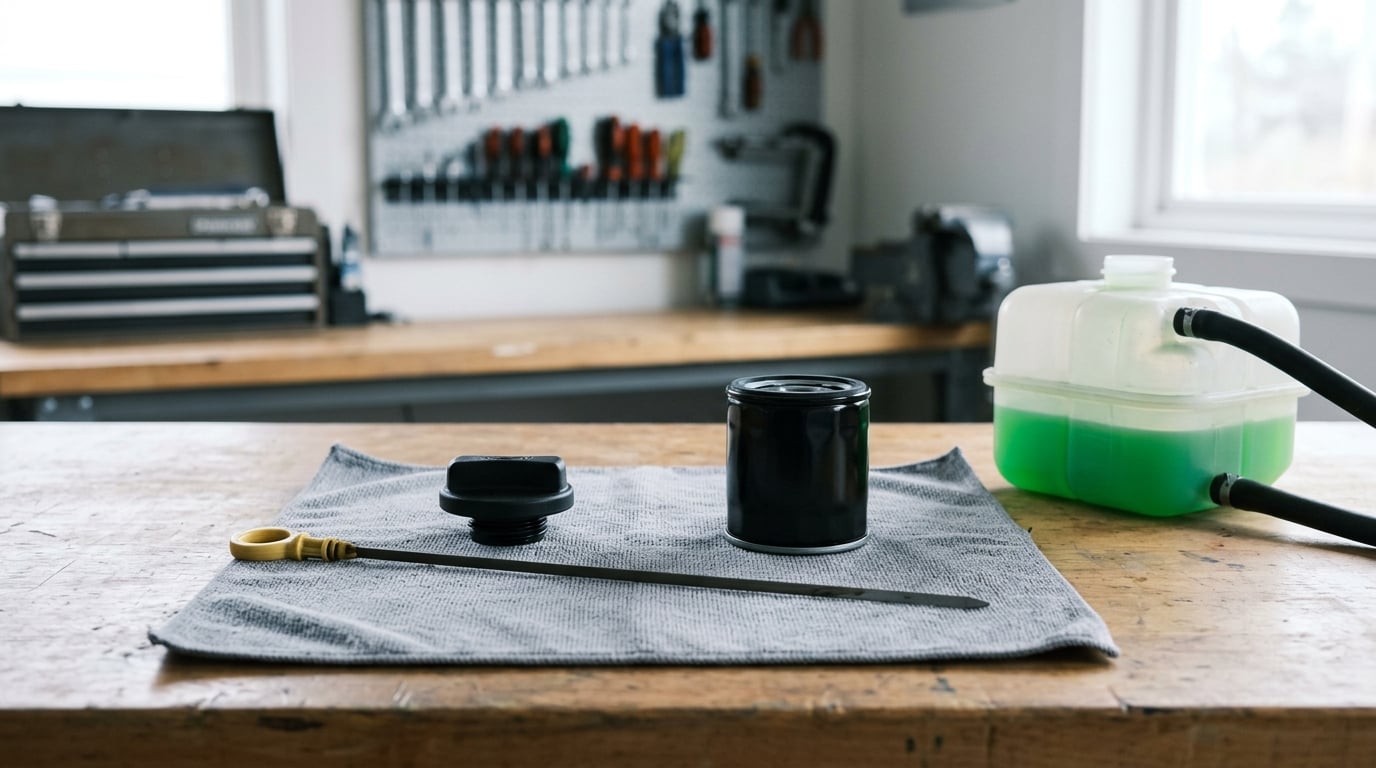
Milky engine oil means water or coolant has mixed with your oil and emulsified into a creamy, off-white sludge. It usually points to coolant leaking into the lubrication system, often through a failed head gasket, though harmless condensation from short trips and older-engine sludge can look almost identical. The first thing to check is whether the residue is on the dipstick or only under the oil filler cap.
That one detail decides how worried you should be, and almost nobody checks it first. Pull the dipstick, look at the oil on it, then look under the cap.
Table of Contents
- What Does Milky Engine Oil Mean?
- What Can Make Engine Oil Look Milky?
- Is Milky Oil Always a Head-Gasket Problem?
- How to Diagnose Milky Engine Oil Safely
- What Signs Mean You Should Stop Driving?
- How to Fix Milky Engine Oil
- Milky Oil in BMW Engines: Common Concerns
- Frequently Asked Questions
- Can I drive my car with milky engine oil?
- Is milky engine oil always caused by a bad head gasket?
- Why does my oil look milky right after changing it?
- Does replacing the oil and oil filter fix milky oil?
- Can coolant mix with oil without the engine overheating?
- What does the dipstick look like when coolant is in the oil?
- What to Do First
What Does Milky Engine Oil Mean?
Milky engine oil means water has mixed with the oil, either coolant from the cooling system or plain condensation, and the two fluids have been whipped together by the moving parts until they emulsify. The result is the beige, cream or chocolate-milk-coloured sludge that clings to the dipstick and the underside of the oil filler cap.
Here is why that happens. A cylinder head bolts on top of the block and seals off three separate systems: the combustion chambers above, the coolant water jacket around them, and the pressurised oil galleries feeding the bearings and cam. The head gasket is the multi-layer steel sandwich that keeps all three apart. When that seal lets go, coolant breaches into the oil circuit and the crankcase churns it into a mayonnaise-like mess.
It matters because coolant ruins oil fast. Emulsified oil loses viscosity, loses its film strength, and stops carrying heat away from the metal. Keep driving on it and the bearings, cam lobes and any turbo up top start wearing far quicker than the mileage suggests.
What Can Make Engine Oil Look Milky?
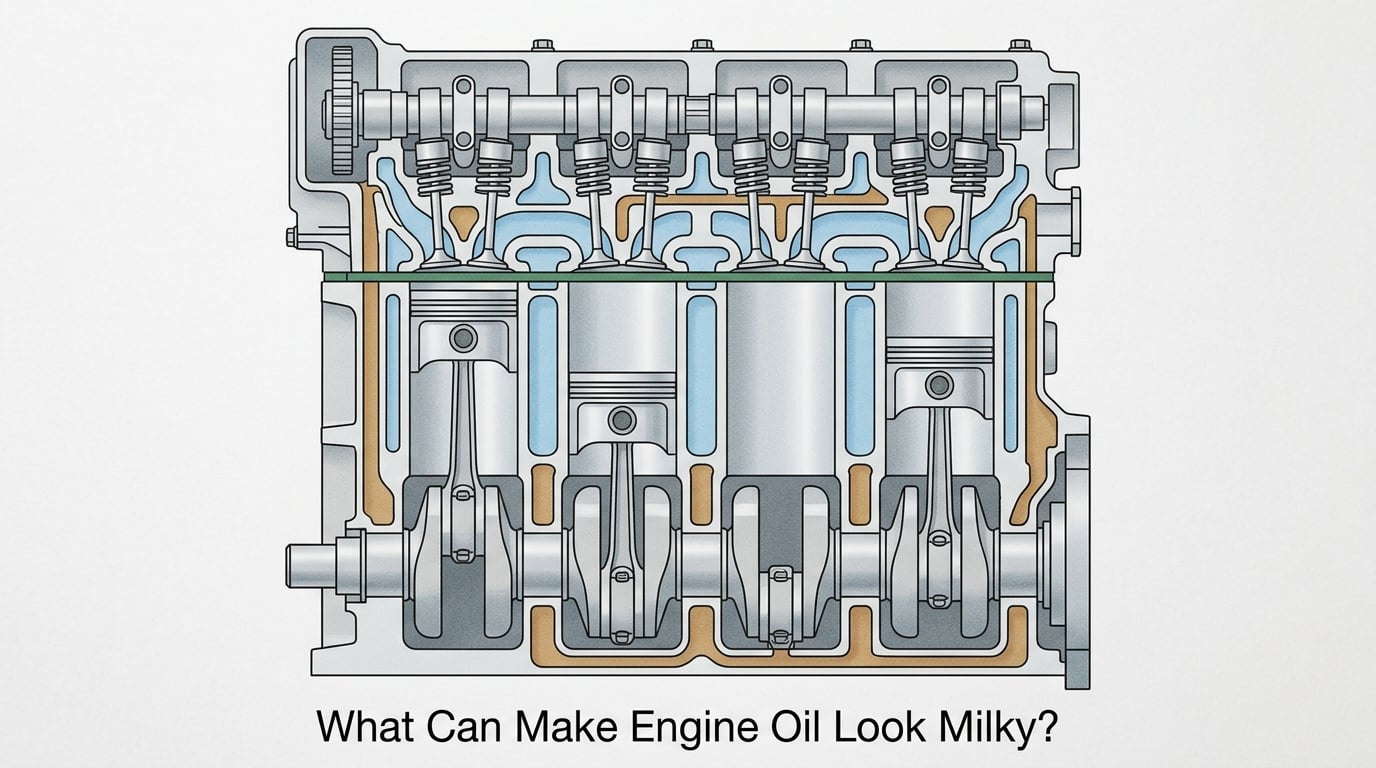
Two very different things produce a pale-looking film. One is coolant getting into the oil, which is a fault. The other is ordinary degraded oil mixing with the water that collects naturally in the crankcase, which on a healthy engine is a housekeeping problem rather than a mechanical one.
| Clue | Coolant in the oil | Condensation or ordinary sludge |
|---|---|---|
| Dipstick | Milky, foamy or chocolate-coloured, may hold pressure on the loop | Normal amber to dark brown, just a little lighter than usual |
| Oil filler cap | Thick opaque cream, often with a sweet or burnt-sugar smell | Thin pale film under the cap only, no smell on the dipstick |
| Coolant reservoir | Level dropping between services, oily film or bubbles in the radiator | Level steady, coolant clean |
| Exhaust | Sweet-smelling white smoke, sometimes a bubble burst of coolant from the exhaust tailpipe | Normal exhaust colour |
| Behaviour | Overheating, misfires, low oil pressure light, knocking under load | Engine runs normally, temperature steady |
| Typical driving | Any, though often after overheating or a cooling system fault | Short trips, cold climates, city-only driving, infrequent starts |
Short trips are the classic condensation case. The engine never reaches full operating temperature, so combustion water vapour never boils off. Owners on Reddit’s r/MechanicAdvice and the Cartalk community describe the same pattern repeatedly, and several report the film clearing completely after one long hot drive and an oil change.
Worth knowing: water is heavier than oil, so in cold weather it settles at the bottom of the oil pan first. It only mixes in once the engine runs and the crankcase gets churned up, which is why the oil can look fine on the dipstick before a drive and worse after one.
Is Milky Oil Always a Head-Gasket Problem?
No. Appearance alone cannot identify the failed part, and assuming it always means a head gasket leads people to write off engines that only needed an oil change. Here are the four things that make oil look pale, roughly in the order I would check them.
1. Condensation from short trips
Water vapour from the combustion process, plus moisture drawn in through the crankcase breather, condenses on cold metal. On a car driven to work and back, it never gets hot enough to evaporate. Beige or yellowish gunk under the cap, normal oil on the dipstick, nothing wrong with the coolant.
2. Head gasket or cylinder head failure
Coolant crosses the gasket or a crack in the head or block and enters the oil. This is the one that matters. Look for the coolant dropping, a film or sludge in the reservoir, white sweet-smelling smoke, or coolant in the exhaust.
3. Combustion by-product sludge
On petrol engines, fuel and combustion gases blowing past worn piston rings create a lighter, foamier sludge that can resemble emulsified oil. It usually comes with rising oil consumption and a rough idle, and an oil analysis will show fuel content rather than coolant content.
4. Fuel dilution
On a diesel, fuel can enter the oil if injectors are worn, if the engine is driven hard on repeated short trips, or if a cold-start system misbehaves. The oil goes thin and light-coloured rather than creamy, and diesel engines are also prone to the EGR cooler leaking into the coolant side, which then shows up as an oily film in the coolant.
Diesel deserves its own mention because owners often see a milky film in the coolant instead of the oil. That is a different failure path with a different repair, and it is the reason a proper diagnosis matters more than guessing.
How to Diagnose Milky Engine Oil Safely
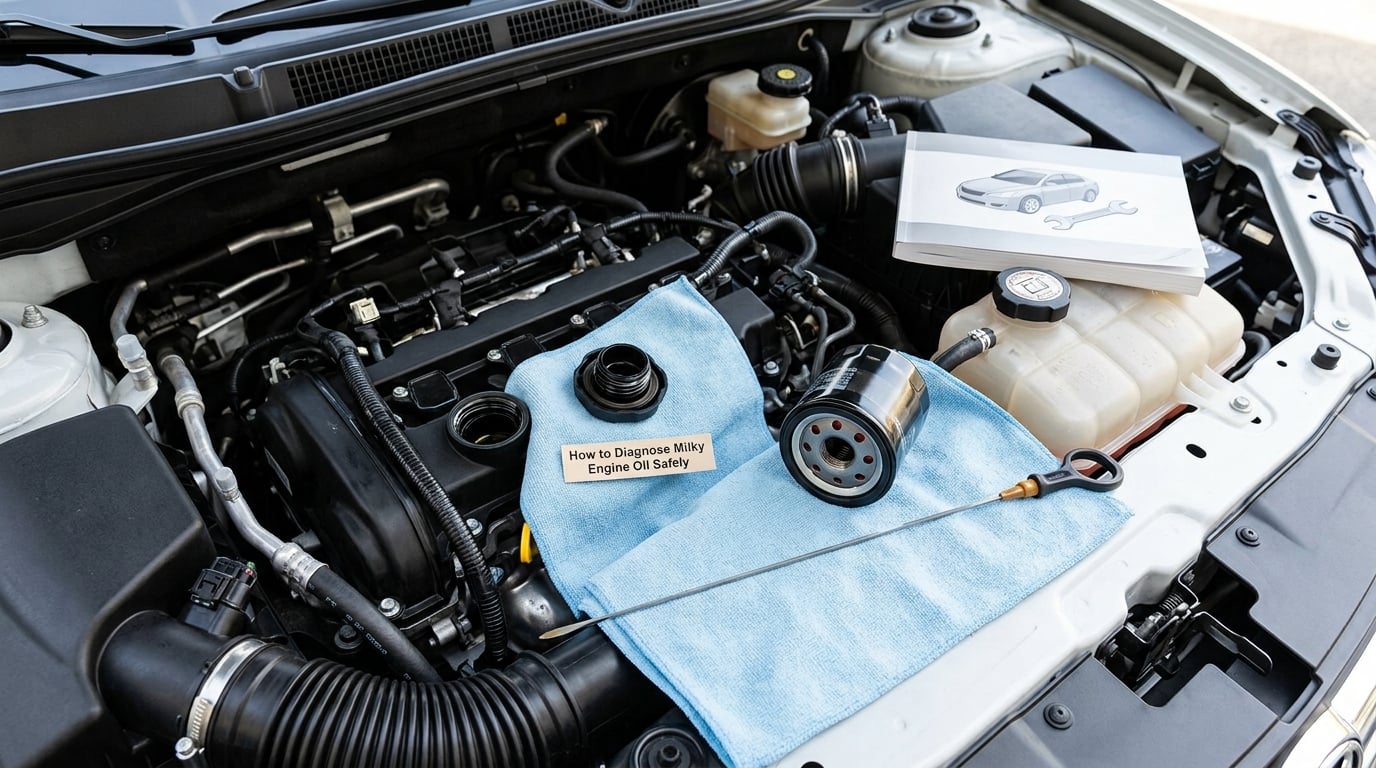
Do this in order, and do it cold. Never open a hot cooling system: the cap releases a burst of steam and scalding coolant that will put you in hospital.
Step 1: Cold dipstick check
With the engine cold and the car on level ground, pull the dipstick, wipe it, and check the oil on the loop. Milky or foamy oil on the dipstick is a much stronger signal than residue under the cap alone. Normal amber or dark brown oil on the dipstick with a pale film under the cap points toward condensation.
Step 2: Look at the oil cap and the breather hoses
Unscrew the filler cap and look at its underside. Then follow the crankcase breather hoses between the valve cover and the intake manifold. Owners on the CarTalk boards note the same residue appearing in the breather, which confirms a lot of crankcase moisture rather than a local spill.
Step 3: Check the coolant reservoir cold
Do it before you start the engine. Open the cap and look for an oily film on the surface, sludge on the bottom, or a texture like milky tea. Then look at the radiator or expansion tank for persistent bubbles. With the engine cold, cover the radiator neck and start it: if coolant surges hard when it warms, that points to combustion gases getting into the cooling system.
Step 4: Inspect the oil filter
Remove the filter and cut it open. A used filter that is milky on the inside face, or holds a mayonnaise-like lump, is strong evidence of coolant in the oil. If the filter is dark and clean, the contamination is more recent than the last service.
Step 5: Get a combustion block test
This is the test the forums keep recommending, and it is cheap. You take a sample of coolant from the radiator, drip it into the test fluid, then draw air through the tube. If combustion gases are present, the fluid turns yellow on petrol engines and green on diesels. Owners on r/MechanicAdvice treat it as the decisive check before booking teardown work.
Step 6: Pressure and compression tests
Pressure-test the cooling system to find where the pressure is going, and run a compression or leak-down test to see whether a cylinder is sealing properly. Both of these are technician jobs. A warped head or a block crack will show up on one of them, and guessing without them is how people replace good head gaskets twice.
What Signs Mean You Should Stop Driving?
Stop driving and shut the engine off if any of these show up alongside milky oil. Each one means the lubrication system is no longer protecting the metal.
- Oil pressure light on, or the gauge dropping with the engine warming up. Emulsified oil does not hold pressure, and low pressure means bearings are running on metal.
- Temperature climbing, or a coolant loss warning with no visible leak outside the car. Internal loss means the coolant is going somewhere it should not.
- Foaming oil on the dipstick that you can see expanding. That is coolant actively churning in.
- White smoke with a sweet smell, or a puff of vapour from the exhaust tailpipe after idling. Coolant is getting into the combustion chamber.
- Knocking, ticking or rumbling that gets worse with load or revs. Bearing or cam damage may already have started.
- A strong fuel smell from the exhaust, or a rough idle with misfires. Unburned fuel in the oil is its own kind of emergency.
The short answer to can I drive it: a five-minute drive home is usually survivable on an otherwise healthy engine, but it is not free. Coolant that entered the oil keeps diluting it, and every minute it runs is another minute of bearing metal without a proper film.
If the oil on the dipstick is normal and only the cap shows a pale film, you have a different problem: change the oil, take one long drive to get everything hot, and recheck. If the dipstick is creamy, do not drive it to the shop. Tow it or drive it gently straight there and tell them the oil is contaminated so they do not contaminate the rest of the car.
How to Fix Milky Engine Oil
An oil change alone does not fix coolant mixing with oil. If the source is still there, the fresh oil goes creamy within a few hundred miles, and you have paid for the same work twice.
The correct sequence runs like this. A technician confirms the contamination and locates the leak, often with the cooling system pressure-tested and combustion gases checked. The failed gasket, cracked or warped head, or leaking oil cooler is repaired or replaced, following the manufacturer’s procedure for that engine. The cooling system is refilled with the specified coolant chemistry, which matters more than most owners expect. The engine is then flushed and run, and the oil and filter are replaced on the final flush. Finally, coolant is rechecked and the oil rechecked after a few hundred miles.
Do the last step. A head gasket repair that loses a little coolant after the job still needs chasing down, and finding it early is the difference between a second gasket and a second repair.
Milky Oil in BMW Engines: Common Concerns
Older BMW inline-six and V8 owners hit this worry constantly, and the honest answer is that milky oil on those engines is a symptom, not a diagnosis. The engines are long-lived and well-proven, and plenty of high-mileage examples have nothing wrong with the head gasket at all.
BMW coolant chemistry is specific, and mixing the wrong coolant type is a genuine way to cause corrosion and sealing problems. Use only what the manual specifies, including on cars that appear to have been maintained. Oil specification matters just as much, because an oil that does not suit the engine can carry fuel and contribute to the by-product sludge that mimics coolant contamination.
Gasket aging is real on high-mileage examples, particularly on engines that have overheated, been mis-fuelled, or had cooling system work done with generic parts. That said, a freeze plug, a leaking oil cooler line, or a filter housing that seeps at the gasket can produce pale residue without the head gasket ever being involved.
Forums like Bimmerforums are full of owners who assumed the worst and were relieved to find a hose clamp or a resealed housing instead. Get a block test and a pressure test before you accept a teardown quote. On an engine worth keeping, a proper diagnosis is worth more than a guess.
Frequently Asked Questions
Can I drive my car with milky engine oil?
Only briefly, and only if the oil on the dipstick still looks like oil. If the dipstick is creamy or foamy, or the oil pressure light comes on, stop driving and have the car looked at. A short trip can be survivable, but the coolant keeps diluting the oil, and bearings run on metal as the film strength drops. Tow it if the pressure light is on or the engine is overheating.
Is milky engine oil always caused by a bad head gasket?
No. Short-trip condensation is far more common and is entirely normal on a car driven short distances in cold weather. Other causes include cracked or warped cylinder heads, a leaking oil cooler, combustion by-product sludge from worn piston rings, and fuel dilution on diesels. A cooling system pressure test and a combustion block test will tell you which one you are looking at.
Why does my oil look milky right after changing it?
Usually because water that collects in the oil pan in cold weather does not mix until the engine runs and churns the crankcase. Check the oil again before starting the engine, then check it again after a full warm drive. If it is creamy on the dipstick, the fresh oil changed just as fast, and that is a leak, not a cleaning job.
Does replacing the oil and oil filter fix milky oil?
It fixes the symptom, not the cause. If coolant is still entering the oil, fresh oil turns creamy again within a few hundred miles. Change the oil, then have the cooling system pressure-tested and the combustion gases checked so you know whether anything is actually failing. Otherwise you will buy the same service twice and still have the problem.
Can coolant mix with oil without the engine overheating?
Yes, frequently. A head gasket can fail without the engine ever reaching high temperature, and some coolant leaks produce no overheating warning at all. Watch the coolant level between services instead, and check the reservoir for an oily film or sludge, and the exhaust for sweet-smelling white smoke. A steady level and clean oil are the reassuring signs.
What does the dipstick look like when coolant is in the oil?
The oil on the dipstick comes up beige, cream or the colour of chocolate milk rather than amber or dark brown. It often looks foamy and holds shape on the loop instead of running back into the pan. Compare it with the underside of the filler cap, because a normal dipstick with a pale cap usually means condensation rather than a leak.
What to Do First
If the oil pressure light is on or the temperature is climbing, do not drive the car. Shut it off, pull the dipstick while it is cold, and photograph what you see along with the coolant reservoir.
Then make the call: pale cap with normal dipstick means an oil change and one long warm drive, creamy dipstick means a cooling system and oil contamination diagnosis before any fluids are replaced. Get the block test done either way. It is the cheapest way to stop guessing, and it is the difference between a service and a teardown.