
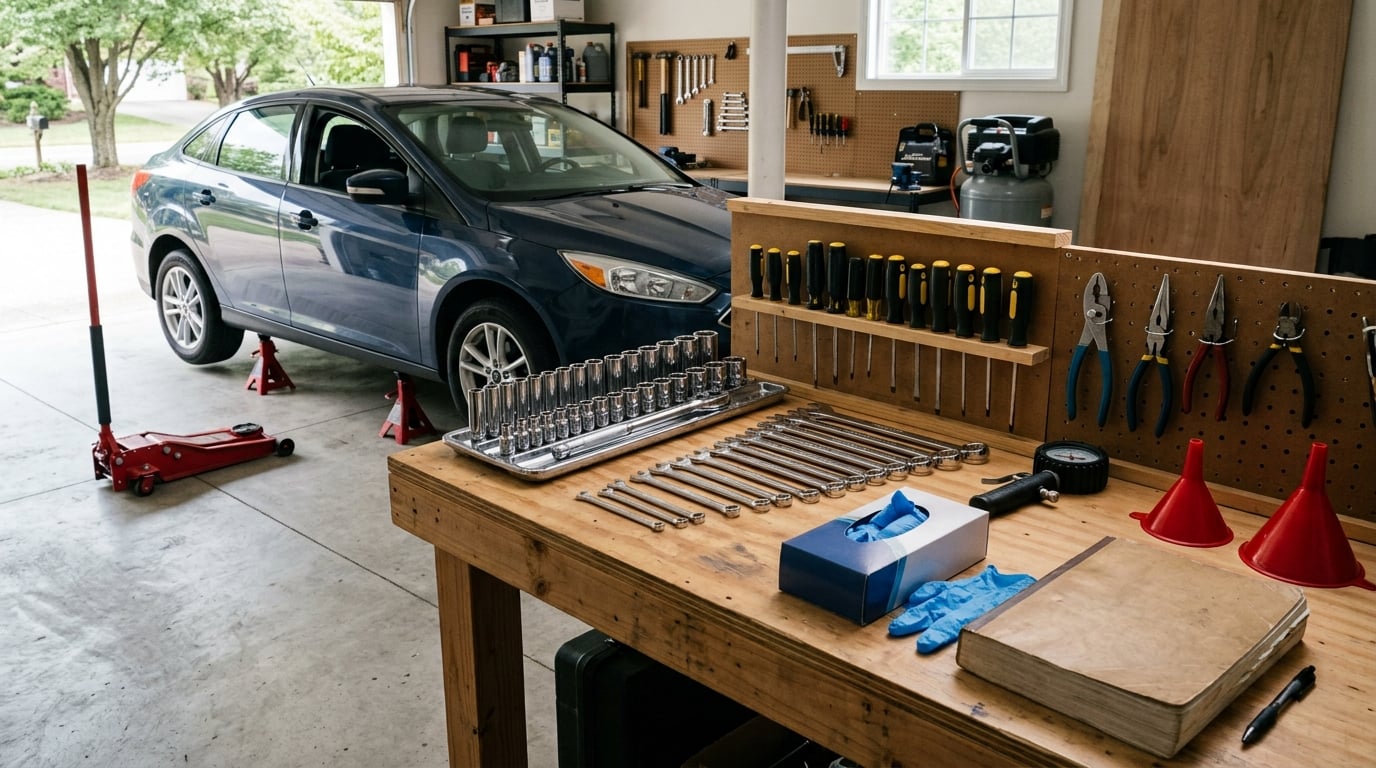
If you are searching for what tools do you need for basic car maintenance, the honest answer is shorter than most tool sales pages suggest: a floor jack and a pair of jack stands, a tire-changing kit, a socket and ratchet set in both metric and SAE with a few extensions, a handful of hand tools such as combination wrenches and pliers, screwdrivers, fluid funnels, a tire-pressure gauge, gloves, a work light, and your vehicle service manual. That list covers tire pressure checks, oil changes, fluid top-offs, battery jumps and most bolt-on jobs.
The exact minimum depends on your vehicle and on which jobs you feel comfortable attempting. A fifteen-year-old compact sedan and a forty-year-old pickup use different fasteners, and the tools that suit one will leave gaps in the other. Buying by job, rather than by piece count, is what actually matters.
Here is how the pieces fit together.
Table of Contents
- What Tools Do You Need for Basic Car Maintenance?
- Essential Tools by Maintenance Job
- Choosing the Right Socket and Wrench Set
- Hand Tools That Make Vehicle Work Easier
- Safety Equipment and Optional Upgrades
- How to Build a Basic Car Maintenance Toolkit on Any Budget
- What Basic Car Maintenance Can You Do Yourself?
- Frequently Asked Questions
- Start With the Essentials
What Tools Do You Need for Basic Car Maintenance?
Every car maintenance tool list I trust starts with the same core, and it is smaller than most people expect. Split it into three groups: hand tools, lifting and safety gear, and diagnostics and fluid handling.
The essential core
- Floor jack rated above your vehicle’s weight, plus two jack stands with a load rating higher than the corner you are supporting
- Lug wrench or socket and ratchet matching your wheel nuts, and wheel chocks
- Socket and ratchet set covering both metric and SAE sizes, with 3-inch and 6-inch extensions
- Combination wrenches in a range of sizes, and an adjustable wrench
- Screwdrivers in flat and Phillips, ideally with a magnetic tip
- Needle-nose and slip-joint pliers
- Tire-pressure gauge accurate enough for monthly checks
- Oil drain pan, funnel and a lidded container for used fluid
- Nitrile gloves, shop towels and a wire brush
- Work light rated for a garage or driveway
- Service manual or owner manual for your specific vehicle
That is roughly fifteen items, and between them they unlock the maintenance tasks most owners would otherwise pay a shop to do.
Essential Tools by Maintenance Job
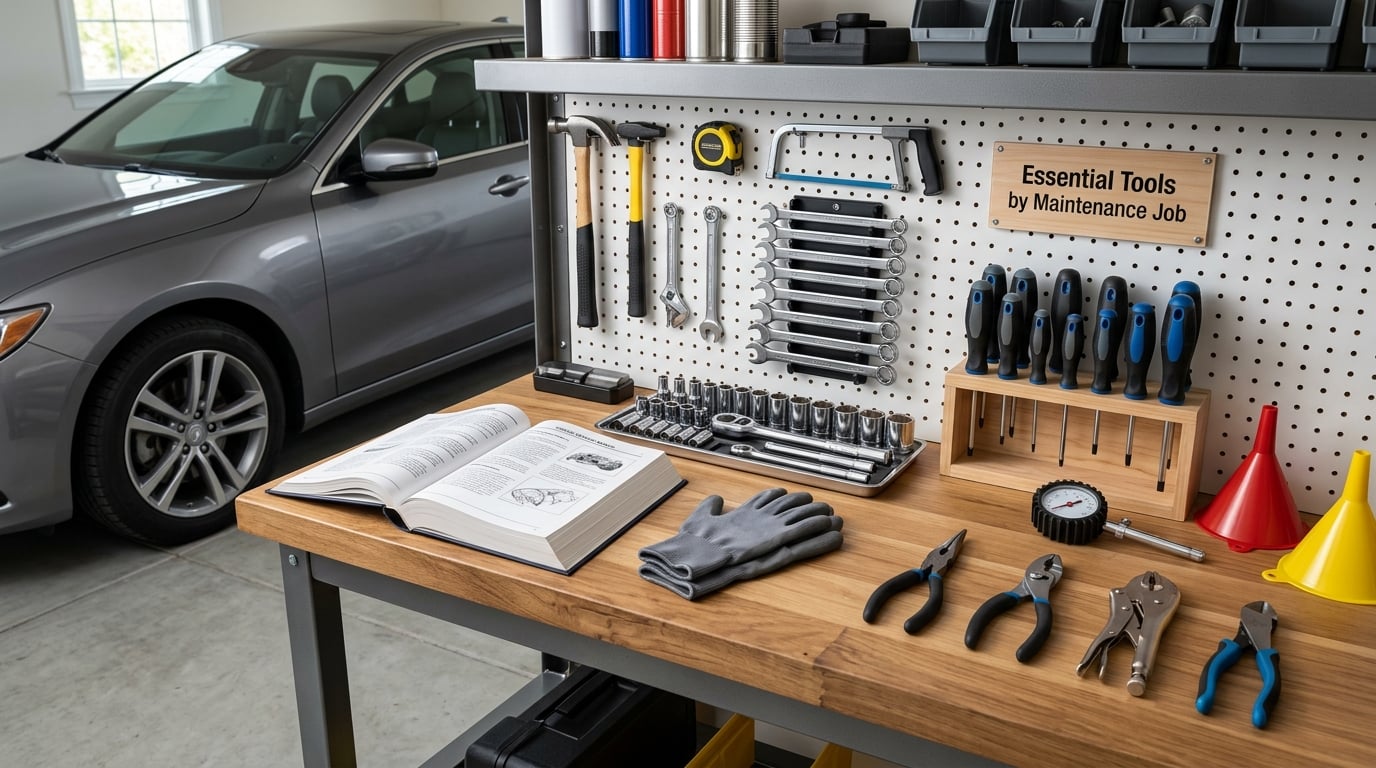
Buying a tool you will never touch is the fastest way to waste a tool budget. Grouping tools by the job they unlock is more useful, so here is what each maintenance task actually requires.
| Maintenance job | Tools required | Essential or task-specific |
|---|---|---|
| Check and adjust tire pressure | Tire-pressure gauge | Essential |
| Change a flat or rotate tires | Floor jack, jack stands, lug wrench or socket, torque wrench, chocks | Essential |
| Oil change | Drain pan, oil filter wrench, funnel, ratchet set, drain plug socket, containers | Essential |
| Top off coolant, washer fluid, brake fluid | Funnel, shop towels, owner’s manual for the correct fluid | Essential |
| Air filter and cabin filter change | Screwdrivers or clip tools, pliers | Task-specific |
| Jump a dead battery | Jumper cables or portable jump starter, gloves, eye protection | Essential |
| Clean battery terminals | Wire brush or terminal cleaner, baking soda solution, gloves | Task-specific |
| Read a check engine light | OBD-II scanner | Task-specific |
| Replace spark plugs | Spark plug socket, extension, torque wrench, gap gauge | Task-specific |
| Battery and charging system test | Digital multimeter | Task-specific |
| Brake pad replacement | Socket set, torque wrench, wheel chocks, brake piston tool | Professional territory for most beginners |
Read that table twice before you shop. The essential column is the shopping list; everything in the task-specific column arrives when a specific job does.
Choosing the Right Socket and Wrench Set
A socket and ratchet set is the workhorse of the whole garage, and it is also where beginners most often buy the wrong thing. Two decisions matter more than the number of pieces: sizing system and drive size.
Metric or SAE
Most cars built in the last few decades use metric fasteners, and most American-market ones mix in SAE for a few brackets, terminals and older engine bolts. A set of both in a tray beats a large set of one system, and the cost difference is small. A 21mm combination wrench sitting next to a 13/16in one is a habit most owners form within a year of their first under-hood job.
Drive size
Drive size is the square opening that connects the socket to the ratchet, and it is not the bolt size. A 3/8-inch drive ratchet handles most under-hood work in a small car and gives you more torque than a 1/4-inch drive with less effort. A 1/4-inch drive set is still worth owning for the fasteners tucked in tight engine bays. Buy one 3/8-inch ratchet and one 1/4-inch ratchet, each with a couple of extensions, and you can turn almost any bolt on the car.
What actually differs between sets
Piece count is marketing. A 130-piece kit with two loose ratchets and a case full of duplicates is a worse buy than a 40-piece set with deep-reach sockets in both systems, a flex-head ratchet, and a tray that shows what is missing at a glance. Deep-reach sockets earn their place on intake runners and tight engine valleys where a shallow socket bottoms out. Check the ratchet’s tooth count too, because a higher count means a smaller arc of travel, which matters in the space behind a wheel.
On used-car forums, the most common regret is stripping a seized fastener, and the second most common is finding out mid-job that the socket you need is the one size you skipped.
Hand Tools That Make Vehicle Work Easier
Sockets handle most of the load, but a few plain tools earn their drawer space for jobs that sockets are wrong for.
Combination wrenches
A combination wrench has an open end on one side and a box end on the other. The open end works in tight spots where a ratchet will not fit; the box end grabs all six or twelve sides of a nut and is far less likely to round it off. Buying a 12-point box end over a 6-point one is kinder to rusty fasteners.
Pliers
Slip-joint pliers adjust to grip, which makes them good for hose clamps, filters and bent hardware. Needle-nose pliers reach into wire harnesses and connectors where fingers will not fit. Diagonal cutters belong to the electrical and trim side of the job, not the engine bay.
Hammer and wire brush
A ball-peen hammer is for pins and brackets, not for persuading a seized lug nut to move. The wire brush earns its keep cleaning battery terminals, threads and rust off a brake caliper slide, often with a dab of penetrating spray first.
Torque wrench
This is the tool most beginners skip and most regret skipping. Lug nuts, drain plugs, caliper bolts and head bolts have specified torque figures, and both under- and over-tightening cause trouble. A click-type torque wrench you set to the figure in your service manual turns “tight enough” into a repeatable step. Rent one for a single big job, or buy a mid-range 3/8-inch drive unit once you are doing wheel work regularly.
What tools do you need for basic car maintenance but should rent?
Brake piston retraction tools, pullers, and specialty pipe and fuel-line tools get used once or twice a year. Borrow them or rent them rather than letting them sit in a chest taking up room. The same goes for a heavy-duty torque multiplier, which only works if your primary wrench can be set to its low end.
Safety Equipment and Optional Upgrades
Never work under a vehicle supported only by a jack. The jack lifts the car; the jack stands carry it. That is the whole rule, and every garage guide worth reading repeats it.
Choose stands with a load rating comfortably above the weight of the car on one corner, and set them on level concrete or timber, not on a soft driveway. Chock the wheel diagonally opposite the one you are removing, every time, and treat the wheel as if it has no lug nut on it at all. The scissor jack that came with the car belongs to a tire shop, not your driveway.
Gloves keep oil and battery acid off your skin, and eye protection is cheap insurance when a drain plug finally lets go. A rated work light matters more than people expect, because half of a car’s fasteners sit in shadowed wheel wells and engine bays.
Once the essentials are covered, three additions pay for themselves quickly. An OBD-II scanner reads stored fault codes so you know what you are chasing before you pull anything apart, and it is the cheapest useful diagnostic tool you can own. A digital multimeter checks battery voltage and charging output in about a minute. A small pressure washer makes rims and the underside of the car much easier to inspect for leaks and corrosion.
A creeper, a parts tray, a magnet tray and a decent tool chest are comfort purchases. A torque multiplier, specialty pullers and a shop press are specialty purchases. None of them should delay the essential list.
How to Build a Basic Car Maintenance Toolkit on Any Budget
Do not buy everything at once. Building a car maintenance toolkit in the right order means every purchase earns its place before the next one lands.
Stage one: safety and tires
A floor jack, two properly rated jack stands, a lug wrench or socket and ratchet sized to your wheels, a torque wrench, chocks, a tire-pressure gauge and gloves. This stage alone gets you through flat tires and rotations, which are the two jobs owners most often need at short notice.
Stage two: general hand tools
A 3/8-inch and a 1/4-inch ratchet with extensions, a metric and SAE socket set, a set of combination wrenches, an adjustable wrench, screwdrivers, and needle-nose and slip-joint pliers. This is the stage that lets you do an oil change, change filters and check for leaks.
Stage three: job-specific tools
Buy the next tool when the next job arrives: a spark plug socket and gap gauge, an oil filter wrench, an OBD-II scanner, a multimeter, a battery jump pack, a funnel and drain pan, a small pressure washer.
Before any of it, spend an hour with your vehicle. Find the wheel key or lug nut size, look up the fastener sizes for the oil drain plug and oil filter, and read the torque figures in the service manual. Buying tools blind is how people end up with a 19mm socket and no 15mm one. Used-car owners with no manual can get the fastener sizes from a parts counter or a vehicle-specific forum, where someone with the same car will tell you exactly what fits.
Renting is underrated, too. Tool libraries and rental counters hand back specialty tools for the cost of a coffee and a deposit, and a borrowed tool is a tool that never needs storing.
What Basic Car Maintenance Can You Do Yourself?
Basic car maintenance includes checking tire pressure monthly, rotating tires on the interval in your manual, changing engine oil and the oil filter, replacing the air filter and cabin filter, topping off coolant, washer fluid and brake fluid, cleaning battery terminals, checking belts and hoses for cracks, and reading a check engine light code before you decide what to do about it.
All of those are reasonable for a first-time owner, and all of them are far more approachable with the right tools in hand. A pressure check takes two minutes. An oil change is the single most commonly learned car repair job, and the forums treat it as the rite of passage for anyone who wants to stop paying shop rates for routine work.
Some jobs are different. Brake work involves heavy components, sensors that must not be contaminated, and calipers that leak if mishandled. Fuel system work carries fire and vapor risk. Electrical diagnosis means tracing circuits you cannot see. Suspension and steering work is safety-critical and frequently torque-specified. In those areas, learning the manufacturer’s torque specifications and proper procedure matters more than any tool, and a qualified technician is the sensible call when the job is unfamiliar.
Two rules cover most of the risk. If the owner’s manual gives a torque figure, use it and use a torque wrench. If a job involves lifting the vehicle, support it on stands before anything else happens.
Frequently Asked Questions
Do I need a full set of tools to do basic car maintenance?
No. A full set is mostly a storage problem. About fifteen tools cover the routine work most owners need: a floor jack, two jack stands, a lug wrench or socket and ratchet, a torque wrench, a tire-pressure gauge, combination wrenches, screwdrivers, pliers, a funnel, a drain pan, gloves, a work light and your service manual. Add a socket set in both metric and SAE as your first real upgrade.
What is the minimum tool kit for changing a flat tire?
Six things: a floor jack rated above your vehicle weight, two jack stands with a load rating above one corner of the car, wheel chocks, a lug wrench or socket and ratchet that fits your wheel nuts, a torque wrench for reinstalling them, and a spare tire plus the jack hardware that came with the car. Keep a flashlight and gloves in the trunk with them.
Should I buy metric or SAE tools for my car?
Buy both. Most cars use metric fasteners for engine and suspension work, while SAE sizes often show up on brackets, terminals and older bolts. A metric set alone leaves gaps that show up mid-job, and the two sets together cost far less than a frustrating trip back to the store. Check your manual or ask a parts counter which sizes your model takes.
Are expensive car tools better than inexpensive basic tools?
It depends on the tool. For a ratchet, a torque wrench, jack stands and a floor jack, mid-tier drop-forged steel is worth the difference because failures there are dangerous. For screwdrivers, pliers, funnels and wrenches you use occasionally, inexpensive tools are fine. Buy cheap where the failure is an inconvenience and better where a slip, a rounded fastener or a collapsing stand is the outcome.
Can a beginner car owner safely do their own maintenance?
Yes, for routine tasks done properly: pressure checks, tire rotations, oil and filter changes, air filter replacement, fluid top-offs, terminal cleaning and reading a fault code. Safety comes from using stands rather than a jack alone, chocking the opposite wheel, following torque specifications in the manual, and stopping when a job involves brakes, fuel, suspension or wiring you do not understand.
Start With the Essentials
If you are still working out what tools do you need for basic car maintenance and want a first order that covers the most ground, buy in this sequence: the service manual, a floor jack and two jack stands, the tire kit, your core hand tools, a tire-pressure gauge, and safety gear.
Then add the socket set, the torque wrench and the fluid-handling tools as soon as you are ready for an oil change and a rotation. Learn how each tool is meant to be used before you rely on it, and check the torque specifications for your vehicle rather than guessing.