
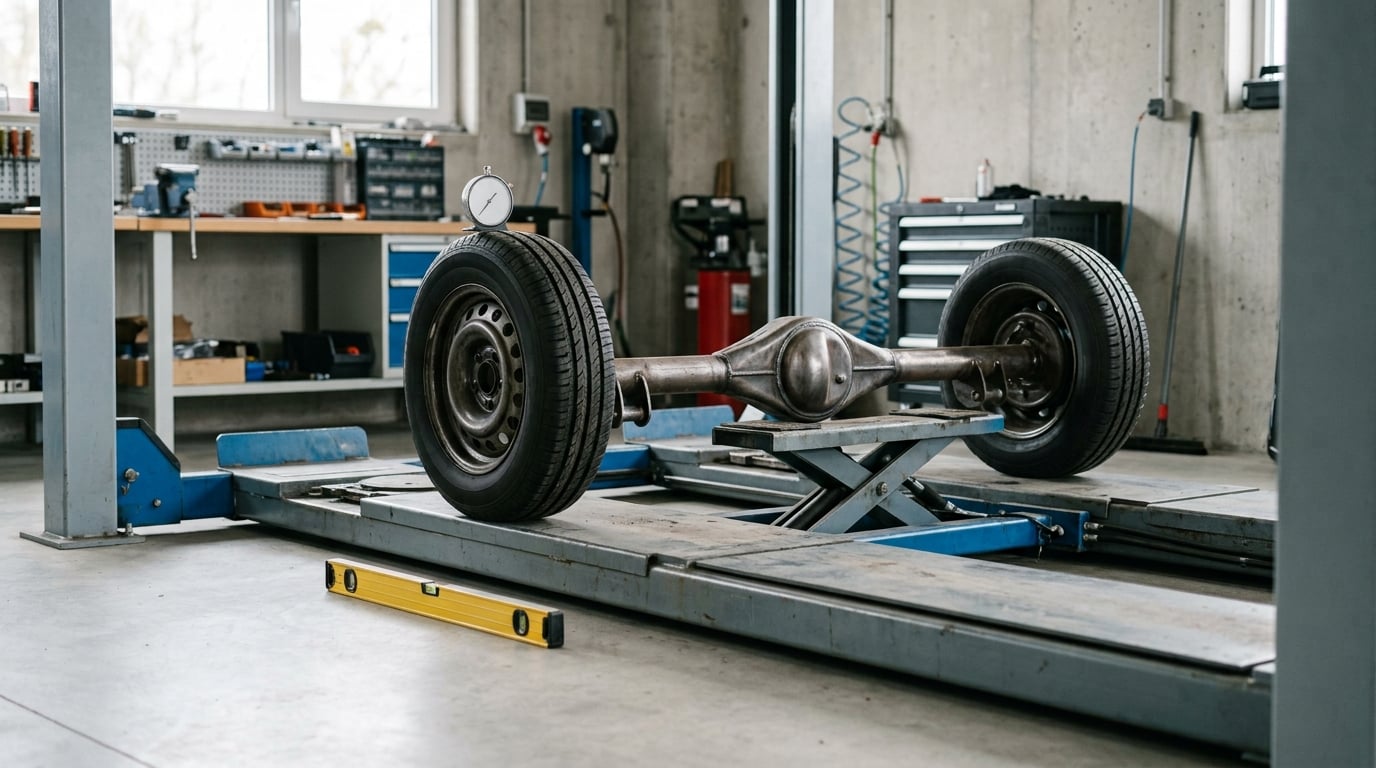
Camber, toe and caster are the three angles that describe where your wheels point relative to the car and to each other. Camber is the tilt of a wheel seen from the front, toe is the direction the wheels point seen from above, and caster is the tilt of the steering axis seen from the side. Get those three numbers right and the car tracks where you point it, the tires wear evenly, and the steering feels like the car you bought.
Most alignment conversations stop at “my car pulls.” This guide goes one level deeper. It explains what each angle physically does on a BMW, which symptoms map to which angle, how the numbers get measured, and what you can genuinely check in your own driveway versus what needs a proper rack. Last checked against current practice in 2026, and the numbers here are typical ranges for orientation only, not a spec sheet for your car.
Table of Contents
- Camber, Toe, and Caster at a Glance
- What Is Camber, Toe, and Caster?
- Why Camber, Toe, and Caster Matter for Your BMW
- What Happens When Camber, Toe, and Caster Are Wrong?
- How Alignment Measurements Are Taken
- How to Check and Adjust Camber, Toe, and Caster
- Factory Settings, Track Alignment, and the Trade-Offs
- Frequently Asked Questions
- Conclusion
Camber, Toe, and Caster at a Glance
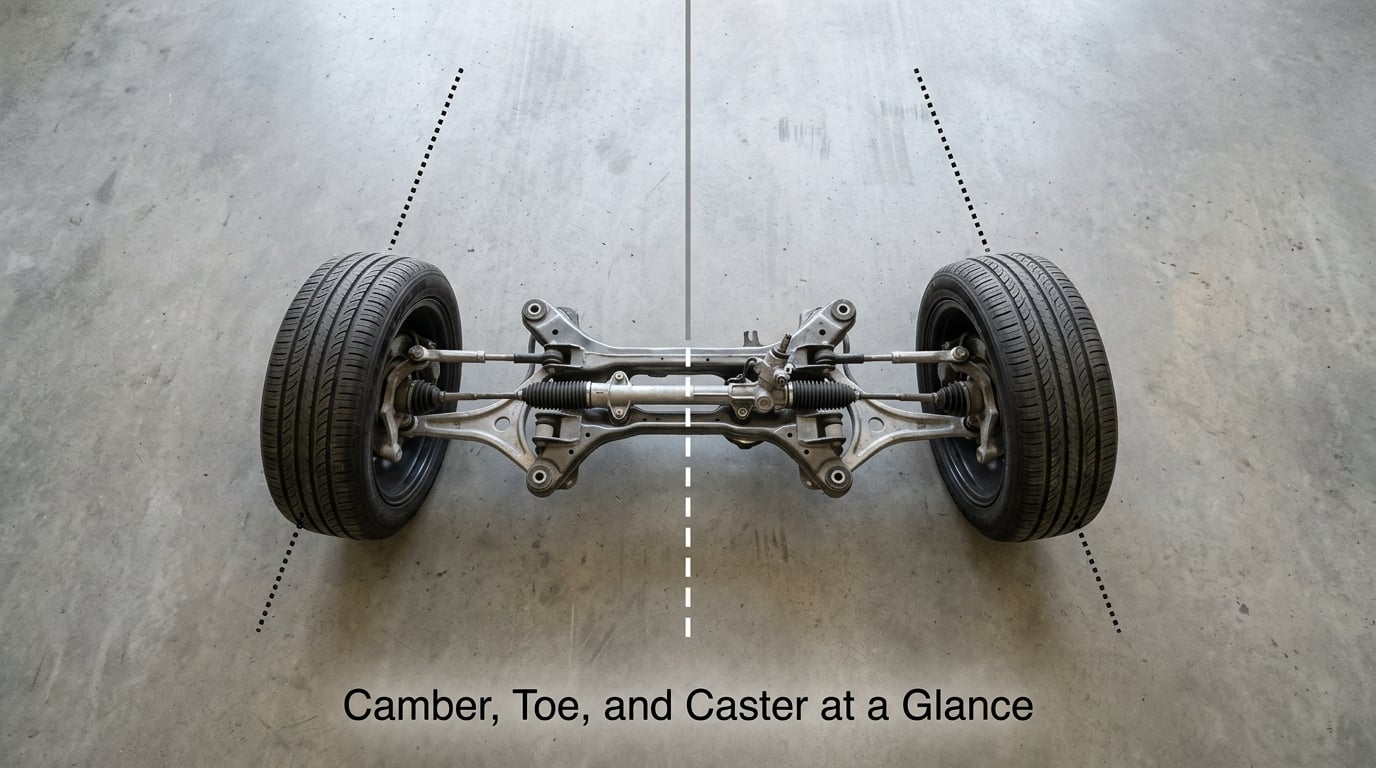
Here is the whole topic on one screen. The three angles are measured from three different directions, which is exactly why beginners mix them up.
| Angle | Viewed from | Positive means | Negative means | What it controls | Tire wear signature |
|---|---|---|---|---|---|
| Camber | Front | Top of the wheel leans out, away from the car | Top of the wheel leans in, toward the car | How the tire sits in a turn and where load lands across the tread | Uneven inner or outer shoulder |
| Toe | Above | Front of both wheels points outward, toe-out | Front of both wheels points inward, toe-in | Straight-line tracking and steering wheel centering | Feathered or saw-tooth tread across the width |
| Caster | Side | Top of the steering axis tilts rearward, toward the driver | Top of the steering axis tilts forward | Self-centering, straight-line stability, steering effort | No distinctive straight-line pattern |
One important framing before the details: positive and negative describe a geometric relationship to a measurement reference, not good or bad. A car can be perfectly aligned with more negative camber than the one parked next to it, because the target differs.
What Is Camber, Toe, and Caster?
Each angle describes something different about a wheel, and each one is created by a different part of the suspension. Keeping those two facts separate is the fastest way to stop confusing them.
Camber is the tilt of a wheel in or out from a vertical line, measured looking at the car from the front. Positive camber means the top of the tire leans away from the centerline. Negative camber means the top leans toward the centerline, which is the “V” shape you see on a car set up for cornering. Camber is created by where the wheel sits on its mounting points: the upper control arm, the strut, and the knuckle.
Toe is the direction the front of a wheel points, measured looking down from above. Toe-in, negative toe, means the fronts of the wheels point toward each other, like pigeon feet. Toe-out, positive toe, means the fronts point away from each other, like duck feet. Toe is created by tie rod length and the position of the steering rack.
Caster is the angle of the steering axis, the imaginary line running through the top and bottom of the wheel’s pivot points, measured from the side. Positive caster tilts the top of that line rearward. Caster is created by the geometry of the strut mount and the position of the steering axis relative to the wheel’s contact patch, and on many BMWs it is the angle that does the most for straight-line stability.
Camber Toe and Caster in One Suspension View
Put yourself above the car, then in front of it, then beside it, and the three angles stop overlapping.
From the front, you see camber. The wheel leans in or out of vertical, and a short line drawn down the center of the wheel makes the lean obvious.
From above, you see toe. The wheel pivots in or out of straight ahead, which is why toe changes are made by turning the tie rod rather than by moving a mount.
From the side, you see caster. The steering axis leans back at the top, and the distance between where that axis meets the ground and the tire’s contact patch is what produces the self-centering feel at the wheel.
Also worth naming, since it shows up on shop printouts: the steering axis inclination, also called SAI or included angle. It is the angle the steering axis makes with the vertical, and it is calculated rather than adjusted. SAI plus camber is how a modern four-wheel alignment machine works out thrust angle, which is the direction the rear axle points. Plenty of “the rear is out” complaints are really a thrust angle problem that started at the front.
Confusing the views leads to wasted money. Owners see a wheel leaning and assume camber when the actual fault is a bent or worn component, or they replace a tire for a pull that is actually toe.
Why Camber, Toe, and Caster Matter for Your BMW
Alignment geometry decides how a tire meets the road. When all three angles match the spec, the contact patch sits flat, the car tracks straight, and cornering loads go where the suspension engineer intended.
BMW specifically is worth understanding here, because the brand builds several layouts that make alignment more complicated than a single front reading. Four-wheel drive models need all four corners within tolerance, and a rear caster or camber error on a driven axle shows up as noise and a wandering rear axle. Models with rear steering turn the back wheels against the front ones at low speed, and the rear alignment spec is part of that system’s calibration. Adaptive dampers can change ride height slightly with temperature and load, and a car that is measured cold with a sagging battery is a car measured wrong.
The practical payoffs are quieter and more ordinary than people expect. Tires last their rated mileage instead of wearing a shoulder in 15,000 miles. Braking stays predictable, which is a bigger deal in rain than most people realize, and it connects to how your car slows down in general. If you have not looked at how regen and friction braking split under load, the regenerative braking explained for beginners guide covers the basics and why traction matters as much as pedal feel.
Steering effort is the quiet one. Correct caster makes the wheel want to return to center after a turn. Too little and the car feels vague and the wheel feels like it has no memory of where it was pointing.
What Happens When Camber, Toe, and Caster Are Wrong?
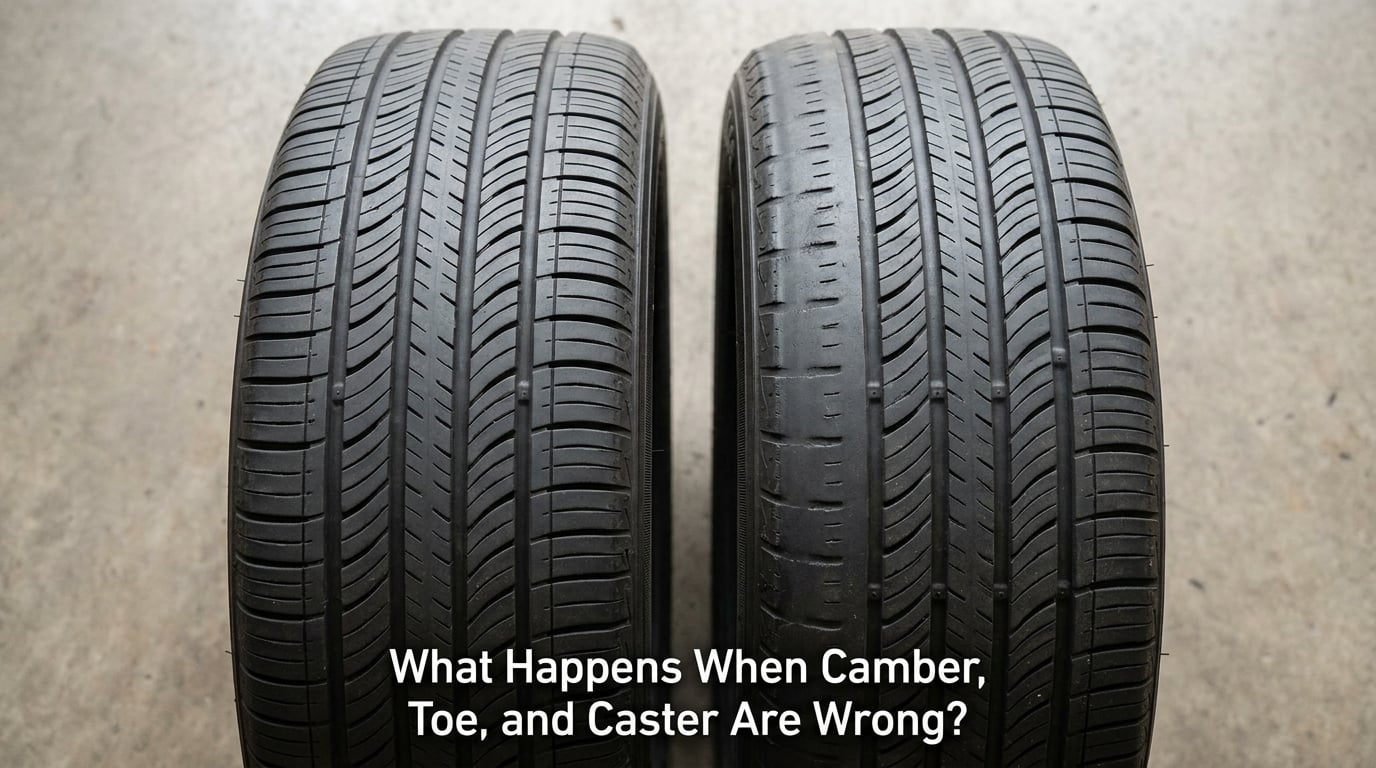
Each fault produces a different set of clues, and matching symptom to angle is most of the diagnostic work.
| Symptom | Most likely angle | Also check |
|---|---|---|
| Car pulls to one side, hands barely off the wheel | Toe, usually total toe out of spec | Camber, a bent wheel, a worn tire, road crown |
| Steering wheel sits crooked when driving straight | Individual toe, not total toe | Steering wheel centered before the alignment |
| Tread feathering, saw-tooth edge one way across the tire | Toe | Tire pressure, wheel runout |
| Inner shoulder worn smooth, outer edge still grooved | Too much negative camber | Ride height, lowered suspension, tire pressure |
| Outer shoulder worn, inner edge unused | Too much positive camber | Sagging or collapsed spring, worn ball joint |
| Dipping potholes, tire cupping, vibration that changes with speed | Usually not an alignment angle | Wheel and tire balance, shock absorber condition |
| Heavy or vague steering, wheel does not return to center | Too little caster | Play in tie rods, worn steering rack |
| Heavy on-center steering, nervous in ruts, car wants to swap ends | Too much caster | Aggressive camber setting, low-profile tires |
The row people miss is the last one, and the row above it is why. Caster leaves no recognizable straight-line tread pattern, so a worn tire can never tell you that caster is wrong. That is the single most common gap in DIY diagnosis, and it is why “my tires look fine, so the alignment must be fine” fails as a test.
Two more reality checks. A wheel that visibly leans when you look at it from the curb is not proof of anything, because tire sidewall bulge, body stance and road crown all shift the apparent angle. And a vibration at highway speed that disappears when you slow down is almost always a balance problem rather than an alignment problem, which is a genuinely different repair.
How Alignment Measurements Are Taken
An alignment machine works by bouncing a beam or a camera off sensors clamped to each wheel, then comparing the reflected angles. The numbers it prints are only as good as the setup around them.
Toe is reported two ways. Total toe is the sum of the two front wheels, so two readings of 0.05 degrees toe-in each add up to 0.10 total. Individual toe is each wheel on its own, and it is what tells you whether the steering wheel will be centered. A car can sit perfectly inside the total toe range and still have one wheel pointing noticeably out, which is why the wheel is off-center and the tire shows a little feathering on one side only.
Some machines also report toe as a linear measurement at the rim, in millimeters or inches, the distance the front edge of the tire sits ahead of or behind the rear edge. That number is the easiest home check to reproduce with a tape measure, which is why it comes up so often in DIY threads.
Caster is measured from the side. A mechanical caster gauge uses a bubble level against a magnetic base on the steering head, which is why a mechanical reading can be thrown off if the wheel is not exactly centered. Electronic sensors remove that error by measuring the steering axis directly at two points.
Camber is measured from the front, and it is reported with the sign convention of the machine. Confirm which convention your shop’s printout uses before you argue about whether a number is positive or negative.
Three setup conditions change every reading. Ride height has to match the specification, which is why a car measured with a weak battery and sagging rear sits low and reads more positive camber at the back. Loading has to be consistent, either at the curb weight or at the curb weight plus a driver, depending on the car. And the floor needs to be level, because a rack on a slope reads a car that is level as a car that is not.
Ride height is also the quiet reason a lift or lowering kit changes alignment. Lowering the car moves the strut top relative to the control arm, which changes camber, and often changes caster enough that toe has to be reset afterwards. An alignment done before the change is not just slightly off, it is measuring a car that no longer exists.
How to Check and Adjust Camber, Toe, and Caster
Start with what you can confirm, then decide whether the car needs a shop. A home check is a screening tool that tells you whether to spend money, not a substitute for a machine.
First, look at the tires. Check pressure cold and inflate to the door placard figure, because a soft tire changes the shape of the contact patch and can imitate a camber problem. Look across the tread for feathering, and along both shoulders for uneven wear.
Second, check ride height. Compare the car to its specification, ideally on a level surface, and note anything that has recently changed, including a lift, a lowering kit, or a spring that has sagged.
Third, look for play. Worn tie rod ends, control arm bushings, ball joints and wheel bearings all move the wheel while you work, and any reading taken with play in the suspension is worthless. Push the tire at the top and bottom and at the 3 and 9 o’clock positions and watch for anything moving that should not be. If you have to pick the correct fasteners and you are not sure of the sizes, the guide to metric vs SAE socket sizes, fit and safety is worth a few minutes.
Fourth, measure toe at home. Mark the center of each front tire at the same height, front and rear, rotate the wheel 180 degrees, and measure the front and rear distances between the marks. The difference is your toe. The real trap is suspension flex, so support the car or unload the bushings properly, and remember that the outer tie rod end rises or falls when caster changes, which moves toe on most designs.
For caster at home, a string and a weight gives a rough relative reading rather than an absolute number. For camber, a plywood square or a straightedge held against a known vertical reference tells you whether the lean is growing or shrinking as you turn the adjuster. Neither is a substitute for a machine, and I would not buy specialty tools to chase half a degree.
Fifth, if a shop is involved, the adjustment order matters. Cast first, then camber, then toe, because changing caster moves the height of the outer tie rod end and therefore moves toe. Set toe last so you are not undoing work. On a four-wheel drive car, ask the shop to specify the sequence for the rear axle too.
Sixth, when you book it, say what you want measured and set. Ask for camber, caster and toe on all corners, on the axle you drive on, not a front-only alignment. Ask for a before and after printout, and ask what the spec is for your model and year. If a reading cannot be brought into range, that usually means a worn or bent component rather than a bad setting, and the answer is a repair, not more adjustment.
Factory Settings, Track Alignment, and the Trade-Offs
Alignment is not one set of numbers. BMW specs differ by model, year, suspension option, tire size and market, and the driver’s door jamb placard plus the service data for your specific vehicle are the authority. Anyone giving you a universal target is guessing.
For orientation only, a typical passenger car lands somewhere around 0 to 1 degree of camber per side on the front, roughly 0.1 to 0.3 degrees of total toe, and caster in the range of a few degrees positive, with many modern cars running more caster than older designs. These are rough bands, not specs.
Track and aggressive street setups push the numbers, and the trade-offs are real. An enthusiast on an enthusiast forum described 1.5 degrees of negative camber as turning exceptionally well, while also reporting the car felt nervous in road ruts and tracked less straight than it used to, with only 0 to 1/32 inch of toe. That is an honest description of the trade: more grip in a corner, less stability in a rut and worse straight-line tracking.
Maximizing one angle always costs something elsewhere. Stiffer caster makes the car stable and self-centering, but heavier at low speed and twitchier over bumps. More negative camber puts more rubber down when leaning into a corner and wears the inner shoulder faster on the commute. Pushing toe out improves turn-in and gives up straight-line stability.
One more thing that gets confused with geometry: visible wheel position at rest is not a measurement. Ride height, body roll, and tire bulge make a car look tilted that is perfectly aligned, which is why the machine exists.
Frequently Asked Questions
Do I need to replace tires when an alignment is corrected?
Sometimes. If the inner or outer shoulder is already worn smooth while the opposite edge still has deep grooves, the tire is no longer square to the road and that tire will wear out faster no matter how well it is aligned. Feathered or cupped tread is often fixable by rotating and re-aligning. On a BMW with an aggressive setup, replace tires that are corded, cracked, or worn past the wear bars in any case, and always replace in pairs on the same axle.
How often should camber, toe, and caster be checked?
Annually is a reasonable baseline, and more often if you drive lots of miles, hit potholes, or tow anything. Check sooner after any suspension work, after a lift or lowering, after a kerb strike or impact, before fitting new tires, and the moment you notice a pull, a crooked steering wheel, or a change in tire wear. Checking before new tires is the cheapest timing, because it prevents a bad alignment from shortening them.
Can bad alignment damage BMW suspension parts?
Yes, but usually slowly. Tires that are no longer square to the road scrub, which loads ball joints, tie rod ends, control arm bushings, and wheel bearings harder than they are designed for, and uneven loading accelerates shock and strut seal wear. The bigger risk is doing the alignment before fixing a worn part, because the new setting will not hold. Replace worn components first, then align.
Why does my car pull even after an alignment?
Common causes: the shop set only total toe and left individual toe unbalanced, the steering wheel was not centered before measuring, a tire is worn or the wrong size for the spec, one side has a worn shock absorbing bumps unevenly, or a bent wheel or tracking component is shifting the reading. A pull on a crowned or heavily worn tire can also be real even at correct settings. Ask for a before and after printout showing every angle on every wheel.
Should I use the BMW factory alignment or a track setup?
Use the factory specification if the car is a daily driver, carries passengers, tows, or runs on the street in poor weather. It is tuned for ride quality, tire life and predictable behavior. A track setup trades straight-line stability, steering effort and tire life for cornering response, and it is more demanding in ruts and standing water. If you do run aggressive angles, have them set to written numbers rather than asking for a generic track alignment.
Conclusion
Start with the first diagnostic step, not the parts bin. Confirm what the car is actually doing, inspect the tires and the suspension for play, then have camber, toe and caster measured on every wheel and compared against the specification for your exact model and year. Camber toe and caster explained properly comes down to three numbers, the right target, and the adjustment order that keeps them consistent.