
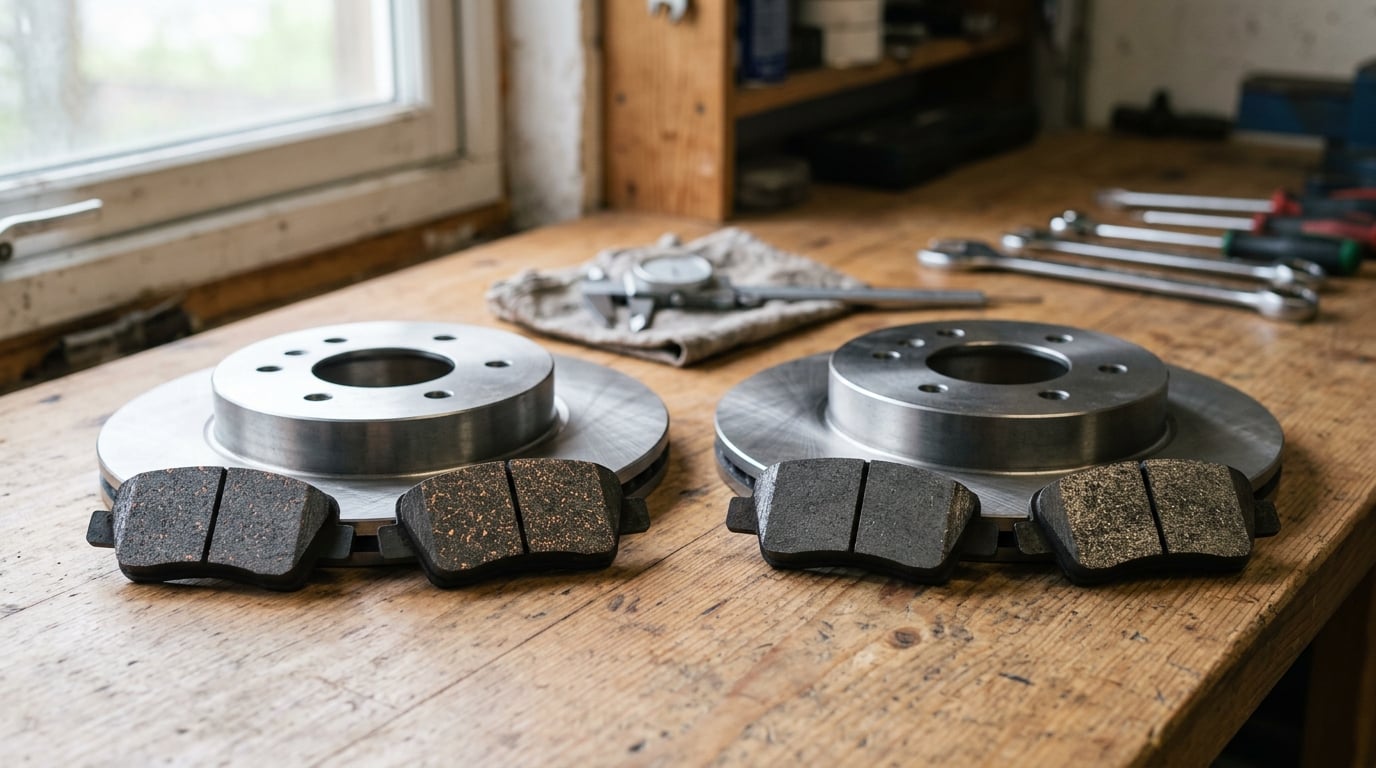
Ceramic brake pads are quieter, produce far less visible dust and suit most daily drivers. Semi-metallic pads hold a stronger bite, shrug off repeated hard braking and make more sense for towing, mountain roads and hard use. The right pick comes down to what your car came with and how you drive it, not which label sounds better. Updated for 2026.
Most of the confusion here comes from marketing, not engineering. A pad labelled ceramic is usually a low-metallic compound, and a magnet will not tell you what you have. So let’s work through what each type actually is, how they behave, and when one clearly beats the other.
Table of Contents
- Ceramic vs Semi-Metallic Brake Pads at a Glance
- How Ceramic and Semi-Metallic Brake Pads Are Made
- Which Type Has Better Stopping Performance?
- How Do They Handle Heat and Repeated Hard Braking?
- Ceramic vs Semi-Metallic Brake Pads: Noise, Dust and Daily Comfort
- Which Works Better in Rain, Snow and Cold Weather?
- Wear, Cost and Vehicle Compatibility
- Which Should You Choose?
- Frequently Asked Questions
- Conclusion
Ceramic vs Semi-Metallic Brake Pads at a Glance
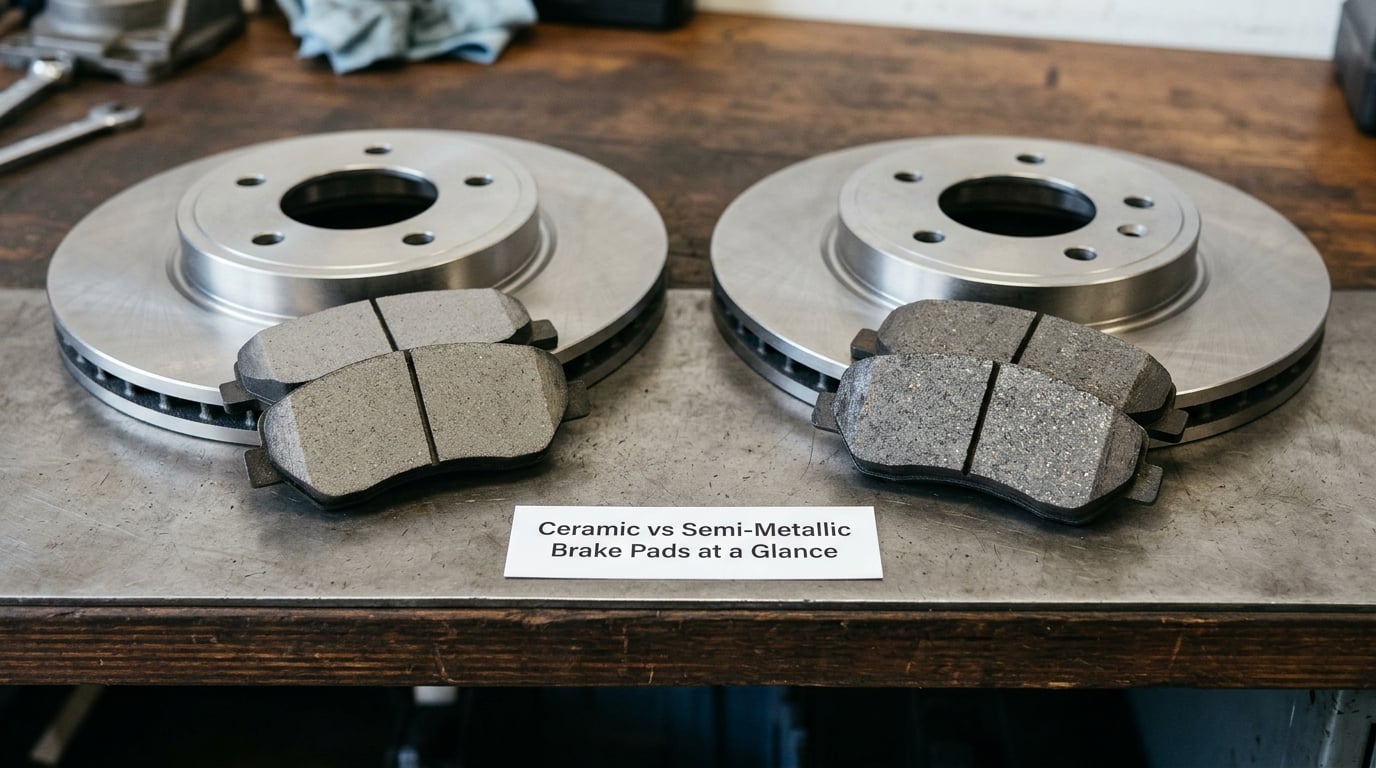
This table answers the question in one view. The right-hand column is the honest trade-off you are making, not a score.
| Criterion | Ceramic (low-metallic) | Semi-metallic |
|---|---|---|
| Initial bite, cold | Good, but takes a few stops to settle | Very strong from the first stop |
| Warm stopping distance | Short and consistent | Short and consistent |
| Pedal feel | Firm, with a slightly longer pedal travel | Firm with more bite and clearer feedback |
| Heat and fade resistance | Very good, weaker in sustained maximum braking | Excellent under repeated heavy braking |
| Noise | Quiet in normal use; still not silent | Louder, especially cold and over bumps |
| Brake dust | Very little, light grey or tan | Noticeably more, dark grey to black |
| Rotor wear | Gentle on rotors | Faster rotor wear, plan on resurfacing or replacing |
| Wet and icy grip | Similar; no material advantage | Similar; no material advantage |
| Typical pad life | Roughly 40,000 to 70,000 miles | Roughly 30,000 to 50,000 miles |
| Best suited to | Commuting, highway, quiet cars, street driving | Towing, mountain descents, delivery work, track days |
How Ceramic and Semi-Metallic Brake Pads Are Made
Both types are sintered friction materials. A backing plate of steel holds a friction layer pressed against the rotor, and the recipe of that layer is where the two diverge.
What ceramic brake pads actually contain
A ceramic pad is a blend of ceramic fibres, a resin binder, filler materials and a small amount of metal, often copper or steel. The ceramic fibres handle heat and wear, the resin holds it together, and the fillers tune the friction.
One important clarification: almost every pad sold as ceramic today is a low-metallic or semi-ceramic compound, not a pure ceramic material. Pure ceramic pads exist for racing but are expensive, brittle and not what you want on a road car. When a shop says ceramic, they mean low-metallic, and the same applies to the semi-metallic pads most cars ship with.
What semi-metallic brake pads actually contain
Semi-metallic pads run roughly 30% to 65% metal by weight, typically steel wool, iron powder or aramid fibres, bound in resin with friction modifiers added. The heavy metal content is what gives them their strong bite and heat tolerance, and also what makes them abrasive against a rotor.
The magnet test does not work
Placing a magnet on a pad tells you almost nothing useful. It confirms that some metal is present, which both types have, and it says nothing about quality, friction coefficient, or the rest of the formula. A low-metallic pad can grab a magnet and still behave like a ceramic pad.
Where organic and low-metallic pads sit
Organic pads use rubber, glass fibre and resin. They are quiet, cheap and gentle on rotors, but they fade earlier and wear faster, which is why they are disappearing from modern cars. If your owner manual specifies an organic or low-metallic compound, that framing matters more than the ceramic versus semi-metallic debate.
Which Type Has Better Stopping Performance?
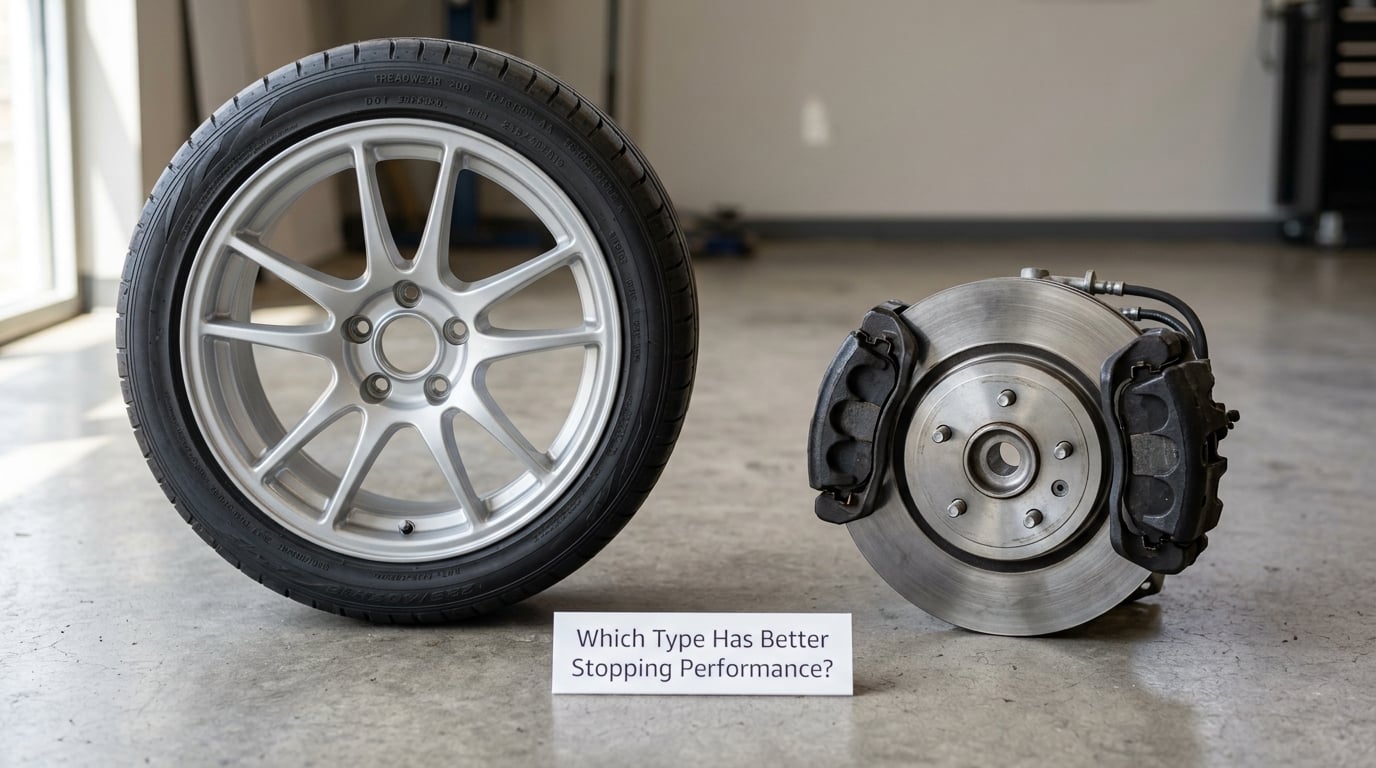
Between a properly made ceramic pad and a properly made semi-metallic pad, warm stopping distance is nearly identical. What differs is pedal feel, cold bite and how the friction holds up once the rotors are hot.
Semi-metallic pads usually bite harder and earlier, so a driver feels a stronger deceleration on the first touch of the pedal. Ceramic pads tend toward a slightly softer initial engagement and a longer, more even pedal stroke. Experienced drivers notice that difference. They rarely notice a change in the actual stopping distance from a steady pedal press.
Here is the part that matters more than the label: tire grip sets the stopping distance. On dry pavement, a good tire on a semi-metallic pad will beat a worn tire on a ceramic pad by a wide margin. Brake design, caliper piston area, rotor diameter, ABS, and road surface all carry more weight than the friction material alone. Pad compound only becomes the deciding factor when everything else is equal, or when the driving is hard enough to heat the brakes.
Avoid the marketing claim that one material gives you shorter stopping distances in normal conditions. A reputable pad manufacturer publishes a friction coefficient curve and an operating temperature range for a reason: no compound is best everywhere. Choose the one whose window matches your driving.
How Do They Handle Heat and Repeated Hard Braking?
Semi-metallic pads win the heat category, and it is not a subtle difference. Metal conducts heat away from the friction surface and tolerates temperatures that would cause a resin-rich pad to glaze or fade.
Fade shows up as a long, soft pedal after repeated hard stops, exactly what happens on a mountain descent, a long grade with a loaded trailer, or several laps of hard braking. At that point the friction coefficient of a ceramic pad drops noticeably while a semi-metallic pad keeps working. For a tow-hauler or a delivery driver running hills all day, that gap is the whole argument.
For ordinary commuting, the difference never shows up because the brakes never get that hot. Rotor diameter and venting still control how much heat the system can absorb, so bigger rotors and good cooling buy you more margin than any pad swap. If you track a car regularly, the correct answer is a sintered or performance pad, which is a different category again.
Ceramic vs Semi-Metallic Brake Pads: Noise, Dust and Daily Comfort
Owners switching pad types almost always say the same two reasons: noise and dust. Stopping distance rarely enters the conversation.
Noise
Ceramic pads are quieter in everyday use. They do squeal sometimes, usually at low speed or when cold, but it is usually brief. Semi-metallic pads transfer more vibration into the caliper and body structure, so they are louder over speed bumps, expansion joints and tight corners, and they can chirp on the first few stops after fitting.
That post-install squeal is normal on new semi-metallic pads and comes from the friction layer not yet seating against the rotor. The fix is a proper bed-in: several moderate stops from about 30 mph down to 10 mph, repeated around eight to ten times without coming to a complete stop, then a cool-down drive without touching the brakes. A clean and lightly greased pad edge, a noise damping shim, and clean caliper slide pins take care of most remaining cases. If squeal continues after bedding, the usual suspects are a glazed rotor, worn hardware or a bent pad.
Dust
Ceramic pads leave very little residue, and what appears is light grey or tan so it barely shows on a wheel. Semi-metallic pads shed noticeably more, and it is dark because it contains iron. Owners of delivery vehicles describe it as a permanent wheel-washing chore, and that is the single most common reason people upgrade.
Ceramic pads are not dust-free, though. Every friction material leaves some residue, and a dusty ceramic pad often means the pad has been sitting underused and glazing rather than that the compound is different. If you want to know what glazing looks like and how to fix it, read our guide on what brake pad glazing is and how to deal with it.
Uneven wear on one side is usually a caliper or hardware problem rather than a pad choice, and we cover that in why one brake pad wears faster than the other.
Which Works Better in Rain, Snow and Cold Weather?
Neither type has an edge in the wet. Wet stopping distance is governed by tire tread, water clearance under the tire, and how hard you brake. A pad compound you cannot feel through the pedal is not what separates a good stop from a bad one on ice.
Cold weather does affect both, in different ways. Semi-metallic pads hold a stronger bite on the first cold stop, which some drivers prefer on a frosty morning. Ceramic pads need a little heat in the friction layer before they reach their best coefficient, so the first few firm stops can feel softer, and pads that sit unused for months can glaze during that period.
If you drive in a cold climate, match the factory compound, keep the rotors clean, and drive gently until the brakes come up to temperature. If a rotor has surface rust or a hard glaze, cleaning it before fitting new pads matters more than the pad choice. Our walkthrough on how to clean new brake rotors before install covers the steps.
Wear, Cost and Vehicle Compatibility
Ceramic pads generally last longer, roughly 40,000 to 70,000 miles, and treat rotors more gently. Semi-metallic pads land nearer 30,000 to 50,000 miles and abrade the rotor faster, so rotors often need resurfacing or replacing at the second brake job. Owners who keep OEM low-metallic pads report exactly that pattern: fewer dust-covered wheels and longer-lasting discs.
Cost per set follows the same curve, and a full axle set of pads plus rotors is where the difference actually shows up. The cheapest way to control total cost is to treat the pair as a system, matching pads to rotor condition instead of choosing pads alone.
Compatibility is where guesswork turns into an expensive mistake. Match the friction code, the pad shape, the size and the axle position specified for your vehicle, and never mix one compound on the front and another on the rear unless the manufacturer allows it. Semi-metallic pads on one end and ceramic on the other change the balance under braking and can make the car pull.
Rotors are the other half. If your rotors are heavily scored, warped or thin below the minimum thickness stamped on them, new pads will not fix that. Pads bed into whatever surface they are given, and a fresh pad on a bad rotor wears fast and stays noisy.
Which Should You Choose?
Start with what the car came with. The factory compound was chosen for the engine weight, the brake sizing, the suspension and the duty cycle, and the single most trusted rule in owner forums is to stay with the OEM specification unless you have a clear reason not to. Long-term owners across BMW, Audi, Cadillac and Volvo communities consistently report more satisfaction from the factory compound than from an aftermarket upgrade.
For quiet daily commuting
Choose the OEM ceramic or low-metallic compound. You get low noise, minimal dust and gentle rotor wear, which is exactly what stop-and-go and school-run driving calls for.
For mixed city and highway driving
Either works, and the OEM choice still wins. Match front and rear, and change them as a set so the compound stays consistent across the car.
For towing and hauling
Choose semi-metallic. Sustained heat from loaded descents and repeated heavy braking is where the metal content earns its place, and fade is the failure you cannot afford.
For mountain roads and delivery work
Semi-metallic again. Expect more noise and more dust, and factor rotor replacement into the schedule. The dust is a real annoyance; fade on a grade is a safety problem.
For track days
Skip both. Buy sintered performance pads matched to your rotor type, and follow the bedding procedure exactly. If you also drive the car to the track, consider a dual setup.
For older or high-mileage vehicles
Stay with the OEM compound. Cost matters most there, and cheap pads on an old car usually mean noise, more dust and a second trip to the shop.
Frequently Asked Questions
Are ceramic brake pads better than semi-metallic brake pads for a BMW?
For most BMW owners, the factory low-metallic pad is the better choice. BMW brakes are sized for that compound, and owner forums consistently report OEM pads giving lower dust and longer rotor life than aftermarket alternatives. A good ceramic compound that matches the correct friction code and size will behave similarly, so match the specification rather than the label on the box.
Do ceramic brake pads stop a car in less distance?
Not in normal driving. Between a well-made ceramic pad and a well-made semi-metallic pad, warm stopping distance is nearly identical once tire grip is equal. Semi-metallic pads feel more aggressive on the first press, which drivers often mistake for shorter stopping. Tire condition, road surface, brake design and your own brake pressure are the factors that actually move the number.
Do ceramic brake pads create less dust?
Yes, far less of it, and the residue is light grey or tan instead of dark. That is the main reason many drivers switch. They are not dust-free, though, since every friction material leaves some residue, and a dusty ceramic pad is often a sign of glazing from sitting unused. Semi-metallic pads shed noticeably more dark iron-based dust on the wheel.
Can I mix ceramic and semi-metallic brake pads on the same car?
Only if the manufacturer permits it. Running a different compound on the front and rear changes the friction balance between axles and can make the car pull under braking, especially on light or wet surfaces. If you want a different material, change all four pads together and replace the rotors if the new compound is more aggressive than the one coming off.
How do I know which brake pad material my car requires?
Check three places. The owner’s manual or maintenance section often names the compound and friction code, the door jamb sticker lists tire and axle load ratings that point to the original specification, and the VIN gets you the build sheet and factory parts catalogue for your exact car. Take the friction code to a parts counter and they can match the correct pad directly.
Conclusion
Ceramic, usually meaning low-metallic, wins on quiet operation, low dust and rotor friendliness, which is why it suits most drivers. Semi-metallic wins on strong bite and heat tolerance, which is why tow-havers, mountain drivers and track-day cars choose it.
Before you buy either one, check your brake pad specification in the owner’s manual or service record, confirm the friction code and pad size for your axle, look at your rotor condition, and be honest about how you drive. Match the factory compound and you will not go wrong in 2026.