
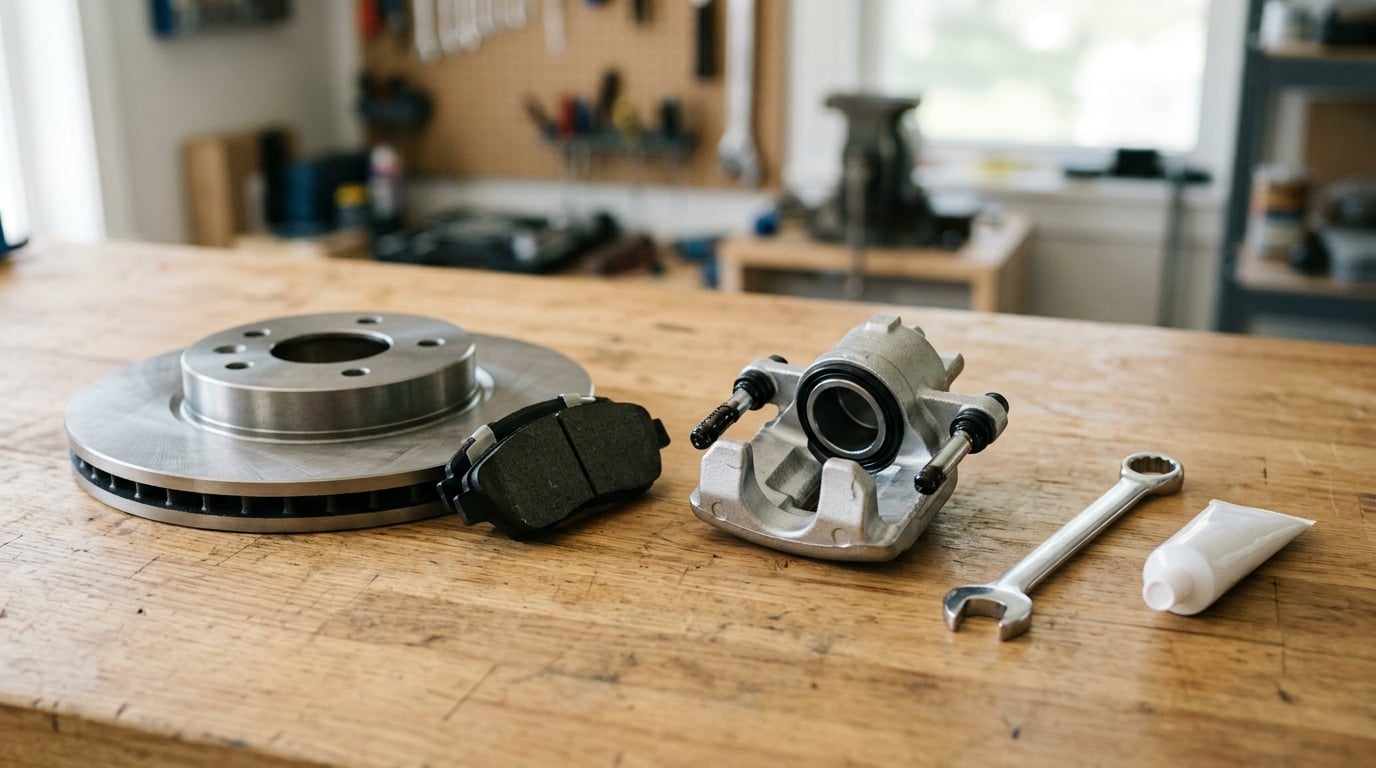
A high-pitched squeal in the first few hundred miles after a brake pad change is usually normal. New pad material has to burnish against the rotor before it stops complaining, and until it does, the pad and rotor can vibrate at a frequency your ear picks up as a squeal. If the noise is still there after a couple hundred miles of normal driving, or it comes with grinding, pulsation or a hot wheel, that is a fault rather than break-in, and it needs a look.
Here is the short version of what causes it:
- Factory protective coating on the pad’s friction surface that has not worn off yet
- Overnight moisture and light surface rust on the rotor that the pads scrape away on the first stops
- A bedding-in drive that never happened, or a pad that was never seated flat against the rotor
- Missing anti-noise shims, anti-rattle clips, or dry caliper slide pins forcing the pad to vibrate
Table of Contents
- Why Do My Brakes Squeak After New Pads? Causes at a Glance
- Is It Normal for New Brakes to Squeak?
- What Causes Brake Squeal After a Pad Change?
- How Can You Tell Whether the Squeal Is Normal or Dangerous?
- How to Fix Squealing After Installing New Pads
- When Should You Stop Driving and Get the Brakes Inspected?
- Frequently Asked Questions
Why Do My Brakes Squeak After New Pads? Causes at a Glance
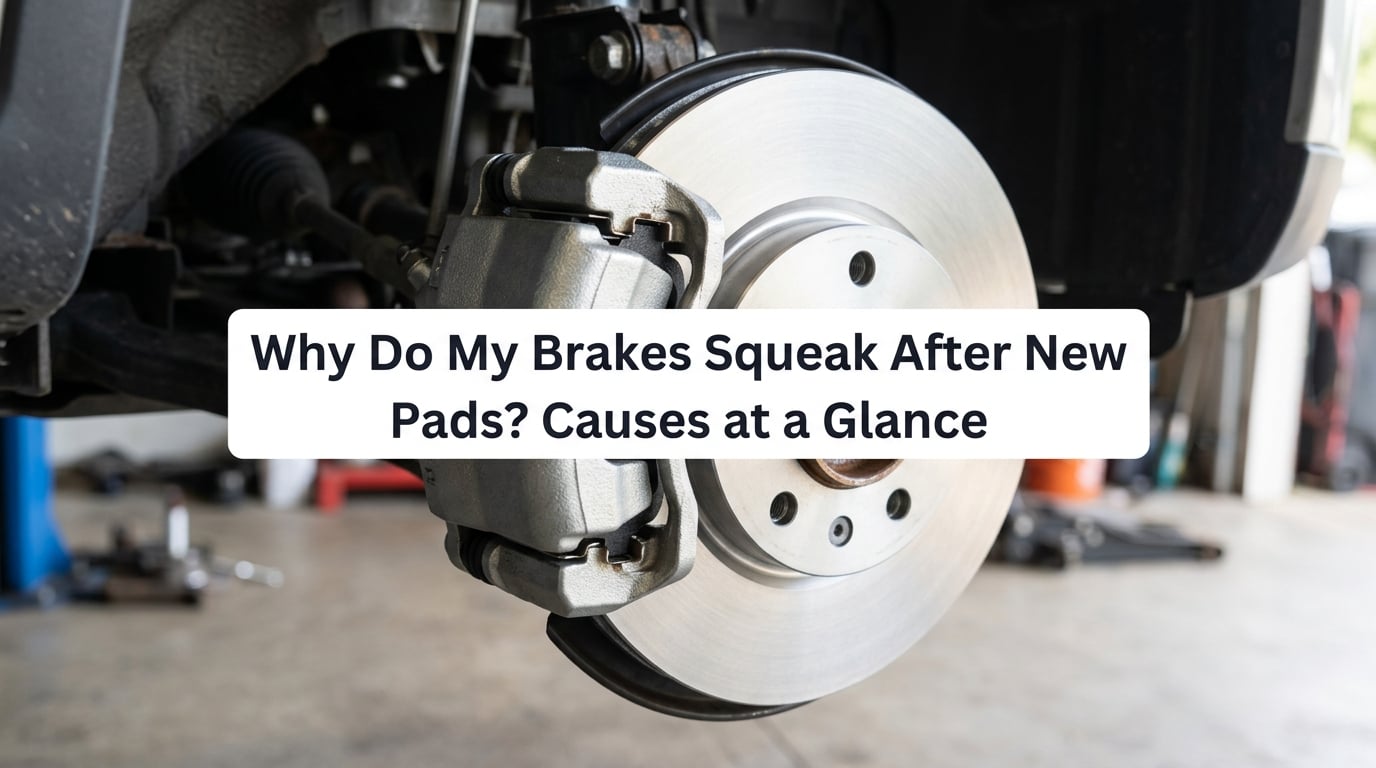
Brake noise is diagnostic information, not just annoyance. The table below maps what you hear to what is most likely behind it, how urgent it is, and what to do next.
| Noise | What it sounds like | Most likely cause | How urgent | What to do |
|---|---|---|---|---|
| Squeal | High-pitched whistle on light braking, gone under hard stops | Bedding-in, protective coating, surface rust, missing shims or clips | Low if it fades within a couple hundred miles | Run a proper bedding-in drive, then re-check hardware and lubrication |
| Grinding | Rough metallic scraping, often loud and constant | Worn or contaminated friction material, seized slide pin, pad pressed into rotor | Stop driving and inspect | Do not drive it. Have the corner disassembled and measured |
| Hum | Low growl that rises and falls with road speed | Warped or scored rotor, worn pads, sometimes tire noise | Medium | Check rotor thickness and runout, then pads and tire balance |
| Pulsation | Shudder or vibration through the pedal under braking | Thickness variation or lateral runout in the rotor | Medium to high | Rotor measurement and machining or replacement |
| Rattle | Clacking over bumps or at low speed | Loose hardware, missing clip, worn caliper bushings | Medium | Re-torque and reinstall all anti-rattle hardware |
| Pulling to one side | Car drifts when braking, often with a hot wheel | Stuck caliper piston, contaminated pad, seized guide pin | High | Stop driving. Caliper teardown and fluid check |
Is It Normal for New Brakes to Squeak?
Mostly, yes. Bedding-in, also called burnishing, is the process of laying an even transfer film of pad material onto the rotor. Until that film exists, the friction surface is uneven and microscopic high-frequency vibration travels up through the pad, its backing plate and the caliper into the body structure. That is the squeal.
The useful benchmark is distance, not days. Most factory and quality aftermarket pads settle down somewhere in the first 50 to 200 miles of ordinary driving. The noise you hear on the first gentle stop of a cold morning, then nothing for a week, is classic bedding-in behavior. So is a squeal that appears briefly after rain or after the car has sat for a week in the driveway.
A pattern that owners frequently misread is worth naming: the squeal shows up on gentle first stops and vanishes once you brake hard and the pads heat up. Warm pads grip, stop vibrating and go quiet. That does not mean a fault, though it does mean the break-in never fully took.
None of the following is break-in noise:
- Grinding, scraping or a metallic roar
- Shudder through the pedal or a vibration in the steering wheel
- A burning smell that does not fade, or one wheel that stays hot after a normal drive
- A pedal that goes soft, sinks toward the floor, or feels spongy
- A squeal that is still there, just as loud, after a few hundred miles
What Causes Brake Squeal After a Pad Change?
Work through these in the order you would actually investigate them: environment first, then installation, then the rotor.
Why Do My Brakes Squeak When Cold?
Overnight, the rotor cools and the steel contracts slightly. The pads do not contract at the same rate, so the first stop of the day puts a small edge-contact pattern on the rotor face instead of a flat, even one. Add a film of condensation or road spray, and the first firm stop of the morning is a slightly wet, slightly misaligned friction pair. That combination is the classic cold squeal. If the car spends more time parked than driven, the same rust-and-moisture cycle repeats far more often, and it is worth reading up on why brakes rust when a car sits before blaming the pads.
It also helps to know what is not happening. The rotor is not spinning in a circle during a cold morning — you are stopped. The sound comes from the transition, when the first light pressure moves the pad a fraction of a millimeter across a damp, uneven surface and the pad springs back. After a few stops the rotor is warm and dry, the contact patch is established, and the noise stops. On a hybrid, where regen handles much of the slowing, cold pads can stay quiet for days and then complain on the first hard mechanical stop, which is normal. We looked at why that happens in why hybrid brakes last longer.
Can Misaligned Pads or Dirty Calipers Cause Squealing?
Yes, and this is the most common genuinely fixable cause. A pad is held in the caliper by friction, plus a small amount of hardware meant to control how it can move. If the anti-noise shim was left off, the anti-rattle clip or pad spring was omitted, or the pad is not sitting flat against the rotor, the pad can chatter at a few thousand cycles per minute. That is a squeal, and it does not go away with mileage.
The caliper side has its own version of the same problem. Slide pins and guide pins are supposed to be coated with high-temperature grease or anti-seize so the caliper can float in and out as the rotor wears. A dry or seized pin stops that float, the pad retracts unevenly, and you get drag, heat, and often a pull to one side. Clean, grease the pins and the pad backing plate edges, and refit the shims and clips exactly as they came off.
One warning, because it comes up constantly: never spray WD-40, silicone spray, chain lube or any other lubricant on the pad friction material or the rotor face. It will quiet the noise for a few days and destroy your stopping performance, and you will not notice the difference until you need it. Lubricant belongs on the hardware, never on the surfaces that grip.
Can Worn or Resurfaced Rotors Cause the Noise?
They can. If the pads were replaced onto rotors that were already thin, the friction material gets less bite, runs hotter and vibrates more. If the rotors were resurfaced, the fresh cut surface is rougher than a factory-finished rotor and takes longer to transfer film onto, so a resurfaced rotor commonly squeals a little longer than a brand new one.
Two measurements decide whether a rotor is still usable: minimum thickness and lateral runout. A rotor below its minimum thickness stamp cannot be machined further and should be replaced. A rotor with too much runout, or with thickness variation across its face, will pulse no matter which pads you fit. A groove deep enough that your fingernail catches in it means the disc is worn past serviceable.
Pad compound matters too. Mismatching a hard ceramic pad onto a rotor cut for semi-metallic, or fitting a cheap pad whose backing plate is thin and flimsy, changes the vibration characteristics of the whole corner. If noise started immediately after switching from original equipment pads to a different brand, that is worth mentioning to whoever installed them. On hybrids, where pads barely move at low speed, the same mismatch tends to show up as uneven wear rather than noise, which is a different problem with a different cause.
How Can You Tell Whether the Squeal Is Normal or Dangerous?
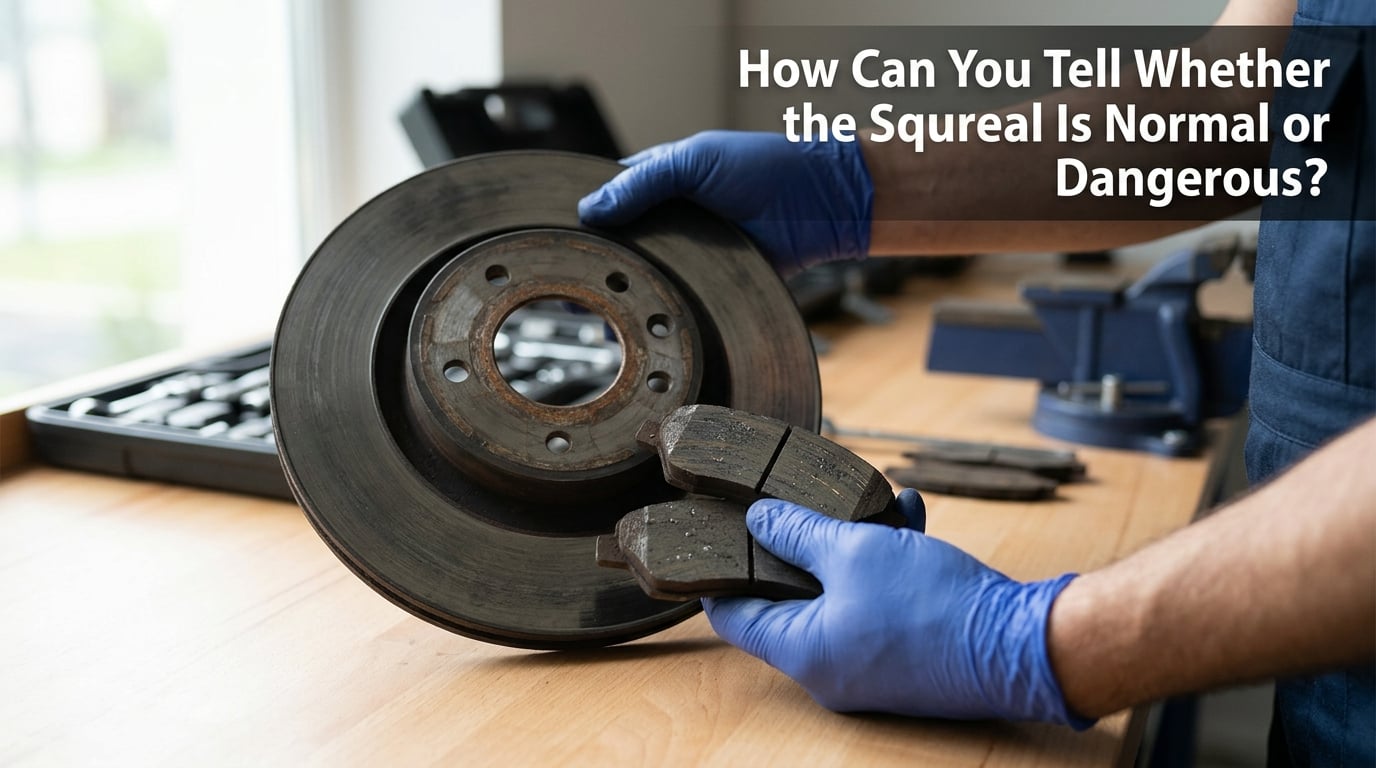
Run this in order, on level ground with the car parked and the engine off for the checks.
First, note when it happens. Does the squeal appear only on the first stop after sitting, only on light pedal pressure, only in the rain, or at every stop? Then note what changes it. If hard braking makes the noise disappear, you are dealing with a vibration or break-in issue. If the noise stays constant regardless of pressure, suspect hardware or the rotor.
Next, listen for the pedal. A shudder under braking that you can feel through your foot is thickness variation, and that is a shop measurement, not a guess. A pedal that stays firm is reassuring; one that creeps down while you hold pressure at a stop is a hydraulic problem that overrides any noise question.
Finally, do a visual check at each corner. With the wheel off, look at the rotor face for rust patches, a bluish glaze, scoring, a lip at the outer edge, or crack lines. Look at the pad friction material: a healthy pad is even across its width with no metal exposed and no shiny melted surface. Check the fluid level in the reservoir and look for wetness around the caliper or a stained wheel rim, which can look like brake dust but is fluid.
If the pads, rotors and hardware all look right and the noise is a fading high-pitched squeal on gentle stops, keep driving gently. If anything on that list is off, the answer is in the shop, not in your driveway.
How to Fix Squealing After Installing New Pads
Work in escalation order. Most squeals disappear in the first two steps.
- Bed the pads in properly. Drive at moderate road speed on a quiet road or a long straight stretch, then make 8 to 10 controlled stops from around 30 to 40 mph. Come to a near stop but do not come to a full stop and hold with your foot on the pedal; that leaves hot pads resting on a hot rotor. Space the stops out so the brakes cool between them, and finish with two or three laps at gentle speed. This is burnishing, and it lays the transfer film evenly.
- Confirm the right parts went on. Check that the pad compound suits the rotor, and that the friction material, shims, clips and hardware all came from the same axle set. Mixing pad types across an axle is a reliable way to keep the noise.
- Clean and lubricate the contact points. Remove the caliper, wipe the pad backing plates and the caliper abutments, and apply a thin film of high-temperature brake grease or a metal-free brake lubricant to the backing plate edges, the pad ears and the slide pins. Reinstall the shims and anti-rattle clips. Never touch the friction material or rotor face with grease.
- Fix installation errors. Reset the caliper so the piston fully retracts, seat the inner pad as the pistons clamp it, then slide the outer pad in. Pump the brake pedal firmly before refitting the caliper so the piston centers, and re-torque the wheel fasteners to the manufacturer figure with the car on the ground.
- Deal with the rotor. If the rotor is below minimum thickness, scored deeply, or measures excessive runout, it gets machined or replaced. A rotor that has already been cut once and is still too thin to pass minimum is finished, no matter how good the pads are.
If a shop did the work, most shops back their labor for a period measured in months or miles, and a persistent squeal is exactly the kind of complaint that warranty covers. Describe the noise rather than arguing about it: cold mornings only, gentle stops, gone when hot. That is a reproducible report, and it is much harder to dismiss.
When Should You Stop Driving and Get the Brakes Inspected?
Stop driving and have the brakes inspected the same day if you notice any of these.
- Grinding or scraping that does not fade
- Braking that feels longer than it used to, or a pedal that is soft, spongy or sinking
- Visible fluid around a caliper, a low reservoir level, or a wet or greasy wheel rim
- A burning smell that lingers, or one wheel that is noticeably hot to the touch after driving
- Heavy pull to one side under braking, or a steering wheel that is off-center after the pads went on
- Vibration through the pedal or steering wheel that scales with speed
- A visible crack, deep scoring or a lip on the rotor
Squeal alone, with firm pedal feel and no heat or smell, is not an emergency. It is a loose end. The other symptoms are the ones that turn a noise into a safety problem, and they deserve the car parked.
Frequently Asked Questions
How long should new brake pads squeak?
Most new pads stop squealing within the first 50 to 200 miles of ordinary driving, once the transfer film has formed on the rotor. Cold-morning squeal that disappears after a few stops can also appear intermittently much later. If the noise is just as loud after a few hundred miles, or gets worse instead of fading, the cause is hardware, lubrication or the rotor rather than break-in.
Is it safe to drive if my brakes squeak after replacing the pads?
Usually, yes, as long as the pedal feels firm, the car stops straight and there is no grinding, heat or smell. A fading high-pitched squeal on gentle stops is a nuisance, not a hazard. Stop driving immediately if the pedal is soft or sinking, the car pulls hard to one side, one wheel is hot, or you hear grinding, because those point to a hydraulic or caliper fault.
Do new brake pads need to be bedded in, and how is that done?
Yes. Bedding-in lays an even film of pad material on the rotor and calms the vibration that causes squeal. Drive at moderate speed on a quiet road, then make 8 to 10 controlled stops from about 30 to 40 mph, spacing them so the brakes cool between stops. Do not stop fully and hold the pedal, and finish with a few laps of gentle driving.
Why do my brakes squeak only at low speeds?
At low speed the pads are lightly loaded and the rotor runs cooler, so the pad has less grip and more room to vibrate, and the squeal is easier to hear against quieter cabin noise. At higher speed the pad runs hotter, grips more firmly and stops chattering. Noise on light braking that disappears under hard braking is usually bedding-in or hardware, not a worn rotor.
Why do the brakes squeak after the rotors are resurfaced?
Resurfacing leaves a rougher cut surface than a factory-finished rotor, so the pads take longer to transfer an even film onto it and the break-in window is longer. A resurfaced rotor is also thinner, and if it is near its minimum thickness it can warp and lose runout, which produces noise and pedal pulsation. A rotor cut below the minimum thickness marked on it should be replaced.
Can brake lubricant stop squealing?
Only on the hardware, never on the friction surfaces. A thin film of high-temperature brake grease or metal-free brake lubricant on the pad backing plates, pad ears and caliper slide pins kills chatter caused by vibration and dry pins. Lubricant on the pad material or rotor face makes the noise go away while sharply reducing stopping performance, and WD-40 is no safer there.
Start with a proper bedding-in drive: 8 to 10 controlled stops from 30 to 40 mph, spaced out to let the brakes cool, and no full stops with your foot on the pedal. Most of the squeal you are hearing right now goes away during that drive. If it does not, pull the caliper and look at the hardware, the shims and the slide pins, and measure the rotor. If the car has been sitting for months between drives, work through our guide to maintaining brakes on a car you rarely drive while you are in there.