

DOT 3 vs DOT 4 brake fluid comes down to heat tolerance: DOT 4 is rated for a higher boiling point, so it resists fade under repeated hard braking, while DOT 3 is cheaper per bottle and absorbs water a little more slowly. Both are glycol fluids that mix safely with each other, and the right choice for most drivers is whichever grade your owner’s manual or reservoir cap specifies.
That is the short version. The details matter more than most people expect, because brake fluid is the only part of your braking system that quietly degrades, and the grade you pick affects how much heat margin you have on a mountain descent or a track day.
I have pulled fluid from enough cars to know the two most common mistakes: people downgrade because DOT 4 sounds like an upgrade they do not need, and people over-spec a car that only ever asked for DOT 3 and then wonder why the fluid needed changing sooner. Both are avoidable with a clear rule, which is what this guide builds.
Table of Contents
- DOT 3 vs DOT 4 Brake Fluid at a Glance
- What Is the Difference Between DOT 3 and DOT 4 Brake Fluid?
- DOT 3 vs DOT 4 Brake Fluid Boiling Points
- Which Fluid Handles Repeated Hard Braking Better?
- How Does DOT 4 Fluid Perform in Cold or Wet Weather?
- Can You Mix DOT 3 and DOT 4 Brake Fluid?
- Which Brake Fluid Should You Use in a BMW?
- How Do You Check and Change Brake Fluid Safely?
- Which Should You Choose?
- Frequently Asked Questions
- Bottom Line
DOT 3 vs DOT 4 Brake Fluid at a Glance
These are the published minimums from the federal standard, not marketing numbers. Every genuine DOT 3 and DOT 4 fluid on a shelf must at least meet them.
| Specification | DOT 3 | DOT 4 |
|---|---|---|
| Minimum dry boiling point (ERBP) | 401 F (205 C) | 446 F (230 C) |
| Minimum wet boiling point (WRBP) | 284 F (140 C) | 311 F (155 C) |
| Minimum viscosity at -40 C | 1500 mm2/s | 1800 mm2/s |
| Base chemistry | Glycol ether | Glycol ether |
| Typical moisture uptake | Moderate | Faster |
| Handling | Fully serviceable | Fully serviceable |
| Common applications | Most passenger cars, light trucks, SUVs | Towing vehicles, performance cars, many European makes |
| Best match for | Ordinary commuting and mild weather | Repeated hard braking, heat, load |
Read the wet boiling point row carefully, because that is the number that decides whether you get fade on a long descent. The dry number describes brand-new fluid. The wet number describes fluid that has absorbed water, which is what your car actually holds after a year of driving.
One more row worth knowing: both grades are hygroscopic, meaning they pull moisture out of the air and slowly out of rubber hoses. That is not a defect. It is the reason fluid has a service interval at all.
What Is the Difference Between DOT 3 and DOT 4 Brake Fluid?
Both standards come from Federal Motor Vehicle Safety Standard 116, and both are also written into the industry specification SAE J1704. DOT is simply the name of the grading system, and the number is a performance class, not a quality score or a brand tier.
Your master cylinder and calipers push fluid through lines and hoses to transmit pedal force. Heat from friction and from the engine bay cooks that fluid. When enough of it boils, the vapor pockets compress instead of transmitting pressure, and the pedal goes soft and long. That is brake fade, and it is the entire reason DOT 4 exists as a separate class from DOT 3.
Here is the honest part that the sales counter will skip. DOT 4 is not a better fluid in every way. It carries a higher heat margin, but it also takes on water faster, and water pulls its boiling point down. In cold, wet climates that tradeoff is worth thinking about, and in mild climates DOT 3 in good condition can easily outlast DOT 4 in neglected condition.
Labels also vary more than the standards do. A DOT 3 fluid from a good manufacturer may well exceed the DOT 4 minimums, which is why enthusiasts running older cars on DOT 3 for decades rarely have a problem. Always check the specification sheet, not the bottle front.
DOT 3 vs DOT 4 Brake Fluid Boiling Points
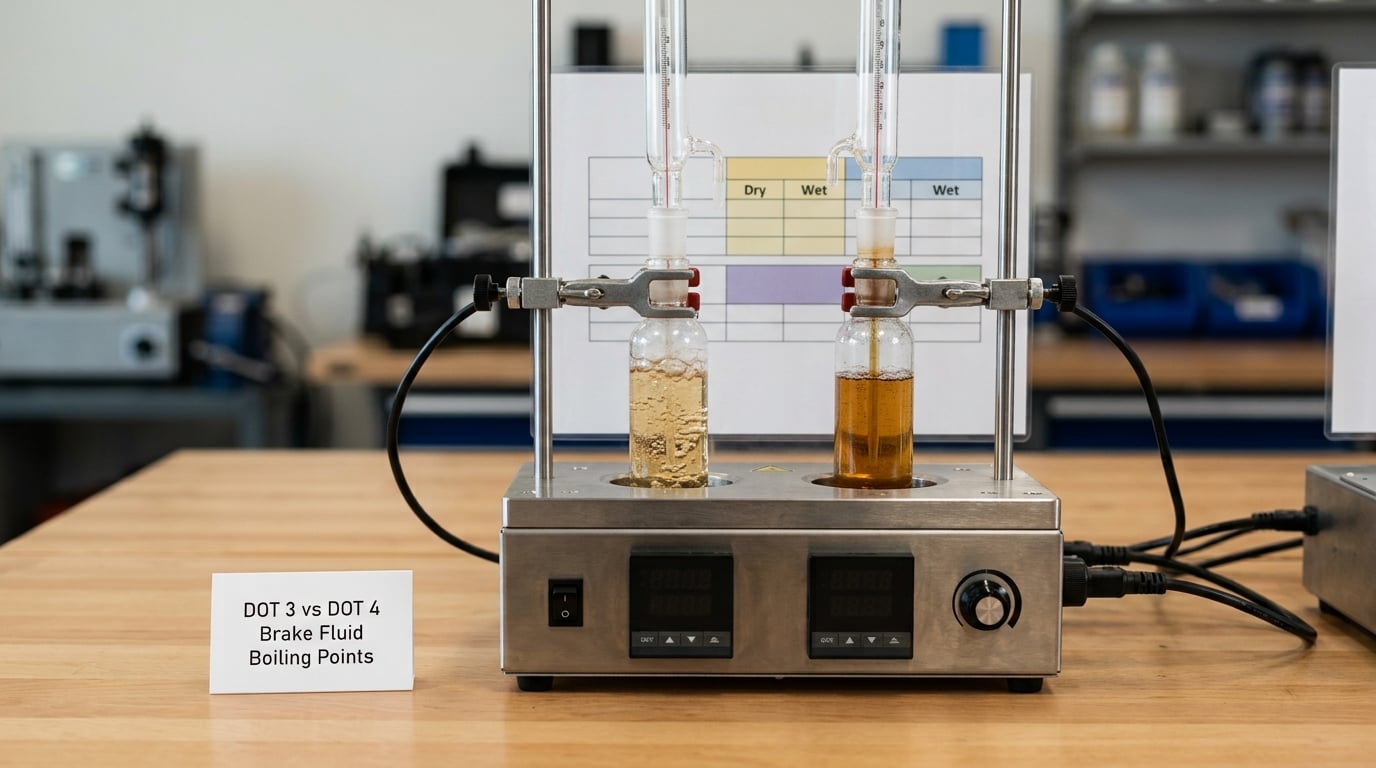
DOT 3 must meet a minimum dry boiling point of 401 F and a wet boiling point of 284 F. DOT 4 must meet 446 F dry and 311 F wet. Those four numbers are the whole argument, and they come straight out of the federal minimum.
Dry boiling point, also called equilibrium reflux boiling point, is measured on fluid straight from an unopened container. Wet boiling point is measured after the fluid has been conditioned to absorb roughly 3.7 percent water by weight, which simulates a system that has been in service for a while.
What vapor lock feels like from the driver’s seat is hard to miss. The pedal travels further before the pedal builds pressure, the pedal feels vague or spongy, and repeated stops keep getting worse instead of recovering. On a descent with a heavy trailer, that is the moment you stop pressing and coast.
Keep in mind these are minimums, not promises. A fluid can print 446 F dry and still be a mediocre product, and a good DOT 3 fluid can comfortably out-perform a cheap DOT 4 fluid. The class sets the floor. Your results depend on the actual fluid in the reservoir and how much water it has swallowed.
Which Fluid Handles Repeated Hard Braking Better?
DOT 4 wins this comparison, and the margin is about 45 F of extra wet boiling point. That extra headroom is what separates a fluid that survives a lap of drag racing from one that fades halfway down the hill.
Situations where that headroom matters most:
- Towing and hauling, where the brakes work against the load and the fluid sits near the heat of the exhaust and transmission.
- Long mountain descents in anything over 2,000 pounds, where one application of the pedal is not an option.
- Track days and autocross, where brake temperatures exceed anything a daily commute will produce.
- Hot desert climates, where ambient temperatures start the fluid far closer to its boiling point.
- Aftermarket big brake kits and staggered setups, which put more heat into less fluid volume.
For ordinary stop-and-go commuting in a temperate climate, DOT 3 rarely approaches its limit. The number of times you go from 30 mph to zero in a week simply does not generate enough heat. That is why most daily-driver cars were specced with DOT 3 in the first place.
Stop-and-go city traffic is a gray area worth naming. The pedal application count is high, but the speeds are low, so each application stays well under the boiling point. Coast-to-crawl traffic does far less brake damage than people assume.
How Does DOT 4 Fluid Perform in Cold or Wet Weather?
DOT 4 flows better than DOT 3 in extreme cold, which is its real winter advantage. The minimum viscosity at minus 40 C is 1800 mm2/s for DOT 4 against 1500 mm2/s for DOT 3, meaning DOT 4 is required to stay more fluid under extreme cold conditions.
That matters for how quickly your ABS and stability control valves can modulate pressure. A fluid that thickens too much in a hard freeze modulates more slowly, and on ice that delay translates into a longer stop. The difference is small in most real winters, and both grades are formulated to work well below freezing.
The wet-weather tradeoff runs the other way. DOT 4 absorbs water faster, so in a humid climate or a car that sits outside, its effective boiling point drops faster. A DOT 4 system that gets neglected can end up worse off than a maintained DOT 3 system, which is exactly the scenario enthusiasts warn about when they say DOT 3 lasts longer in service.
How much margin you need in the cold depends entirely on the specification. If your manual calls for DOT 3, use DOT 3. If it calls for DOT 4, use DOT 4. Over-specifying in freezing weather to chase cold flow is solving a problem you probably do not have.
Can You Mix DOT 3 and DOT 4 Brake Fluid?
Yes. DOT 3 and DOT 4 are both glycol-ether fluids in the same serviceable family, and mixing them will not damage a brake system. If you need to top off a reservoir in an emergency, either grade works, and the system performs to the lower of the two until you flush it properly.
The fluid you must never mix is DOT 5 silicone, which is a polydimethylsiloxane base rather than a glycol base. DOT 3, DOT 4 and DOT 5.1 all mix freely with each other. Silicone does not, and once the two chemistries are in the same system you are looking at a full drain, flush and refill, plus a check for any corrosion that occurred while the mix was in there.
A useful side note: DOT 5.1 is not silicone. It is a glycol fluid that meets the DOT 5 boiling point class, so it is the sensible high-performance pick for a track car rather than a 1960s restomod with original seals.
Topping off with the wrong grade leaves your system running on whatever was already in there, which is the weakest link in the mix. Flush to a single specified standard instead. A partial flush replaces the fluid in the reservoir and the nearest few inches of line, so plan on a full flush if you want a consistent grade end to end.
One myth worth clearing up while we are here. Fluid color tells you nothing about the grade. Amber, clear, and blue dyes are manufacturer choices, and many DOT 3 fluids are dyed a color identical to DOT 4. Judge fluid by the specification label, the date code, and a moisture test rather than by looking at it.
Which Brake Fluid Should You Use in a BMW?
For most BMW models, the approved specification is DOT 4, and the fluid is a branded low-pedal-fluidity type rather than any random bottle. Start with the owner manual or the sticker inside the reservoir cap, and treat that as the deciding word for your specific build.
BMW and other European makes changed course over the years. Earlier manuals often listed DOT 4, and some specified a particular class, while a few older models called for DOT 3. Rather than guessing by year, look up the specification for your VIN or model year in the manual and confirm it against the reservoir cap marking.
That is also the general rule that settles the most-asked question on brake forums: when the manual and the reservoir cap disagree, follow the manual. The manual governs warranty and design intent, while reservoir caps are frequently sourced from a different vehicle and carry a generic or outdated marking.
The important warning here is about silicone. Some BMW literature discusses DOT 5 and high-temperature silicone fluid in the context of racing, and owners sometimes read that as permission to pour anything in. It is not. Silicone fluid behaves differently with the elastomer seals in the system, and what DOT 5 brake fluid is used for is a different subject entirely. Unless the manual or the brake fluid reservoir itself specifies DOT 5 for your model, use the glycol grade it calls for.
If your car calls for DOT 4, do not downgrade to DOT 3 to save money. The cost difference between the two grades on a partial fill is trivial, and the fluid is the cheapest safety-critical consumable on the car. It is also consumable. It does not get better with age.
How Do You Check and Change Brake Fluid Safely?
Start with the bottle, not the car. Check the date code on the unopened container and discard anything that has been sitting open past its stated shelf life, since sealed is the operative word. Our guide on how long brake fluid lasts in the bottle covers the dating details in more depth.
Then test what is in the reservoir. A refractometer or a test strip gives you a water content percentage, and the usual threshold for glycol fluid is 2 percent. Our walkthrough on how to test brake fluid with a moisture tester shows the process, and a reading of 2 percent or more means flush now rather than monitor.
Aged fluid also tells on a vehicle in other ways. Look at the fluid in the reservoir for particles or a cloudy look, check the brake master cylinder and the bleed screws for rust, and note whether the pedal travel has grown longer over the past few months.
When you do the change, work in this order:
- Confirm the required specification before you open anything, then buy enough fluid for the whole system plus a margin.
- Protect the paint. Cover the fenders and the engine bay, because glycol fluid strips paint fast, and rinse any spill immediately with plenty of water.
- Work the bleed screw loose before pressing the pedal, and cap or plug the reservoir so the fluid does not overflow the top.
- Fill the reservoir, then bleed from the caliper farthest from the master cylinder and work inward, one caliper at a time.
- Keep residual system pressure in mind. A jack with the vehicle on stands and the brake line still pressurized can shoot fluid across the garage, so relieve pressure through the bleed screw into a container before loosening a line or caliper banjo bolt.
- Pump the pedal firmly while you bleed, and watch the outlet until fluid runs clear with no bubbles.
- On cars with ABS or stability control, complete the manufacturer bleed sequence afterward so the pump runs and the valves cycle.
- Refill to the correct level between MIN and MAX, retorque any banjo fittings and the bleeder, road-test gently, then recheck the level and the pedal feel a day later.
- Dispose of the old fluid properly. It is a hazardous waste, not something to pour into a storm drain.
If you are not confident bleeding a modern vehicle with ABS and stability control, have a shop do it. The parts involved are cheap; the labor and the consequence of air in the lines are not.
DOT 3 vs DOT 4 Brake Fluid for Drivers
The decision comes down to one document. Open the owner manual, find the brake fluid specification, and use that grade. DOT 3 is the correct answer when the manual says DOT 3 and your driving is ordinary. DOT 4 is the correct answer when the manual specifies it, or when your driving genuinely produces the heat that DOT 4 was designed to absorb.
Going above what the manual specifies is usually safe in practice. Going below it is a compromise you can feel on a hot hill, and it is the option most likely to leave a car stranded at the top of a mountain road with a soft pedal.
If your manual specifies DOT 4 and you have been topping off with DOT 3 for months, the system is running on a mix. That is not an emergency, but it is a good reason to book a proper flush in your next routine service.
Change interval is a range, not a fixed date. A daily commuter on mild climate roads can reasonably go two years or 30,000 miles between changes, while a tow operator, a track car, or a driver in a coastal or humid climate should shorten that considerably. Fluid age, mileage, and moisture reading together decide it, not the odometer alone.
Which Should You Choose?
Choose DOT 3 when your owner manual specifies DOT 3, you drive ordinary daily miles in a moderate climate, and you want the slower water uptake and lower cost. Choose DOT 4 when the manual calls for it, or when you tow, descend mountains regularly, run a track day, live somewhere hot and humid, or have upgraded brakes.
A short verdict by use case:
- Daily commuter in a temperate climate: DOT 3 is fine, and many cars were built with it.
- Mixed rain, snow, and city traffic: whichever the manual lists, changed on schedule.
- Towing, loaded pickups, and passenger vans: DOT 4.
- Track days, autocross, and big brake kits: DOT 4, ideally a low-pedal-fluidity glycol fluid, flushed yearly.
- Older vehicles and classics: the original specified grade, changed more often rather than less, and never silicone unless the system was built for it.
- BMW maintenance: the DOT 4 specification in the manual for that model year, sourced carefully and flushed on interval.
Before you buy, run through four checks. The manual specification, the fluid age on the bottle, the moisture content of what is currently in the reservoir, and whether the grade you have been topping off with matches what is already in there. That four-item check resolves nearly every case of this question.
One caution about service intervals. DOT 4 does not have a different official interval from DOT 3. The two-year guidance is industry practice across serviceable glycol fluids, and because DOT 4 takes on water faster, sticking to that interval matters more rather than less.
Frequently Asked Questions
Is DOT 4 brake fluid always better than DOT 3?
No. DOT 4 handles heat better, with a higher minimum boiling point, which is what you want under repeated hard braking. But it also absorbs moisture faster, so a neglected DOT 4 system can perform worse than well-maintained DOT 3 fluid. Use the grade your owner manual specifies, and change it on schedule regardless of grade.
Can DOT 3 brake fluid damage the brake system?
Only if the system was built for something else. DOT 3 in a car that requires DOT 4 will not damage components, but you have less heat margin and may notice fade on a long descent or a track day. The real damage risk comes from moisture and from mixing silicone DOT 5 with glycol fluid, not from choosing the lower glycol grade.
Does DOT 4 brake fluid freeze in cold weather?
No. Both DOT 3 and DOT 4 are formulated for extreme cold, and DOT 4 actually has a higher minimum viscosity requirement at minus 40 C, which means it stays more fluid in deep cold. A water-contaminated fluid can freeze or gel, which is another reason to test for moisture instead of guessing by the calendar.
How often should DOT 3 or DOT 4 fluid be changed?
About every two years or 30,000 miles is the common guideline for serviceable glycol fluids, and it applies to both grades. Shorten that for towing, track use, heavy city traffic, or humid climates. Fluid that is more than two years old, contaminated past about 2 percent water, or cloudy should be flushed now rather than monitored.
Can switching from DOT 3 to DOT 4 improve brake pedal feel?
A fluid change often improves pedal feel, especially after a long time on neglected fluid, but the grade is not the main reason. A soft or spongy pedal usually means air in the system, moisture in the fluid, or a leak. A complete flush and bleed of the specified fluid is what restores a firm pedal, not simply choosing a higher number on the bottle.
Does BMW require DOT 4 brake fluid in every model?
Most BMW models specify DOT 4, often a branded low-pedal-fluidity glycol fluid, but not every model ever built. Older cars and some specialty models can call for DOT 3, so check the owner manual and the specification on the reservoir cap for your model year. When the two disagree, the manual governs, and avoid silicone DOT 5 unless your model specifically calls for it.
Bottom Line
DOT 3 and DOT 4 are both glycol fluids that mix safely, so the decision is simple: open the owner manual, use the grade it lists, and if your driving produces real heat, DOT 4 is the correct answer. When the manual and the reservoir cap disagree, the manual wins.
Before you replace anything, check the date code on the bottle and test the fluid currently in the reservoir for moisture. A 2 percent reading, fluid older than two years, a cloudy look, or rust at a bleed screw all mean flush now, to a single specified grade, with a proper bleed. That is a small job that keeps the rest of the braking system working the way it was designed.