
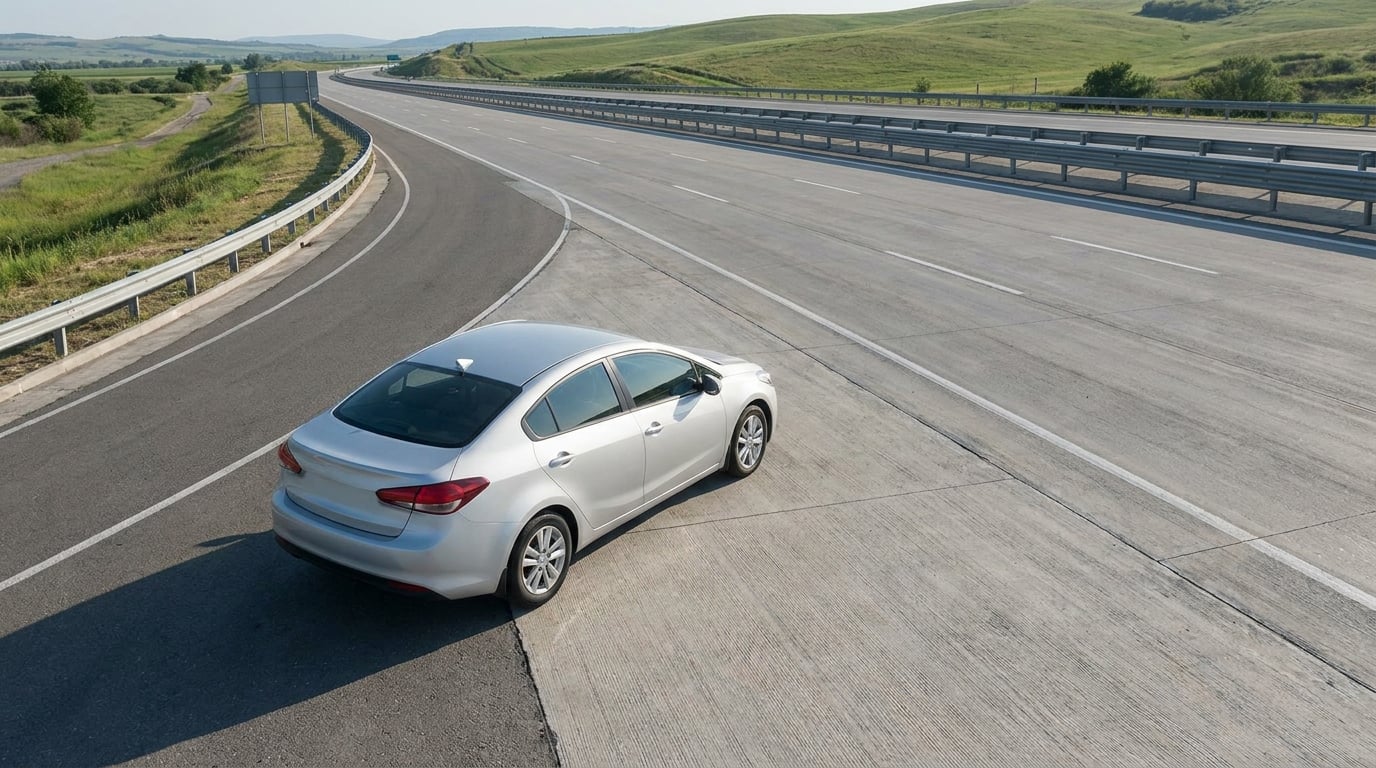
To merge onto a highway safely, accelerate on the acceleration lane until you are travelling at the same speed as the traffic you are joining, signal, check your mirrors and blind spot, pick a gap you can fit into without forcing anyone, then change lanes in one smooth steering movement. You always yield. Never stop on the ramp.
Most beginners already understand the mechanics of highway merging. The problem is not knowledge, it is nerve and timing. People watch the cars, they just cannot judge the distance, and they end up either crawling up the ramp or forcing their way in at the last second.
That is why the highway merging technique for beginners works better as a fixed routine than as a set of rules to remember. Same checks, same order, every time. Practice the order until your hands do it while your mind is busy elsewhere, and the merge stops being a test you can fail.
A first freeway drive takes about 20 minutes of driving time once you are on. The part that takes longer is the waiting, so aim for a quiet stretch of highway, a mid-morning weekday, and a route you can leave at the next exit if a gap never shows up. I would rather you loop back twice than have your first merge be the one that goes wrong.
This guide covers general driving technique in the US. Your state driver handbook is the authority on rules and signs, and where a rule and a habit differ, the rule wins.
Table of Contents
- What You Need Before You Get on the Highway
- Step-by-Step Highway Merging Technique for Beginners
- Common Mistakes and How to Fix Them
- Frequently Asked Questions
- What do I do if no gap ever appears on the on-ramp?
- How fast should I be going when I merge onto the freeway?
- How long should I keep my turn signal on when merging?
- How do I merge onto a highway at night safely?
- Do drivers already on the highway have to make room for me?
- Who is at fault after a collision during a merge?
What You Need Before You Get on the Highway
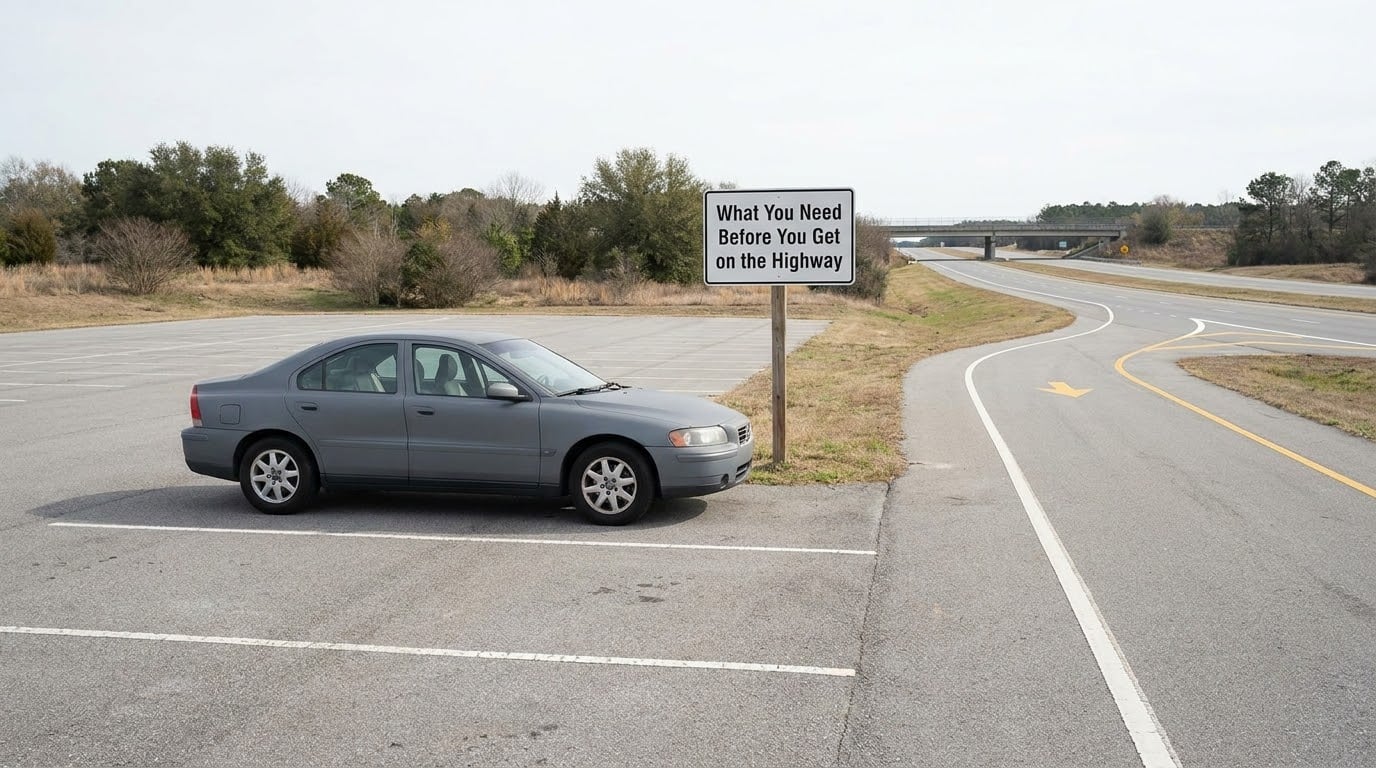
Merging asks more of a car than ordinary street driving, mostly because everything happens faster and there is less room to fix a mistake. Before your first real merge, spend ten minutes on the car and twenty minutes on yourself.
A car that is actually road-ready
Tires first. A tire with low pressure or a bald patch across the tread changes how the car responds to steering input, and a wet highway ramp is where you will feel that most. If you are choosing tires for a car that spends time on the freeway, all terrain vs highway tires for daily driving comes up a lot, and the honest answer is that highway-oriented tread gives you the most predictable response in the rain.
Then check brake lights, turn signals, and both mirrors. Turn signals matter more on a ramp than anywhere else, because that is the moment a driver in the left lane glances over and expects a cue from you. Add fluid levels and tire pressure to the list, and you have covered the mechanical side.
A license and a vehicle you have actually driven
Highway merging is the first thing many new drivers do that they have never practiced. If the car is unfamiliar, drive it somewhere quiet first. Get used to where the indicators are, how much room the car needs to change lanes, and how quickly it picks up speed. An unfamiliar car plus an unfamiliar merge is two unknowns at once, and only one of them is optional.
Do this before your first freeway trip, not during it. Ten minutes in a parking lot teaches you more than ten minutes of nervous hesitation on a ramp.
A license, a handbook, and a low-stress time slot
Most states have a period of restricted driving for new licenses, so check what yours allows before you plan the route. A learner permit or a new license may limit you to daylight, to a single passenger, or to roads that are not divided highways at all. Finding that out at the on-ramp is a much worse place to find out than at the kitchen table.
For the timing, aim for a weekday between 9 am and 3 pm, or a weekend morning. Rush hour traffic on a four-lane interstate is the hardest merging there is, and there is no reason for a beginner to start there. Sunday evening westbound is worse still, because everyone is doing 75 mph and nobody wants to yield.
One more thing: tell the passenger. A nervous friend shouting instructions makes the merge harder, not easier. If you are practicing with someone, agree on one job for them, which is to watch the left mirror and call out a closing car.
Step-by-Step Highway Merging Technique for Beginners
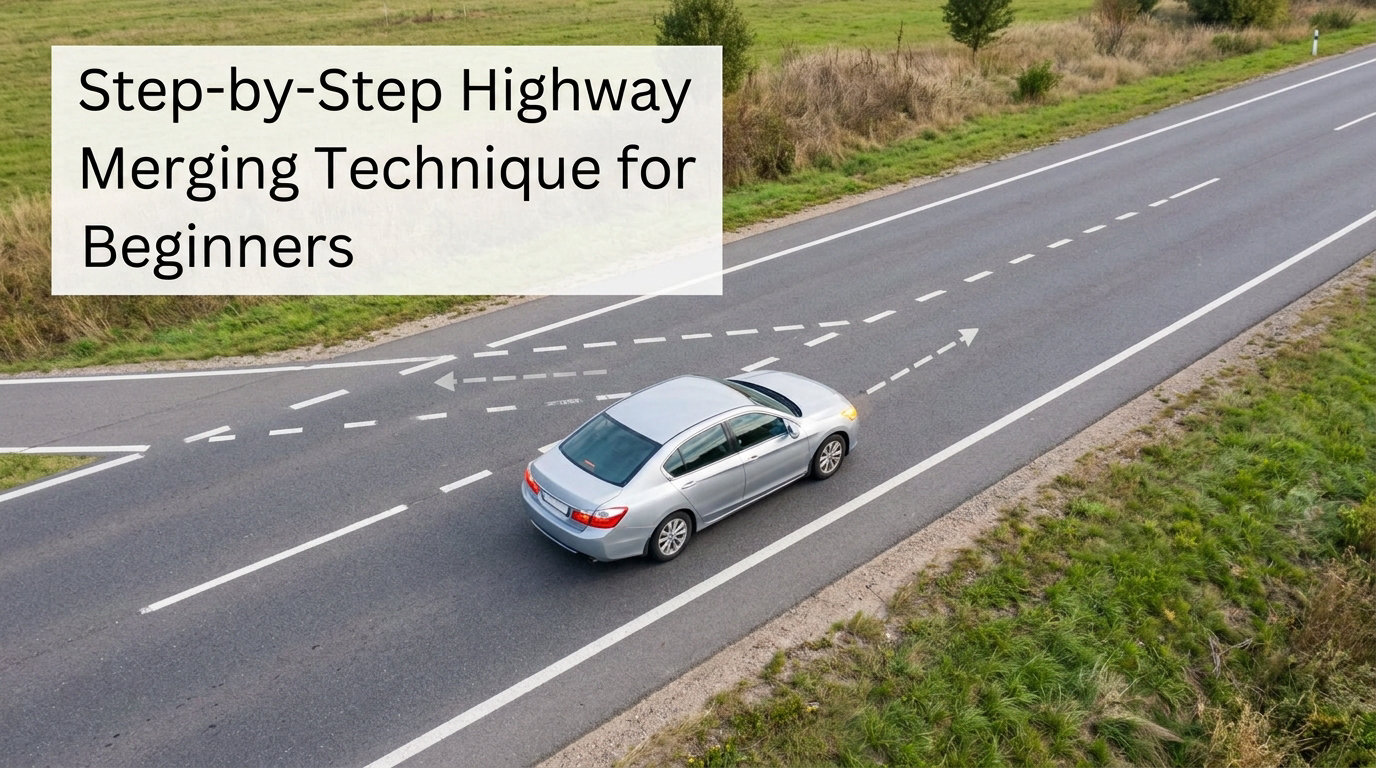
An on-ramp has two parts and beginners usually mix them up. The entrance ramp is the road that gets you up to highway level and lined up with the freeway, and it works at whatever speed the ramp is designed for. The acceleration lane, sometimes called an auxiliary lane or a merge lane, is the extra strip of pavement between the ramp and the through lanes, and it exists for one purpose only: to let you reach the speed of the traffic you are joining.
Every problem with merging comes back to that single purpose. The acceleration lane is not a lane you sit in while you decide. It is a runway.
Step 1: Prepare Before You Reach the Ramp
Do this at the bottom of the ramp, while you are still at low speed and have room to correct yourself. Buckle up, put the phone away, silence it, and get it out of reach. Adjust the mirror and camera angles now, not in traffic, because you cannot safely adjust a mirror at freeway speed.
Decide the lane you want before you accelerate. Most of the time that is the rightmost through lane, since it is the one you are already beside and the one with the fewest speed commitments. Then check the ramp ahead for a posted limit or a yellow advisory speed sign, and note the traffic on the freeway: how many lanes, how fast the cars are actually moving, and how close together they are sitting.
Traffic bunched at bumper-to-bumper spacing is slower than the speed limit, and that is the speed you have to match, not the number on the sign.
Step 2: Check the Merge Area and Traffic
As you climb the ramp, start scanning. Look over your right shoulder into the nearest lane, then check the side mirror, then the rear window or the camera display if your car has one. That three-point scan is the heart of the routine, and the shoulder check is the part beginners skip, because the mirrors show you almost everything except the one thing that matters most.
You are looking for three specific things: how fast the nearest lane is traveling, how large the gap in front of you is, and how large the gap behind you is. Beginners can see the cars. What they cannot do is turn what they see into a distance, which is what the table below is for.
Also look one lane to the left. A driver in the lane over can move into the lane you are aiming for, and if they do that while you are halfway across, both of you end up in the same space. Knowing they are there is how you avoid it.
Step 3: Build Speed on the Ramp
Now accelerate, steadily, to a speed close to the flow of traffic in the lane you are entering. On a 65 mph freeway with traffic moving at 60, you want to be doing about 60 as you approach the merge point. Not 45. Not 40 because you are nervous.
Stopping on the acceleration lane is the single most dangerous error a beginner can make here, and experienced drivers complain about it more than anything else on the road. One stopped car at the merge point turns a normal lane change into a wall for everyone behind it, and the driver who rear-ends you is blameless because you were the one sitting still in a lane that is supposed to be moving.
If traffic is genuinely at a crawl, that is different from a normal merge, but even then keep rolling and follow at a safe distance rather than coming to a stop on the pavement.
Also stay inside the posted ramp speed. A yellow advisory sign gives you a reasonable target for the ramp itself, and the speed limit on the ramp is a real limit, not a suggestion.
Step 4: Signal and Find a Safe Gap
Signal before you start moving over, once you are up to speed and committed to the merge, and give other drivers time to react. Most state handbooks expect the signal well before the lane change, and the practical reason is simple: a signal gives the driver beside you a chance to slow down and let you in. Without one, you are asking someone to notice you and decide to be kind.
Then judge the gap in seconds rather than feet. Count the seconds it takes a car to clear one object length, or use the table below. The merging gap is longer than the following distance you would keep once you are in the lane, because the car behind you has to react to a moving object appearing in front of it rather than to a car already there.
| Speed | Following distance you want behind you once merged (2 seconds) | Gap you want to merge into (4 seconds) |
|---|---|---|
| 30 mph | about 90 feet | about 175 feet |
| 45 mph | about 130 feet | about 265 feet |
| 60 mph | about 175 feet | about 350 feet |
| 70 mph | about 205 feet | about 410 feet |
Those are guidelines, not law, and they assume good visibility and dry pavement. In the rain, double them. What matters is that you have a number, because a number is something you can practice against, and a vague sense that the gap looks big enough is exactly what fails you at 70 mph.
If the gap in front is too small but the car behind is far away, the answer is to pick up a little speed and slide in behind that car. If the gap behind is closing, ease off and let the car you are about to merge in front of pull away. Either way, the merge takes longer than you want and no longer than you need.
Step 5: Merge Smoothly Without Abrupt Changes
When the gap is right, move. One continuous steering input, no back-and-forth correction, no sudden stab of the gas to claim the space. Small steady corrections are fine and expected, but weaving reads to other drivers as indecision, and they respond to it badly.
Yield is not optional. The car you are entering has right of way by law in every state, so the gap is yours to take only when the driver has either left it or slowed to open it. Most do open it, and that is a courtesy, not a right, which is why the good ones vary and you cannot plan around them.
If a car you were about to merge in front of suddenly accelerates, do not chase it and do not panic brake. Let it go, stay at freeway speed, and take the next gap instead. The whole lane is available to you once you are on it, and the merge does not have to happen in the first four seconds.
Step 6: Settle Into the Lane After Merging
Straighten the wheels, keep signaling until the lane change is complete, and do not lift off the gas to show courtesy. That brief lift is read by the driver behind you as you slowing down, and it is how rear-ending happens at a merge.
Move toward the middle of the lane rather than hugging the right line, because the right position on a highway is where you would be during a crosswind or an overtaking truck. Then set your gap using the two-second column above, and check mirrors every few seconds for the first half-mile. Traffic around you is still adjusting to your arrival, and merging is the moment a driver alongside drifts toward you without a signal.
Common Mistakes and How to Fix Them
Almost every merge mistake a beginner makes comes from doing two of these at once, usually slowing down and stopping, or skipping the blind spot and drifting. Fix one and the other gets easier.
Merging too slowly. You enter at 40 when traffic is doing 65, so nobody in the target lane can see a consistent speed and the car behind has to brake hard. Fix: pick your target speed on the ramp and hold it. This is the most complained-about error from experienced drivers on every forum thread on the subject.
Stopping on the acceleration lane. You cannot see a gap, so you stop and wait. Fix: keep rolling and take the next exit. Loop back around, merge from the other on-ramp, and arrive at a time when the traffic is thinner.
Choosing a gap that is too short. It looks big at ramp speed and is gone by the time you commit. Fix: use the four-second column in the table instead of your eyes, and if the gap in front is small, speed up rather than forcing your way in behind it.
Signaling too late. You signal as the wheels are already turning. Fix: signal once you are at speed and committed, while you are still in the acceleration lane. The signal is a request for space, so it has to arrive before you need the space.
Looking only at the mirrors. Mirrors show you almost everything except the car sitting alongside you, which is exactly the car you cannot see. Fix: make the over-the-shoulder check a physical habit, head turning, on every merge and every lane change.
Drifting across two lanes. You aim for the right lane and slide into the middle one. Fix: fix your mirrors so the lane markings sit where you expect them, and make one lane change at a time. If the second lane is clearly empty, take it as a second, separate move.
Braking hard in the lane you just entered. You merge, get a moment of panic, and stamp on the brake for no reason. Fix: a merge is complete once you are in the lane. Breathe, hold speed, and let the following distance do the work.
Conditions That Change the Routine
| Condition | What changes |
|---|---|
| Heavy traffic | Widen the gap you accept, merge at a lower speed, and expect the car in front to be moving slower than the limit. Do not sit on the shoulder to hold a place. |
| Night | Move your scan to the over-the-shoulder check and the rear window, since mirrors are less useful in the dark. Watch for headlights in your mirrors, which arrive faster than a gap looks, and remember a merge point is usually the brightest thing on the road. |
| Rain | Double the distances in the table, add more to your own following distance, and increase the gap between you and any truck beside you, because a truck’s spray hides the car in front of it. |
| Uphill on-ramp | Start accelerating earlier, and expect the ramp speed advisory sign to be a realistic target. If your car will not reach freeway speed uphill, stay in the right lane and let other drivers pass rather than merging at a speed you cannot hold. |
| Short ramp | There is no time to deliberate. Match speed earlier, start scanning at the bottom of the ramp, and be ready to let the first gap go and take the second. Never compensate for a short ramp by merging across solid lines. |
| Ramp that is also an exit lane | Traffic can arrive from the right up to the last moment, so do not commit to the outside edge. Hold a position one lane in from the right and merge from there. |
| Lane drop or work zone | Where two lanes become one, a zipper merge applies: each driver takes a turn at the point the lane ends, and whoever reaches it first goes first. Signal, then alternate, rather than driving to the end and forcing your way in. |
How to Practice Before Your First Real Merge
You can rehearse most of the routine without ever touching a freeway. In an empty parking lot, drive at a brisk walking pace and practice the three-point scan out loud: mirror, mirror, shoulder. Do it twenty times until the order is automatic.
Next, pick a quiet divided road with a real on-ramp, one with very little traffic, and merge there. A two-lane state highway at 10 pm on a Tuesday is a far better classroom than an interstate at 5 pm. When that feels ordinary, add speed, one ramp at a time.
Build the habit of a route with an exit you can take. Knowing you can leave the freeway without panicking changes how the merge feels more than any amount of encouragement will.
Frequently Asked Questions
What do I do if no gap ever appears on the on-ramp?
Keep moving, stay in the acceleration lane at a steady speed, and take the next exit. Looping back to a different ramp is a normal, legal maneuver that experienced drivers use constantly, and it is far safer than stopping to wait for a gap. Only stop on the acceleration lane if the posted sign says to, or if traffic ahead of you has stopped and a hazard light warns you.
How fast should I be going when I merge onto the freeway?
Match the speed of the traffic in the lane you are entering, not the posted speed limit. If the nearest lane is flowing at 55 mph, enter at about 55. Entering 10 mph slower is the most common cause of merge collisions, because the car behind has to brake and the car in front cannot see a steady speed to react to.
How long should I keep my turn signal on when merging?
Signal before you begin the lane change and keep it on until the car is fully established in the lane, which is usually a few seconds after your wheels straighten. The signal is how the driver behind you knows you are about to move into their path, so leaving it on briefly after the change costs nothing and is what other drivers expect.
How do I merge onto a highway at night safely?
Shift more of your scanning to the over-the-shoulder check and the rear window, because mirrors carry less usable information after dark. Watch for headlights and taillights rather than shapes, allow a larger gap than you would in daylight, and do not assume a dark space between two sets of lights is empty. Slow down before the ramp if you cannot see the lane markings clearly.
Do drivers already on the highway have to make room for me?
No. You yield. Every state gives the vehicle already in the lane the right of way, and a courteous driver who opens a gap is being generous rather than following a rule you can rely on. Build your plan around that, and treat an opened gap as a gift. If you plan on other drivers moving over, you will eventually meet someone who does not.
Who is at fault after a collision during a merge?
The merging driver is responsible for yielding, so fault usually sits with whoever entered the lane without a safe gap, drove while merging in a way that obscured traffic, or stopped on the acceleration lane. Report the crash, photograph the vehicles and lane markings, exchange details, and note the highway position of each car before traffic clears. Insurance and the police report settle the rest, so do not argue about fault at the scene.
Merging is not a talent, it is a sequence, and a sequence is the easiest kind of driving skill to learn. On your next drive, do one thing only: pick a quiet on-ramp, run the six steps in order, and take the next exit if the gap never comes. Do it three times this month and the fourth one will be on a busy interstate without you thinking about it.