
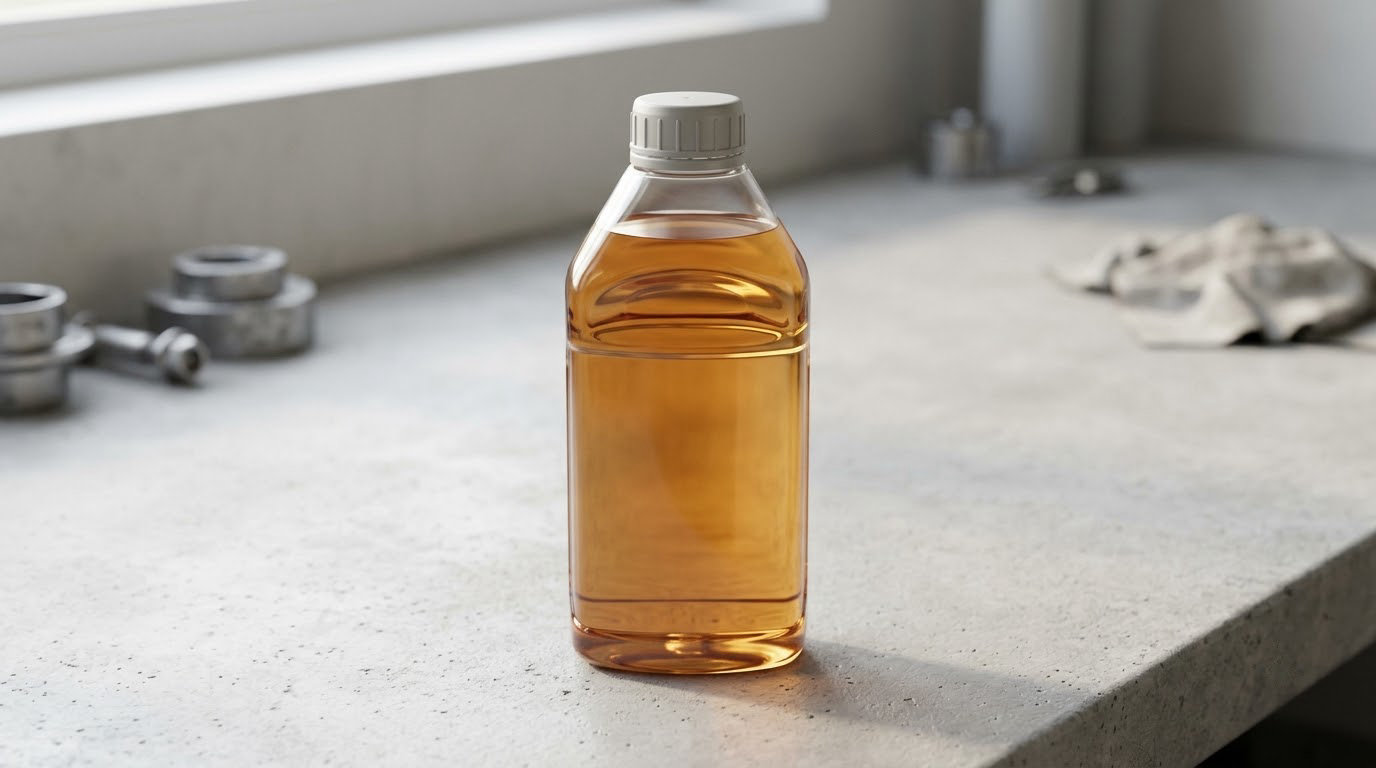
A sealed, unopened bottle of brake fluid is good for roughly 2 to 5 years from the date it was sealed, and an opened bottle should be used within about 3 to 12 months before it gets discarded. That split is the whole answer, and everything else is a detail about how well the bottle was closed, where it sat, and which fluid is inside.
The reason fluid ages at all is that it is hygroscopic, meaning it pulls water molecules out of the air it touches. Most brake fluid is a glycol-ether base, and glycol grabs moisture through any exposed surface, including the headspace of a bottle you thought was tightly closed.
If you want the short version of how long does brake fluid last in the bottle: trust the printed date, treat anything past 12 months after opening as finished, and buy the smallest bottle that covers the job.
Table of Contents
- How Long Does Brake Fluid Last in the Bottle?
- Unopened vs. Opened Brake Fluid Shelf Life
- What Changes the Shelf Life of Brake Fluid?
- How to Tell If Brake Fluid Has Gone Bad
- Do You Need to Replace Fluid Because the Bottle Is Old?
- How Much Brake Fluid Should You Buy?
- Frequently Asked Questions
- Can you tell if brake fluid is bad by its color?
- What happens if you use old brake fluid during a flush?
- Why do brake fluid manufacturers list different expiration dates?
- Does DOT 5 brake fluid last longer than DOT 3 or DOT 4?
- Should brake fluid be discarded after being exposed to extreme heat or freezing temperatures?
- Bottom Line
How Long Does Brake Fluid Last in the Bottle?
The number that matters is whichever is shorter: the manufacturer’s stated shelf life, or the date stamped on the bottle. Many automotive fluid manufacturers print a date code, though plenty of bottles leave you to read the manufacturing date off the crimp or the base, and some carry no date at all.
Unopened is the easy case. Factory-sealed bottles are typically flushed with dry air or nitrogen, so the fluid inside sits in a dry environment it will not see again until you open it. Keep the seal intact and the bottle somewhere cool and dry and 2 to 5 years is a fair expectation, with plenty of enthusiasts arguing for far longer in a sealed metal can.
Opened is where the deadline gets real. Once air is in there, the clock starts. Most manufacturer guidance lands somewhere between 3 months and a year, and mechanics working on critical systems tend to use the cautious end of that range.
There is no universal expiration period for brake fluid, so if a bottle has no date, no intact seal, or a history you cannot vouch for, treat the question as settled and get a new one. Fluid is inexpensive, a brake system rebuilt around contaminated fluid is not.
Unopened vs. Opened Brake Fluid Shelf Life
Here is the split by bottle state. The state of the seal matters more than the calendar.
| Bottle state | Usable life | Why |
|---|---|---|
| Unopened, factory sealed | 2 to 5 years or more | The fluid is sealed against dry air or nitrogen, so there is no fresh moisture to absorb. |
| Opened, then resealed immediately and stored cool and dark | 6 to 12 months | Headspace is limited and the moisture load stays low, but exposure has already begun. |
| Opened and left loosely capped, or in a hot or damp garage | 3 months or less | Air exchange, heat and humidity all push the wet boiling point down fast. |
| Fluid drained out of a vehicle or bled from a system | Do not store for reuse | It has already absorbed contamination from worn seals, corrosion and line debris. |
Two years is a common unopened guideline, not a guarantee. A bottle that sat in a coastal garage through a wet winter and a hot summer has a shorter practical life than one that sat indoors on a shelf, even with both factory seals intact.
The enthusiast position on the forums is that a sealed metal container is effectively long-lived. On the Bob Is The Oil Guy thread, the opener’s claim was that 10 years on the shelf in a sealed can is nothing. A Rennlist poster put the research range out there as 2 years, 5 years, or as long as it stays sealed in metal, and NASIOC regulars generally hold that a tightly closed cap keeps fluid usable well past opening.
Both positions are right about different things. A sealed can genuinely does protect the fluid. What none of those threads change is the manufacturer position, which is that an opened bottle gets used within 3 months and discarded within a year.
What Changes the Shelf Life of Brake Fluid?
Eight things decide whether a bottle is still good: the DOT specification, the manufacturer’s formulation, the integrity of the seal, humidity, heat, sunlight, contamination and age itself. Chemistry is the one most people miss.
Glycol-based fluids are hygroscopic, so they absorb water and the water does not help. That is why the industry measures both a dry boiling point and a wet boiling point, the latter specified at 3.7% water by volume. Once fluid is in a car, it picks up roughly 2% water after one year of service, and under heavy braking the fluid inside a caliper can climb toward 390F. Water boils long before the base fluid does, vapour bubbles form in the lines, and you get a longer pedal, brake fade under repeated stops, or in the worst case vapour lock.
| Specification | Base chemistry | Dry boiling point | Wet boiling point | Moisture behaviour |
|---|---|---|---|---|
| DOT 3 | Glycol | 205C / 401F | 140C / 284F | Hygroscopic |
| DOT 4 | Glycol | 230C / 446F | 155C / 311F | Hygroscopic |
| DOT 5.1 | Glycol | 260C / 500F | 180C / 356F | Hygroscopic |
| DOT 5 | Silicone | 260C / 500F | 180C / 356F | Hydrophobic |
Those are FMVSS 116 and ISO 4925 minimums, not marketing figures, and they explain why the shelf-life numbers are not arbitrary. A fluid that starts at 260C dry has more room to lose before it matters than one starting at 205C.
Silicone DOT 5 is the exception to the moisture story. It is hydrophobic, so it does not absorb water from the air the way glycol does, and it stores far longer opened. It is also not fully miscible with glycol, and silicone fluid can cause water to separate out of a glycol system, so it needs a system designed for it. Check the reservoir cap or the owner manual before putting DOT 5 in a car that was built for DOT 4.
Mineral and LHM fluids, common in older BMWs, some Japanese cars, motorcycles and bicycles, are also hydrophobic. They are not interchangeable with glycol either.
How to Store Brake Fluid Properly
Four steps cover it, and they take under two minutes.
- Keep it in the original bottle with the cap tight. If the seal is damaged, transfer nothing and just discard it.
- Minimise headspace. Small bottles degrade slower than large ones because there is less air above the fluid. Press a disc of plastic wrap under the cap as a secondary barrier.
- Store it cool, dark and dry. Avoid direct sun, damp basements, unheated garages and anywhere near solvents or caustic cleaners.
- Label the bottle with the DOT type and the date you opened it. A masking-tape strip on the side takes five seconds and answers the question six months later.
For shop work, transferring fluid into a dedicated airtight container with a crimped metal lid and small headspace is worth the extra step. The bottle cap on a shop bench is an open bag of potato chips: it lets the room in slowly and steadily.
An open reservoir in a vehicle is not storage at all. It is a vented container that is designed to absorb whatever the air brings, which is fine because the fluid is meant to be replaced on an interval.
How Long Does Brake Fluid Last in the Bottle in a Hot Garage?
Heat and humidity together shorten storage life, and a garage usually has both. Warm air holds far more water vapour than cool air, so a bottle sitting in an unheated space over a humid summer absorbs moisture faster than the same bottle on a shelf indoors.
Freezing is a separate concern. Glycol-based DOT 3 and DOT 4 tolerate cold storage reasonably well, but repeated freeze-thaw cycles can encourage condensation inside the bottle and break down additives over time. If the fluid has been through hard freezes, treat it like anything else you are unsure about and replace it.
How to Tell If Brake Fluid Has Gone Bad
Three checks take about a minute, and only the third one is actually conclusive.
Look at it. Fresh brake fluid runs clear to pale amber. Fluid that has darkened toward brown, gone cloudy, shows a layer at the bottom, or has visible particles in it has been contaminated or is degrading. Contaminated fluid can also leave a residue ring around the cap or on the threads, which means moisture has been getting in and then evaporating back out.
Smell it. Fresh glycol fluid has a mild sweet scent. Fluid that has absorbed water and picked up corrosion can smell sharp, sour or burnt. Do not sniff it from the bottle opening, waft it from a short distance instead.
Test it. A refractometer or a brake fluid tester pen reads the water content by refractive index in seconds and tells you the percentage, which is the only objective answer available to a DIYer. Some pens also report the estimated boiling point.
Here is the part that catches people out. Clear-looking old fluid may already have absorbed enough moisture to push its wet boiling point well below spec, and neither your eyes nor your nose will tell you that. A bottle of ten-year-old fluid can look and smell perfect and still boil at a temperature that shows up as a soft pedal after a few firm stops on a downhill.
So visual inspection is a screen, not a verdict. When the fluid matters, test it or replace it.
Do You Need to Replace Fluid Because the Bottle Is Old?
Bottle shelf life and brake service interval are two different numbers that get mixed up constantly. The bottle shelf life is about a sealed container on a shelf. The service interval is about fluid sitting in a car, and for most vehicles it is around two years regardless of how good the fluid looked on day one.
Your owner manual and the maker’s service schedule set the interval. Condition, driving style and climate move it shorter. BMW service requirements, for instance, treat brake fluid as a scheduled item rather than a lifetime fill, and the age of what is in the reservoir is only one input alongside a fluid test.
Old fluid in a system is not just a fade risk. It corrodes. Water in the lines rusts calipers, wheel cylinders and the master cylinder, and that corrosion produces the metal particles that block the tiny valves inside an ABS module. A working ABS system pays for itself exactly once, and it pays it by staying clean.
Can you put new fluid on top of old? A top-up raises the fluid level and stops a warning light, and for a fluid change it is a partial improvement. It is not a service. The old fluid sitting at the bottom of the reservoir, in the calipers and in the ABS valves stays exactly as contaminated as it was, which is why a proper flush and bleed is the real fix.
On a r/MechanicAdvice thread, someone had found a bottle bought more than two years earlier, never opened, never returned, and was asking if it was still usable. The thread split roughly down the middle between fine as is and buy a new one, it is cheap. That split is the honest answer here too.
How Much Brake Fluid Should You Buy?
Buy for the job, not for the shelf. Most bottles come in 12, 16 and 32 ounce sizes, and the bigger bottle is not a better deal once you are storing the extra for a year.
Check three things before you buy. First, the DOT specification your vehicle requires, usually marked on the reservoir cap or in the owner manual. Second, the system capacity, so you buy enough to do the job plus a bleeder’s worth. Third, how many bleeders and reservoirs you will be servicing, because each caliper or wheel cylinder needs fluid pushed through it and it has to come out somewhere.
Opening a large bottle to top up two ounces is the most common way owners create a storage problem for themselves. If you only need a top-up, buy the smallest bottle. If you are doing a full service, plan the volume first and buy one sealed bottle sized to it, plus a little margin.
Store what you do not use exactly as described earlier, and label it. Used fluid and empty containers go to a household hazardous waste facility or an automotive recycling centre, not down the storm drain.
Frequently Asked Questions
Can you tell if brake fluid is bad by its color?
Colour is a useful screen but not a verdict. Fresh fluid runs clear to pale amber, while fluid that has degraded or absorbed contamination often darkens toward brown, turns cloudy, or shows particles and a residue ring around the cap. Clear fluid can still hold enough moisture to drop well below its wet boiling point spec without changing appearance at all, so a refractometer or brake fluid tester pen is the only objective check available to a DIYer.
What happens if you use old brake fluid during a flush?
A partial flush with old fluid pushes some of the stale fluid out but leaves the worst of it behind, in the calipers, the master cylinder and the ABS valves. It will lower the fluid level, stop a warning light, and reduce contamination without removing it. Water and corrosion products left in the system keep attacking the metal, and the reduced wet boiling point still shows up as a soft or long pedal under repeated hard braking. A full flush and bleed with fresh fluid of the specified DOT type is the only real fix.
Why do brake fluid manufacturers list different expiration dates?
Shelf life depends on the chemistry and the packaging, so dates differ between products. Glycol-based DOT 3, DOT 4 and DOT 5.1 fluids are hygroscopic and absorb moisture from any exposed air, while silicone DOT 5 and mineral LHM fluids are hydrophobic and store far longer opened. Sealing methods, headspace size and added corrosion inhibitors also shift the number. A printed date reflects that specific formulation in that specific container, which is why it beats any general rule of thumb.
Does DOT 5 brake fluid last longer than DOT 3 or DOT 4?
Yes, in a storage sense. Silicone DOT 5 fluid is hydrophobic, so it does not draw water out of the air the way glycol-based DOT 3 and DOT 4 do, and an opened bottle keeps its boiling point far longer than the glycol equivalent. It is not a drop-in replacement, though. Silicone fluid is not fully miscible with glycol and can cause water to separate out of a glycol system, so it should only go into a car the manufacturer specified for it. Mineral and LHM fluids are also hydrophobic and similarly long-lived.
Should brake fluid be discarded after being exposed to extreme heat or freezing temperatures?
Heat and humidity are the ones to worry about, because warm air carries much more water vapour and drives moisture into an opened bottle faster. Freezing is less of a problem for glycol-based DOT 3 and DOT 4, which tolerate cold storage reasonably well, though repeated freeze-thaw cycles can cause condensation inside the container and break down additives over time. Unopened, factory-sealed fluid that saw an extreme temperature in transit is generally fine. An opened bottle that went through it should be tested or replaced.
Bottom Line
So: how long does brake fluid last in the bottle depends entirely on the seal. Unopened and factory sealed, expect 2 to 5 years or whatever the printed date says, whichever is sooner. Opened, use it inside 3 to 12 months and assume three months if it has been anywhere warm or damp.
Store it sealed, cold, dark and dry with minimal headspace, and write the open date on the bottle. Then separate the storage question from the service question and change the fluid in your car on the interval in the owner manual, not on the basis of how clear it looks. Updated for October 2026.