
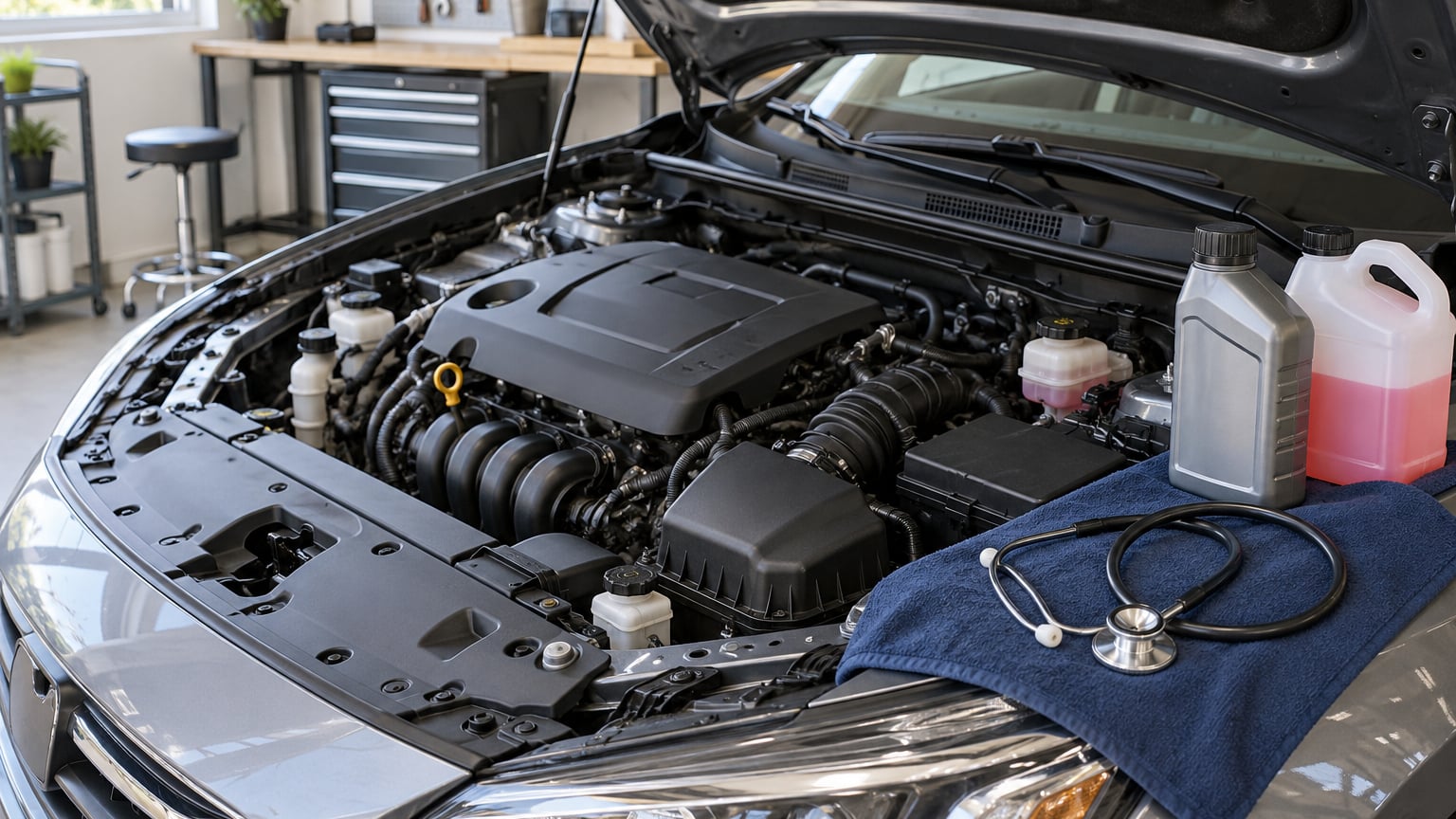
An engine usually ticks because of low or dirty engine oil, worn valve lifters, a leaking exhaust gasket, or normal fuel injector noise. Most of those are cheap to fix or completely harmless. A few are not, and the difference between a benign tick and a warning sign is almost always in how the sound behaves rather than how loud it is.
Engine ticking noise causes fall into three broad groups: a light rhythmic tap that repeats once per engine cycle, a separate clicking from the ignition or fuel system, and a rumbling knock that comes and goes with load. This guide walks through nine of the most common causes, how to narrow them down from the driver’s seat, and where to stop and get a technician involved.
Nobody can diagnose a specific vehicle from a description of a noise. What you can do is rule causes in and out with a dipstick, a phone recording, and a few minutes of listening. That gets you much further than guessing.
Table of Contents
- Engine Ticking Noise Causes at a Glance
- Is an Engine Ticking Noise Dangerous?
- What Does the Location and Timing of the Tick Tell You?
- What Are the 9 Common Engine Ticking Noise Causes?
- How to Diagnose an Engine Ticking Noise Safely
- What Engine Ticking Noises on a BMW May Mean
- When Should You Stop Driving and Get Help?
- Frequently Asked Questions
- What to Do First
Engine Ticking Noise Causes at a Glance
The fastest way to sort this out is by matching what you hear to where it comes from and what changes it. Here are the nine causes worth working through, roughly in order of how often they turn out to be the answer.
| Cause | Where you hear it | How it changes | Also present | Urgency |
|---|---|---|---|---|
| Low or dirty engine oil | Top of engine, front of bay | Worst cold, loudest at idle, may fade warm | Oil pressure warning, dimmer headlights at idle | Check the dipstick first |
| Fuel injectors | Deep in the engine bay, hard to localize | Even clicking, speeds up directly with rpm | Nothing at all if the engine runs clean | Usually normal |
| Loose or damaged spark plug | Top of one cylinder | Steady tick at idle and load, follows rpm | Misfire, rough idle, check engine light | Book a shop visit |
| Hydraulic lifter bleed-down | Top of engine, spread across it | Loud cold, fades in 10 to 30 seconds | Usually nothing else | Monitor |
| Worn valvetrain parts | Top of engine or the cylinder head | Follows rpm, may get louder under load | Rough idle, reduced power, check engine light | Book a shop visit |
| Exhaust manifold gasket leak | Near the manifold, front or side of engine | Louder cold, harsh or irregular at low rpm | Fuel smell, black soot, dropped power, poor economy | Book a shop visit |
| Timing chain or tensioner | Front of engine, near the cover | Rattling on cold start, changes with rpm | Rough running, engine timing warning on some models | Prompt inspection |
| Accessory drive or idler pulley | Front of engine, follows the belt path | Changes with load and with other accessories switched on | Belt squeal, chirping, visible belt wear | Inspect soon |
| Collapsed engine mounts or aerated fuel | Under the car, or a gurgling idle | Present at idle, worse on engagement or tip-in | Shudder, vibration, hesitation, sometimes a hard shift | Driveable until tested |
Is an Engine Ticking Noise Dangerous?
Usually it is not, but you cannot tell from the sound alone. A tick that appears on cold start and disappears within 30 seconds, with a check engine light that stays off and an engine that idles and accelerates smoothly, is almost always hydraulic lifter bleed-down. Cold oil is thicker, the lifters take a moment to pump up, and the tapping goes away once pressure arrives.
The same tick that stays with you at highway speed, comes back louder every time you load the engine, or shows up alongside a stumble or hesitation is telling you something different. So is any tick accompanied by an oil pressure warning, an overheating temperature gauge, a fuel smell, visible dripping, or smoke from the exhaust.
Also pay attention to what the tick does not do. A knock that grows as you climb a hill, an engine that runs rough with the check engine light flashing, or a sound that turns into a bang under load all move this from a monitor situation to a stop-the-car one.
What Does the Location and Timing of the Tick Tell You?
Location narrows the search faster than anything else. Start by working through these comparisons in the car, with the engine warmed to normal operating temperature.
- Rpm but not road speed. If the tick speeds up when you rev the engine while stationary, but stays constant at a given road speed, the source is driven by the engine itself. Injectors, valvetrain parts and accessory pulleys all behave this way.
- Both rpm and road speed. A sound tied to both points toward something in the drivetrain or a wheel rather than the engine. That matters, because a ticking engine that turns out to be a wheel bearing is a much cheaper day.
- Idle only, or at low rpm. Injector noise, a leaking exhaust gasket and hydraulic lifter bleed-down all get worse when the engine is barely turning over.
- Under load only. Exhaust leaks, worn valvetrain parts and detonation all get louder when you ask the engine to work.
- Park versus drive. A tick that only appears in park can be an accessory that only spins with the transmission in neutral, or a vacuum leak. An engine mount problem usually shows up on engagement instead.
- Cabin versus engine bay. With the hood open you will usually hear it more clearly. If it is dramatically louder outside, that supports an engine, exhaust or accessory source rather than a cabin rattle or a body panel resonance.
Do not crawl under a car that is hot, running, or unsupported on a jack. A phone recording taken safely from outside the vehicle gives you more than most people expect, and it lets a technician hear the same thing you did.
What Are the 9 Common Engine Ticking Noise Causes?
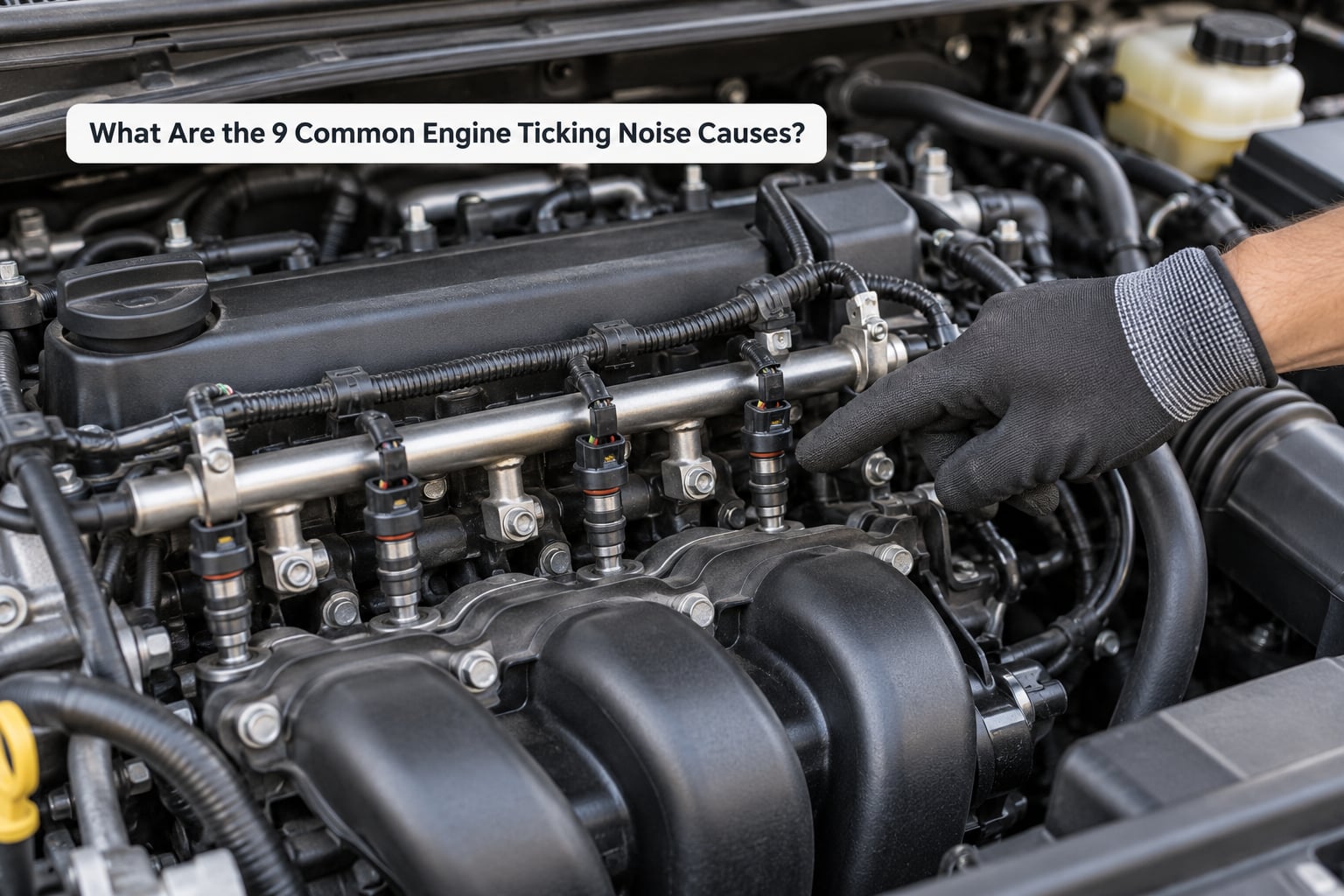
Work through these in order rather than jumping to the scariest-sounding one. The cheap and normal causes come first because they account for most of what owners hear, and because a low oil level changes what everything else sounds like.
Fuel Injector Ticking
High-pressure fuel injectors click as they open and close, several times per engine cycle, and that click is normal on most engines. The sound is regular, evenly spaced, and speeds up immediately when the engine revs. On port-injection engines it is often loud enough to hear through the hood, and on direct-injection engines it is usually muffled by the fuel rail and intake manifold.
Injectors get louder as they age because the armature inside them moves against a worn bushing. An even, mechanical clicking that your engine runs cleanly through is not a fault. A ticking that comes with a rough idle, a strong fuel smell, hard starts, or a throttle body that has not been cleaned is a different story. Long oil-change intervals and short trips are what usually get injectors to that point.
Separating this from valvetrain noise is mostly about pitch and rhythm. Injector clicks are higher and faster, and they do not fade once the engine is warm. Lifter tapping is lower, more metallic, and it thins out as oil pressure comes up.
Low or Dirty Engine Oil and Ignition Clicks
Low engine oil gets reported as the most common cause of a ticking engine more often than anything else, and several owners on owner forums have traced an alarming tap back to a dipstick reading well below minimum. When oil is low, parts that should ride on a pressurized film touch metal to metal, and the impact repeats every cycle.
Dirty oil is the quieter version of the same problem. Oil that has been neglected or run for long stretches of short trips thickens and carries metal debris, and it loses the ability to keep hydraulic lifters pumped up. Check the dipstick before anything else, on level ground with the engine off and cool. Then look at the colour and texture through a rag. Milky residue on the cap means coolant in the oil, which is a different problem entirely.
A loose, cracked, or arcing spark plug produces a tick that is easy to mistake for internal engine noise. It usually comes from a single cylinder, tracks rpm, and shows up with a misfire code. If your check engine light is on, reading the code is more useful than listening for another five minutes.
Valve Adjustment or Worn Valvetrain Noise
Excessive valve clearance makes a lifter and cam lobe tap against each other, which produces a rhythmic ticking that rises and falls with engine speed. The same sound comes from hydraulic lifters that have collapsed internally or a camshaft lobe worn oval, and from rockers or pushrods on engines that use them.
Watch the behaviour rather than the volume. A lifter tick is loudest cold, then fades or disappears once the engine is warm. A worn valvetrain part tends to persist at all temperatures, and often gets more noticeable under load. Real wear usually brings company: a rougher idle, less power, a check engine light, or a camshaft position sensor code.
This is the point where a written description stops being useful. If the tick persists warm, the next steps are a compression test, an oil pressure reading, and possibly a look inside the valve cover. That is technician work with a lift and the right gauges, and a phone call to a shop describing a tick will not narrow it any further.
Exhaust Leaks and Accessory-Drive Ticking
A cracked exhaust manifold or a failed gasket can make a tick that sounds exactly like an engine tap, because hot gas escaping before it reaches the rest of the exhaust pulses at a steady rate. The tell is the company it keeps: a strong exhaust or fuel smell, black soot around the manifold, a drop in power, and worse fuel economy. Exhaust leaks also tend to be louder cold, when the metal has contracted and the gap is at its widest.
Accessory noise is a separate source that gets mistaken for engine noise constantly. Idler pulleys, belt tensioners, the alternator bearing, and the water pump all have bearings in them, and a dry or failing bearing ticks. The clue is that the sound changes when you switch other accessories on, such as the air conditioning or the windshield washer pump, and that it follows the belt path rather than the cylinder grid.
Exhaust components get hot enough to cause serious burns, and an engine under a car is not somewhere to work by feel. Inspection of either is worth handing to a shop.
Timing Chain, Engine Mounts and Aerated Fuel
A timing chain or its tensioner that has gone dry rattles on cold start and often speeds up with rpm. Owners treat chain noise as serious, and they are right to. If oil pressure is low or the wrong oil spec was used, a chain runs without the lubrication it needs, and the guides and tensioner are the parts that fail first. A rattle from the front of the engine alongside an oil pressure warning or a timing-related code is a prompt inspection, not a next-month appointment.
Collapsed engine mounts produce a knock that gets more obvious on gear engagement, on a bump, or on a hard throttle tip-in from idle. You may also feel shudder through the pedals or steering wheel, and you will often see the engine sitting visibly off centre in its bay. That knock sounds vaguely hollow, deeper than a tap, and repeatable at idle.
Aerated fuel shows up as a gurgling or ticking idle that changes with load, often with a stumble when you accelerate. Newer vehicles with high-pressure fuel systems and short trips are the usual suspects, and a properly rated fuel additive or a full tank after driving out of old gas resolves many of these cases.
Sounds That Get Blamed on the Engine
Plenty of ticks never came from the engine at all. Wheel bearings hum or growl and change with road speed, not rpm. A transmission solenoid clicks once per shift. A glovebox or body panel buzzes and resonates at one specific rpm, which can sound remarkably like a valvetrain tap. An exhaust hanger or heat shield tapping against the underbody sounds like an exhaust problem, and a brake pad or caliper rattle at low speed can be mistaken for a mechanical tick.
Because of this, a tick that disappears when you shut the engine off was probably never inside the engine. One that continues briefly after shutdown is usually oil draining back through the pump or the timing chain settling, and it stops within a second or two on most vehicles.
On a diesel, add a short list of diesel-specific sources: injector solenoids chattering, a weak battery during cranking, a failing turbo wastegate, and combustion that is slightly off at idle. They tick for their own reasons, and none of them are covered by a gas engine diagnosis.
How to Diagnose an Engine Ticking Noise Safely
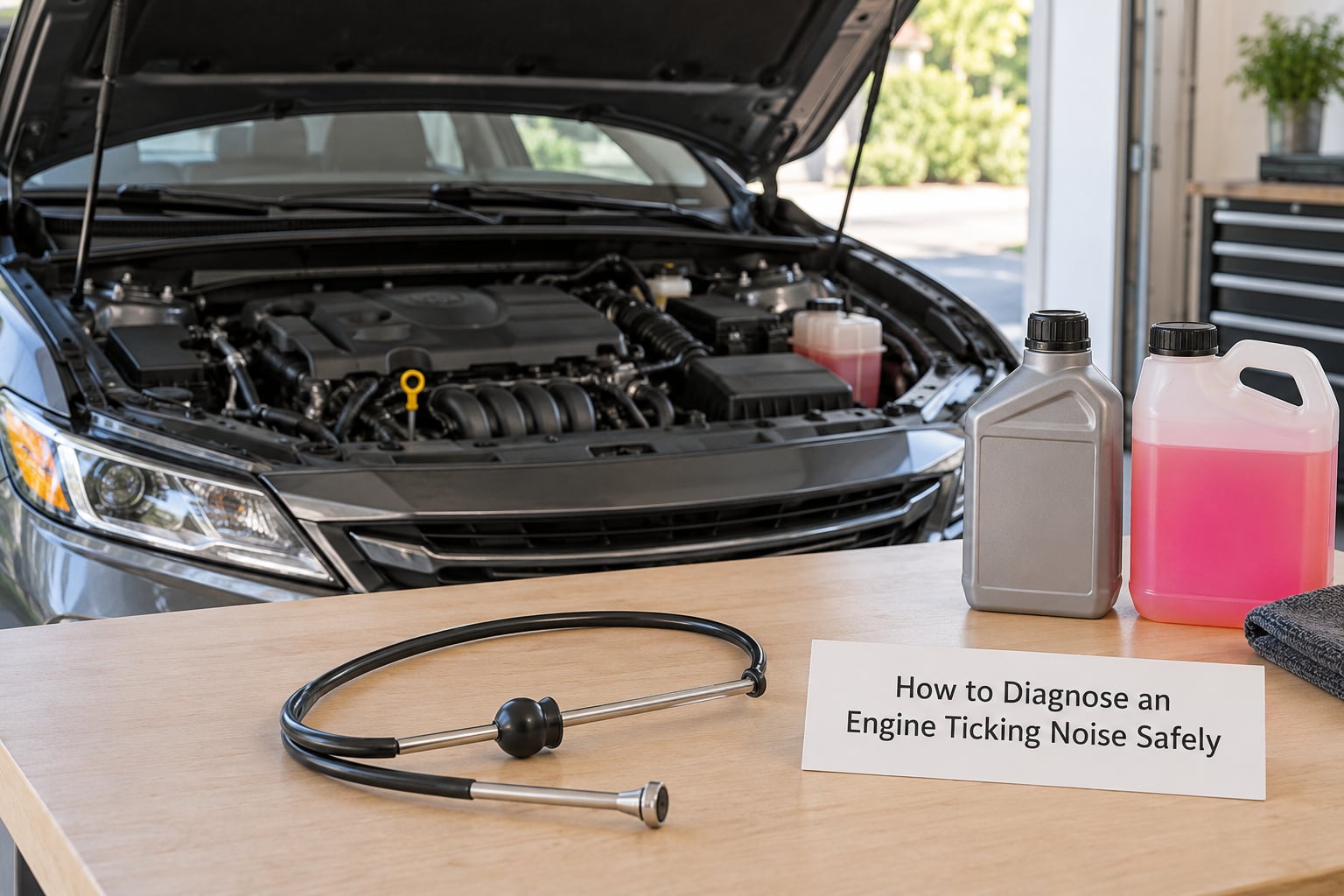
Here is the order I would work in, and it takes about ten minutes with no tools beyond a rag and your phone.
- Record a cold start. Stand outside the vehicle with the hood open, engine off and cold, and record from key-on through the first 30 seconds of running. This is the single most useful piece of evidence, because it captures the transition that separates a benign bleed-down from a fault.
- Listen in park and in drive. With the engine at operating temperature, note whether the sound is constant, appears only at idle, or arrives under load. Record the idle and one steady highway pass.
- Rev while stationary. A tick that climbs with rpm and not with road speed is engine-driven, which eliminates a lot of the car in one step.
- Check the dipstick and the fluid levels. Level ground, engine off and cool. Then look under the car for dripping, and around the manifold area for soot or a fresh heat stain.
- Read the warning lights. A check engine light narrows this down faster than anything else. Note whether it is steady or flashing, and write the code down.
- Look at what is easy to see. Belts for cracking or glazing, the battery terminals, and any obviously loose fastener near an engine mount or exhaust flange.
- Review the maintenance history. When the oil was last changed, whether the oil met the specified grade, and how often the car sits. Short-trip-only driving is genuinely relevant here.
- Use a stethoscope if you have one. Touching the pickup to the valve cover, the exhaust manifold, each pulley housing, and the alternator turns a guess into a location. Mechanic stethoscopes are cheap and this is the technique shop mechanics use most for exactly this noise.
Stop there. Removing a valve cover, pressurizing a fuel or cooling system, or reaching near hot exhaust and moving belts without the right equipment is where owner diagnostics turn into a repair bill. Checking oil and coolant in a cooled engine on level ground is within what any owner should be doing.
What Engine Ticking Noises on a BMW May Mean
On a BMW, the two most common explanations for a steady tick are an injector chattering and a valvetrain-adjacent rattle, and they get confused with each other constantly. The mechanical thread worth following is VANOS, since variable valve timing solenoids and the adjuster itself produce a rattle that arrives with specific rpm and load conditions. Our BMW VANOS rattle causes and fixes walkthrough covers that pattern in detail.
Two things make BMW noise diagnosis harder than it looks. Service history matters more than on most cars, because cam phaser and valvetrain work varies enormously between engines, and a cold-start tick that is new on a car with documented mileage is worth more attention than the same sound on a vehicle nobody has a folder for. If the check engine light is on, reading the code first is the fastest route, and our guide to diagnosing a check engine light in a BMW covers that.
None of this works from sound alone. When a tick persists warm or arrives with a misfire, the tests that actually answer it are live data, an oil pressure reading, a compression test, and in some cases a teardown. Ask for those tests by name, rather than accepting a diagnosis from a two-minute phone description.
When Should You Stop Driving and Get Help?
Any one of these on its own means pulling over somewhere safe and shutting the engine off. Together they mean calling for roadside assistance rather than driving slowly to the shop, which is the advice people most often get wrong. An idling engine in a driveway with these symptoms is not a test drive, and it is not a safe way to get the vehicle to a garage.
- Persistent mechanical ticking that does not quiet down once the engine is warm
- An oil pressure warning light, or a temperature gauge climbing past normal
- Severe misfire, a flashing check engine light, or repeated loss of power
- Smoke from the exhaust, a strong fuel smell, or liquid pooling under the car
- A knock that gets louder with rpm and load, especially with a stumble under acceleration
- A ticking sound that has become louder over a few days rather than staying steady
A tick plus power loss plus a load-correlated noise is a combination owners on the major owner forums consistently treat as a stop-driving sign. Knocking that grows as you climb a hill is a different sound with a very different prognosis, and our breakdown of what a knocking engine sounds like is worth a read if you are not sure which one you have.
Frequently Asked Questions
Can I drive if my engine is ticking?
It depends entirely on how the tick behaves, not on how loud it is. A tick that only appears on a cold start and is gone within 30 seconds, with no warning lights and smooth running, is usually safe to drive to a shop. A tick that persists warm, speeds up with rpm and load, or comes with an oil pressure warning, overheating, a stumble, or a fuel smell means stop driving and arrange a tow. Never use idling in the driveway as a way to judge whether the engine is safe.
Why does my engine tick only when cold?
Cold oil is thicker than warm oil, and hydraulic valve lifters need a moment to pump up the small internal chamber that takes up valvetrain slack. Until they do, the lifter taps against the camshaft lobe, which is the tick. Once oil pressure is up and the oil thins out, the tapping fades. Longer ticks in winter are normal for this reason, and short-trip driving makes them worse because the engine rarely reaches full temperature.
Does engine ticking mean low oil?
Often, yes, and it is the first thing to check because it is free. When the oil level is low, parts that should ride on a pressurized film make metal-to-metal contact on every cycle, and the sound repeats with rpm. Read the dipstick on level ground with the engine off and cool, and check the colour through a rag. If the oil is clean and at level and the tick persists warm, the cause is something else.
Is injector ticking different from valvetrain ticking?
Yes, and the difference is easy to hear once you know what to listen for. Fuel injectors click evenly and rhythmically at a high rate, speed up instantly with rpm, and do not fade when the engine warms. Valvetrain tapping is lower and more metallic, is loudest cold, and usually fades or disappears as the engine reaches operating temperature. An even clicking sound from a fuel-injector-like location is normal, while a ticking sound that persists warm needs a valvetrain inspection.
Why is my BMW making a ticking noise?
On a BMW, the usual suspects are an injector chattering and a valvetrain or VANOS-related rattle, which is why the sound alone is not enough. Record a cold start, note whether the tick fades with heat and whether it changes with rpm, and read any check engine code before guessing. If the tick persists warm or comes with a misfire, the tests that answer it are live data, an oil pressure reading, a compression test, and sometimes a teardown. Service history for that specific engine matters more than a phone description.
What to Do First
Start with a cold-start recording from outside the vehicle, then read the dipstick and look under the car. Those two things take five minutes and settle more cases than any other step, and the dipstick alone resolves a surprising share of the ticks owners chase for weeks.
Next, match what you hear against the table above using rpm, road speed, and load rather than volume. If the tick is a steady injector click or a cold-start bleed-down that fades, you have your answer. If the sound persists warm, speeds up under load, or arrives with warning lights, power loss, or a fuel smell, take it in for a proper diagnosis.
And skip the additives as a first move. Thicker oil and a bottle of cleaner can quiet a marginal lifter for a while, which feels like a fix. They do nothing for a collapsed lifter, an exhaust leak, or a dry chain, and they delay the test that would have told you which of those you had. Fix the cause your evidence points at, not the one that sounds cheapest.