
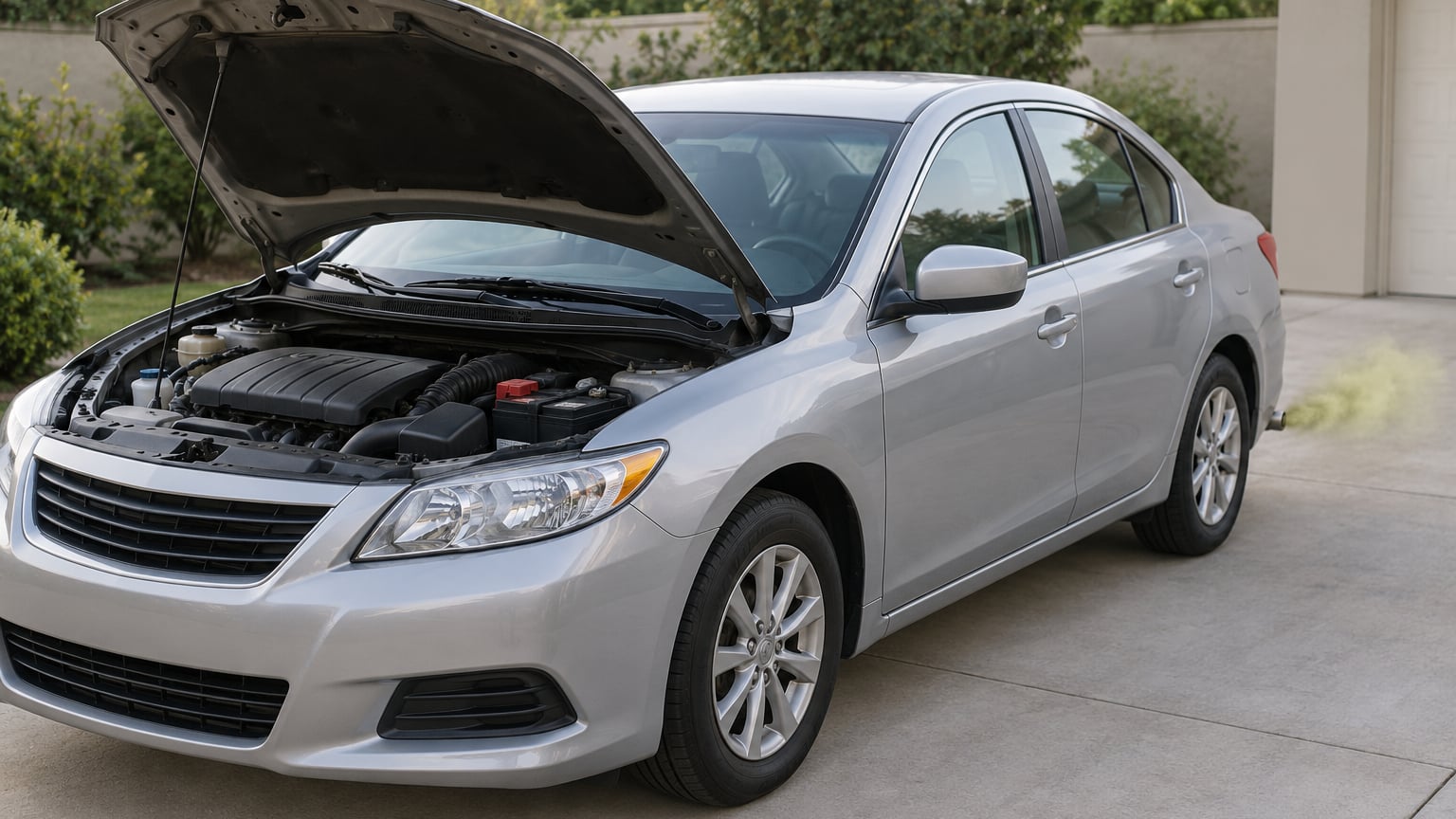
If you’re wondering why does my car smell like rotten eggs, the answer is almost always hydrogen sulfide, a sulfur gas that is supposed to be burned up inside your catalytic converter. When that converter is cold, failing, or flooded with unburned fuel, the gas escapes through the tailpipe and into the cabin.
That matters because the smell is a symptom, not the diagnosis. A converter that smells can also be restricting exhaust flow, which costs you power and fuel economy and can eventually overheat the engine. The difference between a harmless one-off whiff and a real fault usually shows up in when and where you notice it.
Table of Contents
- What Causes a Rotten Egg Smell in a Car?
- Is It Safe to Drive With a Rotten Egg Smell?
- The Most Likely Causes
- Why Does My Car Smell Like Rotten Eggs When Starting?
- Why Does My Car Smell Like Rotten Eggs While Driving?
- How to Tell Whether the Battery Is the Problem
- What to Check in the Exhaust and Catalytic Converter
- What to Check in the Fuel and Air Intake System
- How to Fix a Rotten Egg Smell in Your Car
- Why Does My Car Smell Like Rotten Eggs? Quick Diagnosis Checklist
- When Should You Replace the Battery or See a Mechanic?
- Frequently Asked Questions
- Does a rotten egg smell always mean my catalytic converter is bad?
- Should I stop driving my car if it smells like rotten eggs?
- Can a bad oxygen sensor cause a rotten egg smell?
- Why does my car smell like rotten eggs when I start it?
- Why does my car smell like rotten eggs when the AC is on?
- How long will a car run with a clogged catalytic converter?
- Conclusion
What Causes a Rotten Egg Smell in a Car?
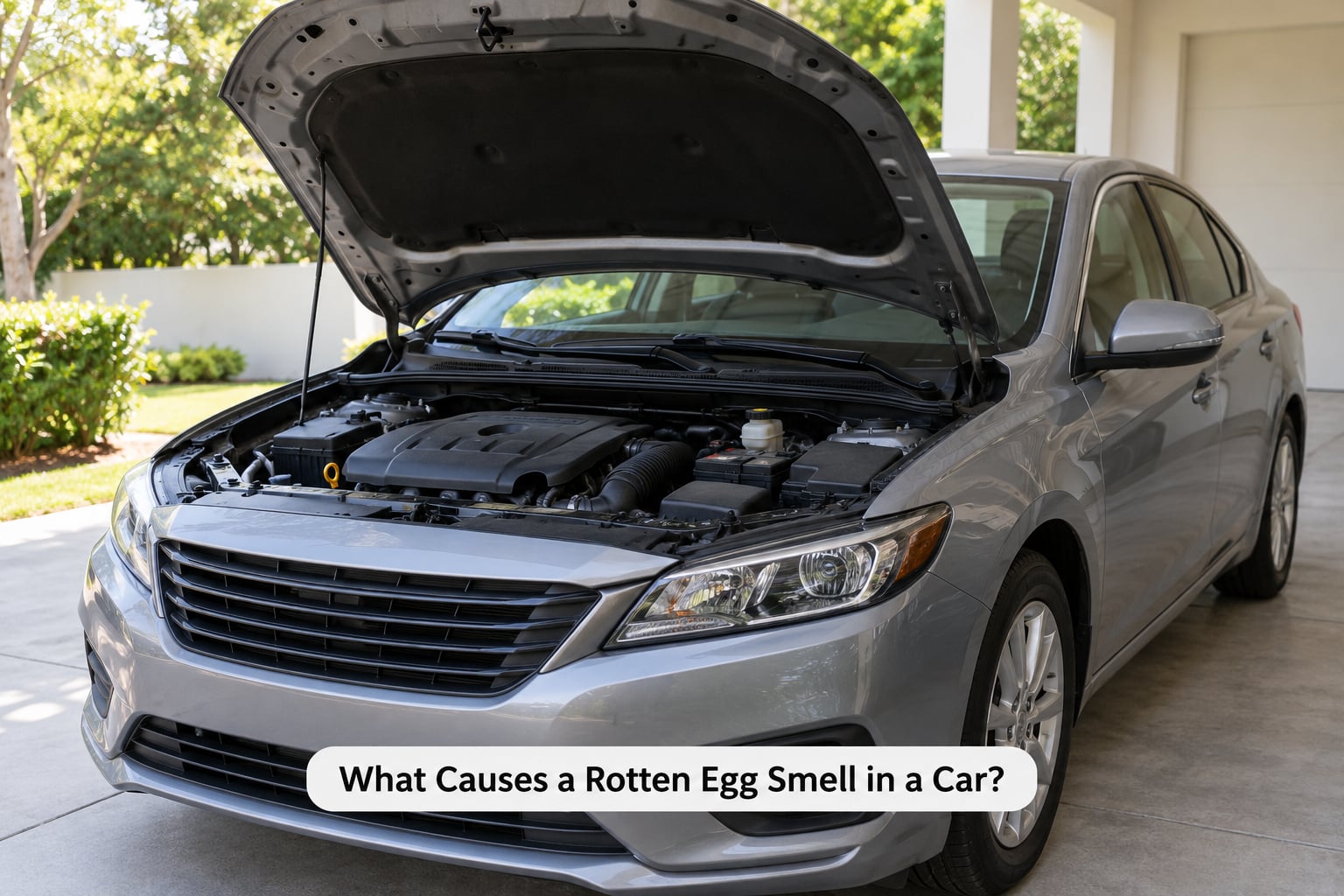
Gasoline contains small amounts of sulfur, and burning it cleanly produces mostly odorless compounds. Hydrogen sulfide is the smelly intermediate, and the catalytic converter’s job is to oxidize what’s left. Four things break that chain: a battery venting sulfuric acid fumes, a converter that isn’t working, an exhaust leak that pulls fumes forward into the cabin, or an engine running too rich so raw fuel drops down the tailpipe.
Diesel owners see this more often than gasoline drivers, because diesel fuel carries more sulfur and the aftertreatment is more sensitive to it. On a gas car, the smell usually points at the fuel or emissions side rather than the fuel tank itself.
There’s also the impostor. A musty, damp smell that appears only with the air conditioning on is mold in the evaporator or a wet cabin air filter, not sulfur. People mix those two up constantly, and they lead to completely different repairs.
Is It Safe to Drive With a Rotten Egg Smell?
Hydrogen sulfide is toxic at high concentration. At low levels your nose detects it easily, but a heavily contaminated engine bay can produce enough of it to cause headache, dizziness, throat irritation, and nausea. Get out, get to fresh air, and ventilate the vehicle if you feel symptoms.
The rule I use: never run an engine in a closed garage, and if you smell sulfur strongly under the hood rather than behind the car, shut it off and pull away from the structure. Rolling windows down and driving is fine for diagnosis.
Stop driving and arrange a tow when you notice a hot, swollen, or hissing battery, liquid under the car near the tank, visible exhaust hanging or a loud roar from under the vehicle, or a burning-plastic smell that gets stronger with every mile. Those are different problems that share a smell, and they escalate fast.
The Most Likely Causes
Start by locating the odor. Where you smell it tells you more than anything else you can check in a driveway.
| Possible cause | Where you smell it | Typical timing | Other warning signs | Urgency |
|---|---|---|---|---|
| Sulfured or overcharged battery | Front of the engine bay, around the battery | At startup, strongest before the engine catches | Corrosion, swelling, dampness, slow cranking, flickering lights | High — stop if the case is hot or bulging |
| Failing catalytic converter | Exhaust tip, and inside the cabin on a highway drive | Under load, acceleration, or a long highway pull | Check engine light, P0420 or P0430, rattling from under the car, less power, dropped fuel economy | Medium — schedule diagnosis promptly |
| Exhaust leak or loose heat shield | Under the car, louder at the front of the cabin | Constant, sometimes louder under load | Rattling or ticking that changes with speed, visible hanging shield | Medium — easy fix, worth doing |
| Rich fuel mixture or bad fuel | Tailpipe, sharpest when accelerating hard | At startup and under acceleration, sometimes only in the first few minutes | Rough idle, misfire, check engine light, higher fuel use | Medium — many cheap fixes first |
| Evaporative canister or purge valve | Near the fuel tank, sometimes faintly in the cabin | After fueling or during a drive cycle | Check engine light, a small fuel odor near the rear | Medium — do not test with a flame |
| Intake gasket or dirty air filter | Under the hood, engine bay | Under acceleration | Sluggish response, misfire, check engine light | Medium |
Why Does My Car Smell Like Rotten Eggs When Starting?
Cold starts are when a catalytic converter is least effective. On a car with a slight exhaust leak or a converter that is starting to clog, the first minute of a cold engine can push a raw sulfur puff out of the tailpipe and through the leak seals. Owners often describe exactly this: a burst of smell at key-on, then nothing.
A brief, localized odor that fades within a minute or two of warm-up is usually not an emergency. It becomes a real concern when the smell is strong at startup, fills the engine bay instead of the tailpipe, or never fades.
That engine-bay version points at the battery. A lead-acid battery that sits cold overnight gives off hydrogen sulfide vapor as it recovers from the night, and a sulfured battery does it constantly. Our fuller battery walkthrough on how long a car battery last by type covers the case and terminal checks in more detail.
Why Does My Car Smell Like Rotten Eggs While Driving?
When the smell shows up while the engine is working hard, the engine is probably running rich, meaning more fuel than it can burn. Unburned fuel carrying sulfur reaches the exhaust, and if the converter can’t oxidize it in the heat, you get the odor at the tailpipe and through any leak in the cabin floor.
Common rich-mixture culprits are worn spark plugs, leaking fuel injectors, a failed fuel pressure regulator, a dirty air filter, or a mass airflow sensor reading low. An oxygen sensor that has gone bad is the version most guides leave out; our explainer on what a bad oxygen sensor does to gas mileage explains the fuel trim side of it. A failed sensor can let the ECU command a rich mixture long after it should have gone lean.
Short trips are the reason some cars smell more than others. The converter needs sustained heat to do its job, and a stop-and-go commute never gives it one. Long highway drives should make the odor disappear, not appear, so if it’s the other way round that’s a clue worth noting.
Diagnostic code P0420 or P0430 means the ECU has measured catalyst efficiency below threshold. Treat that as a strong hint, not proof — a code sets for exhaust leaks and sensor faults too, and plenty of cars smell with no check engine light and no stored code at all. That is the trap: the absence of a code is not evidence the exhaust is healthy.
How to Tell Whether the Battery Is the Problem
Open the hood with the engine off and cold. Look for a white or bluish powder crust on the terminals, a damp or chalky patch on the battery case, a bulging or split case, or a wet smell near the posts. Bulging means stop driving it and don’t charge it. Sulfur odor strongest at the battery with a clean tailpipe points the same way.
Then measure resting voltage with a multimeter. A fully charged, rested 12-volt lead-acid battery sits around 12.6 volts. Below roughly 12.2, the battery is not holding a charge, and a sulfured battery will fail again no matter how far you drive it.
Clean the corrosion next. A crusty terminal, a loose clamp, or a battery strap that has turned to powder can all cause cranking complaints that look exactly like a dead battery. Scrub the posts, tighten the clamp, and then re-test before you buy anything.
Hand the job to a battery specialist or shop if the case is swollen, if it leaks, if the reading stays low after a full charge, or if the vehicle is still under warranty. A parasitic drain test is the right next step there, not another guess-and-check replacement.
What to Check in the Exhaust and Catalytic Converter
An exhaust leak is the cheapest and most commonly missed cause. Start the engine outdoors, park it, and have somebody listen while you crawl underneath with the vehicle secured. A ticking or rasping that changes pitch with engine speed is a broken hanger or a loose heat shield. Do this with the car on stands or ramps and the wheels chocked, never under a car resting on a jack alone.
Visible clues are easier: hanging shields, a shield missing, flex pipe with rust cracks, or a seam with fresh carbon streaking. Any of those can pull exhaust gas into the cabin through the floor or firewall, which is how a tailpipe smell becomes a cabin smell.
Catalytic converter diagnosis isn’t a driveway job. Efficiency testing needs an exhaust gas analyzer, a scan tool, and someone who knows what the numbers mean. If the rattle from under the car comes from the converter substrate breaking loose, that part cannot be repaired — the substrate is a ceramic honeycomb, and it gets replaced as a unit.
One more thing owners miss: a converter can be fouled by coolant or oil that entered the exhaust after a head gasket failure. A sweet coolant smell, a rising engine temperature, or the dipstick reading like mayonnaise all point that way, and that’s an engine repair conversation, not a parts swap.
What to Check in the Fuel and Air Intake System
The evaporative system is a common source that gets overlooked because the smell is faint. The purge valve and the canister manage fuel vapors from the tank, and a stuck-open or stuck-closed valve sends those vapors into the cabin or the air. A check engine light with no other symptom often means the purge monitor flagged it.
Also look at the fuel rail connections and the intake side: a cracked intake manifold gasket can let unburned fuel wash down the cylinders, and a restricted air filter makes the ECU ask for more fuel than it should. Both smell worse under acceleration.
Safety rule for this area: no smoking, no open flame, no aerosol sprays near a suspected leak, and no compressed air to blow vapors around. If you can smell raw fuel strongly, drive the car straight to a shop. If the fuel smell is strong enough to make your eyes water, don’t drive it at all.
Related: why a car smells like gas after starting breaks down the vapor-leak cases that overlap with this one.
How to Fix a Rotten Egg Smell in Your Car
Fix what the smell is actually telling you. A sulfured or failed battery gets replaced, and corroded terminals get cleaned or replaced with the connection. An exhaust leak or hanging shield gets welded or clamped, which is quick and inexpensive. A rich mixture usually starts with spark plugs, injectors, a fuel pressure regulator, or a filter. A catalytic converter or sensor fault gets diagnosed before anything is bought.
Use the part and battery type your owner’s manual specifies, and match the battery case size, terminal layout, and cold cranking rating. A converter has to meet the emissions requirements for the vehicle, not just bolt on.
Two jobs belong to a professional without exception: anything on the fuel system, and catalytic converter or exhaust diagnosis. A shop has the analyzer, the lift, and the storage to handle a car that is hot enough to work on.
Why Does My Car Smell Like Rotten Eggs? Quick Diagnosis Checklist
Work through these in order and you’ll usually have your answer before you touch a tool.
- Note the timing. At startup, while driving, only under hard acceleration, or only with the AC on? Write it down, because the pattern narrows the cause more than any single test.
- Locate it. Stand at the tailpipe, then the front of the engine bay, then inside with the windows up. Note which one is strongest.
- Read the warnings. Check engine light on or not, any stored codes, and whether the headlights flicker at idle.
- Inspect the engine bay cold. Look at the battery case, terminals, and the ground straps for corrosion, moisture, or swelling.
- Look underneath. On stands or ramps with the wheels chocked, look for a hanging heat shield, a broken flex pipe, or a visible leak stain.
- Rule out mold. If the smell is musty and only appears with the AC, change the cabin air filter and treat the evaporator; that’s not a sulfur fault.
- Don’t improvise. No open flame, no aerosol near fuel, no charging a swollen battery.
- Get codes read and a decision made. A scan tool plus a quick exhaust check answers most cases in one visit.
When Should You Replace the Battery or See a Mechanic?
A battery is worth testing, not guessing at, when the car starts slower than it used to, the headlights dim at idle, the terminals are crusty, or the smell is right at the front of the bay. Test first, then replace. If it reads fully charged and holds voltage, the battery is not your problem and replacing it will only cost you money.
See a mechanic promptly when the smell is persistent, when the check engine light is on, when you have stored codes, when the car runs rough or lacks power, or when the exhaust rattles. See one immediately when the battery is hot, swollen, or hissing, when there’s burning plastic, when fuel is pooling, or when you feel dizzy or your throat burns.
For a car that’s still under emissions warranty, mention the smell at the same visit as the code. A converter-related efficiency code on a relatively newer vehicle is sometimes covered, and it’s worth asking before you authorize anything.
Frequently Asked Questions
Does a rotten egg smell always mean my catalytic converter is bad?
No. A converter is the most common single cause, but owners regularly chase the wrong repair because the smell also comes from a sulfured battery, an exhaust leak pulling fumes into the cabin, or an engine running rich on unburned fuel. Location tells you a lot: strong at the front of the engine bay suggests the battery, strongest behind the car under acceleration suggests the converter or a rich mixture. A scan for codes plus an exhaust check settles it.
Should I stop driving my car if it smells like rotten eggs?
Usually you can keep driving, but with firm exceptions. Stop and tow for a hot, swollen, or hissing battery, liquid near the fuel tank, a loud exhaust leak or hanging parts, or a burning-plastic odor that worsens as you drive. Do not run the engine in a closed garage, and if a strong odor is under the hood rather than at the tailpipe, shut it down and move the car outside. Get fresh air immediately if you feel headache or dizziness.
Can a bad oxygen sensor cause a rotten egg smell?
Yes, and it’s a cause most guides skip. An oxygen sensor that reports a lean mixture when the engine is actually rich, or fails to correct the reading, keeps the ECU commanding more fuel than the engine burns. That unburned fuel carries sulfur into the exhaust, where a cold or tired catalytic converter can’t finish the job, so the odor comes out of the tailpipe. Bad sensor readings also show up as long-term fuel trim problems and a check engine light.
Why does my car smell like rotten eggs when I start it?
Because a cold catalytic converter is at its least effective. On a car with a small exhaust leak or a converter starting to clog, the first minute of running pushes sulfur-laden vapor out of the tailpipe and through the leak seals, which is why the odor is strongest before the engine warms up. A brief whiff that fades within a minute or two is often nothing serious. A strong smell at startup that never goes away, or one that fills the engine bay instead of the tailpipe, points at the battery.
Why does my car smell like rotten eggs when the AC is on?
That pattern usually isn’t sulfur at all. Air conditioning routes outside air through the evaporator core and the cabin air filter, so a musty, damp, sour-sock odor from the vents means mold or bacteria growing on a wet evaporator, often because the filter is overdue or the system only ever runs briefly. Sulfur smells get stronger when you floor the engine and can enter the cabin through an exhaust leak near the floor. If it fades once the air is cold, it’s a mold and filter job, not a converter.
How long will a car run with a clogged catalytic converter?
There’s no fixed mileage, and that’s the problem. A converter that is partially blocked still lets the car start and drive, often with less power and worse fuel economy, and the smell shows up under acceleration first. As the restriction worsens, exhaust back pressure raises engine temperature, which leads to misfires, failed spark plugs and coils, and eventually melted piston valves. Once you have a smell plus stored P0420 or P0430 codes, get it diagnosed rather than driving until something expensive gives out.
Conclusion
Start by locating the smell and noting exactly when it happens, then look at the battery cold before you blame the most expensive part in the car. Don’t mask it with air freshener, and move the vehicle outdoors rather than running it in a garage.
If the odor is persistent, strong under the hood, or comes with warning lights, codes, or a rattle from underneath, get a professional diagnosis. If you’re wondering why does my car smell like rotten eggs and the answer turns out to be a loose heat shield or a bad oxygen sensor, you’ll be glad you checked before authorizing a converter replacement.