
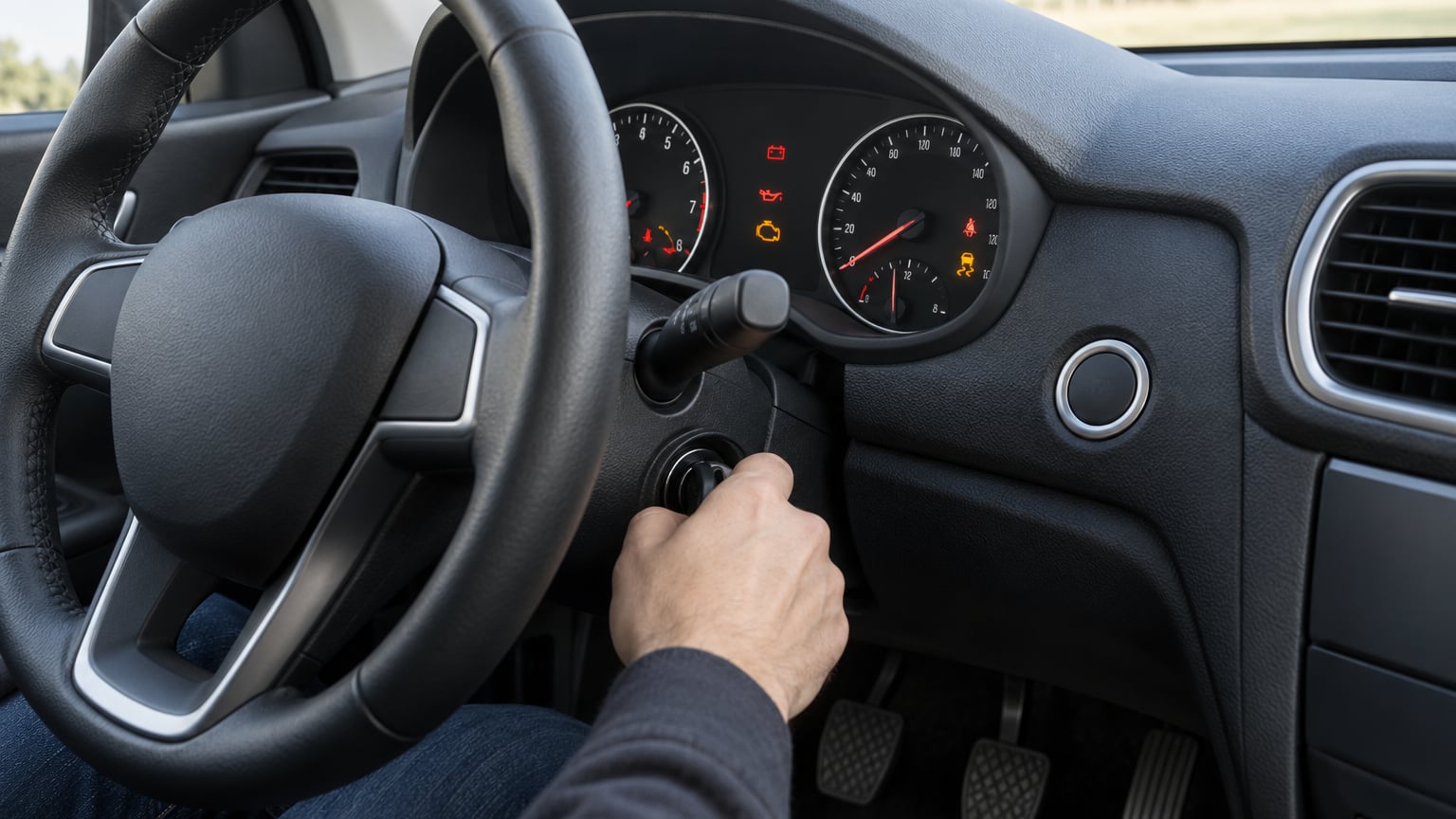
If your car cranks but won’t start, the starter and battery are probably fine. The engine needs fuel, spark, air, and compression with correct timing at the same instant to fire, so a normal-speed crank that never catches means one of those four is missing. Work through them in order and you can usually name the fault in about twenty minutes, before buying a single part.
That order matters. The most expensive mistake in this category is replacing the battery, the starter, and the alternator on a car that turns over perfectly well, then wondering why it still cranks but won’t start. It comes up constantly in the DIY forums, and it is almost always a wasted afternoon and a few hundred dollars.
Table of Contents
- What Does It Mean When a Car Cranks but Won’t Start?
- The 10 Most Common Car Cranks but Won’t Start Causes
- 1. A failed fuel pump or a clogged fuel filter
- 2. Clogged or leaking fuel injectors
- 3. Fouled or worn spark plugs
- 4. A failed ignition coil or coil pack
- 5. A failed crankshaft position sensor
- 6. A camshaft position sensor or MAF sensor fault
- 7. An air restriction
- 8. Low engine compression
- 9. An immobilizer or key programming fault
- 10. A flooded engine
- How to Tell Whether the Battery or Starter Is the Problem
- Fuel and Ignition Checks for a Cranking Engine
- Immobilizer, Key, and Wiring Problems
- What to Check Before Replacing the Starter
- How to Fix Common No-Start Problems Safely
- When to Call a Mechanic
- Frequently Asked Questions
- Conclusion
What Does It Mean When a Car Cranks but Won’t Start?
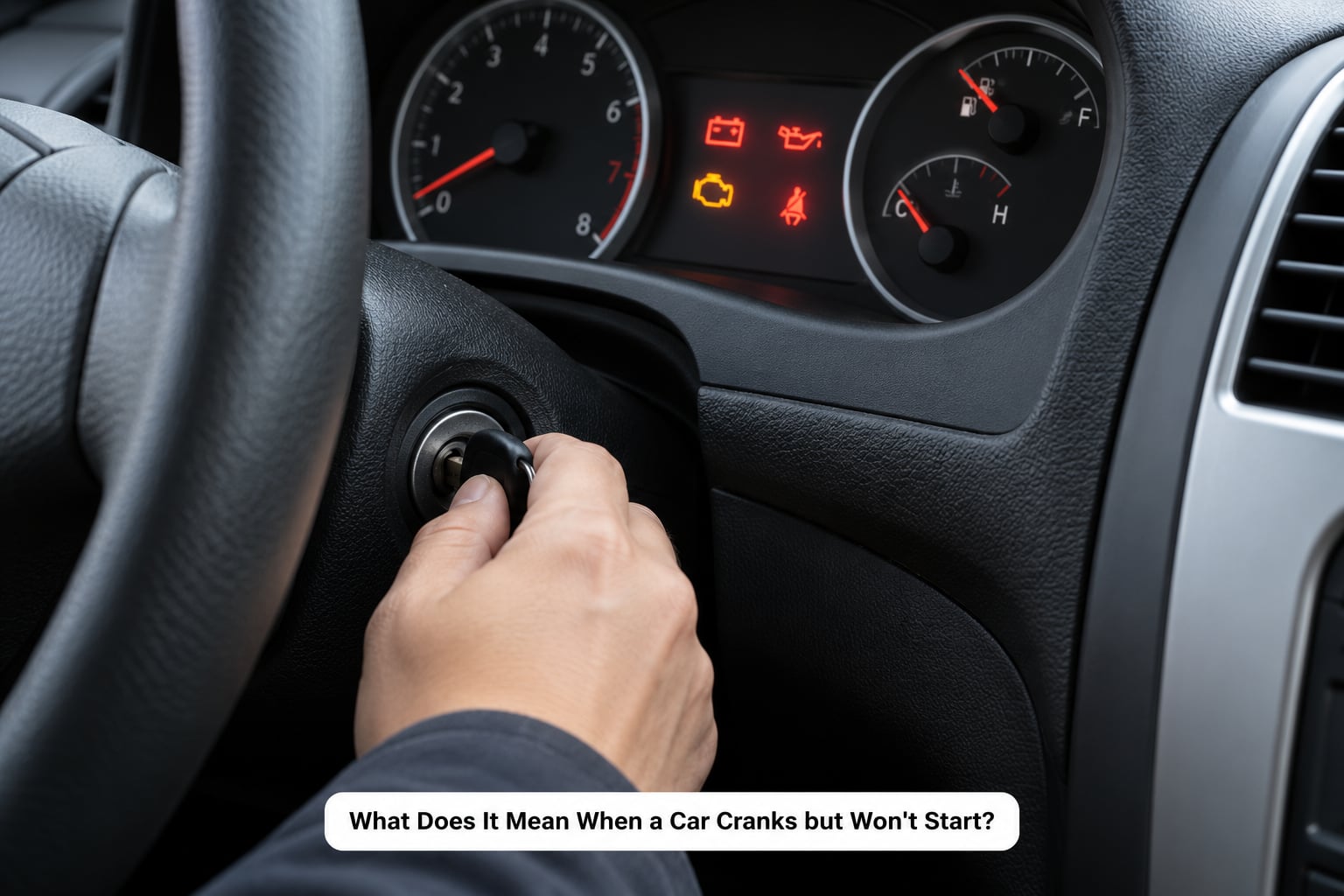
Cranking is the starter motor physically turning the crankshaft. No crank and no start points at the battery, the starter, or the wiring between them. A crank with no start points somewhere else entirely, and the way it cranks tells you a lot before you touch a tool.
Normal, fast crank
A smooth, steady whirr at a healthy speed, usually 200 to 300 rpm. The battery, the starter, the alternator, and the main engine grounds are doing their job, so stop spending money there and move to fuel and spark.
Slow, laboured crank
The starter drags and the engine barely turns, like a yawn. That is a discharged battery, corroded terminals, a loose ground strap, or a starter whose solenoid is beginning to fail. Lights dimming hard while it cranks points at voltage, not mechanics.
Uneven, lumpy crank
The engine jerks back and forth instead of spinning smoothly. That usually means low compression in one cylinder, sometimes a bent valve or a damaged piston, and it is a mechanical problem rather than an electrical one.
Clicking or rapid chatter
That noise is the solenoid or relay engaging and dropping out immediately. There is barely enough current to close the circuit, so the battery is either flat, badly connected, or the starter solenoid is welded shut.
Grinding
The starter pinion is not engaging the flywheel properly. Keep cranking on a grinding starter and you can chew through the ring gear teeth, which turns a cheap starter repair into a much bigger one.
If the dashboard lights come on bright and hold steady, the ignition switch, key, and main power feed are working. That is a genuine clue, but it isn’t proof the battery is healthy, since a worn cell can hold 12.6 volts at rest and still collapse under cranking load.
The 10 Most Common Car Cranks but Won’t Start Causes
These are the ten causes that account for nearly every crank-no-start on the road, ordered by how often they turn out to be the answer. Read the symptom line first. If it doesn’t match what your car is doing, skip that cause rather than forcing it.
1. A failed fuel pump or a clogged fuel filter
Symptom: crank sounds completely normal, no fire, sometimes a whirring or grinding noise from under the rear seat or tank.
Test: turn the key to ON without starting and listen for a 2 to 3 second fuel pump priming hum. No hum points to a dead pump, a blown pump fuse, or a bad relay. A failed pump is one of the most common causes of a car that cranks but won’t start, and the telltale signs are covered in our BMW fuel pump failure symptoms guide.
2. Clogged or leaking fuel injectors
Symptom: it cranks hard and shakes, smells strongly of raw fuel at the exhaust, or ran fine until a fuel-quality or tank-contamination event.
Test: pull one injector connector and check for injector pulse while cranking. You want a repeating click. Leaking injectors flood individual cylinders and mimic a flooded engine on their own.
3. Fouled or worn spark plugs
Symptom: slow acceleration leading up to the fault, mild misfire shudder, and a check engine light that comes on under load.
Test: pull a plug and look at it. Black, oily, or badly eroded tips tell the story. P0300 through P0304 misfire codes in your scan tool point the same direction.
4. A failed ignition coil or coil pack
Symptom: smooth crank, no fire, and a blinking check engine light that you should stop driving on.
Test: check spark at the plug while cranking. No spark on one cylinder means that coil or its power feed. Coils fail far more often than plugs, which is why replacing plugs first often wastes an afternoon.
5. A failed crankshaft position sensor
Symptom: even crank at normal speed with absolutely no fire, sometimes with no check engine light at all.
Test: scan for P0335 or P0336. The computer needs this signal to know when to spark and inject, so with no signal the engine simply cranks forever. If you want to see what an intermittent sensor fault looks like in practice, jump-starting a car with a dead alternator covers a related case where a weak charge system let the sensor go intermittent.
6. A camshaft position sensor or MAF sensor fault
Symptom: no start from cold, or a start that dies the moment you touch the throttle.
Test: P0340 for a cam circuit, and check for MAF-related codes and a plausible live airflow reading on your scan tool. A MAF reading pinned at zero while the engine runs is a dead sensor.
7. An air restriction
Symptom: cranks and catches but won’t stay running, and only dies at idle or low speed.
Test: pull the intake hose and look at the filter element. A badly blocked MAF or a carbon-choked intake manifold starves the mixture at idle. Cold-only failures also point at old fuel and stale varnish, which is a different problem from a frozen battery.
8. Low engine compression
Symptom: an uneven crank and a sound like the engine is thrashing rather than turning over.
Test: a compression test. Bad piston rings, a stretched head gasket, or worn valve seats can pull a healthy fuel and spark system down to nothing. This is the point where a fuel system rebuild quote from a shop is often chasing the wrong system, because the fault is mechanical.
9. An immobilizer or key programming fault
Symptom: normal crank, no fire, and a security or anti-theft light flashing on the dash.
Test: try the second key, then the spare. A glitching immobilizer or an unrecognized key chip can cut both fuel and spark with the battery in perfect health.
10. A flooded engine
Symptom: you cranked several times trying to start it, and now it cranks, shakes hard, and smells like fuel.
Test: stop cranking and let it sit for 15 to 30 minutes, then try once with the throttle held down a quarter inch. Stopping is what clears a flooded engine. How cold does it have to be before this becomes the normal explanation is worth knowing too, since how cold it has to be for a car not to start covers the temperature side of cold starts.
One more cause deserves a mention because it is severe and easy to miss: a slipped timing belt or chain. It usually follows a jump-start, a wrong pulley, or timing work done recently, and the signs are an even crank with no fire plus P0016 or P0017 codes. If you see those codes, stop cranking and check the marks before the valves bend.
How to Tell Whether the Battery or Starter Is the Problem
A fast, smooth crank clears the battery and starter from suspicion almost entirely. Here is the quick comparison that gets you there in under five minutes without a scan tool.
A healthy battery rests at 12.6 volts or higher with the engine off. Watch what happens when you crank: if the voltage collapses below about 9.5 volts and the starter sounds slow, the battery or its connections cannot carry cranking current. If the voltage holds steady through a fast crank and the engine still won’t fire, the battery is fine and you’re looking at fuel or spark. If voltage looks healthy but the starter drops out with nothing running, the solenoid is the fault.
| What you hear or notice | What it usually means | Next test |
|---|---|---|
| Fast, even whirr, no fire | Battery and starter are good | Fuel pump hum, then spark |
| Slow, groaning crank | Low battery or poor connection | Resting and cranking voltage |
| Dash lights dim hard while cranking | Voltage drop under load | Terminals and ground strap |
| Uneven, jerky crank | Low compression in one cylinder | Compression test |
| Rapid clicking, no movement | Solenoid or relay not holding | Battery charge state |
| Grinding on engagement | Starter pinion not meshing | Stop cranking, inspect teeth |
| Fluctuating needles on the cluster | Loose ground or alternator fault | Charging system check |
Two safe driveway checks handle most of it. Clean the terminals with a wire brush and baking soda, tighten them, and confirm the negative cable reaches bare metal on the body or engine. Then measure voltage at the battery while cranking, which tells you immediately whether the battery or the connections are at fault.
Fuel and Ignition Checks for a Cranking Engine
Fuel first, then spark. That order is deliberate because a working spark test is easier to interpret once you know fuel is reaching the rail, and because fuel faults are more common.
1. Confirm fuel is actually in the tank. Watch the gauge with the key on. Some cars have a notoriously unreliable sender, so put a flashlight in the filler neck and check the level physically.
2. Listen for the pump. Key to ON, not START. You should hear a 2 to 3 second hum from the tank area. Silence means the pump, the pump fuse, or the relay, and that is a solid place to start.
3. Smell and look. Raw fuel at the exhaust means fuel is arriving but not igniting. No fuel smell at all, on a carbureted or older port-injected engine, points at fuel delivery rather than ignition.
4. Check fuel pressure. A gauge on the fuel rail should read in the range your service manual specifies. Low pressure says a weak pump or a clogged filter. Remember that a sitting car can varnish the tank and gum up the filter, especially after storage.
5. Test spark. With the plug out and the plug wire or coil boot held firmly against a grounded metal strap, crank and watch for a bright snap across the gap. No spark on every cylinder is a coil, coil power, or crank sensor fault. Sparks on all cylinders send you back to fuel or air.
6. Scan for codes before you clear them. Intermittent faults often erase themselves, and clearing a code destroys the evidence you need. Read P0300 to P0304, P0335, P0340, P0087 or P0088, and P0016 before you touch the key again.
7. On a diesel, skip the spark test. There is no spark plug to test. Diesels fail on fuel delivery, clogged water-separating filters with built-in heaters, or dead glow plugs on a cold start, and a working starter with no fire means air or fuel, not ignition.
Keep it safe. Unplugging injector connectors while cranking stops fuel delivery without spraying a mist across the driveway, and never loosen a fuel line without relieving pressure first. Working around ignition-coil and plug wires under load gets you shocks, so keep both hands and the tool clear of the moving engine when a plug is out.
Immobilizer, Key, and Wiring Problems
An engine that cranks with a flashing security light has told you exactly where to look. The immobilizer cuts fuel and spark when the key chip is not recognized, and the classic owner error is putting a new battery in a car and losing the key programming along the way.
Try every key you own before anything else. If the car starts on the second key, you have your answer. Beyond that, an aftermarket alarm or remote-start module can interfere even when the factory system is fine, and a drained or removed aftermarket battery is a classic cause of an anti-theft system that no longer communicates.
Wiring faults produce the same symptom. A blown ignition-on fuse, a chafed harness near the steering column, or a ground strap that has corroded through can all allow a crank with no fire, and the dash will usually flicker or the lights will dim as the engine turns. Look for a connector that has been mashed under a bracket before you start pulling fuses apart one at a time.
What to Check Before Replacing the Starter
If the engine turns over at normal speed, the starter is doing its job and replacing it will change nothing. That scenario is all over the DIY forums: owners who fitted a new starter, alternator, and battery on a car that cranks fine and still never fires.
Run the preliminary checks first, every time, in this order. Battery resting voltage and voltage under load, then terminal and ground connections, then fuel delivery including the pump hum, then immobilizer status and warning lights, then stored codes, and finally a compression test if fuel and spark are both confirmed good.
Only buy a starter after the crank itself is slow, the voltage checks pass, and the solenoid drops out with nothing running. A cheap starter that fixes a healthy starter’s symptom is the most common way owners turn one fault into three.
How to Fix Common No-Start Problems Safely
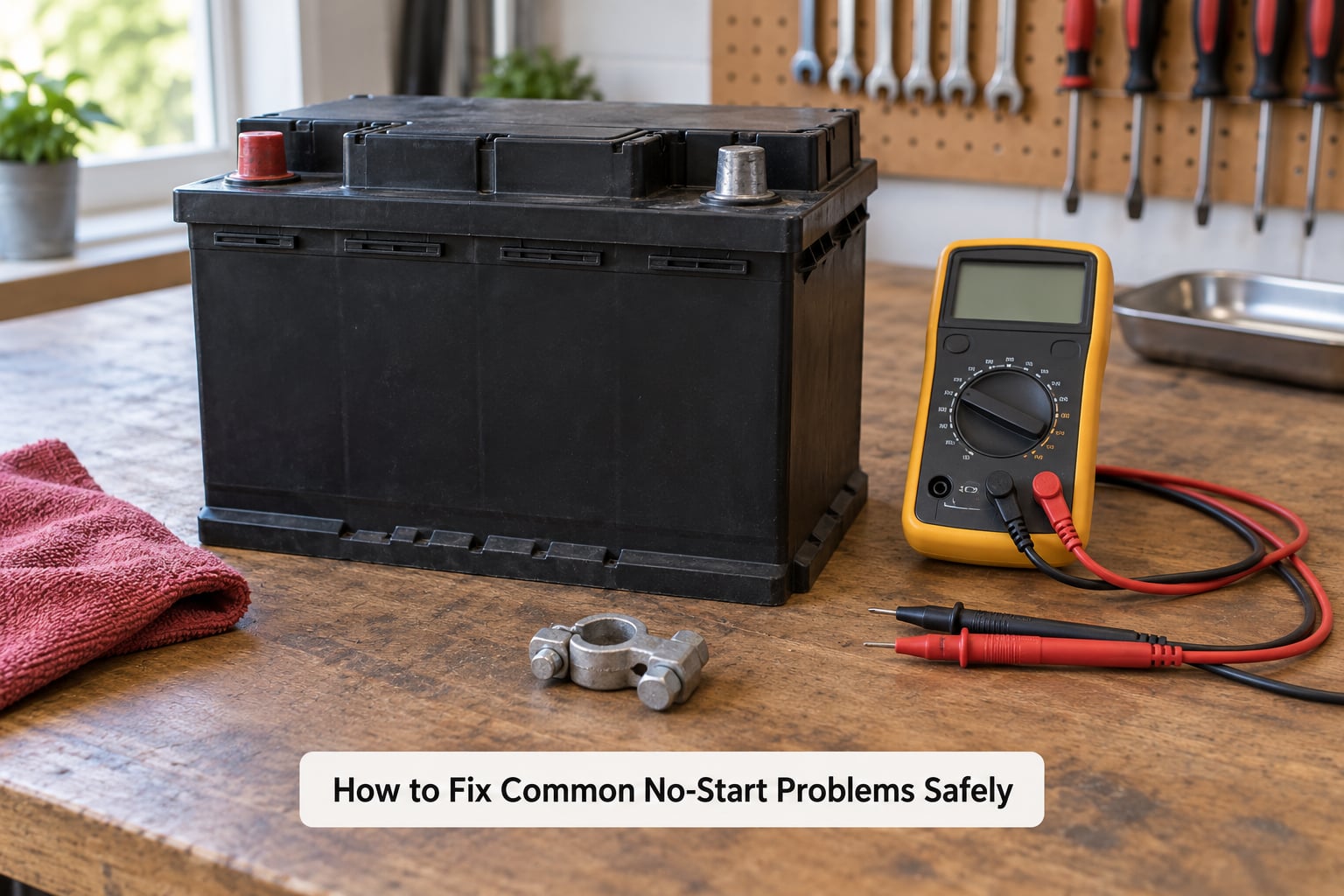
Battery terminals and grounds. Disconnect the negative cable first, clean both posts and the ground point with a wire brush and baking soda solution, rinse dry, and reconnect with the negative last. This fixes a surprising share of cold-weather crank-no-starts on their own.
Battery replacement. Match the group size and reserve capacity, clean the new posts before fitting them, and let a smart charger bring it to full charge. A brand new battery that sat on a shelf for months may still be partly flat.
Fuel delivery. Replace the pump and filter as a set, keep the new filter submerged in clean fuel, and prime the system before the first crank so you don’t airlock it. Clean or replace injectors only after a pressure test confirms they are the problem, and add the correct detergent if varnish from long storage is suspected.
Ignition. Set coil gaps and spark plug gap to your service manual figures rather than by feel. Replace coils and plugs as a matched set if the engine has run long on worn plugs, since the igniter inside an old coil can be the real fault.
Sensors and wiring. Follow the sensor’s wiring, not just the sensor. Test the crank sensor for a clean signal at the connector and check the connector pins for green corrosion, which is water, not age.
Key programming and anti-theft. This is dealer or locksmith territory on most cars. Attempting to re-learn a transponder key with the wrong procedure can leave you with a car that won’t start even with the correct key in your hand.
Starter and alternator. Once everything above has been ruled out, replacing the starter or alternator is reasonable. Have the alternator’s charging output tested with the engine running before you accept the work, since a marginal alternator quietly kills a fresh battery.
Any work involving fuel lines, high-voltage ignition components, or the engine internals belongs with a certified technician. Follow your owner’s manual for anything the manual covers, and follow safe fuel-handling practice for anything it does not.
When to Call a Mechanic
Stop diagnosing and get the car to a shop when you hit any of these. A visible fuel leak or pooling fuel under the car. A strong fuel smell that isn’t a flooded engine, or burning coolant or oil. Coolant in the combustion chambers points at a head gasket or cooling fault, and the car cranks but won’t start because the engine is hydro-locked. Significant damage to the wiring harness, frayed or melted insulation near the battery or steering column, or a fuel pump fuse that blows again the moment it is replaced.
Also stop when the compression test comes back low and uneven, which points at rings, valves, or a head gasket. An even crank and run with low compression means the timing has slipped and continued cranking can bend a valve. A check engine light flashing, repeated cranking after a clear spark and good fuel pressure, or a fuel pressure reading far outside your service manual spec.
One more practical limit: if you need to crank the engine repeatedly to get any kind of response, the battery is being drained faster than it can recover, and every attempt costs you the next one. Most shops charge a diagnostic fee before they lift a wrench, and that fee buys you a scan tool and an ordered test rather than a guess.
Frequently Asked Questions
What does it mean when my car cranks but won’t start?
It means the starter motor is turning the engine over at normal speed but it never fires. That clears the battery, the starter, and usually the alternator, so the fault sits in fuel delivery, ignition, air intake, compression, or timing. The fastest first test is turning the key to ON and listening for a 2 to 3 second fuel pump hum.
What sensor can cause a crank no start?
The crankshaft position sensor is the usual suspect, because the engine control module needs its signal to know when to spark and inject fuel. With no signal the engine cranks indefinitely with no fire and often no check engine light. P0335 or P0336 codes point at it, and a camshaft position sensor fault shows up as P0340.
Why is my car cranking but not catching?
Your engine needs fuel, spark, air, and compression with correct timing at the same instant, and one of those is missing. Test them in order: check the fuel gauge, listen for the fuel pump hum on key-to-ON, check spark at a plug, then read stored codes, then run a compression test. Skipping straight to parts is what leads owners to replace a good starter.
Why does my car have power but won’t start?
Lights and a working dashboard prove the ignition switch and main power feed work, but not that the battery is healthy. A worn cell can read 12.6 volts at rest and still collapse under cranking load. Measure voltage at the battery while the engine cranks: a drop below roughly 9.5 volts means the battery or its connections are the problem.
What if my car starts and then dies immediately?
That pattern usually means the engine fires but cannot keep running. Look at fuel delivery while it is running rather than at the no-start side, plus crank sensor signal dropouts as rpm climbs, and an immobilizer cutting out once the engine is moving. Check whether it dies every time, or only when the throttle is touched, because that separates a lean mixture from a sensor fault.
Is it bad to keep trying to start a car that won’t start?
A handful of short cranking attempts is fine. Long cranking on a flooded engine soaks the plugs and makes the next attempt worse, so stop for 15 to 30 minutes and try once more with a little throttle. Continuous cranking also drains the battery, so if you need more than three or four serious attempts, stop and diagnose instead of burning the last of the charge.
Conclusion
Start where the DIY crowd starts, because it is cheap and it splits the problem in half: key to ON, listen for the 2 to 3 second fuel pump hum. No hum and you are in the fuel system. A hum and you move to spark at the plugs, then to stored codes, then to compression.
A fast, even crank is good news, not bad news. It tells you the battery and starter already passed their test, so leave them alone and go hunting for the fuel, spark, air, or timing fault that is actually stopping the engine.