
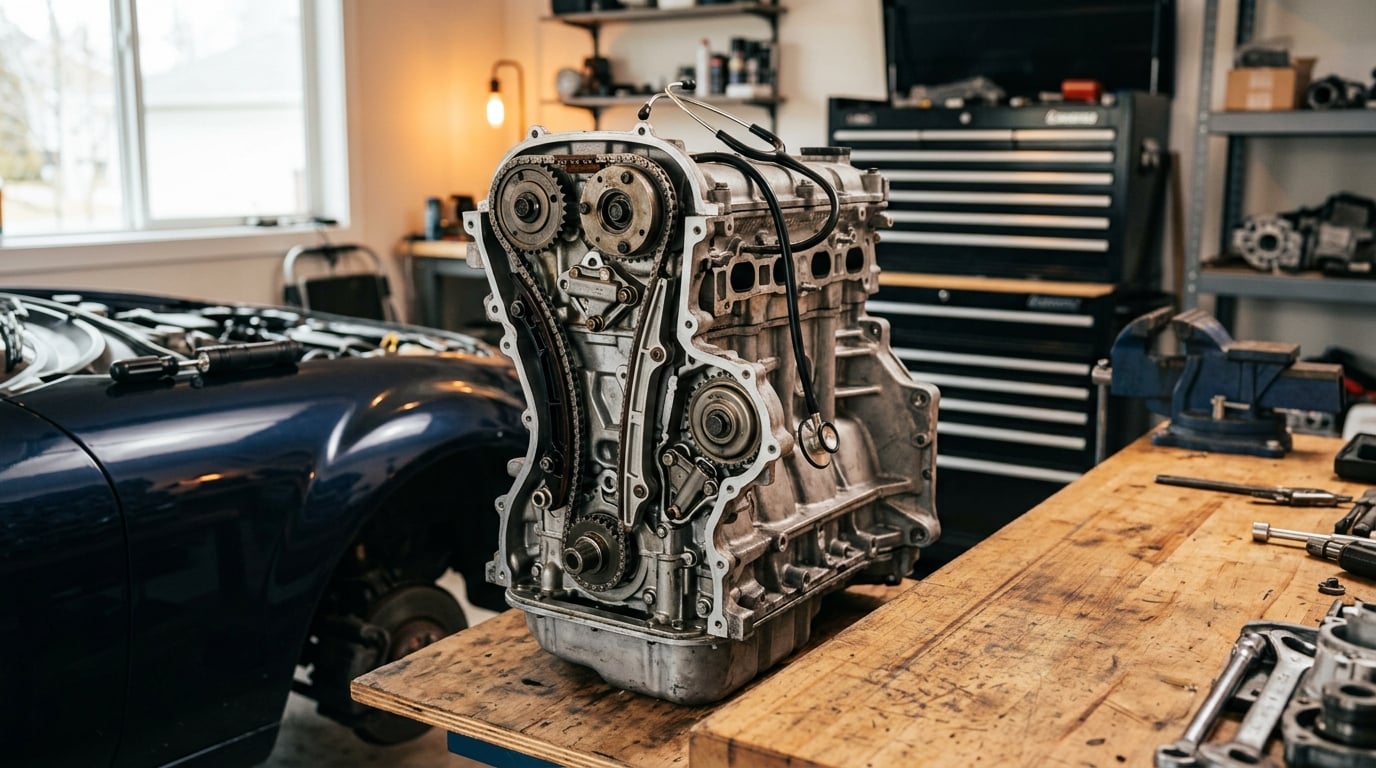
What does a knocking engine sound like? It sounds like a hollow metallic ping, a rapid tick from the top of the engine, or a low rhythmic thump from the bottom — each one tied to a different part wearing out at a different speed. Telling those three apart tells you whether to drive to the shop or call a tow.
That distinction is the whole ballgame. A hollow ping that only shows up under acceleration is usually fuel, plugs, or carbon, and it gives you weeks. A deep thump that speeds up with revs is a rod bearing, and it gives you minutes.
Below is the breakdown: what each knock sounds like, what causes it, how to locate it by ear, and the point where the noise stops being a diagnosis problem and starts being a safety one.
Table of Contents
- What Does a Knocking Engine Sound Like?
- Is Engine Knocking Always a Major Problem?
- Common Engine-Knocking Sounds and What They Mean
- What Causes an Engine to Knock?
- How to Tell Engine Knock From Other Noises
- Can You Fix Engine Knocking Yourself?
- BMW Engines and Common Knocking Complaints
- Is It Safe to Drive With a Knocking Engine?
- Frequently Asked Questions
- What to Do First
What Does a Knocking Engine Sound Like?
Knocking noise falls into three broad families, and they differ in where they come from, how fast they repeat, and what makes them louder.
The first family is the combustion knock. It is a hollow, ringing, sometimes metallic sound that you hear under load: accelerating hard, climbing a hill, hauling a trailer, or sitting at high RPM at a steady highway speed. It tends to fade when you drop back to light cruise. Owners often describe it as marbles bouncing in a tin can, or a ballpoint pen click scaled up and sped up.
The second family is the valvetrain tick. It is faster, thinner, and higher in pitch, like a sewing machine or an old alarm clock. You hear it from the top of the engine, it often carries through the cabin, and it frequently gets worse as the oil thins out with heat and miles. A tick that shows up on cold start and stays for a few minutes usually means something different from a tick that is there all the time.
The third family is the deep internal thump. It is low, dull, and synchronized to engine speed — the “card in the wheel of a bicycle” description that comes up over and over on car forums. It is loudest at the bottom of the engine, gets faster and usually louder as revs climb, and it does not care whether the engine is cold or warm.
Two variables tell you more than the sound itself: engine speed and load. Rising RPMs with a sound means the source is moving with the engine. A sound that only appears when you’re pushing against resistance points at combustion, not wear. A sound that shows up once per driver revolution instead of once per camshaft revolution is mechanical metal-on-metal, not fuel.
Is Engine Knocking Always a Major Problem?
No. Plenty of noises people call engine knock come from a loose exhaust heat shield, a failing accessory pulley, an engine or transmission mount, or a leaking exhaust gasket that lets combustion noise escape into the cabin. None of those are catastrophic on their own.
What matters is the combination around the sound. Treat it as urgent if the knock comes with an oil pressure warning light, a check engine light, white or blue smoke, a rising temperature gauge, visible loss of power, or a roughness that makes the car shake. A knock on its own is a question; a knock with those alongside it is an answer you already have.
What Does a Knocking Engine Sound Like When It Comes From Inside?
Internal mechanical knocking sits lower in the frequency range and carries further through the block. You get a heavier thump with more body to it, a repeated clank from underneath, and the sound tightens as revs come up instead of thinning out. Main bearing knock sits even deeper and duller than rod knock, and it often shows up as a low-frequency shudder felt in the seat and steering wheel more than heard clearly.
The startup test separates one-time from continuous. A single clunk or rapid rattle on the first half-second after the key turns, then silence, is usually chain lash, a timing event, or the transmission taking up its mount. The same sound repeating continuously is a different conversation entirely.
You can narrow it down safely with the engine in park, parking brake on, and your phone recording. Rev in small steps and note the pitch. Shut it off and listen to where the sound seems to have come from, because the block and the exhaust side carry differently. A mechanic stethoscope on the block, the front cover, and the exhaust manifold will find the exact source in a couple of minutes. This is the first step people on the forums recommend, and it is the right one.
Common Engine-Knocking Sounds and What They Mean
| Sound | What it sounds like | When you hear it | Likely source |
|---|---|---|---|
| Metallic clack (rod knock) | Heavy, deep hammering on the block, like someone striking the casting with a hammer on every revolution | Constant, rising with RPMs, no change when warm | Worn rod bearings, usually after oil starvation |
| Light tapping (piston slap) | Rapid tick-tick-tick with a hollow rattle behind it | Worst cold, fades or vanishes once the engine is at operating temperature | Worn pistons and bores, too much clearance when cold |
| Hollow ping (detonation) | Marbles in a tin can, ringing and metallic, not rhythmic against the engine | Under load only: accelerating, uphill, towing, high steady RPM | Low-octane fuel, carbon deposits, advanced ignition timing, lean mixture |
| Valve train tapping | Fast, high-pitched clicking from the top of the engine, like a sewing machine | Constant or intermittent, often worse with low or thinned oil | Low oil pressure, worn hydraulic lifters, valve lash out of spec |
| Exhaust pops and bangs | Loud one-off pops on decel or throttle blips, sometimes a crackle on shutdown | Lift-off, overrun, and key-off; follows a fuel smell | Exhaust leak, dirty or failing injectors, misfire on overrun |
| Clunk that changes with the road | Dull single or double thump, feels like it comes through the floor, not the engine | On bumps, turns, and gear changes, not tied to RPM | CV axle, wheel bearing, transmission mount, or driveshaft |
Read the last row carefully. A knock that does not keep time with the engine is not engine knock, no matter how much it sounds like it.
What Causes an Engine to Knock?
Ignition timing that is off, or fuel with an octane rating below what the engine wants, lets the air-fuel mixture ignite before or after it should. That early, uncontrolled burn spikes cylinder pressure and rings the walls — that is the ping. Carbon deposits do the same thing by making hot spots in the combustion chamber that go off at the wrong moment, which is why engines that never get a proper tune-up tend to start knocking first.
Worn valvetrain parts make noise mechanically instead. A hydraulic lifter that has lost its internal plunger, or a valve adjusted outside spec, clatters metal against metal at a rate tied to the camshaft. It has nothing to do with fuel and nothing to do with combustion.
Oil pressure problems sit underneath both of those. A lifter needs pressure to take up lash; without it, the valve train clatters. Rod bearings need pressure to keep the crank pin suspended in the bearing; without it, the rod touches metal. That is why a low oil level is the first thing to check and why an oil pressure warning light next to a knock means stop the car now.
Exhaust leaks, loose engine and transmission mounts, a failing water pump or alternator bearing, and a worn serpentine belt all produce noise that gets called knock by owners. Each has a different fix and none of them is an engine job.
Understanding what does a knocking engine sound like is not a trick for naming parts. Diagnosis matters far more than parts: the same ping can come from bad fuel, a vacuum leak, fouled plugs, or an over-advanced timing curve, and swapping parts based on sound alone is how people turn a small repair into a big one.
How to Tell Engine Knock From Other Noises
Start with location. Open the hood, let the engine idle, and use your phone’s voice memo or a stethoscope to walk the noise back. Front of the engine points at the timing chain, water pump, alternator, or tensioner. Top of the engine points at the valvetrain. Bottom and rear points at the oil pan, pickup, or mounts. The exhaust side of the block sounds more hollow than the intake side, because the exhaust is a resonant pipe — a leak there projects the noise outward and louder than it really is.
Next, vary the conditions. Blip the throttle in park. Watch whether the sound tracks RPMs, which means engine, or whether it does not, which means driveline, exhaust, or accessory. Compare a cold start to a warm one. Cold-only that fades is usually not the same problem as warm-and-persistent.
Then use the frequency trick. Internal rod knock fires once per engine revolution. Valvetrain and chain noise fires once per camshaft revolution, which is half as often on most four-stroke engines. If you rev the engine in park and can feel the sound happening twice for every revolution, it is coming from the valvetrain or timing drive, not the bottom end.
Check the oil level the way your owner’s manual says to, with the car level and the engine warm. Look under the car for a fresh puddle, and look in the bay for a crusty ring of residue around a plug or the oil filter housing, which tells you a slow leak you may not have smelled. Read stored codes with a scanner; a P0300 through P0304 range points at specific misfiring cylinders, and a knock sensor fault will show its own code.
Record the noise, and record it cold if it is a cold-start sound. Forum users say this over and over: the recording is what lets the shop hear the exact condition that makes the noise, instead of describing it in words and getting three different opinions.
Can You Fix Engine Knocking Yourself?
Some of it, yes. Check and correct the oil level first, using the specified oil and the specified interval. Look for a loose, broken, or mismatched aftermarket part — a rattle that appeared right after an intake, exhaust, or turbo install is usually a broken gasket or a missing spacer. Inspect spark plugs if the engine is due for them; worn or fouled plugs cause both misfires and knock.
Two popular shortcuts are not fixes. Octane additives treat a symptom for a few tankfuls and do nothing about carbon, plugs, or timing. Pouring thicker oil to quiet a lifter tick hides a low-pressure problem that ends with an engine, not a fix.
Know where your owner’s manual and your skills end. Valve adjustment, timing work, injector cleaning, and anything that means opening the engine are shop jobs with defined specifications and torque values. Same for anything involving a knock sensor, a lifted throttle cable, or fuel system work — those are safety-critical and not DIY.
BMW Engines and Common Knocking Complaints
BMW engines do not share one defect, and any writeup that claims otherwise is selling something. What changes is where the noise shows up.
Direct-injection engines tend to build carbon on the intake valves and in the combustion chamber, which shows up as the hollow under-load ping rather than a deep knock. Naturally aspirated models that have been neglected often present a lifter tick instead. Turbocharged engines add a boost leak and intercooler noise to the mix, both of which get mistaken for knock at low engine speeds.
Some older BMW inline-six and V8 designs have a reputation for rod knock, and owners of those engines tend to panic the moment they hear any metallic noise at low RPM. The reputation is real for some variants and irrelevant to others. Diagnose by engine code, service history, and oil change records rather than by badge — bring the code, the maintenance history, and a recording of the sound.
Is It Safe to Drive With a Knocking Engine?
Stop driving and call a tow if the knock is loud, rapid, or gets worse as you add throttle, or if it comes with an oil pressure warning light, an overheating gauge, smoke, misfire codes, or a loss of power. Rod knock destroys an engine in minutes; that is not theoretical.
Driving is reasonable if the sound is faint, only present on a cold start and gone after a minute, and the oil level is correct, the gauge is normal, and the check engine light is off. Schedule an inspection this week rather than next month.
Continuing to drive a knock that is getting worse is how a fixable ignition, exhaust, or valvetrain problem turns into a seized engine. The failure mode is not gradual. A rod bearing that has lost its oil film grabs, throws its liner, and takes the rest of the bottom end with it.
Frequently Asked Questions
Does engine knocking get worse when you accelerate?
Usually yes, and the pattern is diagnostic. A hollow ping that appears only when you accelerate, climb a hill, or hold high RPM points at combustion timing, fuel octane, carbon deposits, or a lean mixture from a vacuum leak. A deep thump that speeds up with revs at idle and under load points at rod bearings. If the sound instead shows up when you lift off the throttle or shut the key off, think exhaust leak or injector tick rather than combustion knock.
What sounds like knocking when I press the gas?
Three things get called knocking under throttle. Detonation gives a hollow, ringing ping like marbles in a tin can that only appears under load. Rod knock gives a heavy, low hammer-on-the-block thump that keeps perfect time with revs. A transmission or CV axle clunk gives one or two dull thumps tied to gear engagement and road surface, not to engine speed. Check whether the sound changes when you change gears to tell the last one apart.
Can low engine oil cause a knocking sound?
Yes, and it is one of the most common causes, which is why the oil check comes first. Lifters need oil pressure to take up valve lash, and rod bearings need it to keep the crank pin suspended. With low oil you get a fast ticking from the top of the engine, and with starved bearings you get the deep knock from the bottom. An oil pressure warning light alongside a knock means shut the engine off and do not restart it.
Is it safe to drive a car with engine knock?
It depends entirely on the sound. If it is loud, rapid, gets worse with revs, or comes with an oil pressure light, smoke, overheating, or power loss, stop and tow it — rod knock can ruin an engine in minutes. A faint sound that only appears cold and disappears once warm, with correct oil and no warning lights, is generally fine to drive to a shop. Rule of thumb: knock that climbs with revs gets you a tow, knock that vanishes when warm gets you an appointment.
What information should I give a mechanic about the knock?
Give them the sounds, not just the noise. Say whether it is deep or hollow, whether it follows engine RPM or the road surface, whether it happens cold, hot, idle, under load, or on lift-off, and whether the oil level is correct. Bring a phone recording made while the problem was happening, any stored codes including the P0300 range, your recent service history, and your last oil change date. If you know a knocking engine sound like, that detail usually shortens the diagnosis.
What to Do First
If any red flag is present — oil pressure light, smoke, overheating, power loss, or a knock that climbs with revs — shut the engine off and arrange a tow. If none of those apply, check the oil level warm and level, listen in park while you blip the throttle and note whether the sound tracks RPMs, look under the car and in the bay for a leak or a loose heat shield, and record it on your phone while it is happening.
Then book the inspection instead of guessing at parts. A knock is a symptom, and the sound tells you the neighborhood, not the part.