
A stretched timing chain rattles for a few seconds on a cold start, throws camshaft/crankshaft correlation codes like P0016, and leaves the engine idling rough with misfires and lost power. Those are the timing chain stretch symptoms worth acting on, and they show up long before anything breaks.
The catch is that a healthy engine is not silent. Oil pump, valve train, alternator bearings and water pumps all make noise on older cars, so most owners end up ignoring a rattle that was the first real clue. The difference is duration, temperature and whether the noise follows you through the rev range.
Here is the short version before the detail. A rattle that happens only before the engine is warm and then goes quiet is the classic early sign. A rattle that persists once oil pressure is up, plus a check engine light, means the wear has progressed past the tensioner being able to take up the slack. If you have a code rather than a noise, the chain is usually no longer the only problem.
Table of Contents
- What Are Timing Chain Stretch Symptoms?
- 8 Timing Chain Stretch Symptoms
- 1. A rattle or clatter in the first second or two of a cold start
- 2. A ticking or metallic whine that gets louder as the engine warms
- 3. A rough or hunting idle, especially when cold
- 4. Misfires and hesitation under load
- 5. The check engine light and timing codes
- 6. Metal shavings in the oil or on the oil cap
- 7. A long crank before the engine fires
- 8. Loss of power, poor economy, or the engine dropping into limp mode
- What Does a Stretched Timing Chain Sound Like?
- What Causes a Timing Chain to Stretch?
- Timing Chain Stretch vs Other Engine Noises
- How Bad Is a Stretched Timing Chain?
- How to Check for Timing Chain Stretch
- Timing Chain Replacement and Prevention
- Frequently Asked Questions
- What to Do First
What Are Timing Chain Stretch Symptoms?
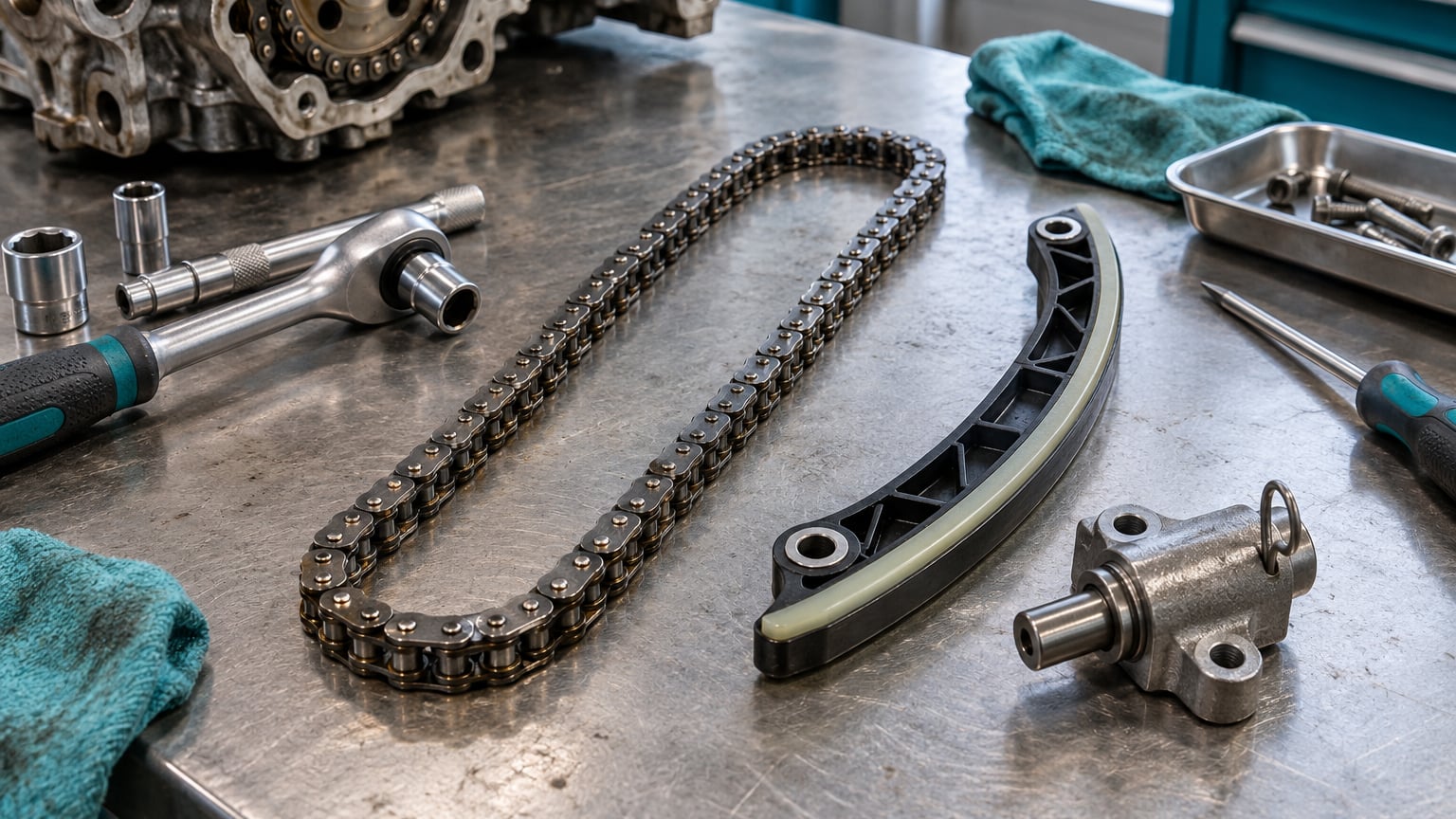
The timing chain connects the crankshaft to the camshaft and keeps them turning in step, so the valves open and close at the right moment relative to the pistons. A hydraulic tensioner and a set of curved guides push the slack to one side of the chain and keep it tight against the sprockets.
Chains are steel, but the pins, plates and rollers wear as they articulate over millions of revolutions. That wear is called chain elongation, and even half a percent of growth adds up to enough free play for the chain to bounce off its guides. Once it does, valve timing drifts, the engine starts managing the position electronically, and eventually the chain can climb a tooth.
What most people mean by timing chain stretch symptoms is really one of three separate failures wearing similar clothes: a chain that has grown longer, a tensioner that has lost its push, or a guide that has worn through its plastic. The sound is often the same. What is different is whether the noise follows the revs or disappears with heat.
A healthy cold start is not silent either. A brief clatter in the first second or two, before the oil comes up to pressure, is normal on most engines. The part that is not normal is noise that hangs around, gets louder, or comes back every time the engine cools down.
8 Timing Chain Stretch Symptoms
1. A rattle or clatter in the first second or two of a cold start
Oil drains into the sump while the engine sits, so the tensioner has no pressure behind it and the chain hangs loose. When you turn the key, the slack chain slaps the guide until oil pressure builds and the tensioner pushes it back tight. That is a two-second rattle, not a fault.
The version worth investigating is four seconds or more, or a rattle you can hear again on every cold start for months. Forum owners with a worn Honda chain report the noise growing gradually year after year, which fits wear rather than a one-off.
2. A ticking or metallic whine that gets louder as the engine warms
This is the more serious noise pattern. If the sound does not fade with temperature and instead rises with engine speed, the chain is still loose once the tensioner is working, which means the tensioner or a guide has failed rather than the chain simply being old.
It is worth checking whether the pitch changes when you lift off and the engine drops to idle. A chain rattle usually follows revs closely. A deeper knocking sound that stays at the same pitch is more likely a bearing or a valve train issue.
3. A rough or hunting idle, especially when cold
When the chain has enough slack to move the camshaft slightly out of position, the engine is running on slightly wrong valve timing. The idle wanders, the revs hunt up and down, and the engine can sound like it is searching. On a warm engine the same car usually idles cleanly, which is the clue that separates this from a vacuum leak or dirty throttle body.
4. Misfires and hesitation under load
Slack in the chain can cause a stumble off idle or a hesitation when you ask for full throttle. Owners describe a surge or lurch forward when coming to a gentle stop, and a lack of power accelerating from a dead stop. That combination usually shows up as misfire counts alongside the timing code.
If the engine is firing on all its cylinders and still feels weak, check whether the car is in limp mode. Some engines cut fuel and ignition timing on a correlation fault, which costs real power until the code is cleared and the cause fixed.
5. The check engine light and timing codes
Modern engines see the correlation drift before a human hears anything. On a vehicle with variable valve timing the light usually comes on first and the rattle is a bonus. On older pre-VVT engines without a direct cam sensor there is often nothing to log, so noise is the only warning you get.
The four codes that matter here are P0016, P0017, P0018 and P0019. They mean the engine control module has seen a mismatch between where it thinks the crankshaft is and where it thinks the camshaft is.
6. Metal shavings in the oil or on the oil cap
Shiny grey dust on the inside of the oil cap, or glitter in the oil on the dipstick, is the sound problem turned visible. That material comes off the guides and tensioner rather than the chain itself, and it can block the small oil feeds that feed the timing system. Treat it as a stop-and-inspect item rather than a “top it up” item.
7. A long crank before the engine fires
This one gets misdiagnosed constantly. When the tensioner is starved or the guides are shedding debris, the chain can take a moment to find its tension, and the engine cranks longer before firing. Owners chase the starter and the battery and never look at the timing system.
Cranks but will not start, or cranks and immediately backfires, is a more advanced version of the same symptom. On an interference engine that combination needs the engine stopped, not driven.
8. Loss of power, poor economy, or the engine dropping into limp mode
The least specific symptom and often the most frustrating, because owners report it with no rattle at all. Nobody searching for timing chain stretch symptoms mentions lost power off idle first, yet that is how it presents on cars where the chain has stretched far enough to confuse the cam signal.
Reduced fuel economy comes from the same cause: the ECU correcting timing as best it can, which means retarding ignition and cutting drive. If the car is running in limp mode the numbers drop hard and the car feels like it has a limiter on.
What Does a Stretched Timing Chain Sound Like?
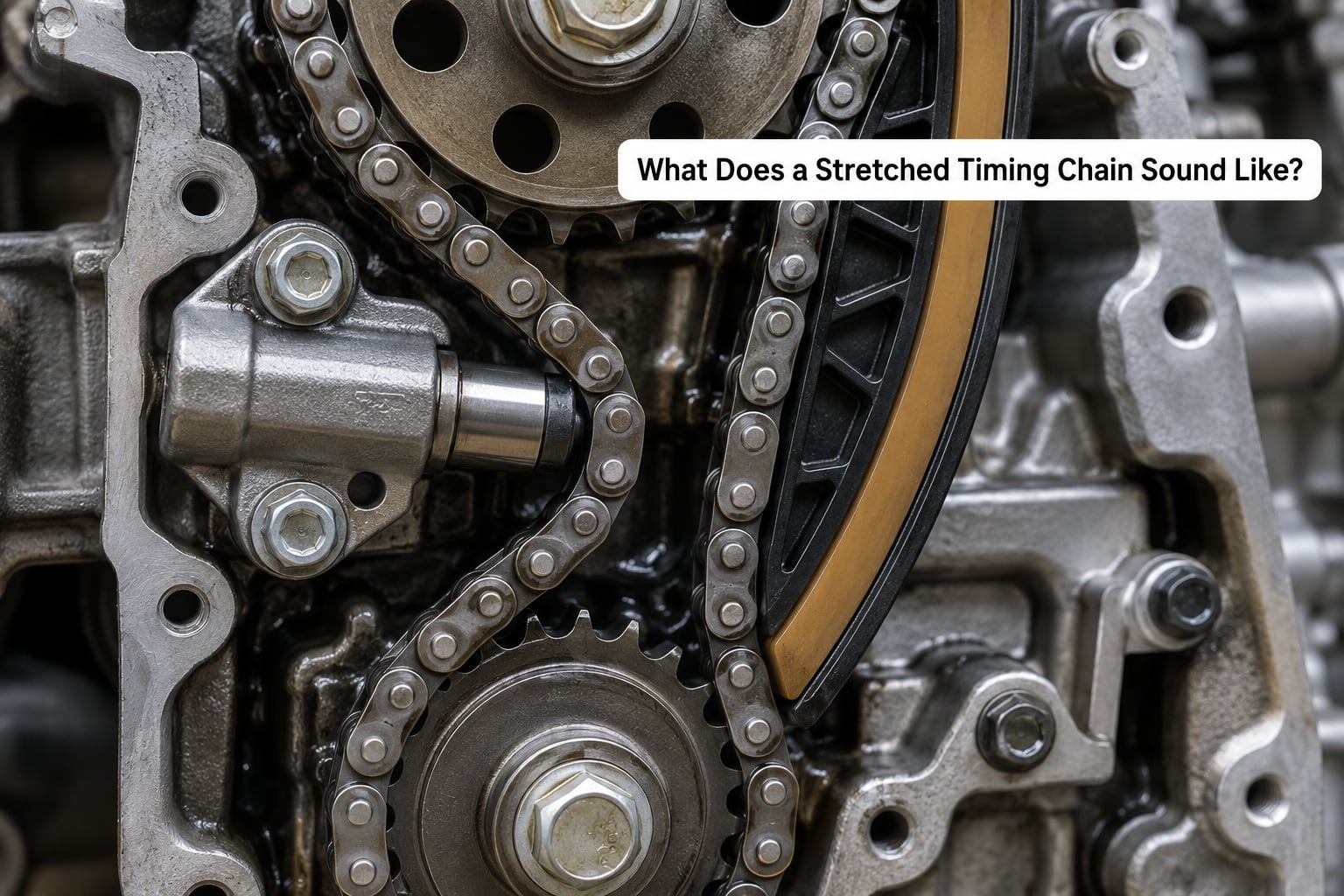
The classic sound is a dry metallic rattle, like a handful of spanners being shaken in a cardboard box, that lasts a second or two at idle and stops once the engine is warm. Some engines give a higher chirping tick instead, which is the same looseness meeting a tighter guide surface.
The most useful thing you can do is time it. Count how many seconds of noise you get on a cold start, then again an hour later on a warm engine. Owners who track this end up with a far better conversation at the garage than owners who say it makes a noise.
Three variables tell you a lot:
- Cold versus warm. Noise that only happens cold points at tensioner starvation or normal early-life clearances. Noise that persists hot points at a chain, guide or tensioner that can no longer take up the slack.
- Idle versus rev range. A rattle that follows engine speed all the way up and down is chain or guide related. A sound that only appears at idle and disappears at 1500 rpm is more likely an accessory or water pump.
- Oil condition. With fresh, correct oil the engine should settle almost instantly. With thin, burnt or contaminated oil the rattle lasts several seconds longer, which is a useful clue about the cause as well as the symptom.
Some stretches are intermittent. If your car is quiet for weeks and then clatters at a roundabout, suspect a tensioner that is on its way out rather than a chain that is suddenly failing. If it never goes quiet and the pitch climbs with revs, do not wait it out.
What Causes a Timing Chain to Stretch?
Oil is the whole story. The chain, the guides and the tensioner all run on the same oil supply as the rest of the engine, and the timing system is usually the first part to suffer when that oil is wrong or overdue. Particulates that get trapped in the oil end up sitting between the chain pins and plates, and that is where the wear is generated.
The usual causes, in rough order of how often I see them:
- Oil changes stretched too far. Beyond the manufacturer’s interval the oil thins and the hydraulic tensioner loses the pressure it needs to push the chain tight.
- Wrong viscosity. A thinner oil than the manual specifies gives a softer tensioner and more chain whip. On engines that call for a specific viscosity, this is the single most damaging shortcut.
- Wrong specification. Additive packages and low-friction oils that do not meet the stated standard can cause the same failure, and a marginal oil filter lets more particulate into the system than a good one.
- Worn guides and tensioner. The tensioner is the part that fails first in most cases. Once it stops pushing, the chain grows slack whether or not the chain itself has stretched, and it starts hammering the guide it depends on.
- Mileage and age. Timing chains that survive their whole life still have wear guides. Around 80,000 to 150,000 miles is where I start asking about noise, and shorter intervals on small turbo engines with the chain at the back of the block.
Some engine families have a documented history of stretching rather than lasting forever: GM 1.6 and 1.8 and 2.4 Ecotec, Ford 2.0 Duratec and 2.5, the VW and Audi EA888 2.0 TFSI, BMW N47, Jaguar and Land Rover Ingenium, and Vauxhall and Opel 1.6 CDTi. That list is not a rule, but if your engine is on it and it is past 100,000 miles with an oil change history you cannot vouch for, check the noise.
One honest correction to the old saying: timing chains are not a lifetime part. They last as long as the oil service they are given, which is the same argument people make about turbochargers and then regret.
Timing Chain Stretch vs Other Engine Noises
Here is the triage that saves people the most money, because chain, tensioner, guide and sensor wear all sound similar and get confused constantly on forums. Compare what you hear and what the scan tool says before buying anything.
| Noise or code | Most likely cause | Cold vs warm | Codes | How urgent |
|---|---|---|---|---|
| Metallic rattle, 2 to 5 seconds at start, silent after | Early chain elongation or tensioner at end of travel | Cold only | Usually none yet | Book an inspection |
| Rattle that stays and climbs with revs | Failed hydraulic tensioner | Cold and warm | Often none | Repair soon |
| Persistent tick from one side, follows revs | Worn or broken timing guide | Cold and warm | P0016 to P0019 possible | Repair soon, shavings may follow |
| Long crank before firing, cranks but will not start | Guide debris blocking oil feed, or chain jumped | Any | P0016 plus misfire codes | Stop driving, tow it |
| Single loud tick at idle, gone above 1500 rpm | Accessory or water pump bearing | Either | Usually none | Monitor |
| Hard knock that rises with load | Rod or bearing wear, not chain related | Either | Misfire or knock codes | Stop driving |
| Intermittent miss with no noise | Crankshaft or camshaft position sensor | Either | P0016 plus sensor codes | Repair soon |
Two useful filters. First, a timing problem is almost always tied to temperature or to a code; a sensor problem is not. Second, if the engine has variable valve timing and complains about VANOS operation, the noise you are chasing may be a known issue rather than the chain. I covered that separately in the guide to BMW VANOS rattle causes and fixes.
If P0016 is the only complaint and there is no noise at all, test the sensors before condemning the chain. That is a well-worn owner trap, and I explain it in what a bad crankshaft position sensor does.
How Bad Is a Stretched Timing Chain?
Stretch is not a cliff, it is a slope, and knowing where you sit on it tells you how much patience you have. Owners want a straight answer to whether they can keep driving; the honest answer depends on the stage.
| Stage | What you hear or feel | What is happening | Urgency |
|---|---|---|---|
| 1. Early | Two or three seconds of rattle on a cold start | Chain has small slack the tensioner still absorbs | Plan a check within a month |
| 2. Middle | Rattle every cold start, longer now, some warmth-related tick | Chain elongation plus guide wear, tensioner working at its limit | Book the repair, keep oil changes short |
| 3. Advanced | Check engine light, P0016 or P0017, rough idle, misfires, limp mode | Timing is genuinely out of spec and the ECU is compensating | Stop extended driving, diagnose now |
| 4. Critical | Cranks but will not start, backfires, sudden power loss | Chain has skipped teeth, valve timing lost | Tow it. Do not start it again |
Stage four is where the money changes category. On an interference engine, where the pistons share space with the valves, a skipped chain means pistons meet valves. What would have been a chain and guide job becomes a head off the block, sometimes with the cam damaged. Many engines built as non-interference engines will bend valves or break the chain outright instead, which is still a head off job.
How bad it ends up depends on the engine, where the chain sits and how far the wear has already gone. That is genuinely unknowable from outside the block, which is why noise plus codes should be treated as a diagnosis question, not a driving decision.
How to Check for Timing Chain Stretch
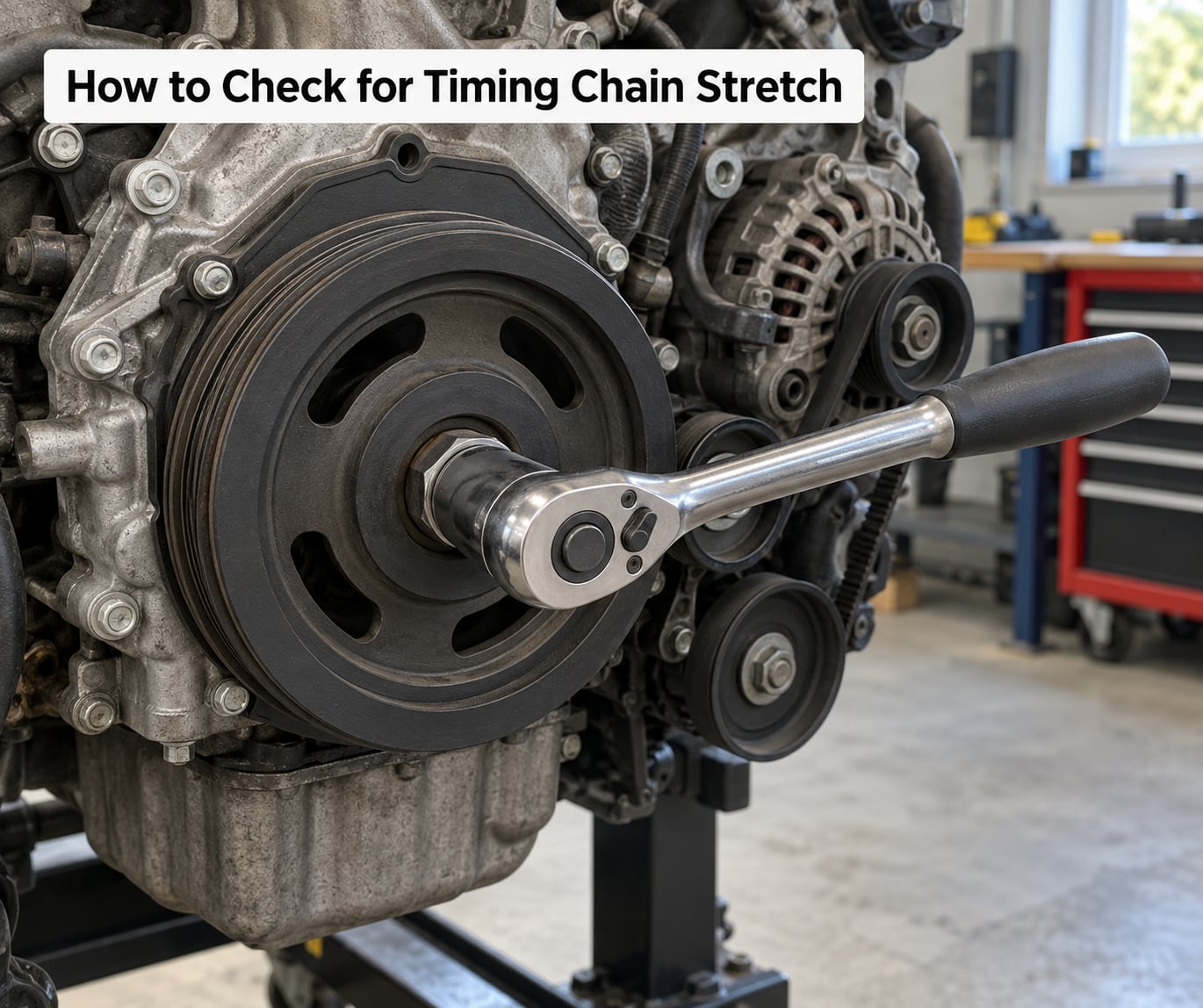
You can narrow this down at home in about ten minutes. You cannot confirm chain measurement without the service procedure and the right access, but you can rule things in and out. Work on a cold engine, on level ground, with the parking brake on and the transmission in park or in gear for a manual.
- Listen on a cold start. Time the noise. Note whether it returns on every start and whether it is still there once the engine is warm. Write it down; the number matters later.
- Pull the dipstick. Look at the colour and texture of the oil. Glossy rainbow sheen, a fuel smell, or grey glitter in it changes the priority of everything else you find.
- Check the oil cap for dust. Grey or silvery residue inside the cap is guide material. Do not run a long distance with it in there.
- Scan for codes. Any OBD2 scanner, even a phone dongle, will read stored and pending codes. Note P0016 to P0019, misfire counts, and any VVT actuator or cam position sensor codes alongside them. If you see a camshaft position sensor fault, read what a bad crankshaft position sensor does before you buy a chain.
- Do the engine-off slack check. With the engine cold and off, put a socket on the crank sprocket bolt where access allows, then gently rock the crank back and forth. The amount you can move before the sprocket takes up feels like play. On a distributor-driven engine the equivalent is rotating the distributor housing and watching how far it moves before the engine turns.
- Watch live cam and crank data if you have access. A scan tool showing requested versus actual camshaft position drifting is close to a diagnosis on its own.
A word on that slack test. It is a screening check, not a measurement, and it only works on engines with a removable sprocket bolt or a distributor. Do not pry on plastic covers to get at it, and do not force anything. If the chain has truly stretched, the tensioner is not holding it and the free play you feel is the answer; if the tensioner is simply tired, the same free play means a different repair.
Measuring chain elongation properly means removing the cover and comparing the chain against the factory marks on the sprocket, following the manufacturer’s procedure for that engine. That is a shop job with a torque specification and a timing alignment step afterwards.
Timing Chain Replacement and Prevention
If you are at stage one or two, the repair is planned maintenance. If you are at stage three with a code, it is a proper timing job. Replace the chain, both sprockets, the guides and the tensioner as one kit, because a new chain running on old hardened guides or a tired tensioner will stretch again quickly. Some engines also pull the oil pump chain and the VVT actuator into the job.
Budget for the timing alignment afterwards, and expect the engine to still need a cam and crank correlation check before it clears. P0016 coming back after a full chain, guide and tensioner job is common, and the usual cause is a cam or crank sensor rather than the work you just paid for. Check the sensor before anyone proposes taking it apart twice.
Prevention is boring and effective. Change the oil on the interval in your manual rather than the one on the sticker, use the exact viscosity and specification the manufacturer calls for, and keep a clean filter fitted. Owners who skipped every other service are the ones who turn up at 150,000 miles with stage three.
If you are still deciding between belt and chain on a car you own, my timing belt vs timing chain explained guide covers the service interval difference properly.
Frequently Asked Questions
How can I tell if my timing chain is loose?
Cold start first: a rattle that lasts two seconds and goes silent is often normal. A rattle that lasts longer, returns every cold start, or climbs with engine speed after warm is the real signal. Rock the crank sprocket bolt gently with the engine off to feel free play, check the oil cap for grey dust, and scan for P0016 to P0019 codes. A workshop can measure elongation against the sprocket marks properly.
How does a timing chain work?
The chain links the crankshaft to the camshaft so both rotate in step, keeping the valves timed to the pistons. A hydraulic tensioner pushes the chain tight against the sprockets and curved guides hold it on its path, removing slack. The whole system runs on engine oil, which is why oil service and specification have such a direct effect on how long a chain lasts.
What is the average lifespan of a timing chain?
Most timing chains last the life of the engine if the oil is changed on schedule with the correct viscosity and specification. In practice I start asking about noise around 80,000 to 150,000 miles, and earlier on small turbo engines that carry the chain at the rear of the block. Engines with a documented history of stretching, such as some Ecotec, EA888 and N47 units, deserve an ear sooner.
Is it safe to drive with a bad timing chain?
A cold-start rattle with no codes and clean oil is usually fine for a short while. A rattle that persists hot, a check engine light with P0016, misfires or metal in the oil are not. Driving on a stretched chain risks the chain skipping teeth, which on an interference engine means bent valves and a head off the block. Short trips to a shop are a reasonable compromise, long drives are not.
Can you drive with P0016?
You can drive to a shop, but treat it as a deadline rather than a warning light to ignore. P0016 means the engine has seen the crankshaft and camshaft in different positions than expected, so the ECU is correcting timing and you are likely in reduced power. If the engine also misfires, cranks slowly, or runs rough, stop driving and tow it. Clearing the code does not fix the cause.
Why does P0016 come back after I replaced the chain?
Because the chain was not always the only fault. P0016 after a full chain, guide and tensioner job usually points at the camshaft or crankshaft position sensor, a tensioner that has not been set correctly, or a missing timing alignment step. On some engines the VVT oil feed has to be primed and the timing verified with a scan tool afterwards. Test the sensors first before anyone proposes a second teardown.
What to Do First
Recording the noise before you forget it is step one of narrowing down timing chain stretch symptoms. Two seconds on a cold start and silent after is a different conversation from a rattle that follows the revs, and the count matters more than the description.
Then do three things in order. Look at the oil and the inside of the oil cap, scan for codes with any OBD2 reader you have or borrow, and check your oil change history against the manual’s interval and specification.
If you find codes, metal in the oil, or noise that persists once warm, stop treating it as background noise. Get it diagnosed before you drive further than the nearest workshop, and if the engine cranks but will not fire, tow it rather than trying it in the car park.