
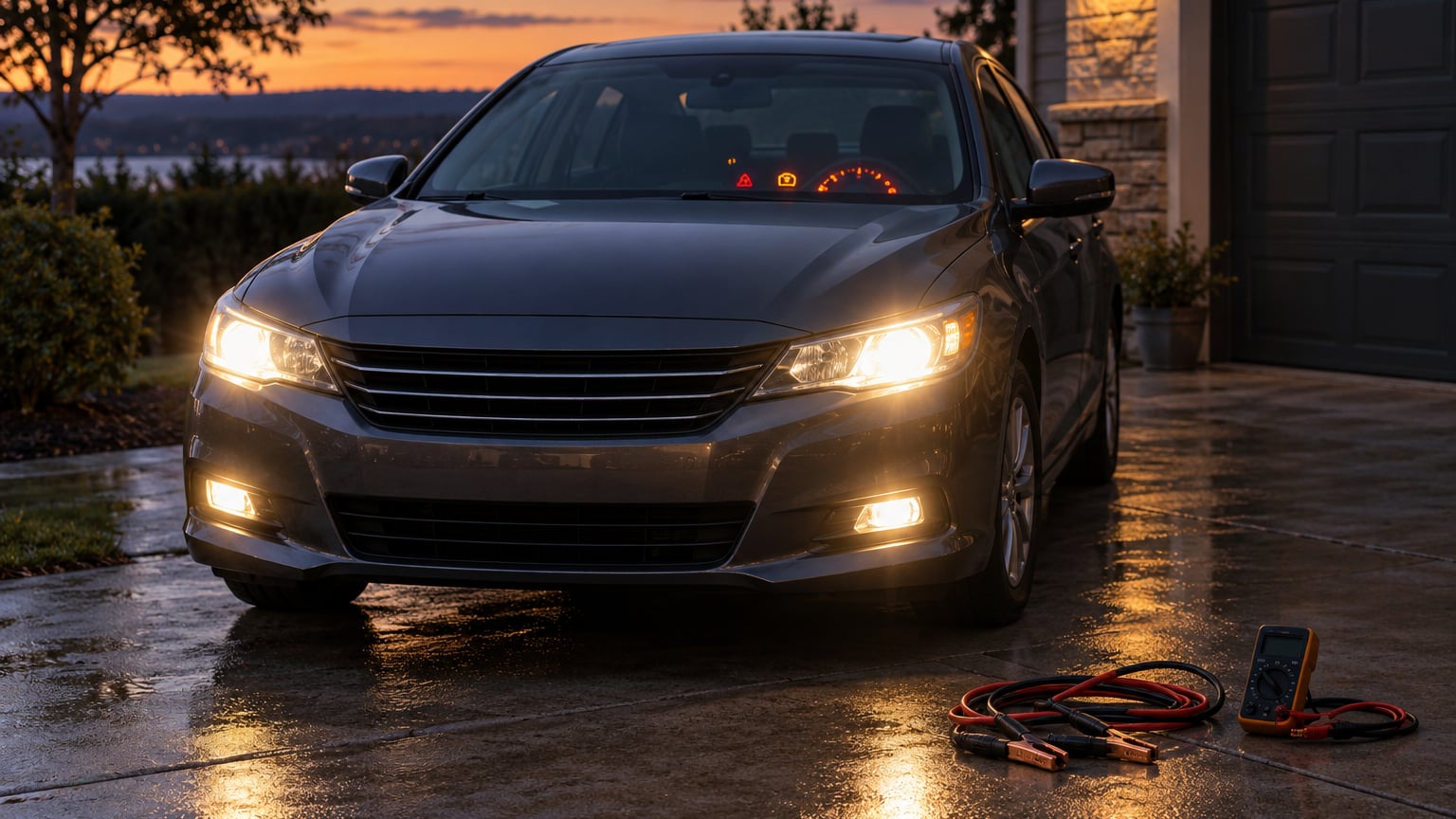
If your car won’t start but lights work, the battery usually still has enough charge for low-draw accessories but not for the starter, which pulls 150 to 250 amps in one surge. Headlights and dash lamps together need somewhere around 5 to 15 amps, so they can look perfectly healthy while the engine has nothing left to crank with.
That means the fault is in the starting circuit rather than a dead electrical system: a sulfated battery, corroded terminals, a tired starter solenoid, a failed ignition switch, a gear selector that isn’t registering, or an immobilizer that never released. Two questions narrow it down fast. Do you hear clicking or silence when you turn the key, and do the headlights dim while it cranks?
Here is the order I’d work in, starting with what you hear.
Table of Contents
- Car Won’t Start but Lights Work: Quick Diagnosis
- What Does It Mean When the Car Lights Work but Won’t Start?
- Why Does the Car Crank but Not Start?
- Why Does the Car Not Make Any Sound When You Turn the Key?
- How to Test the Battery and Charging System
- How to Check the Starter, Ignition, and Fuel System
- How to Tell If the Immobilizer or Engine Light Is the Problem
- Fixes for the Most Common Causes
- Frequently Asked Questions
- Conclusion
Car Won’t Start but Lights Work: Quick Diagnosis
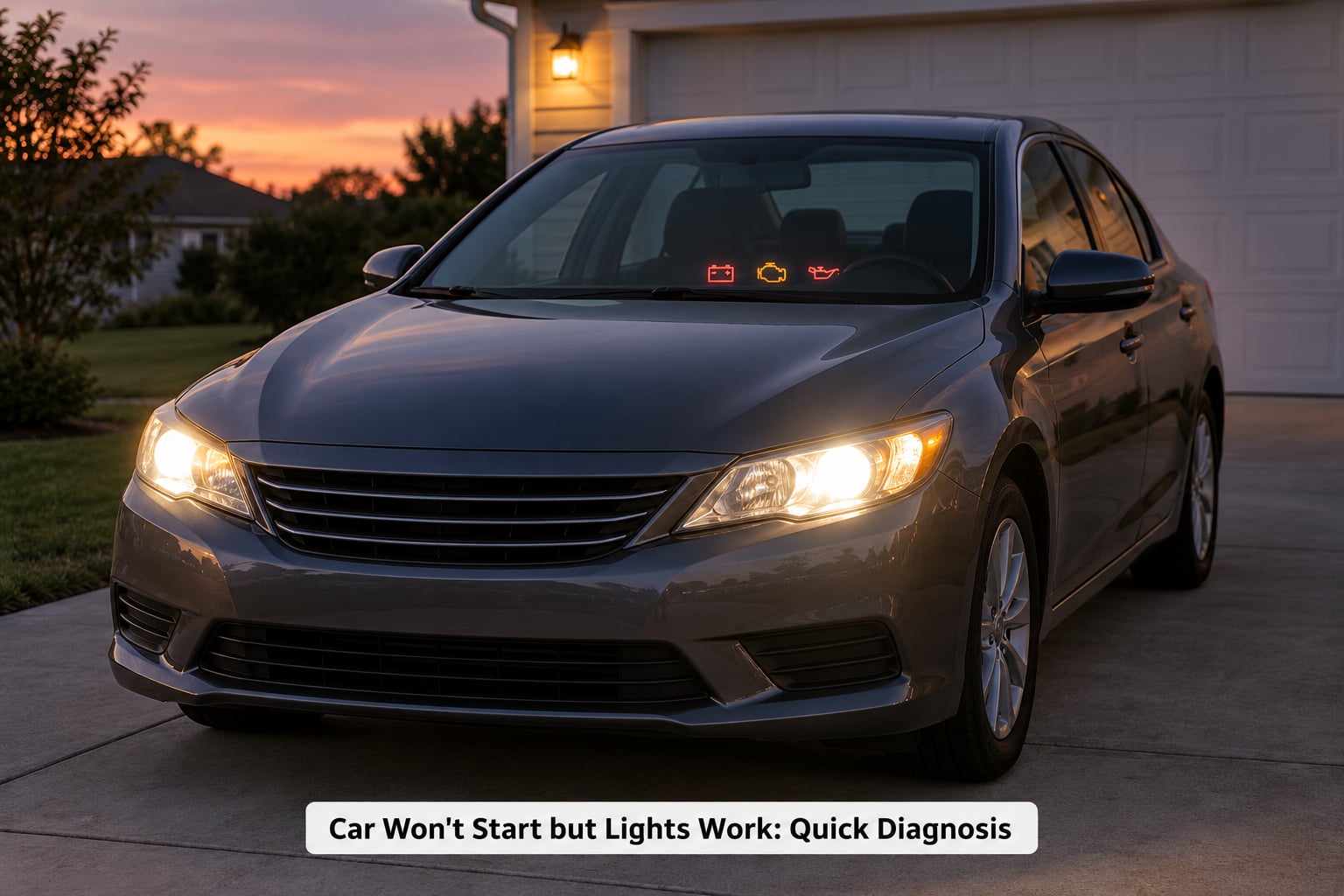
Listen before you touch anything. The sound the car makes when you turn the key tells you which half of the starting system to look at, and it takes about five seconds to gather.
Have someone watch the headlights while you crank, because dimming during the crank is the single most useful piece of information you can collect.
| What you hear | What it looks like | Likely cause | Next test |
|---|---|---|---|
| Rapid-fire clicking | Lights dim noticeably while cranking | Weak or sulfated battery | Clean terminals, then load or voltage test |
| One loud click, then nothing | Dash lights stay on, no crank | Starter solenoid or an open circuit to it | Check battery voltage and the main ground strap |
| Total silence, no click | Key turns, nothing happens at all | Blown fuse, failed ignition switch, or gear selector not registering | Check fuses, shift to neutral, wiggle the key |
| Grinding or whirring that stops | Brief spin then silence | Starter motor gear or ring gear stripped | Stop cranking, replace the starter |
| Steady crank, no fire | Engine turns over but dies immediately | Fuel supply, spark, compression, or immobilizer | Listen for a fuel pump hum, then read codes |
Park on level ground, transmission in park (or neutral for a manual), parking brake set, and don’t keep cranking. Three attempts is the limit before you start doing real damage to a weak battery or a tired starter.
What Does It Mean When the Car Lights Work but Won’t Start?
Working lights tell you the battery isn’t completely flat. They tell you very little about whether it can deliver real current under load.
A starter motor draws 150 to 250 amps the instant the solenoid closes. That’s a huge multiple of what the rest of the car asks for. When a battery has sulfated or lost a cell, it can still hold 12 volts and happily feed a bulb, but its voltage collapses the moment that surge hits.
So when a car won’t start but lights work, think of it as a problem somewhere between the battery and the starter, not as a dead battery by default. The chain looks like this: battery positive terminal, main power cable, ignition switch, starter relay, starter solenoid, starter motor, then ground back through the engine and chassis.
Any broken link in that path stops the crank while leaving the accessory circuit untouched. Corroded terminals are the most common break. Failed ignition switches and worn solenoids come next, and a misaligned park/neutral interlock or clutch safety switch can block the whole sequence without touching a single wire.
One more modern wrinkle: on many cars the battery sits in the trunk or under a floor panel, and an aftermarket alarm or stereo install can interrupt the circuit. If the car has extra wiring that the factory didn’t have, that’s worth knowing before you buy parts.
Why Does the Car Crank but Not Start?
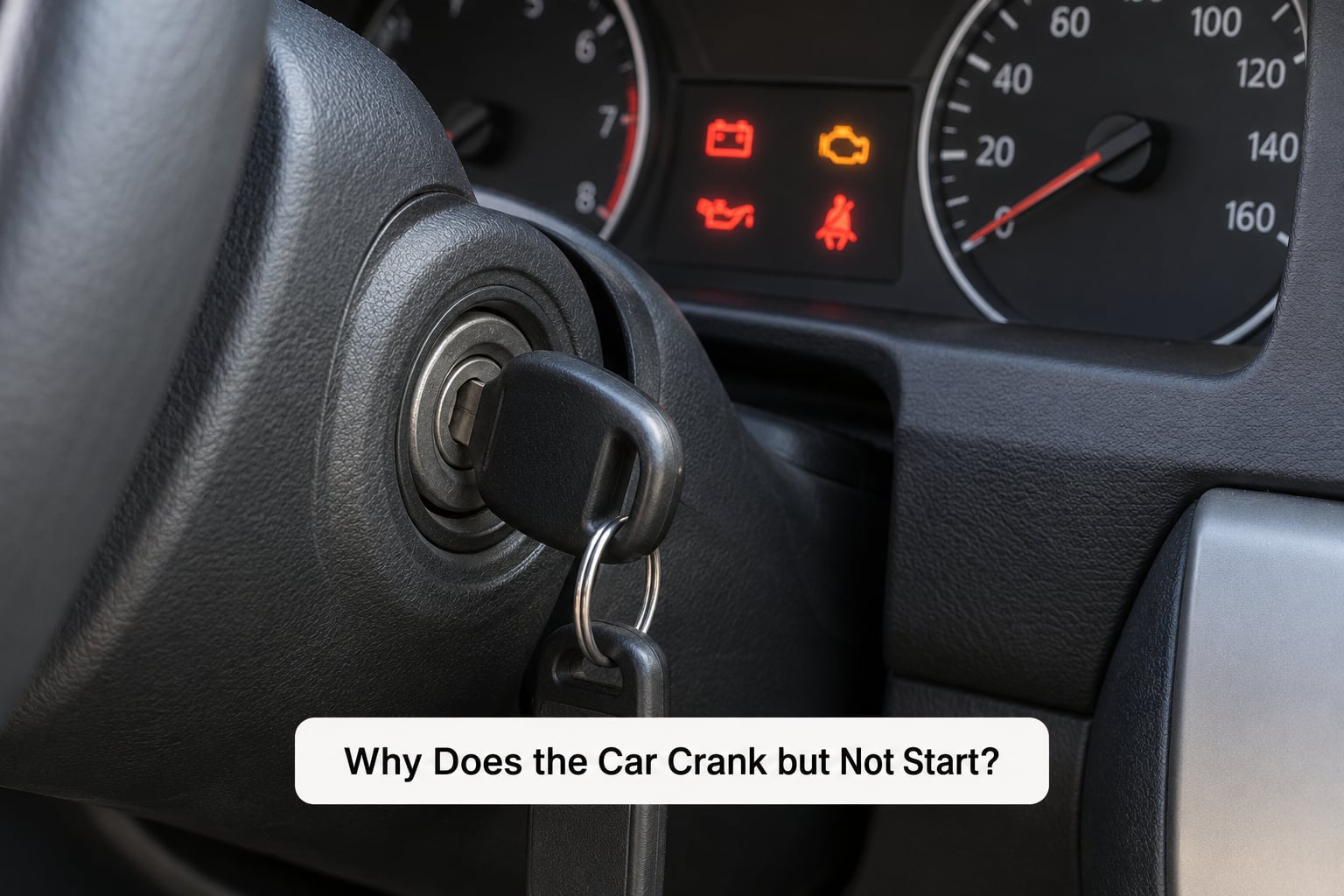
A cranks-but-won’t-start condition is a completely different problem from a no-crank condition, and mixing them up sends people down the wrong path with new parts.
If the engine turns over at a normal speed, the battery and starter are working. What you need next is fuel, spark, compression, or a signal from the immobilizer.
Listen for the fuel pump
Turn the key to on without starting and hold it for a few seconds. Most fuel pumps should hum or whirr for two or three seconds while they prime. Silence usually means a failed pump, a blown fuse, or a clogged filter. Many owners have assumed an electrical fault here and paid for a starter they didn’t need.
Think about fuel delivery before additives
A clogged fuel filter and a weak pump are far more common explanations than dirty injectors. If your car has a high-mileage history or questionable fuel habits, injector cleaners are worth reading up on, but treat them as a preventive move rather than the fix. You can see what that involves in our guide to whether fuel injector cleaners actually work.
Check spark and compression
Worn spark plugs or a failing coil pack on a multi-cylinder engine often still starts the car but leaves it shaking hard. Low compression from valve or timing issues usually turns the crank slowly and unevenly. If the engine spins fast and evenly but never fires, ignition and fuel are the two things to test.
Watch for the immobilizer light
A flashing security or immobilizer light after the engine starts, or a no-start with no fuel pump hum at all, points to the anti-theft system rather than the engine.
A scan tool helps here. A code for a misfire, an oxygen sensor circuit, or an immobilizer communication fault tells you immediately which branch you’re on.
Why Does the Car Not Make Any Sound When You Turn the Key?
Total silence means the circuit never reached the starter solenoid. That narrows the search to a small set of items you can check without a wrench.
Check the fuses first
Look at the fuse for the starter and the ignition circuits in the engine bay box and the cabin box. A blown fuse is cheap to replace and the reason for a lot of wasted starter purchases.
Confirm the gear selector is registering
Put the transmission in neutral and try again. On an automatic this also happens if the shifter cable or the interlock has slipped out of alignment, which owners often discover by accident. On a manual, the clutch must be pressed fully to the floor, not halfway.
This is the most commonly missed step, and it costs nothing but a minute.
Look at the terminals and grounds
White, green, or blue crust on a battery post means resistance is building. Wiggle the clamp; if it moves, clean it. Also check the ground strap from the engine to the body, which is easy to forget and just as easy to fix.
Rule out the ignition switch
If the key turns but the dash lights behave oddly, the switch itself can be worn. Leave the key in the start position for a few seconds and try again; if holding it changes the behavior, suspect the switch rather than the starter.
How to Test the Battery and Charging System
A multimeter turns a guess into a reading, and the reference numbers below are worth memorizing because they’re the same on nearly every car made in the last forty years.
| Measurement | Healthy reading | What a low reading means |
|---|---|---|
| Engine off, key off, rested 10 minutes | 12.6V or higher | Below 12.2V: partly charged. Below 12.0V: sulfated or worn out |
| While cranking | Holds above 9.6V | A collapse below that means the battery cannot carry starter current |
| Engine running | 14.2V to 14.7V | Below 13.5V: the alternator isn’t keeping up. Above 15V: overcharging, which kills batteries |
The steps, in order
Look at the battery date sticker first. Most lead-acid batteries last three to five years, and a battery that has been sitting past its date deserves suspicion before anything else.
Clean the terminals with a wire brush or a terminal cleaner and tighten the clamps until they don’t move. Retest before assuming the battery is finished.
Measure resting voltage, then cranking voltage, then running voltage using the table above. Those three numbers separate a dead battery from a dead alternator from a bad alternator.
If the car jumps and dies again within days, the alternator isn’t holding a charge. Swap in a new battery and you may well be replacing it again in a month, which is one of the most expensive mistakes in this whole diagnosis.
Cold weather makes this much more likely
Battery capacity drops hard in the cold, so a marginal battery that starts fine in July can refuse to crank on a January morning. Our piece on how cold it has to be for a car not to start covers the actual numbers.
Safety before you probe anything
Wear eye protection. A swollen, hot, hissing, or leaking battery is a failed battery, not a testable battery. Never clamp a jump lead to it, and never work near fuel lines with a lead attached.
How to Check the Starter, Ignition, and Fuel System
Starter solenoid versus starter motor
The solenoid is a switch that slams shut and connects the battery to the starter motor. It’s the part that makes the click. The motor is what spins the engine.
One click and no spin means the solenoid engaged but the motor didn’t turn: bad contacts, a dead motor, or a low-voltage supply arriving at the terminal. A single loud click with no crank at all points at a low or dead battery reaching that circuit.
A light tap is a diagnostic, not a repair
Owners across mechanic forums report that a light tap on the starter body during the crank sometimes frees a seized solenoid and the car starts immediately. Treat that as one useful data point: if a tap starts it, the starter is the problem and needs replacing. Don’t hammer it every morning until the starter disintegrates.
Checking ignition and fuel without a shop
With the key on, you should hear the fuel pump prime for two or three seconds and hear nothing else obvious from the fuel system. Ignition coils and plugs are inspectable, but finding fuel pressure means opening a fuel line, which is dangerous and not a driveway job. Leave pressure testing to a technician with the right gauge and extinguisher.
The alternator is testable from the driver’s seat with a multimeter, which is why it belongs in the electrical section rather than here.
How to Tell If the Immobilizer or Engine Light Is the Problem
The immobilizer is the anti-theft system that reads a transponder in your key or fob and tells the engine control module to allow a start. If it never gets that message, you get lights and nothing else.
Try the fob battery first
On a keyless entry fob, a weak coin cell can stop the car from reading the fob at all, which means no start request and no dashboard response beyond the lights coming on. Swapping that battery takes a few minutes and costs a couple of dollars. It’s the cheapest thing on this whole list and it fixes an embarrassing share of no-start calls.
On a push-button start car, the same symptom usually means a fob that isn’t being detected, a start button that needs a long firm press, or a vehicle that hasn’t seen its driver. The button doesn’t turn like a key does, so “turn it harder” doesn’t apply.
Read the check engine light
A stored code on an OBD-II scanner separates an ignition or fuel fault from a security fault faster than anything else a DIYer can do. Codes referencing the immobilizer, the body control module, or communication between modules point to wiring, a bad key, or the anti-theft module itself.
When to stop and call an auto electrician
Ask the owner’s manual first; it lists the expected light behaviour for your exact model. Beyond that, stop when the wiring has been modified by an alarm or stereo install, when codes reference the immobilizer or body control module, when the key or fob has been visibly damaged, or when the car was previously flooded.
Modern security systems run through the same wiring as the starting interlock. Removing or bridging them is both a security problem and a legal one in many places, so it isn’t a DIY fix.
Fixes for the Most Common Causes
Here is how the causes divide up between what you can safely do yourself and what a shop needs to handle.
| Cause | Safe DIY check or fix | What the shop does |
|---|---|---|
| Sulfated or dead battery | Voltage test, then a proper charger or a jump | Load test and replacement, and a charging check |
| Corroded or loose terminals | Clean, tighten, apply protectant | Usually a five-minute job |
| Starter solenoid | Nothing beyond the sound test | Replace the solenoid or the starter assembly |
| Starter motor | Nothing | Replace the motor, and check the ring gear while in there |
| Ignition switch | Hold the key in start and watch behaviour | Replace the switch and check the connector |
| Park/neutral interlock or clutch switch | Try neutral, try full clutch travel | Align the selector or replace the switch |
| Blown fuse or starter relay | Read the fuse and relay | Trace the circuit if it blows again |
| Alternator not charging | Measure running voltage | Output and ripple test, replacement |
| Immobilizer or fob | Replace the fob battery | Key programming or module diagnosis |
How to jump start a car safely
Only do this if the car is a manual-transmission car or the transmission is in park on level ground, and only if the dead battery isn’t swollen or leaking. Keep the ignition off on both cars until the last step.
Open both hoods and find the terminals. The positive post is marked with a plus sign or a red cover; the negative is marked with a minus or black.
Clamp the red lead to the dead battery’s positive terminal.
Clamp the other red lead to the good battery’s positive terminal.
Clamp the black lead to the good battery’s negative terminal.
Clamp the last black lead to an unpainted ground point on the dead car, away from the battery. Never attach it to the dead battery’s negative post on a modern car, because some vehicles use that post for power management.
Start the donor car and let it idle for a minute so the alternator builds a steady output.
Try starting the dead car. If it cranks and runs, leave the donor attached and drive for 20 to 30 minutes to put a real charge back in, then re-test the voltage.
Remove the leads in the reverse order. If the car won’t start again within a few days, the charging system is the suspect, not the new battery. Whether you can jump start a car with a dead alternator covers that case properly.
What not to do
Don’t keep cranking after three attempts. Every attempt pulls a large amount of current out of a battery that’s already weak, and heat from a flat battery is what kills it.
Don’t replace parts in sequence and hope. A terminal clean costs nothing; a starter you didn’t need costs two or three times that again in labour.
Don’t ignore a dashboard warning light that comes on once the engine does run. A charging fault or a sensor fault right after a restart often points to the real cause of the no-start.
Frequently Asked Questions
Can a car battery be dead but lights still work?
Yes. A battery can hold enough charge for low-draw circuits like headlights, dash lamps and the radio while being too weak to deliver the 150 to 250 amps a starter needs. Look at what the lights do during the crank: if they dim dramatically, the battery is the likely culprit. If they stay bright and the car still doesn’t crank, look at the terminals, the starter circuit, or the gear selector instead.
How to tell if it’s a dead battery or starter?
Listen first. Rapid-fire clicking with lights that dim while cranking points to a weak battery. A single loud click then silence usually means the solenoid is engaging but not enough voltage is reaching it, which is also a battery or terminal problem. A grinding whir that stops means the starter motor itself. A clean, fully charged battery with dim-free lights and a grinding noise is a starter.
Will lights work if the starter is bad?
They usually will, and that’s exactly why the symptom confuses people. Headlights draw a small fraction of what the starter does, so a completely failed starter motor can leave every light on the car working perfectly while the engine never moves. The tell in that case is silence or a single click, not clicking and dimming.
How long can you go without starting a car before the battery dies?
A healthy battery typically holds its charge for three to four weeks parked with everything shut down, and longer in warm, dry weather. Cold weather and short trips shorten that considerably, since the alternator doesn’t have time to replace what the engine used. A battery more than three years old can go flat in a few days rather than weeks. Parasitic drain from a stuck circuit is the other common culprit.
What is wrong with a car that won’t start but has power?
The fault is somewhere in the starting circuit, not a total power loss. Common culprits are a sulfated battery, corroded or loose terminals, a failed starter solenoid or motor, a worn ignition switch, a blown fuse, a gear selector interlock that isn’t registering, or an immobilizer and key fob that aren’t talking to each other. Start with what you hear and what the lights do while cranking.
Conclusion
Start with two observations and nothing else: whether the headlights dim during the crank, and whether you hear rapid clicking, a single click, or total silence. Those two answers separate a weak battery from a failed starter before you spend a dollar or a single minute under the hood.
Then work outward from the battery: clean and tighten the terminals, test the voltage, try neutral, and only after that move to the starter, ignition switch, fuel system, or immobilizer. If the jump start doesn’t hold for more than a few days, get the charging system tested before you buy another battery.