
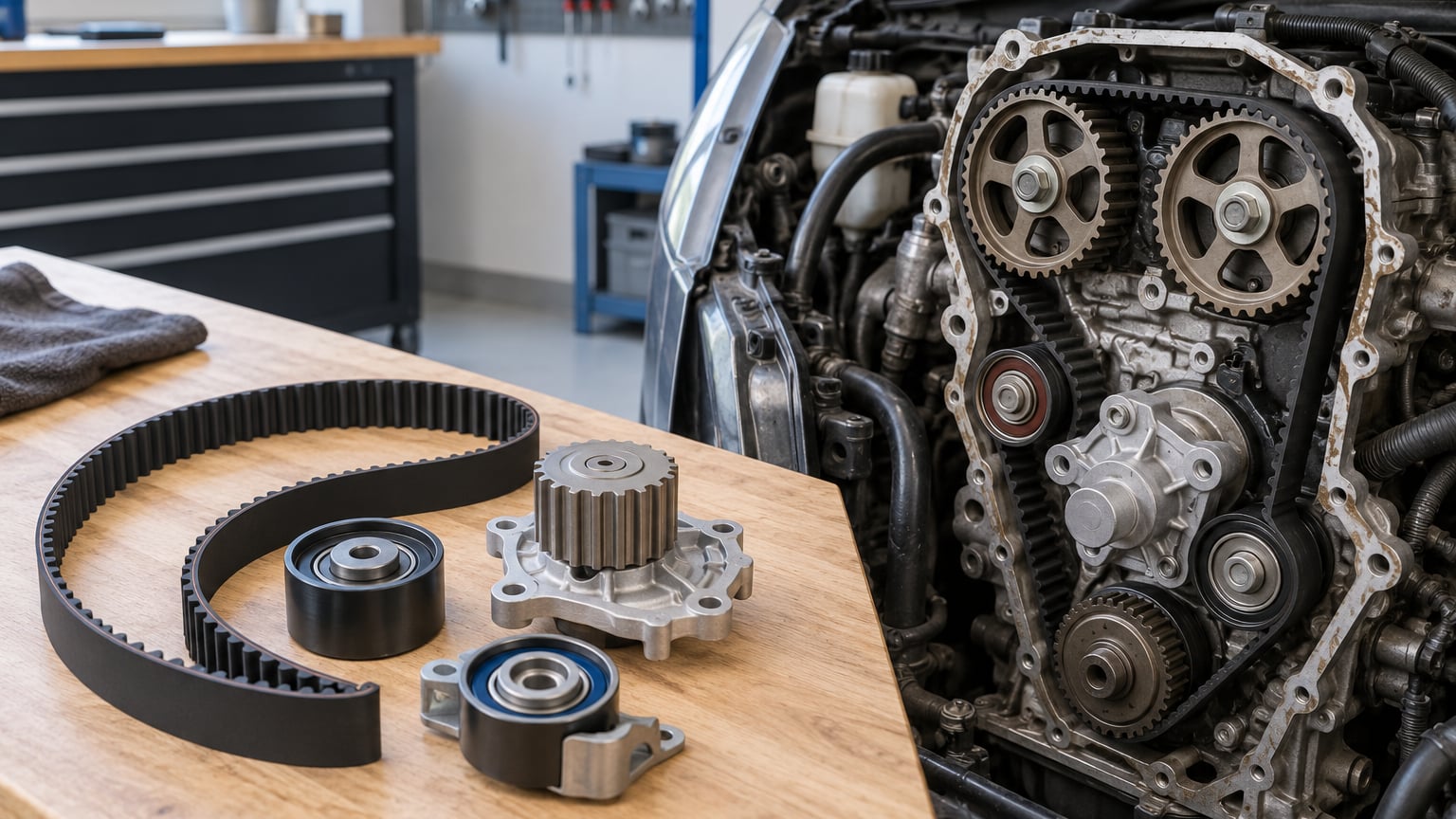
A timing belt replacement costs 400 to 1,000 USD for most passenger cars in the US, split between 100-350 USD in parts and 3-6 hours of labor. Luxury, BMW, and big V8 engines run 1,000 to 3,000 USD or more because the belt sits deep inside the engine.
The belt itself is the cheapest part of the job. What you are really paying for is shop access to the front of the engine, the skill to set valve timing right, and the insurance that if something goes wrong, the shop absorbs it. Get the interval from how often a timing belt should be replaced before you start shopping for quotes.
All the ranges below are typical US figures from independent shops. They move with region, shop type, and parts brand, and they change over time, so treat them as a ballpark rather than a quote.
Table of Contents
- Timing Belt Replacement Cost by Vehicle and Service Type
- What Affects the Price
- Ways to Save
- Frequently Asked Questions
- How much should I pay for a timing belt replacement?
- Why are timing belt jobs so expensive?
- Is it worth replacing the timing belt and water pump at the same time?
- Can I replace a timing belt myself?
- How much does it cost to replace a timing belt tensioner and water pump?
- Is it worth fixing a timing belt on a car?
- Conclusion
Timing Belt Replacement Cost by Vehicle and Service Type
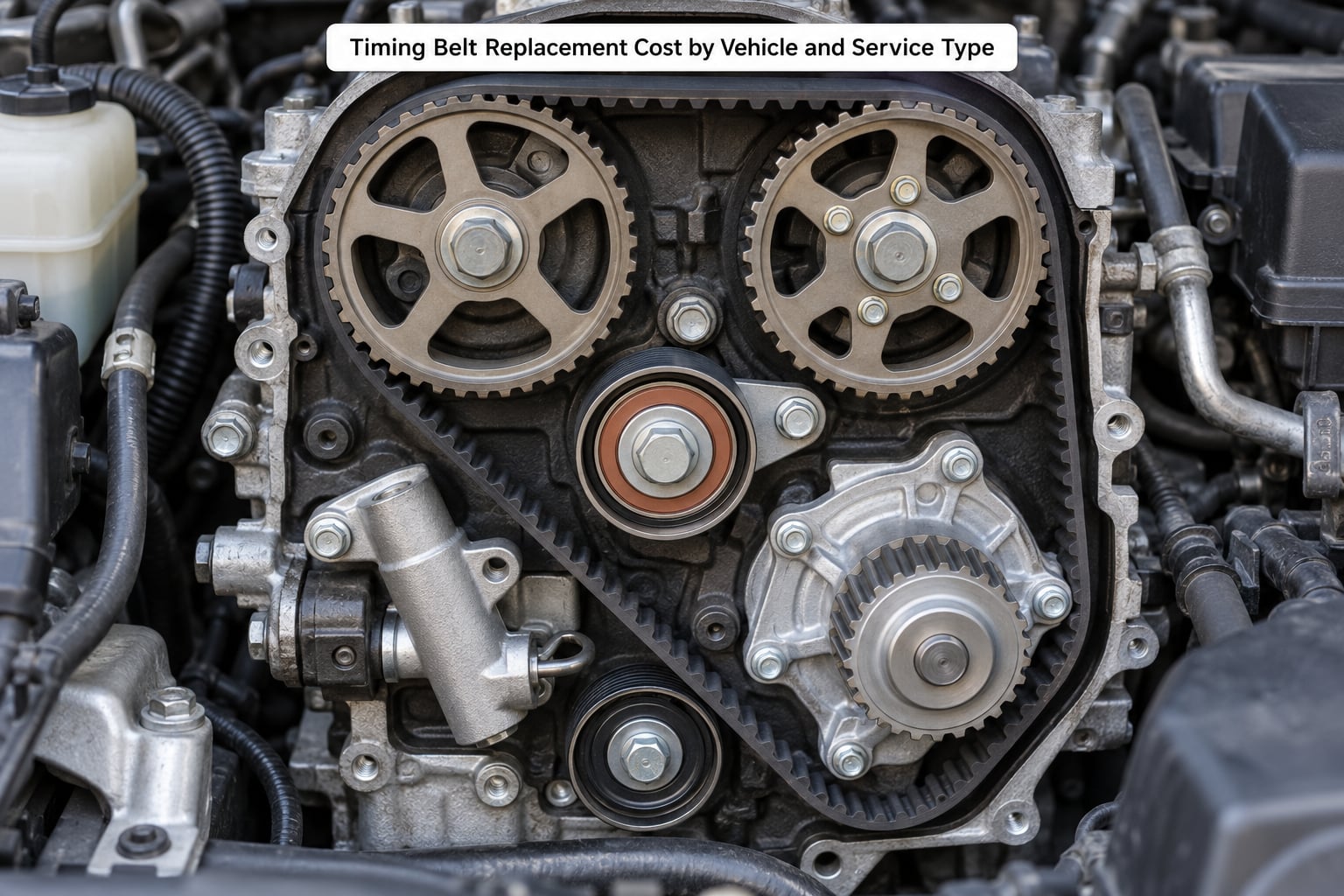
The same job costs very different amounts depending on what the shop has to take apart to reach the belt and how many parts get replaced while everything is already open.
| Service type | Parts | Labor | Typical total |
|---|---|---|---|
| Belt only, reusing tensioner and pulleys | 40-120 USD | 3-4 hours | 350-700 USD |
| Full timing belt kit (belt, tensioner, idler pulleys) | 100-350 USD | 3-6 hours | 500-1,200 USD |
| Kit plus water pump | 180-500 USD | 4-7 hours | 700-1,600 USD |
| Full service with seals, coolant, and inspection | 250-700 USD | 5-9 hours | 900-2,500 USD |
| DIY, parts and tools only | 100-500 USD | Your Saturday | 150-600 USD |
Labor is billed by the hour, and shops usually quote 3 to 6 hours for a straightforward four-cylinder. Anything with a transverse V6, a transverse engine behind a transverse transmission, or a cover that is part of the structural brace pushes shop time higher. Add an hour if the engine has to come out of the car.
Belt-only service is the cheapest line on the table, and it is also the one most shops quietly talk you out of. That is not always greed. A tensioner that is 10,000 miles past its service life can throw a belt off its sprocket a few months later, and you pay for the labor twice. We will get into the numbers in the water pump section below.
Typical timing belt replacement cost by vehicle size and engine type
Compact cars with four-cylinder engines, the kind where the belt sits under a plastic cover on the front of the engine, are the cheapest job. Expect 350 to 700 USD for a kit and labor at an independent shop.
Mid-size sedans land in the same band, usually a little higher because more of these engines hide the belt behind brackets that must be removed for access. Four-cylinder sedans from Toyota, Honda, Ford, and Subaru are routine work for any independent shop.
SUVs and crossovers with four-cylinder engines mostly price like the sedans they are built from. The cost climbs when the model shares a platform with a transverse V6, because the water pump often shares the same cover, which is why bundling pays off here.
Transverse V6 engines are where quotes start climbing past 1,000 USD. The belt is tucked underneath, the idlers and tensioner are harder to reach, and the water pump frequently lives in the same area. A bundled service on one of these engines can run 900 to 1,600 USD at an independent shop.
BMW models carry a premium that comes from parts, not just labor. Many of the four-cylinder and six-cylinder engines in this category need the tensioner, both pulleys, the water pump, and often a plastic or metal cover as a kit. A reputable independent shop usually lands 900 to 1,800 USD, while a dealer can quote well above that.
Long-block V8 engines and performance cars are the top of the range at 1,500 to 3,000 USD and up. Some V8 designs use a chain instead of a belt, so check before you go shopping. If your car runs a timing chain instead of a belt, the entire cost conversation looks different.
What Affects the Price
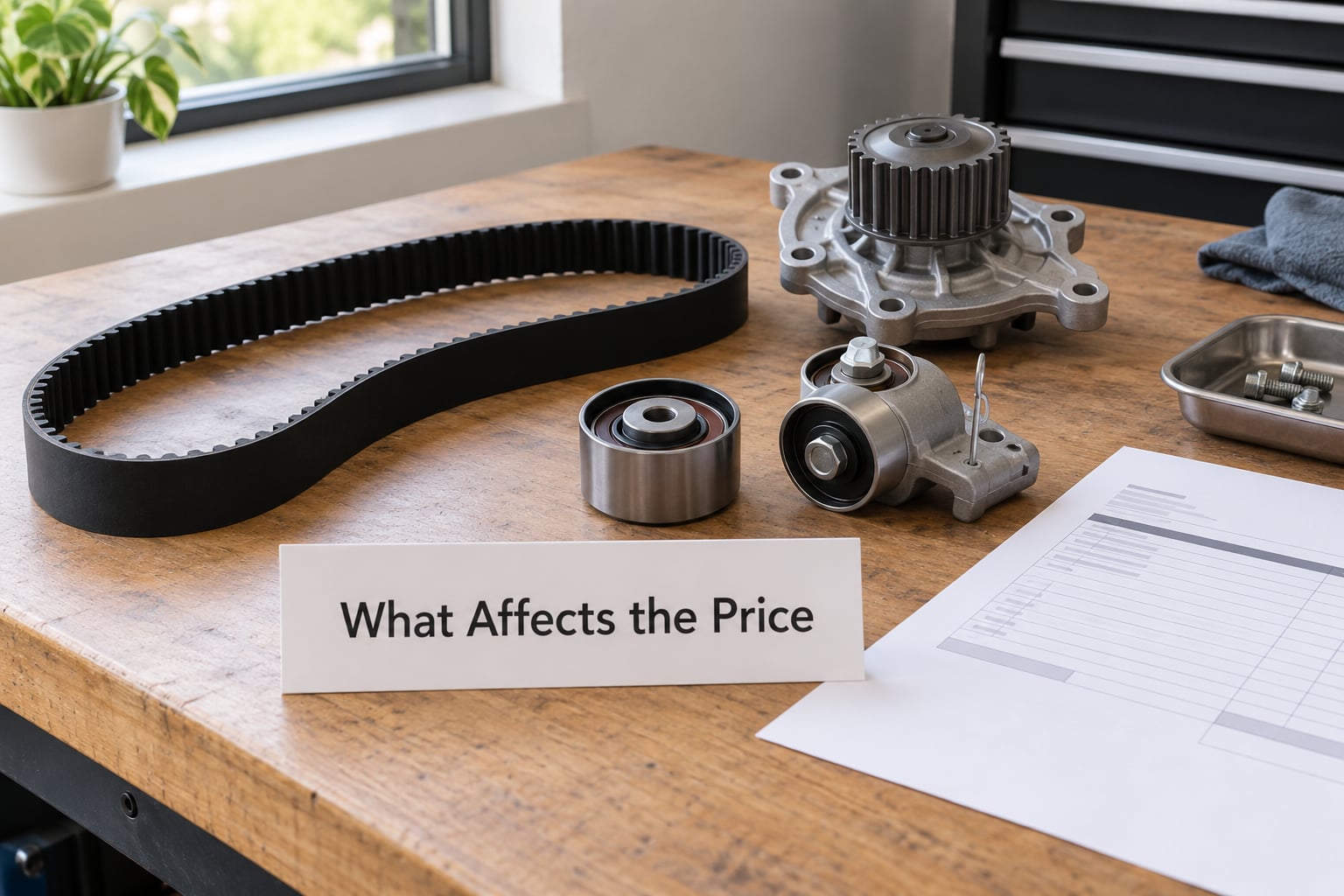
Engine access is the biggest driver. Some timing covers come off in minutes. Others sit behind the power steering pump, a brace, the alternator, or a bracket that also holds the engine mount, and each of those turns a small job into a longer one.
Labor hours follow access. Three hours for an easy four-cylinder, six to nine for a tightly packaged six-cylinder or a V8 where the intake has to come off. Shops charge by the hour, so a job quoted at 120 USD per hour and one quoted at 200 USD per hour diverge fast on anything above five hours.
The water pump is the deciding add-on. On most engines it sits behind the timing cover, so replacing it later means paying for most of the same labor again. A pump runs 150 to 300 USD in parts plus an hour or two of labor, and on many engines it is cheaper to do it now. If your car matches the models in our BMW water pump replacement guide, read the labor steps before assuming the pump is a cheap add-on.
Tensioner and pulleys are the other line item shops watch for. A belt kit usually includes the belt, the hydraulic tensioner, and one or two idler pulleys. Reusing a tensioner saves maybe 60 to 150 USD, and it is the single most common thing owners regret later.
Shop type moves the total as much as parts do. A dealership carries a higher hourly rate and marks up parts harder, and it will quote the full service package by default. An independent shop or a well-run mobile mechanic works from the same manual and the same belt.
Geography and shop supplies finish the bill. Metropolitan shops bill 150 to 250 USD per hour while rural shops charge 90 to 140 USD. Taxes and shop supplies add roughly 5 to 12 percent, and that is where the awkward line item named on an estimate usually lives.
Ways to Save
Get three written quotes, not phone prices. Two independent shops and one dealer, itemized, on the same day. A phone quote hides whether the water pump and tensioner are inside the number. Written quotes let you compare line for line instead of total for total.
Ask for the kit price and the installed price separately. A belt, tensioner, and pulley kit usually runs 100 to 350 USD from the parts counter. Ask the shop what they would charge if you bought parts yourself, then decide whether the labor rate difference is worth arguing about.
Bundle the water pump while the engine is open, but only if the pump sits behind the timing cover on your engine. If it is on the back of the engine, that advice inverts and you have paid for labor you did not need. Our BMW water pump replacement guide shows which layout specific models use.
Use an independent shop or a reputable mobile mechanic for routine belt service. It is planned maintenance with a known outcome, and any competent shop can do it. Save the dealer for recalls, warranty work, and diagnostics on cars that still have a new-car warranty.
Combine the job with other service. If the car needs coolant, a serpentine belt, or brake work, doing everything in one visit saves a diagnostic charge and the shop setup time. Ask for the labor time discounted, not just for a bundle discount coupon.
Consider the DIY math honestly. Parts run 100 to 500 USD and the job takes most of a weekend with a torque wrench, camshaft holding tools, and crankshaft positioning tools. You save the labor line, roughly 350 to 1,500 USD. You take on the risk of a timing error that bends valves on an interference engine, and that repair costs more than every savings you made.
Frequently Asked Questions
How much should I pay for a timing belt replacement?
Most US drivers pay 400 to 1,000 USD for a timing belt replacement at an independent shop, which covers 100-350 USD in parts and 3-6 hours of labor. A dealer will quote noticeably more. Transverse V6 engines, BMW models, and V8 engines commonly run 1,000 to 2,500 USD, especially with the water pump bundled in.
Why are timing belt jobs so expensive?
The belt is cheap, so the labor is the whole story. Reaching the belt means removing covers, brackets, and sometimes the engine, then setting the engine to top dead center and aligning marks on the crankshaft and camshaft sprockets. Add the shop hourly rate for 3-6 hours of careful work and the cost lands where it does.
Is it worth replacing the timing belt and water pump at the same time?
Usually, yes, when the pump sits behind the timing cover. Labor is most of the bill, so doing both at once adds roughly 150 to 300 USD for the pump and very little shop time. If your engine mounts the water pump at the back of the block, the savings disappear and you should skip it.
Can I replace a timing belt myself?
You can, on many four-cylinder engines, but not with hand tools alone. Expect 100-500 USD in parts plus holding tools for the camshaft and crankshaft, a torque wrench, and a full day of careful work. A timing error on an interference engine bends valves, so read the procedure for your engine twice before removing anything.
How much does it cost to replace a timing belt tensioner and water pump?
As a parts-only job, a timing belt kit with tensioner and pulleys runs 100-350 USD, and a water pump adds 150 to 300 USD. Installed, expect 700 to 1,600 USD at an independent shop depending on engine access. The tensioner is cheap to include now and expensive to leave behind.
Is it worth fixing a timing belt on a car?
If the belt already snapped, the answer depends on your engine. A non-interference engine usually survives and needs a belt and inspection. An interference engine can bend valves and crack the cylinder head, turning a 700 USD job into an engine repair that often exceeds the value of the car. Check your engine type before deciding.
Conclusion
Most timing belt replacement cost lands between 400 and 1,000 USD at an independent shop, and climbs past 1,500 USD on BMW, transverse V6, and performance engines. Start by confirming the replacement interval for your year and model, then ask for written quotes from two independent shops and one dealer that spell out which pulleys, which tensioner, and whether the water pump is included. A line-by-line quote is the only real protection against paying for a job that was never quoted.