
Short answer: most cars take a 19mm or 21mm deep socket, with 17mm and 22mm close behind, and you want a 6-point lug nut socket on a 1/2 inch drive. If that is the question you came with, the table below covers the common sizes and the steps to confirm yours in about a minute.
Searchers usually type this with a specific car in mind, so the fastest fix is to check the driver’s door jamb sticker first. Everything else is a fallback for when the sticker is faded, repainted, or missing.
Table of Contents
What You Need
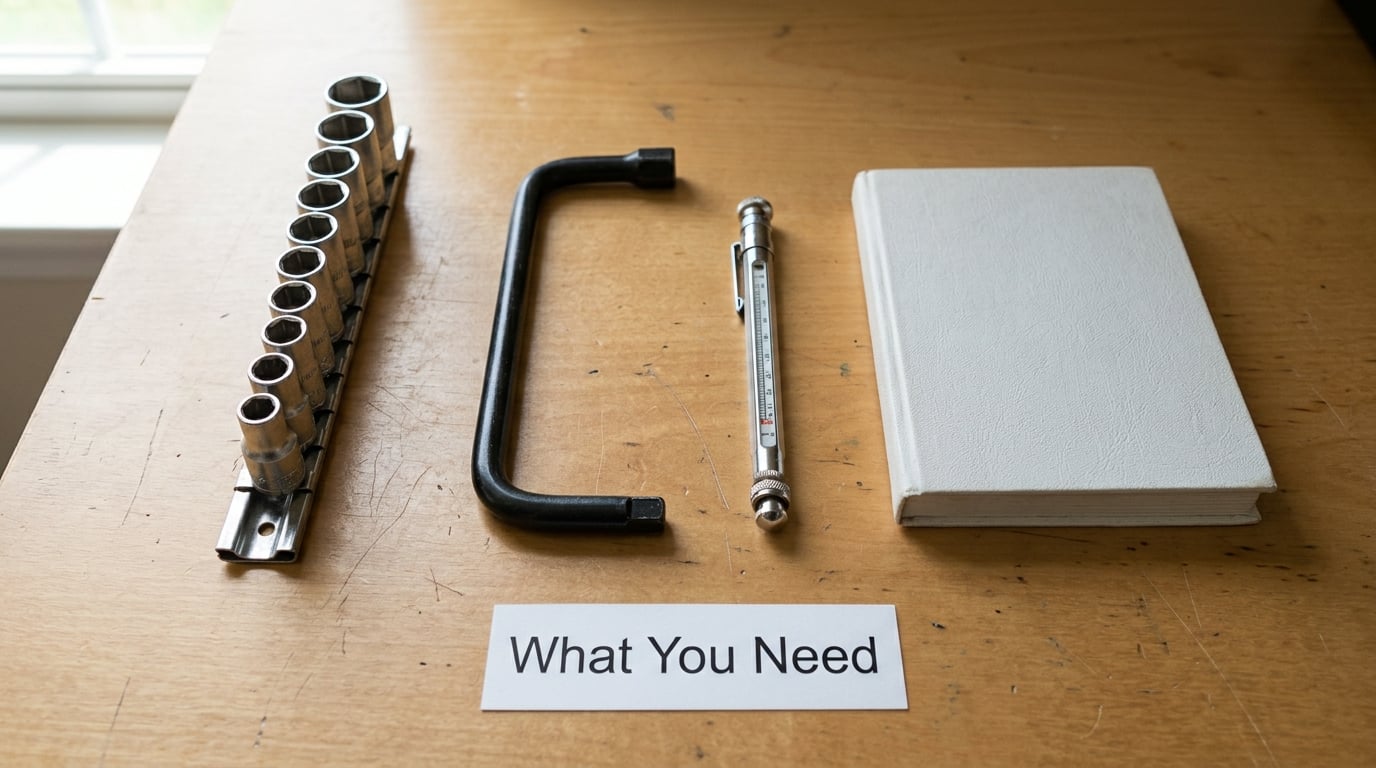
You do not need much, and most of it you probably already own. A basic set covers nearly every passenger car on the road.
- A set of deep 6-point metric sockets, typically 17mm, 19mm, 21mm, and 22mm on a 1/2 inch drive
- A 1/2 inch breaker bar, roughly 24 to 36 inches long, for leverage on a stiff nut
- A torque wrench with a 1/2 inch drive, if you are putting the wheel back on
- Dial calipers or a steel ruler, for measuring a nut whose size you do not know
- Wheel chocks, a jack, and a safe, flat place to work
If you also work on trailers or a truck, add 9/16 inch and 5/8 inch deep sockets. Those two sizes cover a lot of light-duty trailers and older light trucks, and they are the sizes owners most often find missing from the toolbox.
Step-by-Step: How to Find the Right Lug Nut Socket Size
Check the door jamb sticker
Open the driver’s door and look at the sticker on the frame pillar, the door itself, or the glove box area. It usually lists tire pressures, the tire size, and often the lug nut size and torque. On many Toyotas, Hondas, Nissans, and Subarus it even states the size outright.
Look in the owner’s manual
If the sticker only shows tire data, the manual’s maintenance section lists wheel fastener torque and, on some models, the socket size. Your year, make, and model is the one piece of information that beats any generic chart.
Measure the nut across the flats
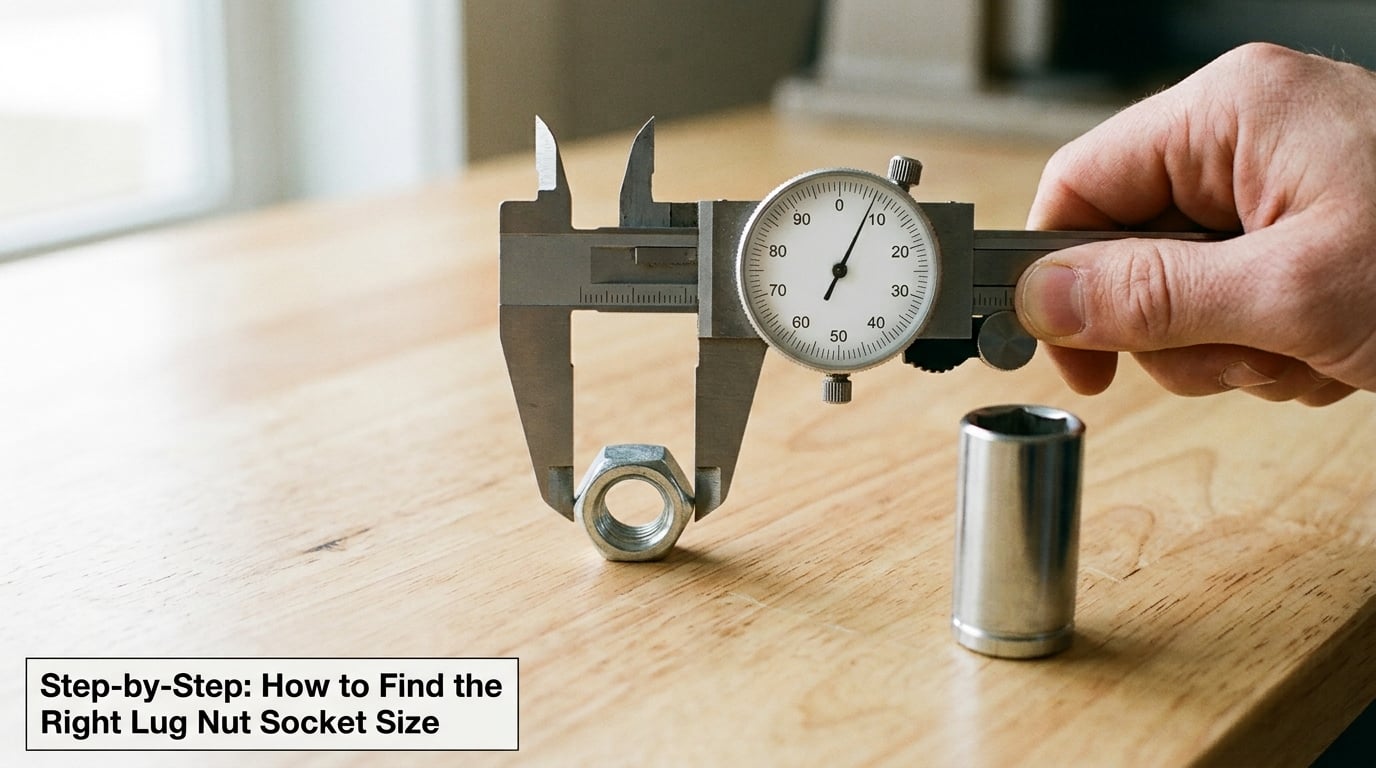
With calipers, measure the distance across two opposite flat sides of the hex nut, not corner to corner. Read the number and match it to the chart below. A 19mm reading lands on a 19mm socket, not on a 3/4 inch one, and that distinction matters.
Test-fit in a breaker bar
Seat the socket on the nut and push down firmly. It should slide on and click over the flats with no wobble and no forcing. If it feels loose or it only catches a corner, you have the wrong size.
Confirm the socket is deep enough
The socket has to clear the wheel stud, not just reach the nut. Most passenger wheels leave 1/2 inch or more of stud showing above the nut, which is why a deep well socket is standard and a shallow one often will not seat at all.
How to Measure a Lug Nut if You Do Not Know the Size
Open the calipers, slip them over two opposing flats, and read the width in millimeters. Lug nut sockets are specified in metric almost everywhere in the world, so a measurement in millimeters maps straight to a socket marking.
Measure the flats, not the corners. Across-corners on a hex is about 15 percent larger, and using that number is how people end up buying a 22mm socket for a 19mm nut.
If the nut has a cosmetic cap over it, measure the cap, not the nut underneath. Those caps are usually a hair larger than the hex and they are the first thing to strip if you pick the wrong socket or point count.
Metric Lug Nut Socket Sizes Explained
This is the chart to bookmark. Metric size is what you put on the socket. SAE is the nearest inch equivalent, and it is only ever nearest, not identical.
| Socket size | Nearest equivalent | Typical thread | Where you see it |
|---|---|---|---|
| 17mm | about 11/16 inch | M12 x 1.5 | Smaller European cars, Mini, some compact and Japanese models |
| 19mm | about 3/4 inch | M12 x 1.5 or M12 x 1.25 | Compact cars, crossovers, most Japanese and Korean imports |
| 21mm | no exact twin, 13/16 inch is close | M12 x 1.5 | Larger sedans, many crossovers, Class C motorhomes |
| 22mm | about 7/8 inch | M14 x 1.5, 1/2-20 on some trucks | Full-size American trucks and SUVs, heavy pickups |
| 9/16 inch | about 14mm | 9/16-18 | Trailers, some RVs, older light trucks |
| 5/8 inch | about 16mm | 5/8-11 | Heavy trailers, older trucks, some classic cars |
Why 19mm and 3/4 inch are not the same thing
People treat these as twins because they are close in size, and that assumption is the most common way to round a nut. A 3/4 inch socket measures 0.750 inch, which is 19.05mm. On a worn or crowned nut that difference is enough to slip off and chew the corner.
Measure in millimeters and buy millimeters. The same trap exists at 22mm versus 7/8 inch, where 7/8 inch is 22.2mm, and at 21mm, which has no clean inch twin at all.
Thread size is a separate number from socket size. A 19mm nut on an M12 x 1.5 stud is completely normal, and M12 x 1.5 describes the stud’s diameter and threads per millimeter, not the hex width.
How to Test That the Socket Fits Properly
A correct socket seats fully and does not rotate on the flats under hand pressure. Push the breaker bar down gently, then pull: the socket should stay locked on the nut.
Watch the clearance between the socket and the wheel. On recessed lug pockets, and on wheel adapters, an outer diameter that is too big for the nut can hit the pocket wall and stop the socket seating even though it fits the hex. A slim-profile or thin-wall socket solves it.
Choose 6-point over 12-point for wheel work. A 6-point socket contacts the flats of the nut and resists rounding under torque, while a 12-point socket has to push the corners apart and will round a stuck nut faster.
Check the marking on the socket body before you use it. Standard sockets are stamped or laser-etched with the size, and impact-rated sockets carry an impact mark or a different finish. A cheap chrome-plated hand socket is not built for an impact gun and can shatter in the socket holder.
How to Remove and Reinstall Lug Nuts Safely
Jack the vehicle, chock it properly, and loosen in a crisscross star pattern rather than going around in a circle. Even tightening matters, because a wheel that tightens evenly settles flat against the hub.
Clean the studs and the hub face before mounting. Rust under the wheel is a common reason a wheel will not sit flat and why torque readings feel inconsistent.
Hand-thread every nut first, then snug them in the star pattern, then finish with a torque wrench in the same order. Many specs call for a first pass around 40 ft-lbs before the final figure, and the final number comes from your vehicle, not from a general table.
Socket size and thread size together shape the torque value. A 1/2-20 stud on a steel wheel and the same stud on an aluminum wheel can have very different published figures, and aluminum wheels usually carry the lower one because the stud stretches less. Check the door jamb and the manual for your specific wheel type.
If you use an impact wrench, use it only to break the nuts loose, then finish every fastener by hand with a torque wrench. Impact torque is not a substitute for a measured final value.
Common Mistakes
Guessing the size from the vehicle’s make. Import and domestic badges overlap in every segment, so the sticker or a caliper is faster and correct.
Buying a shallow socket. It may look identical from the top and it will not clear the stud. Deep well is the default for a reason.
Using a 12-point socket or an impact gun on a capped nut. The cap strips, then the nut rounds, and then you are extracting a seized fastener. Six points, steady pressure, and the last few turns by hand.
Forcing a stuck nut. Break it loose with a breaker bar and a little penetrating oil first. If it still will not move, a socket one size down with a long breaker bar applies more torque than a short one at full length.
Corroded or swollen nuts that no standard socket fits. Half-size sockets in 19.5mm, 21.5mm, and 22.5mm exist for exactly this. Heat the nut, not the wheel, or replace the nut and the stud as a pair.
Tightening in a circle instead of a star. The wheel rocks, the fasteners never reach the same preload, and the torque reading means nothing.
Frequently Asked Questions
What is the standard socket size for lug nuts?
Most passenger cars use a 19mm or 21mm deep 6-point socket on a 1/2 inch drive, with 17mm on smaller cars and 22mm on full-size trucks and SUVs. Trailers and RVs often use 9/16 inch or 5/8 inch. The socket must also be deep enough to clear the protruding wheel stud.
Do I need a special socket for lug nuts?
You need a deep well, 6-point, 1/2 inch drive socket, and it should be impact-rated if you plan to use an impact gun. A 6-point socket grips the flats of the nut and resists rounding. Thin-wall or slim-profile versions help on wheels with recessed lug pockets, and a six-socket set covers nearly every car on the road.
How do I find the correct lug nut size for my car?
Check the driver’s door jamb sticker first, then the owner’s manual maintenance section. If neither tells you, measure the nut across two opposing flats with dial calipers and match the reading to the size chart. Finally, test-fit the socket on a breaker bar at low pressure before you put the wheel back on.
Can I use a 3/4 inch socket on a 19mm lug nut?
Sometimes, but not as a habit. A 3/4 inch socket is 0.750 inch, which is 19.05mm, so it sits slightly loose on a worn or crowned 19mm nut and can slip and round the corner. The same near-miss applies to 7/8 inch versus 22mm. Measure in millimeters and buy the metric size.
What vehicles use 22mm lug nuts?
Full-size American pickups and body-on-frame SUVs are the usual answer, along with some heavy-duty trucks and tow vehicles. Many of those use a 22mm socket over an M14 x 1.5 stud, and some older trucks pair a 22mm nut with a 1/2-20 stud, so the socket size and thread size are not the same number.
What can I do if I lost my lug nut key?
The wheel lock key is usually stored in the glove box or under the trunk floor with the owner’s manual. If it is gone, the practical moves are to order a replacement set from a wheel lock manufacturer or dealer using the lock’s stamped code, or have a shop pull the studs. Keep a spare key at home and one in the vehicle.
Open the driver’s door and read the jamb sticker before you spend a dollar on anything else. If it does not answer the question, measure the nut across its flats with calipers, match the number to the chart, and carry a 1/2 inch breaker bar with 17mm, 19mm, 21mm, and 22mm deep 6-point sockets in the car so the next flat tire is a five-minute job.