
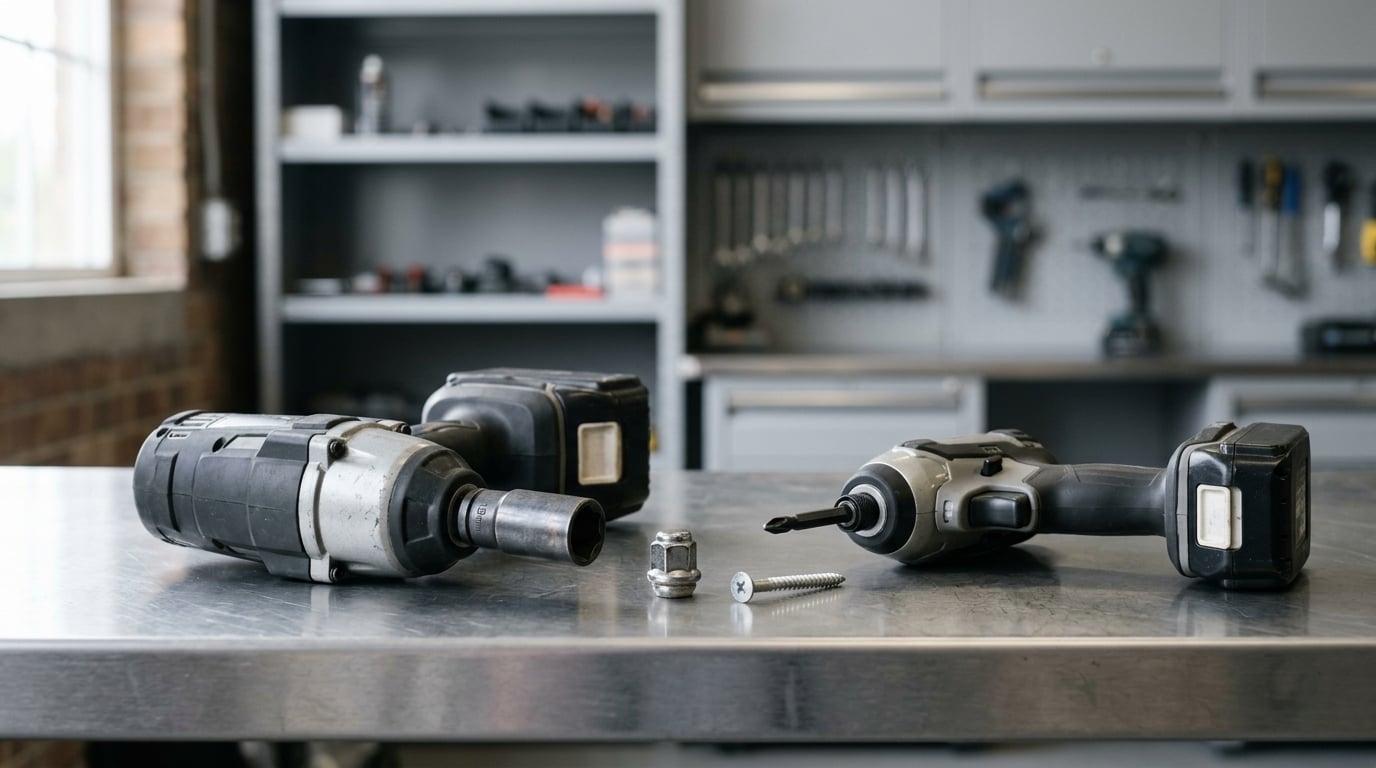
The impact wrench vs impact driver difference comes down to the fastener and the drive. An impact driver holds a bit in a 1/4-inch hex collet and drives screws fast at roughly 1,000 to 2,000 inch-pounds. An impact wrench holds a socket on a square-drive anvil and turns nuts and bolts hard at 300 to 2,000 foot-pounds.
Most people who own one of these own the driver first, then add the wrench when a rusted lug nut or a seized suspension bolt makes the driver a joke. If you are matching a tool to a job, the fastener decides everything else.
Table of Contents
Impact Wrench vs Impact Driver Difference at a Glance
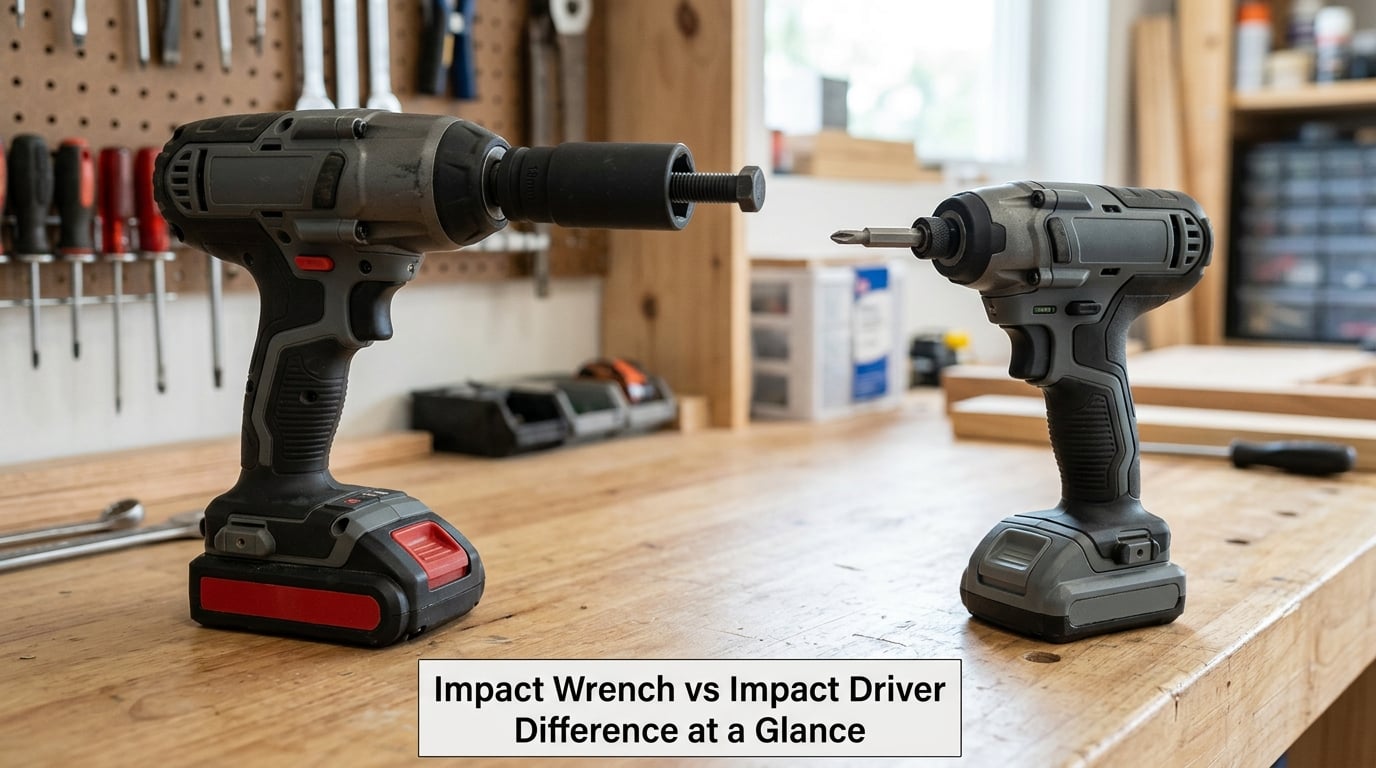
Here is the whole impact wrench vs impact driver difference on one page. Read the drive and torque rows first, because those two decide the tool.
| Criterion | Impact driver | Impact wrench |
|---|---|---|
| Primary job | Driving and removing screws and small fasteners | Loosening and tightening nuts and bolts |
| Output connection | 1/4-inch hex collet | Square-drive anvil, 1/4 inch, 3/8 inch or 1/2 inch |
| Accepts | Hex shank bits, driver bits, socket adapters | Impact-rated sockets only |
| Torque unit | Inch-pounds (in-lb) | Foot-pounds (ft-lb) |
| Typical torque | 1,000 to 2,000 in-lb | 300 to 2,000 ft-lb |
| Speed | High RPM, up to about 3,000 impacts per minute | Lower RPM, heavier impacts |
| Fastening control | Very good, slow trigger lets you ease a screw home | Limited, most have no torque-limiting clutch |
| Rotation | Forward and reverse switch | Forward and reverse switch |
| Size and weight | Short, light, fits in tight spaces | Longer and heavy, tiring on long jobs |
| Best fasteners | Deck screws, cabinet screws, lag screws, body panel screws | Lug nuts, suspension bolts, exhaust fasteners, seized hardware |
| Worst mistake | Using it to break a seized lug nut | Using it to drive a screw and shearing the head off |
| Common power source | Cordless battery | Cordless battery or pneumatic air |
How an Impact Wrench and Impact Driver Work
Both tools smash a fastener rather than spin it smoothly. Inside each one, a motor drives a hammer mechanism that strikes an output anvil, and every blow delivers a short spike of torque into the fastener. That is why an impact tool can produce far more turning force than its motor could on its own.
The motor runs at a relatively low speed and relatively high power. The hammer adds speed in the form of thousands of short, sharp strikes per minute, and the combined result is torque that arrives in pulses rather than as a steady push.
Here is where the impact wrench vs impact driver difference becomes mechanical. An impact driver uses a lighter hammer that fires fast, often in the neighborhood of 3,000 blows per minute. An impact wrench uses a heavier hammer that fires fewer times, closer to 1,000, and each blow carries a lot more energy. One trades blow count for blow weight.
How to tell them apart in three seconds
Look at the nose. A driver has a narrow cylindrical collet with a hole and a small spring-loaded clip on the side, and it looks like a fat screwdriver. A wrench has a short, blunt anvil with a square hole, often with a detent pin or a rubber hog ring holding the socket on. If the tool takes a socket, it is a wrench.
Why the joint is offset (the joggle)
The hammer cannot hit the anvil dead center, because the blow would twist the whole tool in your hand. Manufacturers use a joint called a joggle to keep the striking point slightly off axis. The hammer swings, contacts the offset point, and the tool reacts to the blow without the handle being thrown sideways. If you have ever felt a driver buzz hard against a screw head, that is the mechanism at work.
Torque and Fastening Control
Published maximum torque is the number most people argue about, and it is the least useful number on the box. A maximum rating is the hardest hit the tool can deliver, not the torque it applies when you tap the trigger once.
Impact wrench vs impact driver difference in torque numbers
One foot-pound equals twelve inch-pounds. That single conversion explains most of the confusion in online arguments: a wrench rated at 740 ft-lb is a tool that can put out about 8,880 in-lb, and comparing that to a driver rated at 1,330 in-lb makes the wrench sound like roughly six and a half times stronger. It is, and that is by design.
Two more numbers matter. Breakaway torque is the force needed to start a rusted, tight fastener moving, and it is the highest number the tool will ever produce. Fastening torque is what goes into a clean, lubricated nut going on, and it is far lower. Benchmarks for a given tool almost always quote breakaway, which is why an impact wrench looks far more capable than the job actually requires.
An impact driver is a much better controlled tool. Its trigger is a variable speed control, so you can feather the screw down until the bit stops biting, then stop. That is why experienced carpenters drive long deck screws with a driver rather than a drill. A drill can strip the head, a driver cannot be talked out of the head by a sudden stall.
An impact wrench has no such collar on most models. There is no setting to dial back. If you keep pulling, you keep delivering blows, and the only thing that eventually stops is a stripped fastener, a rounded nut or a cracked part. Wheel lug nuts and suspension bolts still get finished with a torque wrench to spec, because the impact wrench only breaks them loose or runs them snug.
Sockets, Fasteners and Application Differences
The bit connection is the clearest part of the impact wrench vs impact driver difference. A driver accepts any 1/4-inch hex shank bit, including driver bits, socket adapters, nut drivers and drill bits in a pinch. A wrench accepts only impact-rated sockets on a square drive of 1/4 inch, 3/8 inch or 1/2 inch, with 3/4 inch showing up on high-torque models for truck and trailer work.
Standard chrome sockets are not made for impact use. They are thinner in the walls and can crack, and pieces of a shattered socket inside a square drive are a genuine hazard. Impact sockets are noticeably heavier and usually marked as such.
Socket retention is worth checking in the store. A detent pin drops into a hole in the socket and holds it firmly. A hog ring is a rubber band around the anvil that just pushes the socket on. Both are fine, but a pin is better on a wrench you will hold out over a brake or up under a fender liner.
Matching the tool to the fastener:
- Wheel nuts and lug bolts: wrench. A driver with a socket adapter can do a routine, clean wheel change, but it will not break a seized one.
- Suspension, subframe, exhaust and engine bolts: wrench, driven by breakaway torque rather than final torque.
- Body panel screws and interior trim fasteners: driver. The hex shank gives you a short, straight bit for a straight screw hole.
- Deck screws, cabinet hardware, furniture bolts: driver, run slow at the end to avoid chewing the head.
- Large lag screws into hardwood: driver, with a pilot hole drilled first if the lag is big or the wood is dense.
- Confined spaces, overhead work, between spokes: driver. It is roughly an inch shorter and half the weight, and it fits one-handed.
Using the wrong tool is not a slow job, it is a ruined fastener. An impact wrench driving a screw will usually shear the head clean off and leave the shank threaded into the part. An impact driver on a seized nut will chew the corners into a hexagon that no socket fits. Both mistakes are expensive and both are avoidable.
Impact Wrench vs Impact Driver Difference in Practice
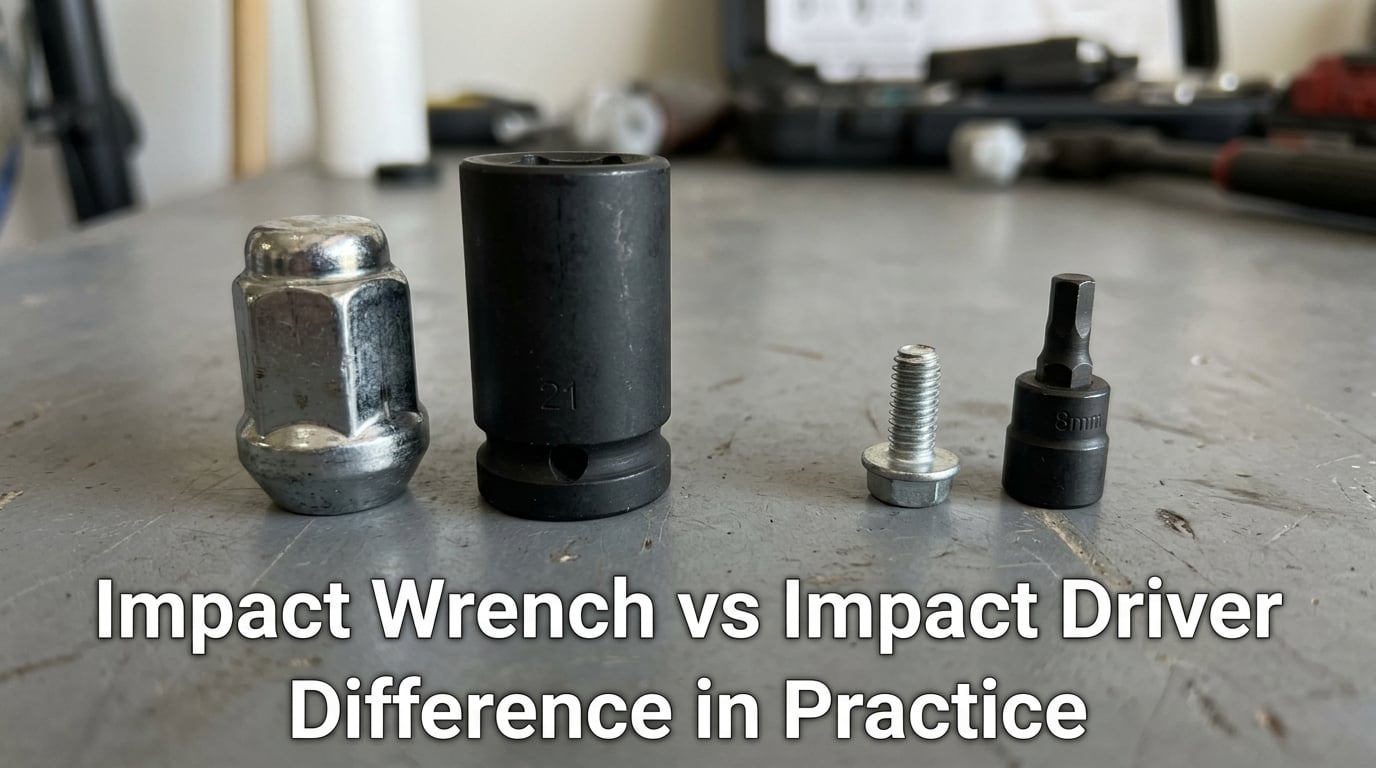
Picture a Saturday afternoon tire change. A driver with a 1/2-inch socket adapter will take off clean, road-salt-free lug nuts in seconds, and that is exactly what most wheel changes are. The same tool on a lug nut that sat through one winter in a wet fender well will round the nut, then spin the stud, and the afternoon gets worse rather than better. That is the moment a wrench earns its bench space.
Now picture a weekend rebuilding a rear bench seat. Three dozen Torx body bolts, mostly hidden, several at awkward angles, a couple of them broken off from the last person who used a drill. The driver does this job almost as fast as a hand screwdriver and never breaks anything. Reaching for a wrench here would be slower, heavier and likely to damage a plastic trim piece.
One more real case. A rusted exhaust hanger bolt on an older truck will not budge with a driver, a cheater bar, or a lot of swearing. It takes the high breakaway torque of an impact wrench, and once it breaks free the exhaust comes off the same wrench. The reverse also happens: someone using a big wrench on the soft head of a 3/4-inch lag screw will hear a sharp snap and fish the ruined screw out of the timber.
On r/Tools, in a thread titled “Can you use impact wrench as a impact driver,” the consensus is that a wrench can drive screws, but at lower RPM and with a real chance of shearing screw heads. That is the honest version of the substitution question: capability yes, speed and safety no.
Which Should You Choose?
Choose an impact driver if:
- You build decks, install cabinets or assemble furniture more than you turn wrenches.
- You want one tool that covers screws of every size, plus light drilling in soft material with an adapter.
- You work overhead or in spaces where a short, light body matters.
- You want control when a screw reaches its final depth and you need to stop.
Choose an impact wrench if:
- You change tires or work on brakes, hubs or suspension regularly.
- You own a vehicle old enough to grow seized bolts and rusted fasteners.
- You work on trucks, trailers, tractors or heavy equipment.
- You already know which bolts you will hit and they are all nuts and hex bolts.
Own both if you do any real automotive work. A mid-torque 1/2-inch cordless wrench covers most cars and light trucks, and you still reach for the driver on every screw that day.
One simple rule if you are buying only one
Buy the driver. Drivers cover more fasteners, weigh less and cost less, and forum users consistently treat the wrench as the second tool. Add the wrench when a specific job needs breakaway torque you do not have.
Battery platform is the sneaky decision
If you already own a cordless drill from a brand, check that the impact wrench you want runs on the same battery and charger. The biggest complaint in garage forums is not tool performance, it is ending up with two batteries and two chargers for the same job. A 20V-class wrench on the platform you already own is the cheap decision even if a smaller model fits the work better.
One middle-ground option worth knowing: 1/4-inch square drive impact wrenches. They take a small socket adapter, sit between a driver and a full 1/2-inch wrench, and cover light bolt work where a 1/2-inch wrench is overkill.
Frequently Asked Questions
Can an impact driver replace an impact wrench?
Partly, and only for light work. A driver with a 1/4-inch socket adapter can remove clean wheel nuts and light bolts, but it lacks the breakaway torque for a seized or rusted fastener, and it has no square drive for the sockets that job needs. It can also round a stubborn nut rather than break it loose. If your work is mostly screws, the driver is all you need. If rusted nuts are a regular part of the job, buy the wrench.
What torque does an impact wrench produce?
Cordless models range from about 100 to 1,000 ft-lb, with mid-torque 1/2-inch drives commonly around 400 to 700 ft-lb and high-torque 1/2-inch and 3/4-inch drives from 900 to 2,000 ft-lb. Pneumatic wrenches sit in a similar band. Remember that the quoted figure is usually breakaway torque, the hardest hit the tool can deliver, and not the torque it applies during final tightening.
Are impact drivers better for small bolts and small screws?
Yes. The impact driver is the better tool for small fasteners because it delivers thousands of light impacts instead of one heavy hit, so the head rarely shears and the collar on the bit does not slip. A wrench driving a small screw usually shears the head and leaves the shank stuck in the part. One exception: a big lag screw into dense hardwood can split the wood, so drill a pilot hole first.
Can I use an impact wrench on car bolts?
Yes, and on a car that is exactly what it is for. Use it to break suspension, subframe, exhaust and engine bolts loose, and to run lug nuts snug. Most impact wrenches have no torque-limiting clutch, so they keep hammering as long as you pull the trigger. That is why lug nut and suspension torque specs still get finished with a torque wrench, and why a wrench on a small engine or body bolt can crack the casting.
Is a hammer wrench the same as an impact driver?
No, and the two names get tangled in a hurry. A hammer wrench is a hand tool, a ratchet handle with a sliding hammer that you bang against the cheek to add force. An impact driver is a powered tool with a motor, a collet and a trigger. An impact wrench is the powered one with the square drive. Same idea of impact, completely different tool.
Bottom Line
Match the tool to the fastener, not the other way around. Note the fastener size and material, the access you have, the torque the job actually needs and whether you can stop before you overtighten. A screw job gets the driver, a nut or bolt job gets the wrench, and anything with a published torque spec still gets finished with a torque wrench.