
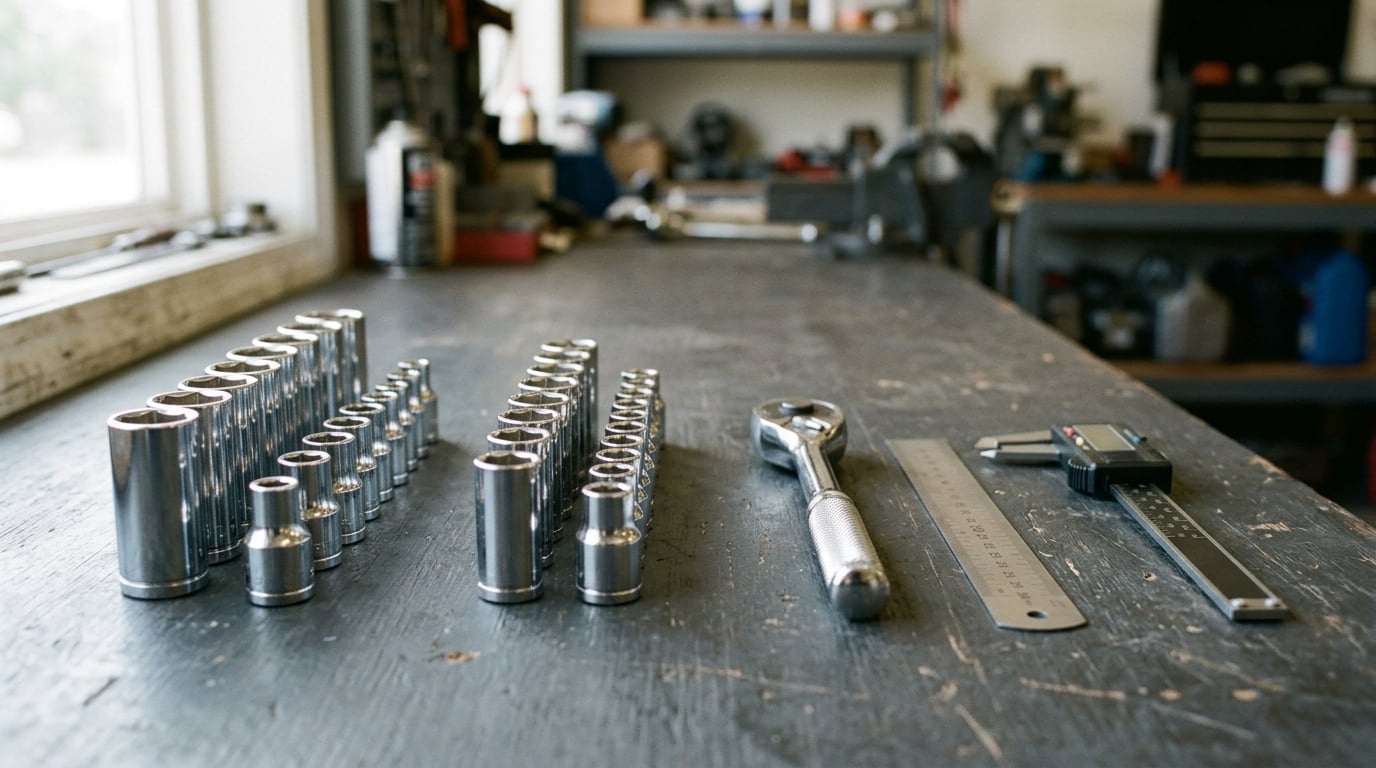
Metric vs SAE sockets explained in one line: SAE sockets are sized in fractional inches (3/8, 1/2, 9/16) and metric sockets are sized in millimeters (10mm, 13mm, 19mm). The two systems measure the same thing in different units, so a socket in one can sit near a fastener built for the other, but they are never the same size. A 10mm socket measures 0.394 inch across the flats; the nearest SAE socket, 3/8 inch, measures 0.375. That 0.019 inch gap is where rounded bolt heads come from.
Table of Contents
- Metric vs SAE Sockets at a Glance
- What Is the Difference Between Metric and SAE Sockets?
- How Do Metric Socket Sizes Work?
- How Do SAE Socket Sizes Work?
- Metric vs SAE Socket Fit and Compatibility
- How to Tell Which Socket System You Need
- Are Metric and SAE Sockets Interchangeable?
- Metric vs SAE Sockets: Which Should You Choose?
- Which Should You Choose? A Quick Decision Path
- Frequently Asked Questions
- Can a 10 mm socket fit a 3/8-inch SAE bolt?
- Are 10 mm and 3/8-inch sockets the same size?
- What socket size do BMW bolts usually use?
- How do I know whether a socket is metric or SAE?
- Can I use an SAE socket on a metric fastener if it seems close?
- Do socket adapters make metric and SAE sockets interchangeable?
- Conclusion: Choose by Fastener, Not by Number
Metric vs SAE Sockets at a Glance
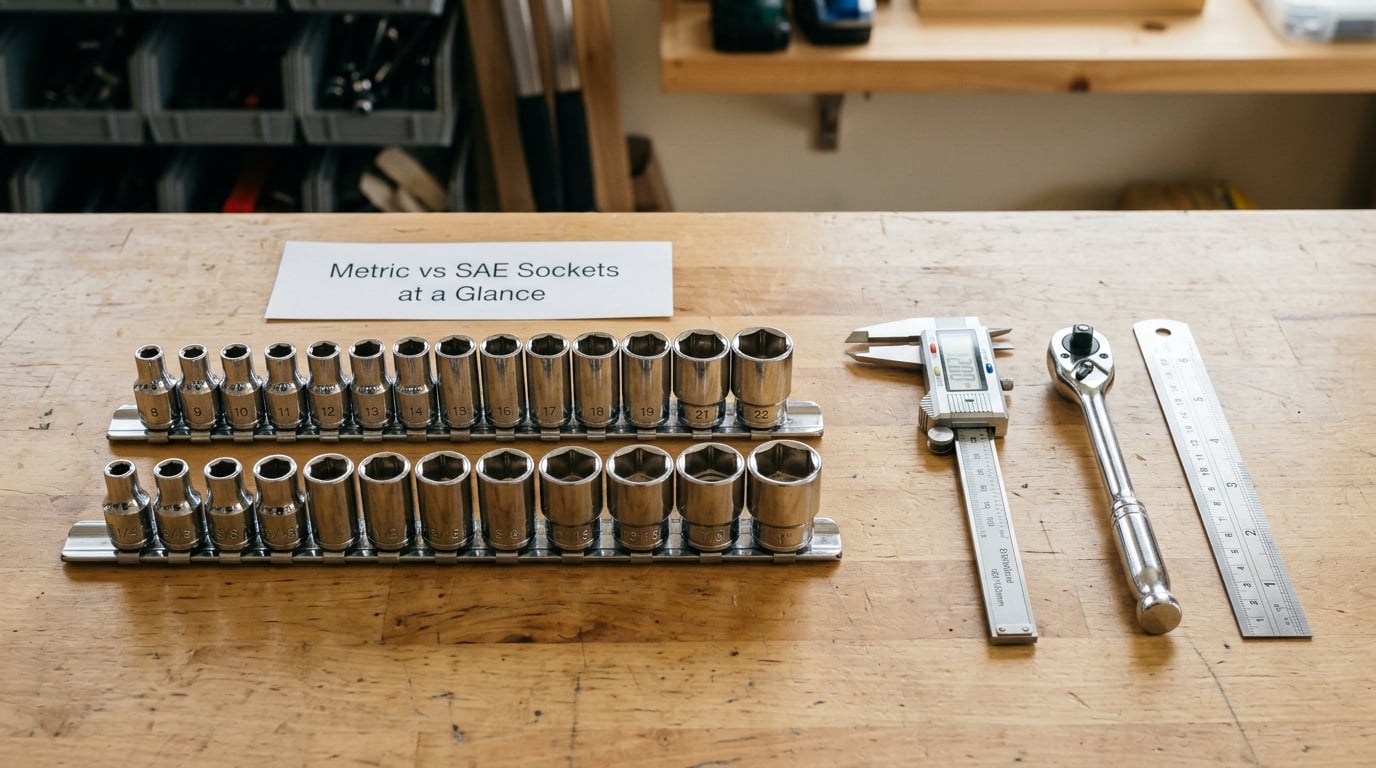
The table below is the whole difference in one view. Read the top rows carefully, because the number stamped on a socket is the width of the fastener head, not the thread diameter.
| What it is | Metric sockets | SAE sockets |
|---|---|---|
| Unit of measurement | Millimeters | Fractional inches |
| What the number means | Head width across the flats, in mm | Head width across the flats, in inches |
| Written like this | 8, 10, 13, 17, 19 | 1/4, 3/8, 7/16, 1/2, 9/16, 3/4 |
| Size steps | 1mm steps from 8 to 19, then 2mm steps | 1/16 inch steps, skipping a few in places |
| Typical home range | 4 to 24mm | 1/4 to 3/4 inch |
| Where you meet it | Japanese, Korean and European cars, most modern machinery, bicycle and furniture hardware | American trucks, motorcycles, plumbing fittings, lawn and farm equipment, older domestic cars |
| Thread standards behind it | ISO metric coarse and fine, marked M10x1.5 and so on | Unified coarse (UNC) and fine (UNF), marked 1/2-13 and so on |
| Forcing the wrong one | Rounds the head, slips off the corner | Rounds the head, slips off the corner |
Two columns, one rule: match the system to the fastener, never to what is closest in your drawer. The rest of this article is the detail behind that table.
What Is the Difference Between Metric and SAE Sockets?
The difference is a unit, not a shape. Both systems size a socket by the distance across the flats, which is the width of the hex fastener head the socket grabs. A metric socket reports that width in millimeters; an SAE socket reports it in fractional inches.
SAE stands for the Society of Automotive Engineers, which set fastener dimensions used across American industry. SAE is not the same as imperial, even though plenty of people use the words together. SAE fasteners follow the Unified thread standard with a defined head-width table, and imperial covers a wider family of things that includes some awkward leftovers nobody uses on cars.
What matters at the bench is tolerance, and this is where sockets and wrenches behave differently. A good-quality socket is typically made to fit within about 0.004 inch of nominal across the flats. An open-end or combination wrench is looser, commonly around 0.010 inch, because it touches only two flats and can rock. A six-point socket touches six flats, so it stays on the head far better and forgives less.
That single fact explains most of the frustration people have with conversion charts. A mismatch that a wrench might survive, or that a small gap looks like it should survive, will still round a fastener when a socket concentrates the whole load on the corners of the head. Never force a socket that drops onto a bolt with visible daylight at the corners. The correct socket should sit flat and turn without rocking at all.
How Do Metric Socket Sizes Work?
Metric socket sizes are the head width in whole millimeters. A 13mm socket fits a fastener head that measures 13mm across the flats, give or take the manufacturing tolerance of the socket itself. Below about 10mm you will also find half-millimeter sizes such as 5.5mm on a full set.
The number on the bolt is not the number on the socket, and this trips up almost everyone at first. Metric fasteners are named for thread diameter, so an M10 bolt has a 10mm thread and, under common ISO head standards, a 16mm-wide hex head. It wants a 16mm socket, not a 10mm socket.
| Bolt designation | Standard hex head width | Socket needed |
|---|---|---|
| M8 | 13mm | 13mm |
| M10 | 16mm | 16mm |
| M12 | 18mm | 18mm |
| M14 | 22mm | 22mm |
| M16 | 24mm | 24mm |
| M20 | 30mm | 30mm |
Metric sets are built around the sizes a European and Japanese car actually uses, so 8, 10, 12, 13, 14, 16, 17, 18 and 19mm cover most of the work. 17mm and 19mm come up constantly on wheel fasteners and suspension arms. If you own a German or Japanese car, that middle range of the set earns its keep.
How Do SAE Socket Sizes Work?
SAE socket sizes are fractions of an inch, quoted across the flats: 1/4, 5/16, 3/8, 7/16, 1/2, 9/16, 5/8, 11/16 and 3/4 inch are the ones you will use most. The steps are sixteenths of an inch, though a few sizes are skipped in cheaper sets, so 5/16 and 11/16 inch are sometimes missing.
As with metric, the bolt designation is its thread diameter and the socket is the head width. A 1/2-13 bolt has a half-inch thread and, at the standard SAE head width, a 3/4 inch hex head. It takes a 3/4 inch socket.
| Bolt designation | Standard hex head width | Socket needed |
|---|---|---|
| 1/4-20 | 7/16 inch | 7/16 inch |
| 5/16-18 | 1/2 inch | 1/2 inch |
| 3/8-16 | 9/16 inch | 9/16 inch |
| 1/2-13 | 3/4 inch | 3/4 inch |
| 5/8-11 | 15/16 inch | 15/16 inch |
| 3/4-10 | 1-1/8 inch | 1-1/8 inch |
The last column is the part that surprises people. A 3/8 inch bolt does not take a 3/8 inch socket. It takes a 9/16 inch socket, which is why SAE bolt names never match the socket number and why guessing from the bolt label gets you into trouble.
Metric vs SAE Socket Fit and Compatibility
Here is the conversion everyone searches for, with the difference worked out in thousandths of an inch and a verdict for each pairing. A socket fits comfortably when the difference is inside roughly 0.004 inch, which is the usual manufacturing tolerance of a good socket. Between 0.005 and 0.011 inch it will usually work once, and it will annoy you. Past that, it will round the head.
| Metric | Nearest SAE | Decimal inch | Difference | Fit verdict |
|---|---|---|---|---|
| 8mm | 5/16 inch | 0.312 inch | 0.002 inch | Effectively interchangeable |
| 10mm | 3/8 inch | 0.375 inch | 0.019 inch | Will round the bolt. No substitute exists |
| 11mm | 7/16 inch | 0.438 inch | 0.004 inch | Close enough for most non-critical work |
| 12mm | 1/2 inch | 0.500 inch | 0.028 inch | Will round the bolt |
| 13mm | 1/2 inch | 0.500 inch | 0.012 inch | Too loose, use with caution |
| 14mm | 9/16 inch | 0.563 inch | 0.011 inch | Too loose, use with caution |
| 15mm | 9/16 inch | 0.563 inch | 0.028 inch | Will round the bolt |
| 16mm | 5/8 inch | 0.625 inch | 0.005 inch | Usable on a seized or awkward fastener |
| 17mm | 11/16 inch | 0.688 inch | 0.018 inch | Will round the bolt |
| 19mm | 3/4 inch | 0.750 inch | 0.002 inch | Effectively interchangeable |
| 22mm | 7/8 inch | 0.875 inch | 0.009 inch | Usable with care |
| 24mm | 15/16 inch | 0.938 inch | 0.007 inch | Usable with care |
Read the verdicts as a warning, not a shopping list. The pairings people actually rely on are 3/8 inch with 10mm, 7/16 with 11mm, 1/2 with 13mm, 9/16 with 15mm, 5/8 with 16mm and 3/4 with 19mm, and the point of that list is that every one of them is a compromise. Only 8mm and 19mm land inside tolerance. If a fastener is torque critical, head bolt or wheel stud, the correct system is the only acceptable answer.
Flange nuts make the size mismatch look even bigger. A flange nut has a washer face built into it, and the head is wider across the flats than a plain hex nut of the same thread, so a flange nut needs its own size in your set. If a socket sits on a nut but bottoms out before it is tight, the nut is a flange and you want the flange size.
Drive size is not socket size
Every socket has a drive size, and it is always in inches: 1/4, 3/8, 1/2 and 3/4 inch. That is true of a fully metric set, which is why a metric ratchet set is sold as a 1/2 inch drive set. The drive size describes the square end that fits your ratchet, while the socket size describes the fastener head it turns. A 13mm socket on a 3/8 inch drive is a perfectly normal thing to own.
Use a quarter-inch drive for small spaces and low torque, a 3/8 drive for general work, a half-inch drive for wheel and suspension work, and a 3/4 inch drive for the heavy fasteners on trucks and large machinery. If the numbers confuse you while shopping, read the drive size first, then pick socket sizes in the system the vehicle uses.
How to Tell Which Socket System You Need
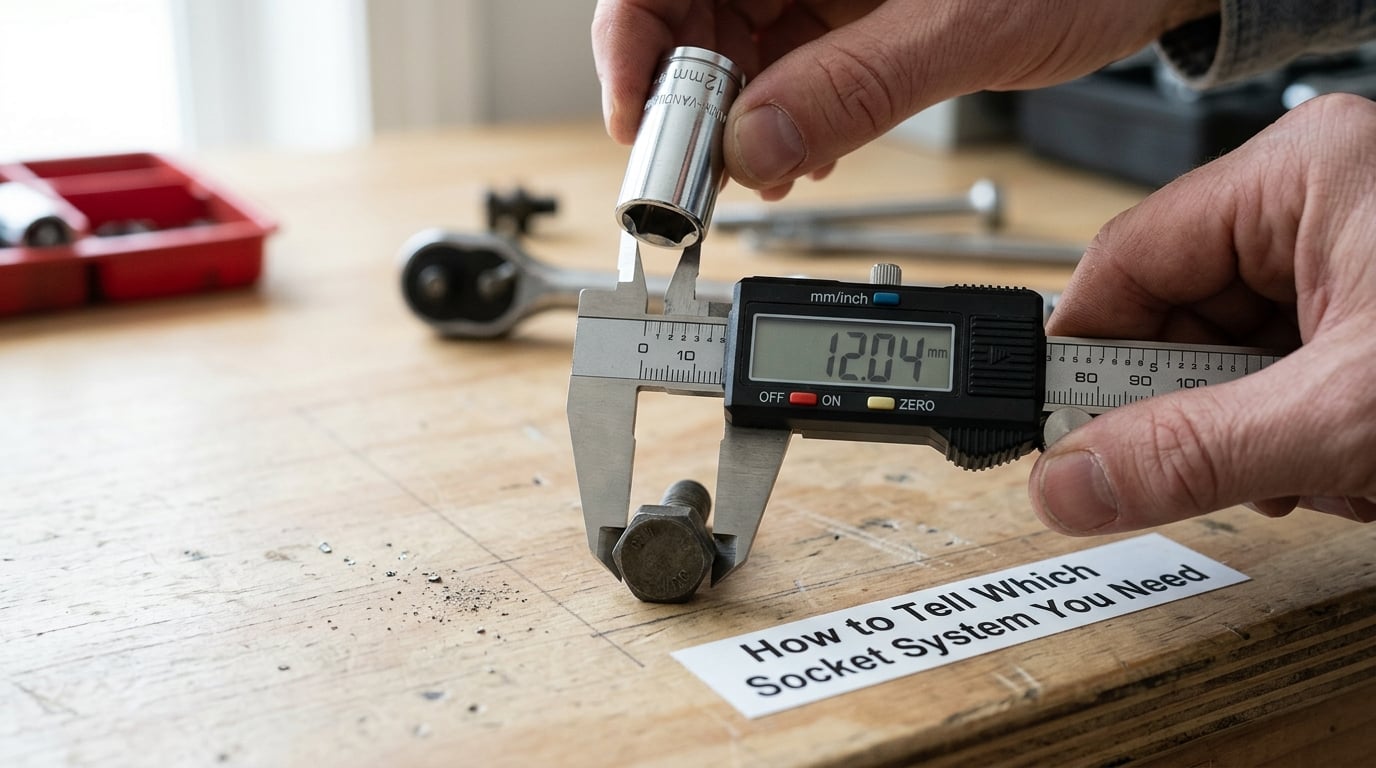
You can identify a loose bolt without a chart in about a minute. Use these three checks in order and stop when they agree.
1. Measure across the flats with calipers. Open the jaws, touch two opposing flats on the head, and read the number. Between 15 and 17 you have a metric fastener. Between 9 and 16 you could be in either system, so keep going. Between 7 and 8, or above 18, it is SAE.
2. Count the thread pitch. Lay a ruler along the threads and count the ridges inside one inch. Metric coarse threads give around 20 threads per inch for an 8mm bolt, 16 for a 10mm, and 12 for a 12mm, dropping as the bolt grows. SAE coarse gives 20 threads per inch on a quarter inch, 16 on a 3/8, 13 on a half inch and 11 on a 5/8. Fine threads are always denser, and fine metric and fine Unified are easy to mix up, so treat this as a supporting check rather than proof.
3. Compare the head to the thread. A hex head is noticeably wider than the thread it carries. If the head is about one and a half times the thread diameter, you are in either system, and the caliper reading settles it. If the head is only slightly wider and shallow, you may be looking at a light-pattern or button head from a piece of equipment rather than a car.
If you still cannot tell, do not guess with a socket. Try the candidate socket loosely and watch the corners. A correct socket sits flat with no daylight. A wrong one rocks, and the moment you apply torque you are rounding the fastener.
On the socket itself, metric sizes are stamped bare, so a 13 is 13mm. SAE fractions are stamped with a fraction, a decimal, or a letter, so 3/8, 0.375 and E all point to 3/8 inch. A 1/2 inch drive marking tells you nothing about the sizing system; it is the square end, not the fastener size.
Are Metric and SAE Sockets Interchangeable?
Not in general. A metric socket and an SAE socket of similar numbers describe different widths, and the gap between them is usually larger than the tolerance a socket can absorb. Use them across systems only when the table above says the difference is within 0.004 inch, and never on head bolts, wheel studs, connecting rods or anything else you intend to torque to a specification.
Adapters do not change this. A drive adapter converts the square that fits your ratchet, and a universal joint gives you an angle, so neither one makes a 3/8 inch socket grip a 10mm head any better. The wrong socket with a fancy adapter is still the wrong socket, and it now has more places to slip.
What adapters are genuinely good for is moving between drive sizes while you work, such as dropping to a quarter-inch drive to get into a tight wheel well. That is a legitimate use. Swapping a 1/2 inch socket for a 13mm one and hoping is not.
One more note on thread systems, because a socket can fit and the joint still fail. Metric fasteners are marked with an M and a pitch in millimeters, for example M10 by 1.5. SAE Unified fasteners are marked with a fraction and a threads-per-inch count, for example 1/2-13. A fastener that looks like it belongs in one system can carry threads from the other, which is exactly what happens on older imported machinery.
Metric vs SAE Sockets: Which Should You Choose?
Match the set to what you actually own. A Japanese, Korean or European car is a metric kit, nearly end to end. A domestic truck, a Harley or most other motorcycles, plumbing fittings, lawn equipment and farm machinery lean heavily SAE. A household with one of each needs both, and buying two half-size sets beats buying one full set twice.
Sockets also come in styles that matter more than the sizing debate. Six-point sockets are the workhorse and grip the flats hardest, which is why they are the right choice on a stubborn fastener. Twelve-point sockets fit a ratchet at 30 degree steps so you can work in tight spaces, and they are the default for a starter set. Ratcheting sockets have internal teeth that let you turn without lifting the tool, which saves knuckles more than it saves time. Deep well sockets add length for spark plugs and recessed bolts, and impact-rated sockets are a thicker, tougher steel meant for a gun, not for a ratchet.
Buy a shallow and a deep set in whichever system your vehicle uses, skip 12-point for anything you intend to hit hard, and add magnetic retention if you work overhead where dropping a small socket means fishing in a footwell. Impact-rated sockets are not interchangeable with hand sockets; the softer chrome hand socket will shatter in an impact gun, and that is a genuinely expensive mistake.
A cheap ratchet set that mixes both systems in one tray is a reasonable way to cover a mixed household, as long as the drive size is the same. Otherwise you are juggling two ratchets, which is where mistakes get made.
One historical footnote that explains the split. American manufacturers stayed on SAE fastener dimensions after the 1980s, while Japanese and European makers standardized on metric. American trucks then ended up with mixed content, American-bought engines in a metric chassis, which is why even a domestic pickup can ask for a 15mm or 17mm socket on a job you assumed was all SAE.
Which Should You Choose? A Quick Decision Path
Use the vehicle, the fastener and the toolkit in that order. Start with the car you own most, buy the set that covers its system completely, and add the other system only when a second vehicle or a specific job demands it.
If you are starting from nothing on a Japanese, Korean or European car, a metric set in 1/2 inch drive with 8, 10, 12, 13, 14, 16, 17 and 19mm will cover the overwhelming majority of jobs. Add a 21 or 22mm for wheel hardware and a 4 to 6mm trio for small engine bay fasteners. On an American truck or a motorcycle, an SAE set in 1/2 inch drive with 1/4 through 3/4 inch in 1/16 steps covers it, and you will want the deep six-point sockets.
If a household runs one of each, a quarter-inch drive set is the portable answer for both systems, and a half-inch drive set in whichever system covers the more work. That split keeps the weight down and stops you from carrying a full set you use once a year.
Your first practical step takes five minutes. Open the manual or the service record for the vehicle you work on most, and write down the head width of the three or four bolts you touch most often. Those are the sizes your set needs first, and the rest of the range is a nice-to-have.
If the bolt head is already rounded
Stop using an impact wrench on it. A gun will finish the job you already started by hammering the corners off. Soak the fastener with penetrating oil, give it time, then try a six-point socket that fits properly with light, steady pressure. If it will not break free, a left-hand or reverse extractor socket bites into the rounded head and backs it out slowly. Applying heat to the bolt body and letting the threads cool can help on a seized exhaust or bracket, and clamp a wrench on the head of the bolt so the fastener turns instead of the stud.
Last resort is a thread chaser or a tap matched to the correct thread, and if the head is truly gone, drilling and extracting is the last option before cutting. Match the thread to the fastener marking before you go near it, because re-cutting the wrong thread is how a repair becomes a bigger one.
Frequently Asked Questions
Can a 10 mm socket fit a 3/8-inch SAE bolt?
Not safely, and not for a reason most people expect. A 3/8 inch SAE socket measures 0.375 inch across the flats while 10mm measures 0.394 inch, a gap of 0.019 inch. That is roughly five times the tolerance a quality socket is built to, so the socket sits on the corners of the head instead of the flats and rounds it under load. Buy the 3/8 inch socket.
Are 10 mm and 3/8-inch sockets the same size?
No, they are close but not the same. 10mm is 0.394 inch and 3/8 inch is 0.375 inch, so the metric socket is 0.019 inch larger across the flats. Because the numbers came from two different systems, no metric size matches any SAE size exactly. The nearest near-ties are 8mm with 5/16 inch and 19mm with 3/4 inch, both within 0.002 inch.
What socket size do BMW bolts usually use?
Metric, across the board, and 8mm, 10mm, 13mm and 16mm cover a large share of body and suspension work. Wheel fasteners are the sizes people notice most, commonly 17mm on many models and 19mm on others, so check the vehicle before buying. A half-inch drive metric set covering 8 to 19mm handles the bulk of it. Torque wheel fasteners to the value in the manual, not by feel.
How do I know whether a socket is metric or SAE?
Read the marking. A bare number on the socket means millimeters, so a 13 is a 13mm socket. A fraction, a decimal, or a trailing letter means SAE, so 3/8, 0.375 and E are all 3/8 inch. A marking such as 1/2 inch DR describes the drive that fits your ratchet, not the sizing system, which is why metric sets are still sold in inch drives.
Can I use an SAE socket on a metric fastener if it seems close?
Only when the difference is inside about 0.004 inch, which covers 8mm on 5/16 inch, 11mm on 7/16 inch and 19mm on 3/4 inch. Even then, keep it off head bolts, wheel studs and connecting rods, where a corner load changes how the joint is clamped. A visibly loose fit that rocks at the corners will round the head, so treat close as not close enough.
Do socket adapters make metric and SAE sockets interchangeable?
No. A drive adapter changes the square that fits your ratchet and a universal joint adds an angle, so neither improves how a socket grips a fastener head. Using a 3/8 inch socket on a 10mm bolt with a universal joint attached is still the wrong socket, now with extra places to slip. Adapters are for changing drive size or reaching an angle, never for changing the sizing system.
Conclusion: Choose by Fastener, Not by Number
Identify the system first, then match the socket to the head width and the drive to your ratchet. Never force a socket that rocks or shows daylight at the corners, and never substitute on a torque-critical fastener.
Start with the vehicle you work on most. Write down the head width of the three bolts you touch most, buy a half-inch drive set in that system, and add the other system only when a job actually calls for it. That is a faster, cheaper and far less frustrating way to build a socket set than memorizing a conversion chart.