
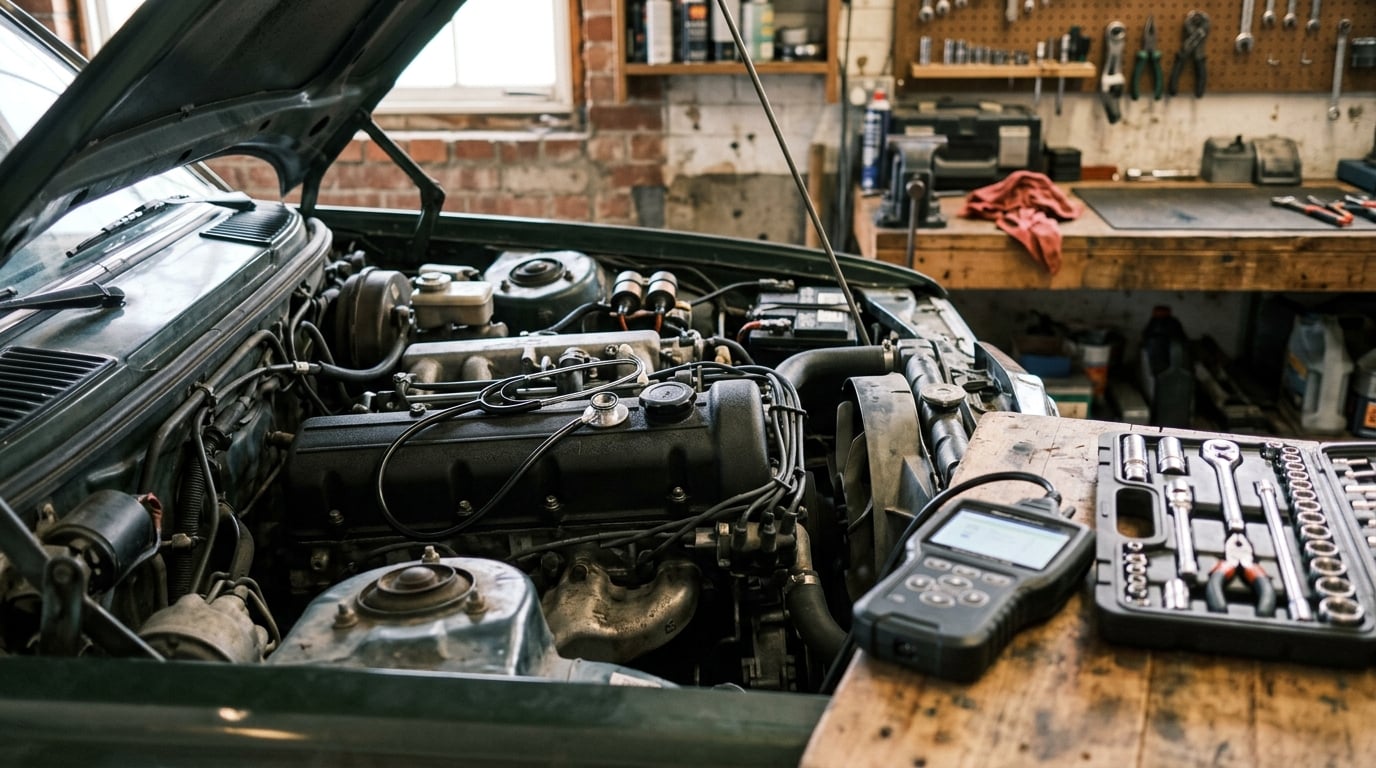
What is engine ping and how to stop it? Engine ping is a light metallic rattle or ring that comes from inside the combustion chamber when the air and fuel mixture burns at the wrong moment, and the fix depends entirely on what is causing it. Most pinging is a fuel, spark plug or exhaust gas recirculation problem you can sort in an afternoon with hand tools. A smaller share is genuine detonation or rod knock, and that one ends an engine if you keep driving it.
This guide walks through the diagnosis in the order a technician would do it, cheapest checks first, so you do not end up replacing parts that were never the problem. Nothing here needs a lift or a shop to start with. Budget an hour for the first pass, and more if a scan turns up stored codes.
Table of Contents
What You Need
Before you touch anything, gather what you already need for basic service work. The diagnosis is mostly listening, reading and looking, not disassembly.
- The owner’s manual for your exact model, for the fuel octane the engine was designed for, the oil specification, the cooling system procedure and the scheduled service intervals. On a European car, the manual also tells you whether the engine uses an octane knock sensor and how the ECU is meant to respond.
- A phone or a listening device to record the sound from outside the car and again from the engine bay. A twenty-second recording played back at half speed separates a hollow injector tick from a dense knock far better than memory does.
- An OBD-II scanner, even a cheap code reader. Knock-related trouble codes are one of the fastest ways to tell a sensor fault from a real combustion event.
- Basic hand tools: a ratchet set, spark plug socket and torque wrench, a dipstick, a flashlight, a wire brush, an intake cleaning tool or brake cleaner, and a vacuum or fuel pressure gauge if you want to go further.
- Correct fluids and fuel: the specified engine oil, the specified coolant, and fuel at the octane rating printed on the fuel filler flap. Buy a full tank of the right grade before you start, not a quart.
Safety note: repeated metallic pinging that appears under load, and especially at wide-open throttle, is the sound of abnormal combustion. Every cycle it fires it erodes pistons, rings and valves, and it can escalate into rod knock, which means a rebuild or a replacement engine. If the sound gets louder as you accelerate, treat the car as a vehicle to drive gently to a shop or not at all.
Two more rules before you start. Do not diagnose a car while it is moving, and do not remove a valve cover, intake manifold or spark plug while the engine is running. Hot components, moving belts and pressurised cooling systems cause more injuries than engines do.
Step-by-Step
Work through these in order. Each step assumes the previous one came back normal, and the order is deliberate: the cheap and common causes get ruled out before anything gets replaced.
What Is Engine Ping? Confirm the Noise Before You Drive
Engine ping, engine knock, spark knock and detonation all describe the same family of noise. What you are hearing is pressure waves from a second, uncontrolled combustion event inside the cylinder bouncing off the chamber walls, and it sounds like a brief metallic tap, tick or ringing that follows the engine speed.
Distinguish it from the noises that get confused with it, because the fix is completely different in each case. A hollow tick that only appears for the first second or two after startup, then fades, is usually injector noise. A hard rattle that follows rpm the whole time, even at idle, is often the timing chain or a valve-train rattle. A rhythmic slap that speeds up and slows with engine speed is piston or wrist pin. A leak that changes pitch with rpm and gets louder on overrun is usually an exhaust leak ahead of the catalytic converter. Ordinary engine vibration feels like it comes through the seat or steering wheel rather than your ears.
Two different ignition events get lumped together under this label. Pre-ignition happens before the spark, usually from a hot spot such as a carbon deposit or glowing valve. Detonation happens just after the spark, from pressure waves igniting the end gas. Both produce the noise you hear, and both mean the burn is running early or uncontrolled.
If the sound only shows up when you lift off the accelerator, changes with load, and disappears at a steady warm idle, you are looking at a combustion-related ping rather than a mechanical rattle.
Determine Whether the Ping Is an Emergency
Severity is decided by what the sound does, not by how loud it is. The single most useful clue is throttle response: if the engine pulls normally and the sound comes and goes, you are probably in the manageable group. If the ping comes with hesitation, a flashing check engine light, or a loss of power when you ask for more, the situation is not manageable.
Here is how the behaviour maps to a likely cause.
| When the ping happens | What it usually points to | How urgent |
|---|---|---|
| Cold start only, fades after a few seconds | Injector tick or valve-train rattle as oil warms up | Low |
| Steady part throttle, roughly 1500 to 2500 rpm, warm | EGR flow problem, vacuum leak or lean fuel trim | Moderate |
| Hard acceleration in one specific gear, or wide-open throttle | Low octane fuel, carbon hot spot, ignition timing | High if it is getting louder |
| Pulling away from a stop with light throttle | Injector tick, misread as knock on many cars | Low |
| Two or three seconds after the engine shuts off | Oil drain-back through the timing chain | Low |
| Follows rpm continuously, louder as engine warms | Rod knock, bearing wear or internal mechanical damage | Stop driving |
Stop driving and arrange a tow or roadside diagnosis if the ping continues at a steady cruise speed, becomes louder rather than fading, arrives with a flashing check engine light, or comes with any loss of power. Those four together point to a combustion problem that is actively damaging the engine.
Temperature matters too. Knock that only appears when the engine is fully hot and only under load is a different problem from knock at cold start, and it usually points at fuel octane or a cooling problem rather than a mechanical failure.
Check Fuel Quality, Spark and Engine Basics First
Start with what is engine ping and how to stop it in the cheapest possible order, which is fuel and spark. Nearly half the pinging cases reported on owner forums resolve here, and the fix is a tank of the correct fuel or a set of plugs.
Fuel octane. Check the rating on the fuel filler flap against what is actually in the tank. One tank of too-low octane is enough to cause ping under load, and no amount of driving will change it. On a turbocharged or tuned engine the knock limit is a hard constraint, and a knock sensor retarding timing to protect the engine is not a fix, it is a warning.
Fuel contamination or restriction. Water, ethanol-blended fuel from a stale station, or a clogged fuel filter leans the mixture and creates ping at part throttle. Look for a fuel filter service interval in the manual, and check that fuel pressure meets the specification if you own a gauge.
Spark plugs. Worn, fouled or incorrectly gapped plugs change the burn long before they change how the engine starts. Replace them with the specified part number and gap them to spec. Ignition coils fail in a way that mimics a mechanical noise on some engines, and swapping coils across cylinders is a cheap way to find out which one is bad.
Air restrictions and leaks. A dirty mass air flow sensor, a clogged air filter or a cracked intake boot sends a lean or wrong signal, and both produce ping. Check the intake ducting and the vacuum hoses around the intake and brake booster while the engine runs at idle, listening for a hiss. A faulty oxygen sensor skews fuel trim enough to cause knock on an otherwise healthy engine.
Oil and coolant. A low oil level thins the film on the rod bearings and the noise that follows can be genuine knock rather than combustion noise. Low coolant or a failing thermostat lets combustion chamber temperature climb, and hot chambers make octane limits disappear.
Recent service history. If the ping started right after a timing belt or chain job, have the timing rechecked before anything else. A belt installed a tooth off will make noise that sounds like a knock and will eventually destroy the engine.
Use Scans and Controlled Tests to Narrow the Cause
Once the cheap checks are clean, a scan usually tells you more than another hour of listening. Read stored and pending codes before you clear anything, and look specifically for the knock and crank position families: P0325 and P0331 point at the knock sensor circuit, P0335 is the crankshaft position sensor, and P1326 is a manufacturer knock-sensor code. P0335 is worth understanding properly, because a trade publication has described it as a secondary code the engine control unit sets when it misreads rod-bearing vibration as a crank sensor fault. The code does not mean the sensor failed, and replacing it will not stop a rod knock.
Live data narrows it further. Knock counts climbing during a controlled load mean the ECU is hearing something real. Long-term fuel trim far from zero points at a vacuum leak or a sensor problem rather than a spark problem. Throttle position or mass air flow data that jumps while the noise is happening points at a wiring or connector fault instead of combustion.
Injector balance testing shows whether one or more injectors are flowing unevenly, and uneven delivery makes combustion irregular. A compression test and a leak-down test separate a healthy engine from one with a low cylinder. A technician-controlled load test on a dyno or in a bay is the only honest way to reproduce wide-open-throttle knock, and it is the test to insist on before paying for a mechanical repair.
Do not hold the engine at high rpm in a driveway, do not remove covers while it is running, and do not pour additives into a tank and hope. If the ping is real knock, additives will quiet it for a few minutes and then the damage continues.
Repair the Confirmed Cause and Stop the Ping
The repair is always tied to what the diagnosis found, not to the sound. Fuel or delivery problems get fuel, plugs, coils, filters or injectors. Ignition and air problems get timing, plugs and cleaned intake sensors. Cooling and oil problems get coolant, a thermostat, a water pump, a correct oil change or an oil-pressure fix. A failed sensor or wiring fault gets the sensor or the harness.
Internal mechanical damage is the one case that needs a qualified mechanic and a proper teardown. Low compression, a failed leak-down test, a knocking noise that follows rpm continuously or a knock-related code on a healthy mechanical engine all point that way. Have the engine opened and measured before committing to a rebuild, and get a second opinion from a shop that does not stand to gain from the work.
For owners of German cars, the octane specification in the manual is a hard requirement, not a suggestion, and the same applies to any engine with a knock sensor tuned to a specific fuel. Running the wrong grade on a turbocharged model is the single most common way a healthy engine starts pinging under load.
Verify the Repair Before Driving Normally
Clearing a code is not the same as fixing the cause, so treat the clear as a checkpoint rather than a finish line. Clear codes only after the repair is done, then drive and watch that none come back. A code that returns within a few minutes of restarting means the fault is still there.
Listen through the first start and the first ten minutes. The noise should either be gone or audibly different. If it was an injector tick or a timing rattle, you will hear the change immediately.
Then drive gently through the speed and load range where the ping used to appear, and ask for a load test before returning the car to highway use. Unverified repairs are how a cheap fuel problem turns into a rebuild, and the shop that did the work should be willing to prove the noise is gone under load.
Common Mistakes When Stopping What Is Engine Ping
Almost every expensive engine ping repair started as one of these. Each has a straight fix.
Ignoring the sound until it gets worse. A ping that is quiet at idle and loud at full throttle is giving you a warning with time attached to it. Fix: follow the load table above the day you hear it.
Dumping octane booster into the tank without finding the cause. It may quiet a low-octane case for a tank or two, and it does nothing for carbon, timing, a bad sensor or low compression. Fix: confirm the fuel rating and get a scan first.
Replacing spark plugs, coils, injectors and sensors one at a time. Owners on the forums describe this pattern more than any other, and it turns a small bill into a large one. Fix: run the diagnostic sequence above before ordering a single part.
Continuing to drive through worsening knock. Every knock event is metal being eroded. Fix: stop driving the moment the sound grows under load or comes with a flashing check engine light.
Assuming every metallic sound is valve-train damage. Injector tick, timing chain rattle, piston slap and exhaust leaks all get called knock. Fix: record the sound cold and warm, and match it to the table.
Clearing the check engine light and forgetting about it. A code that comes back is a real result, not a nuisance. Fix: read pending codes, repair, then re-read after the repair.
Those are the mistakes. These are the eight remedies that actually work, in the order I would try them.
- Fill up with the octane on the fuel filler flap. One full tank of the correct grade is the cheapest possible fix and resolves a large share of pinging cases.
- Service the EGR valve. A plugged EGR that stays shut leaves the chamber hot at part throttle, which is the classic part-throttle ping. A valve that should flow exhaust gas at part throttle and does not is the single most repeated fix in owner reports across multiple vehicle platforms.
- Replace spark plugs at spec and test coils across cylinders. Correct gap, correct part number, and a coil swap tells you which cylinder is the problem in a couple of minutes.
- Clean the air intake and check the air flow sensor. Ducting, air filter and sensor data first, because a lean signal is one of the most common causes of part-throttle ping.
- Restore fuel delivery. Service the fuel filter on the manual’s schedule, confirm fuel pressure at spec, and balance the injectors if the codes point that way.
- Find and fix vacuum leaks. Listen for a hiss at idle around the intake, brake booster and hose connections, and watch long-term fuel trim before and after the repair.
- Service the cooling system. Correct coolant mix, a working thermostat and a clean radiator keep chamber temperature down so the engine keeps its octane margin.
- Check oil level and pressure, and correct the oil spec. A low or wrong oil causes real knock at the rod bearings, and a worn pump makes noise that sounds like combustion noise.
Prevention is the same list on a schedule. Use the specified octane, service the plugs and coils on the manual’s interval, keep the EGR clean, keep coolant mixed and topped up, and change the oil on time with the specified grade. High-mileage carbureted engines ping as a matter of course, and for those cars the realistic goal is management with fuel choice and EGR upkeep rather than a cure.
Frequently Asked Questions
What is engine ping and how to stop it — can fuel additives fix it?
Engine ping is a metallic rattle from abnormal combustion in one cylinder, and how to stop it depends on the cause. Fuel additives only help when low octane or fuel quality is the trigger, and even then a full tank of the grade printed on your fuel filler flap does the same job for far less. They do nothing for carbon hot spots, ignition timing, a stuck EGR valve, a failing knock sensor or low compression. Check the octane spec and run a scan before you pour anything into the tank.
Is it safe to drive if my engine pings when accelerating?
It depends on the behaviour, not the volume. Ping that only appears briefly at part throttle with normal throttle response is usually manageable for a short trip to a shop. Ping that appears under hard acceleration, gets louder as you push, or comes with hesitation, a flashing check engine light or loss of power means stop driving and arrange a tow. Continuous knock that follows engine speed and worsens as the engine warms is rod knock until proven otherwise, and driving it can end the engine.
What is the difference between engine ping and engine knock?
They are two names for the same event, which is why the terms get used interchangeably. Ping is the lighter, more common description: a brief metallic tap that appears under load and often fades once the engine control unit retards timing. Knock is the more serious description, usually reserved for a deep rattle that follows engine speed continuously and worsens with heat, which points to rod bearing wear. If the sound tracks rpm the whole time, treat it as knock, not ping.
Why is my BMW making a pinging sound under load?
German engines run high compression ratios and rely on a knock sensor and premium fuel to stay inside the octane limit, so pinging under load almost always means the octane in the tank is below what the manual specifies. Less often it points to carbon buildup on the valves, a stuck EGR valve, a vacuum leak or an ignition timing issue after recent service. Start by confirming the fuel grade in the manual, then scan for knock and crank position codes before replacing anything.
When should I take my car to a mechanic for engine ping?
Take it in when the ping happens under hard acceleration or at wide-open throttle and does not fade, when it comes with a flashing check engine light, stored knock-related codes, hesitation or a loss of power, or when it follows engine speed continuously and grows as the engine warms. A knock that only appears at cold start or only at idle for the first seconds is usually worth a few cheap checks first. Request a controlled load test, because most pinging is silent at idle and will not reproduce on a lift.
What to Do First After an Engine Ping
If you do only one thing from this guide, do these four. Stop driving the car if the sound appears under load or is getting louder, and tow it rather than test it. Write down the conditions when it happens: idle, part throttle, wide-open throttle, cold or hot, and whether a light was on.
Then read the stored codes before you clear anything, and note any knock or crank position codes you find. Verify the fuel grade against the fuel filler flap and the manual, and pull the service history to see whether plugs, EGR work, coolant service or a timing job happened just before the noise started.
Finally, get a qualified technician to run a controlled load test before you spend money on parts. Most of what gets called engine ping turns out to be fuel, spark, air or EGR. The small minority that is real knock is the reason you check, not the reason you guess.