
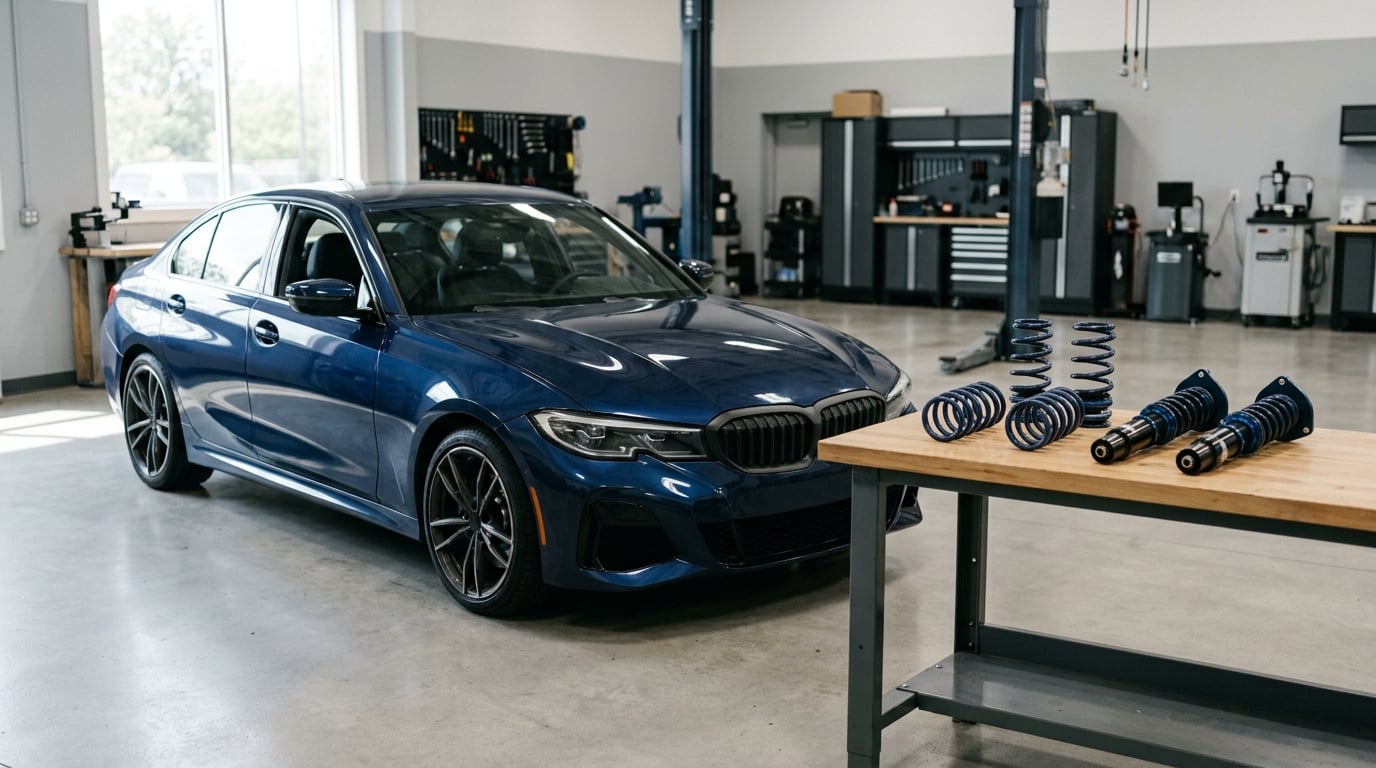
Lowering springs replace only the springs, shortening and stiffening them so the car sits lower while your factory dampers keep doing the shock work. Coilovers replace the whole unit: a matched spring and damper assembly, usually with a threaded perch so ride height and damping are adjustable. Most BMW owners end up happier with a matched spring and short shock kit than with either extreme.
That last sentence is the honest summary, and it is not what most people expect when they start shopping. Springs are cheap and simple, coilovers are flexible and expensive, and the kit in between beats both for a car that spends its life on public roads.
What follows is a straight comparison for a BMW owner deciding where to spend the money, including the drop figures that cause trouble later, the questions to ask a shop before parts arrive, and the honest list of things you lose with each option.
Table of Contents
- Lowering Springs vs Coilovers at a Glance
- How Lowering Springs and Coilovers Work
- Ride Quality and Daily Comfort
- Handling and Performance Driving
- Adjustability and Track-Day Capability
- Installation and Maintenance Requirements
- Cost, Value, and BMW Fitment
- Which Should You Choose?
- Frequently Asked Questions
- Are lowering springs more comfortable than coilovers?
- Can I use coilovers for everyday street driving?
- Do lowering springs need alignment after installation?
- Are lowering springs better for track days?
- How much do lowering springs cost compared with coilovers?
- Will lowering springs fit my BMW without changing other parts?
- Conclusion: Choose by Driving Priorities
Lowering Springs vs Coilovers at a Glance
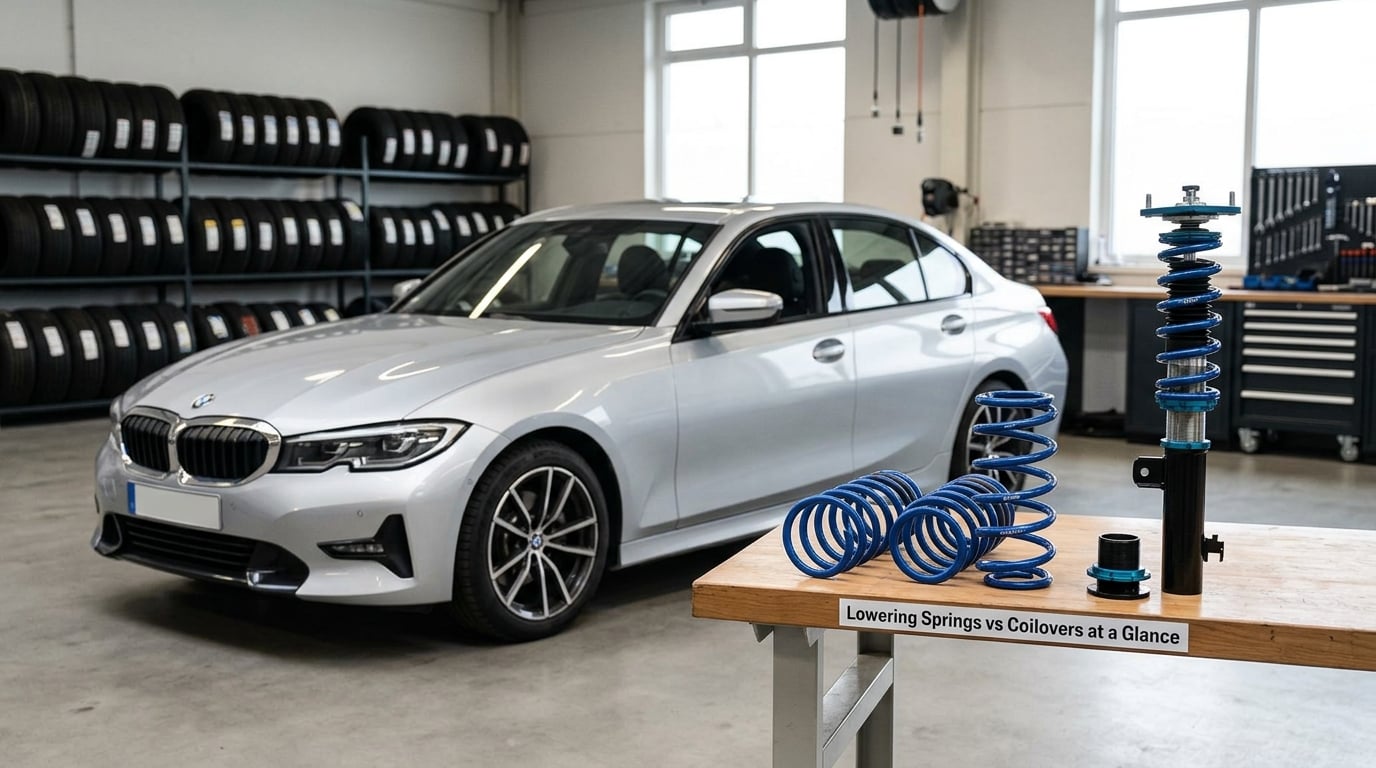
Three options get compared here, not two. Adding the matched spring and short shock kit changes most recommendations, because it fixes the main complaint about springs without the cost of a full coilover.
| Criterion | Lowering springs | Spring and short shock kit | Coilovers |
|---|---|---|---|
| What changes | Springs only | Springs and dampers | Whole strut or shock assembly |
| Typical drop | 20 to 40 mm | 20 to 40 mm | 20 to 50 mm, set by the perch |
| Ride height adjustable after install | No | No | Yes, on most models |
| Damping adjustable | No, unless the car already has electronic dampers | No | Yes, compression and rebound on most kits |
| Spring rate options | Fixed by the set you buy | Fixed by the set you buy | Often swappable |
| Ride quality with a matched set | Rough on factory dampers | Closest to stock comfort | Wide range, depends on valving |
| Body roll | Reduced | Reduced | Reduced, adjustable |
| Servicing | None specific to the springs | Normal shock servicing | Seals and damper oil, roughly every 20000 miles or less |
| Install difficulty | Easy to moderate | Moderate | Moderate to high |
| Best for | Closing the wheel gap on a budget | A daily driven car with real spring rates | Track days and changing conditions |
One row matters more than it looks. Servicing is the item owners forget, and a coilover is a serviceable shock with springs wrapped around it, while a lowering spring is just a spring.
How Lowering Springs and Coilovers Work
A lowering spring does two things at once. It is shorter, which drops the car by the difference in free length, and it is stiffer, usually progressive rather than linear, which is what cuts body roll.
The rate change is the part that gets overlooked. Factory dampers are valved around a factory spring rate, and a stiffer spring pushes the damper harder through its stroke than the valving was designed for. More force in, more heat and more oil moving through small passages, faster wear on the seals and piston.
Coilovers, short for coil-over shock, bolt in as one unit. A threaded damper body carries the spring on a perch you can screw up or down, and that changes ride height without changing spring rate. A separate knob or cartridge dial on most kits changes how the damper resists compression and rebound.
The middle option is a matched kit: lowering springs plus a set of shorter shocks built to the same rate. The dampers are designed for the springs instead of being leftovers, which is the whole point.
Ride Quality and Daily Comfort
How lowering springs vs coilovers differ on broken pavement
Stiffer springs transfer more of every expansion joint, pothole edge and speed bump straight into the seat and the steering wheel. Over smooth tarmac the difference is small. Over the roads most European city driving involves, it is the first thing you notice and the reason so many spring-only installs get regretted.
Forum owners describe it the same way. Someone running a factory-brand lowering spring set on r/FocusST called them a little rough compared to what they were used to, but still worth it for the stance. A Toronto driver on r/mazda3 put it more bluntly: do not fit lowering springs without upgrading the shocks, because the ride quality is terrible.
Damper condition decides how much of that you get. Bilstein’s guidance is to treat dampers as a consumable at 80000 km or more when stiffer springs go on, and to replace them together rather than one corner at a time.
Coilovers are not automatically the comfortable answer, which is worth repeating. The cheap no-name sets use vague valving and thin oil, and owners on several platforms report a harshness that made them wish for springs. A well-valved coilover from a known maker, set in the middle of its damping range, is the most refined option of the three. Set it stiff and it will punish you.
Winter makes this more relevant. Salt and road grime attack shock bodies and boots, and an owner on r/ft86 asked the winter question directly because a Toronto car lives on both. If your car faces salted roads, sealed dampers and cleanable shock bodies matter more than anything on the adjustment list.
Handling and Performance Driving
Lowering a car reduces body roll, sharpens weight transfer and lets the suspension work inside its designed range instead of topping out over every bump. That part is real and both options deliver it.
Where the two split is in geometry. A bigger drop changes control arm angles, and past roughly an inch the consequences appear: bump steer, where the wheel moves fore and aft as you steer, and reduced clearance over speed bumps. An owner on fordmustangforum described the same limit, that more than about an inch starts to create control arm angle, bump steer and clearance problems.
For a BMW specifically, remember that lowering compresses the suspension geometry that the engineers designed around. A modest drop on a short-wheelbase model is more forgiving than a deep drop on a long-wheelbase touring car with the factory sport package.
Grip does not come from ride height. Tires, alignment, differential and the rest of the running gear decide how much a corner actually feels. Braking bite and steering response improve when the wheel is closer to the road and the geometry is sorted, but no suspension swap recovers bad tires.
Adjustability and Track-Day Capability
Adjustability is the real argument for coilovers, and the honest weakness too. Height and damping changes matter when conditions change: stiff damping and low ride height for a track morning, softer and higher for a rough road home, more clearance for a driveway or a car park ramp.
If you never adjust them, you paid for a feature you did not use. An owner on my350z said coilovers are a waste of money if you never adjust them, and that complaint is fair. Most people never do.
What earns the money back is changing spring rates. Many kits let you swap springs within the family range, so a car that is fine on a back road in spring can be stiffened for autocross and softened again for winter. An owner on r/ecoboostmustang described a night and day difference and pointed to the springs as the part that was already good, with the rest of the money going into track use.
The other argument is consistency. A spring and damper set built as a package has damping matched to that rate, so the car behaves predictably. That predictability is what you need when the margin is a second, and it is what cheap coilovers fail at.
Owners on mx5nutz and bimmerfest both landed on the same caution from opposite directions. Coilovers are far more adjustable but more aggressive, and on a BMW daily they can be overkill.
Installation and Maintenance Requirements
Both options are garage jobs, and coilovers are not dramatically harder. The difference is that coilover height settings are set during installation, so the alignment happens after the collars are dialled in, not before.
You will need a spring compressor rated above your spring’s free length, jack stands or a lift, a torque wrench, and a ball joint separator. Front struts on a BMW are a press-fit pin bolt on many models, which means a press or a safe way to transfer the load, and that is where a shop earns its money.
Safety first here, because compressed springs store serious energy. Support the vehicle properly, never work under a car on a jack alone, and follow the manufacturer’s instructions for the compressor.
You can lower a car with just coilovers, and a matched kit is functionally the same idea with less to assemble. What you cannot skip is the four-wheel alignment afterwards. A drop changes camber, toe and caster, and a car that was aligned to stock spec will pull or wear oddly without a reset.
Camber loss is the visible one. Lowering the car tilts the top of the wheel inward, and past a certain drop the inner edge of the tire can contact the suspension arm. Faster, more consistent. Check arch clearance and tire clearance before the install, not after.
Cost, Value, and BMW Fitment
Cost of ownership is where the two diverge most and where the online figures are least reliable, so check current quotes from a specialist rather than trusting a forum number from a few years back. The shape of the spend, though, is stable.
Lowering springs are the smallest line item. A matched kit with short shocks sits in the middle, and a full coilover set from a known maker is the largest by a wide margin, often several times the parts cost of springs alone.
Labour is the counterintuitive part, and the number most people get wrong. The installation time for springs versus coilovers is roughly the same, so do not expect the parts saving to shrink the invoice. On top of both, budget a four-wheel alignment, which is not optional.
Value follows the tier a car lives in. A daily-driven BMW on rough roads usually gets the most out of a matched kit. Coilovers pay off if the car is modified, tuned and driven hard, or if the same setup has to serve street, winter and track. Springs pay off when the goal is closing the wheel gap for a specific set of wheels.
Before buying anything, confirm the chassis code, year, body style, and whether the car has electronically controlled dampers. Adaptive dampers on newer BMWs need a coding or adaptation step after a change, and parts that ignore the electronics can leave warning lights on. Also check the brand tiers most often recommended by owners: H&R and Eibach for springs, Bilstein and BC Racing for dampers and kits, and price against the tier rather than the badge.
Which Should You Choose?
Match the setup to the use case, not to the aspiration. A few rules cover almost everyone.
- Daily driver on rough roads, healthy factory dampers: a matched lowering spring and short shock kit. Best comfort-to-cost result for a car that gets driven in all weather.
- Worn shocks already, replacing them anyway: springs plus new short shocks, or a kit. Never springs onto dampers you already planned to replace.
- Track days, autocross, or a car that changes role between the street and the circuit: coilovers. Height and damping adjustability earns its keep here.
- Cosmetic drop for wheel fitment on a strict budget: lowering springs. Accept the firmer ride and the faster damper wear.
- Winter-heavy or salted-road driving: the kit, or coilovers set in their softer range. Do not chase the lowest ride height.
Nobody in the threads behind this question regrets the height itself. Every regret traces back to ride quality, matched rates, or the bill.
Three things decide it for your car: is this your only vehicle, do you drive it in winter, and will you change the setup between uses. Answer those and the choice is usually obvious.
Frequently Asked Questions
Are lowering springs more comfortable than coilovers?
Neither is inherently more comfortable. A lowering spring on a tired factory damper is usually the harshest combination of the three, because stiffer springs outpace the valving they were never designed for. Comfort depends on the spring and damper being matched, the dampers being fresh, and the damping being set in the softer range. A well-matched spring and short shock kit is usually the most comfortable option on rough European roads.
Can I use coilovers for everyday street driving?
Yes, and plenty of people do. The reason people warn against it is usually the default setting, not the product. A quality coilover with damping adjusted to the softer end can be more refined than a cheap spring set on worn dampers. Watch the cost: you are buying adjustability, and if you never change the height or damping, a matched spring and shock kit gives you most of the ride quality for far less.
Do lowering springs need alignment after installation?
Yes. A four-wheel alignment should be done after any suspension work that changes ride height, and it is not optional. Lowering the car changes camber, toe and caster, so a car aligned to stock specification will often pull to one side and wear tires unevenly. Ask the installer to set the alignment to the vehicle’s ride height, not the factory height, and to check that the tire clears the suspension arm at the new drop.
Are lowering springs better for track days?
For a casual track day, a matched spring and short shock kit is genuinely competitive. Springs give you consistent stiffness, which is most of what a track day needs, and they cost far less. Coilovers earn their extra cost when you want to change setup between sessions, tune damping on the day, or swap spring rates. The practical warning is that springs alone on factory dampers can bottom out and degrade quickly under repeated hard use.
How much do lowering springs cost compared with coilovers?
Lowering springs are the cheaper option, usually a fraction of what a quality coilover set costs, and a matched spring and short shock kit sits between the two. Install labour is roughly the same for both, so the difference is entirely in the parts, and a four-wheel alignment is required on top of either. Check current quotes from a specialist, since pricing varies by model and brand tier.
Will lowering springs fit my BMW without changing other parts?
Usually, yes. Quality lowering springs are made for specific chassis codes and years, and the drop is designed to stay inside factory geometry. Verify the chassis code, year and body style, and check whether your car has electronically controlled dampers that need coding afterwards. Also check that your intended wheels fit at the lowered height. If your dampers are already worn, budget to replace them at the same time.
Conclusion: Choose by Driving Priorities
Lowering springs and coilovers both lower the car, and neither is wrong. Pick a matched spring and short shock kit for a daily-driven BMW on real roads, coilovers if the setup has to change between street, winter and track, and plain lowering springs when the budget is tight and the goal is wheel fitment.
Before you order anything, confirm the chassis code and whether the car has electronically controlled dampers, check that your wheels clear at the new ride height, and get a four-wheel alignment in the quote. Get those three right and most of the regret people report never happens.