
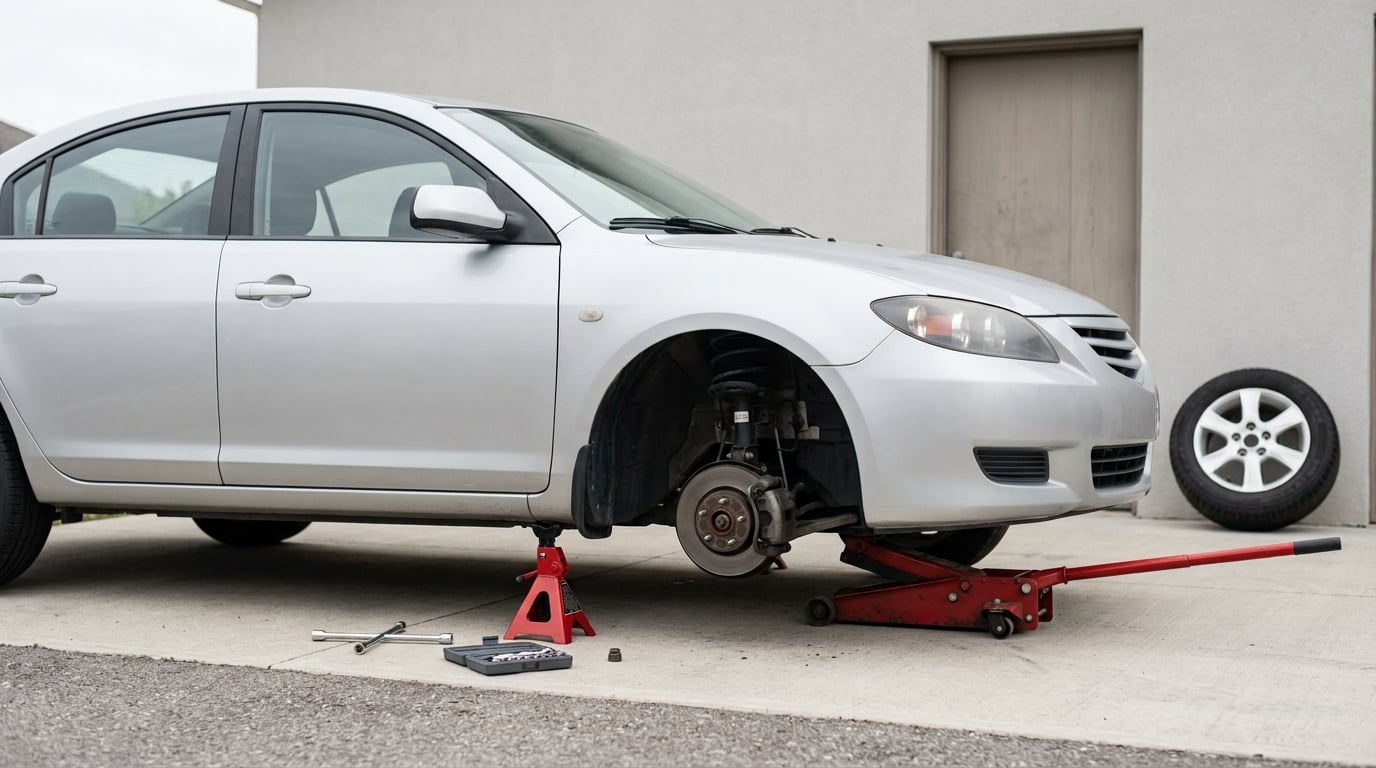
Worn shocks and struts show up in three ways: fluid weeping down the damper body, bouncing that continues for several seconds after a bump, and tire wear that goes uneven or cupped for no obvious reason. None of those alone proves failure, and a dry shock can still be spent. Here is how to sort real damper wear from the tire, brake and bushing problems that look identical from the driver’s seat.
This is a diagnostic guide, not a parts list. The goal is to help you narrow it down in your own driveway before you pay anyone to look. If the car has become genuinely unsafe to drive, stop driving it and get a technician’s opinion rather than running more tests.
Damper wear is gradual, which is exactly why it gets ignored for years. A shock that has lost part of its damping still settles eventually, so the car never feels obviously broken. It just feels tired, and the tire shop becomes your regular stop. If you want a shortcut, jump to the five-step check order below.
Table of Contents
How to Tell If Shocks and Struts Are Worn: 7 Signs (October 2026)
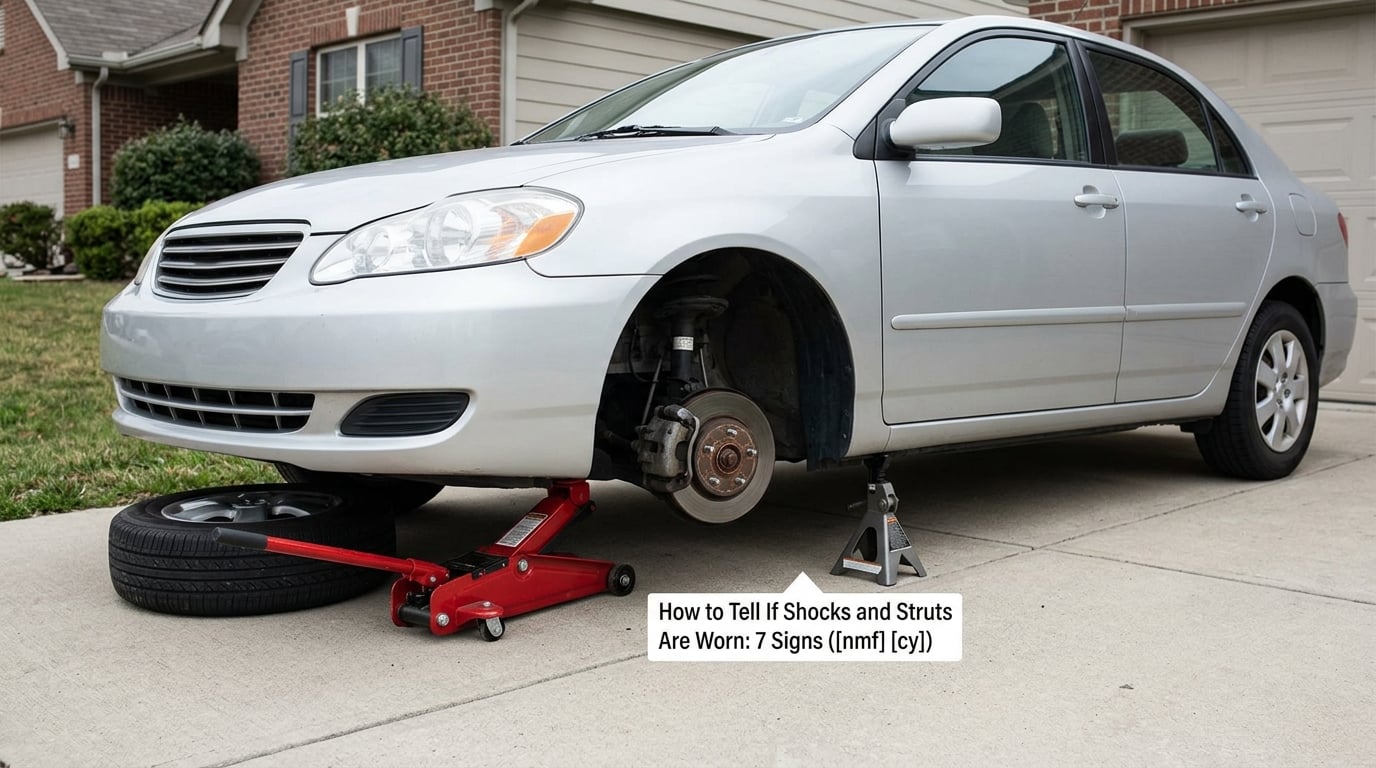
Start with the three groups. Visual signs live on the damper itself: fluid streaks, a torn dust boot, a dented body, a cracked mount. Ride and handling signs appear on the road: extended bouncing, nose dive, rear squat, body roll, a floating feel. Noise and tire wear signs show up between services: a clunk from one corner, a rumble tied to road speed, and tread that cups or scallops.
The single most useful habit is checking two or three of those groups together. One symptom alone sends you chasing the wrong part far more often than not, and clunking noise is the classic example. Put the seven signs below in order of how reliably they point at the damper.
What Worn Shocks and Struts Do
A shock or strut turns the energy of a road impact into heat. Hydraulic fluid is forced through internal valves as the piston moves, and that resistance is what stops a spring from storing energy and releasing it as a series of oscillations.
As seals, valves and bushings wear, fluid leaks out or bypasses the valves where it should not. The spring still does its job, but nothing is controlling it. That single loss explains nearly every symptom you will feel, because tire contact is what suffers first.
With the damper not controlling the wheel, the tire loses contact with the road longer than it should during braking, cornering and after every expansion joint. Braking distances stretch, steering response slows, and the car stops tracking a lane on rough highway surfaces. Crosswinds push it around more than it used to.
The knock-on damage is expensive. Tires cup and wear unevenly, then cup again in a few months on the replacement set. Springs, bump stops, strut mounts and control arm bushings take shock loads they were never designed to absorb. Ignore a bad damper for a year and you have turned one repair into four.
Seven Signs Your Shocks or Struts May Be Worn
1. The car keeps bouncing after a bump. A healthy suspension absorbs one dip and settles within a second or so. Two or three oscillations, or a car that floats up and comes back down again on a smooth road, is the clearest signal that damping is gone.
2. Floating, vague steering that settles slowly. When the wheel takes a long time to return to center after a bump, or when the car feels like it is gliding rather than following your hands, the damper is slow to return to full extension. This is the “loose around the bumps” feeling people describe without knowing the word for it.
3. Nose diving under braking and rear squat on acceleration. Weight transfer is normal, but a worn damper exaggerates it. The front end dips harder and takes longer to recover, the rear squats noticeably under throttle, and small stop-and-go inputs start feeling busy.
4. Too much body roll in turns and sway in crosswinds. If the body leans noticeably and then keeps leaning after the turn is over, roll control is compromised. On the highway, a car that wanders in its lane on rough pavement or gets pushed around by wind is telling you the same thing.
5. A clunk, knock or rattle from one corner. Do not assume this is a bad damper. A strut that has lost damping lets the spring reach the bump stop, and that impact is often the clunk. But worn sway bar end links, loose strut mount hardware and collapsed control arm bushings make similar noise.
6. Fluid weeping down the damper body. Dampers use hydraulic fluid. A wet trail down the tube, oily film around the dust boot or a puddle that appears again after you wipe it clean means an external seal has failed. A light film and surface rust are not the same thing, and we come back to that below.
7. Cupped, scalloped or uneven tire wear. Cupping shows as repeating dips across the tread, scalloping as uneven high and low spots around the circumference, and sawtooth wear as one-sided feathering. All three mean the tire is not sitting flat and steady through the rotation, which points straight at damping.
How to Tell If Shocks and Struts Are Worn: A Five-Step Check Order
Work through these in order and stop as soon as one of them explains everything. Later steps assume earlier ones came back normal.
- Inspect first, with the car cold and on level ground. Set the parking brake, then look at ride height from one side to the other. A car that sits noticeably low or high at one corner points to a broken spring or a collapsed mount rather than a spent damper.
- Compare the four tires. Compare tread depth and wear pattern across all four. Cupping on every tire points to dampers. Cupping on one axle points to that axle, and sometimes to an alignment problem that has nothing to do with the shocks.
- Run the bounce test on each corner. One corner at a time, described in full below. Compare how the car behaves on a good wheel versus a bad one.
- Look at the damper hardware and body. With the wheel off, check for fluid, damaged boots, dented bodies, seized bushings and cracked mounts. This is also your chance to check the sway bar end link and control arm bushings while you are in there.
- Confirm with a road test or a shop. Drive over a familiar rough section and note what you feel. If the diagnosis still is not clear, have a technician load the suspension and isolate the source rather than replacing parts on the sound of a noise.
Visual Checks: Look for Leaks, Damage, and Uneven Tire Wear
Start at the damper body itself. A glossy wet streak running down the tube, especially one that returns after you wipe it, is fluid loss. Shine a light on the chrome piston rod: a wet ring or a misting film near the seal is the same story. A rust-colored or oily film on the dust boot seal means the boot has failed and dirt has gotten in behind it.
Now check the rest of the assembly. Look for a dented or scraped shock body, a torn boot, a bump stop torn out of its cup, or a broken spring sitting inside a badly cracked spring seat. On struts, the top mount and its bearing deserve attention: a mount that turns freely, has a gap in it, or rattles when tapped is a worn mount, not a worn strut.
Surface rust and scuff marks are not failure signs. A shock body lives in a splash zone and picks up a light film of surface rust in a season of wet weather. That is cosmetic. The question is always whether the body still holds fluid, not whether it looks clean.
Finish with the tires. Turn the wheel so you can see the full tread face and look across it at a shallow angle. Repeating dips across the tread are cupping. Uneven highs and lows around the circumference are scalloping. One-sided feathering points toward alignment, and a single bald patch that lines up with where a shock mounts can point somewhere else entirely.
One caveat matters here: a cup tire that keeps coming back months after replacement usually means the underlying cause was never corrected. New tires on worn dampers get destroyed in a season.
The Bounce and Push Test
You do not need a lift for the most useful version. Park on level ground, chock the wheels, set the parking brake and loosen the lug nuts on one corner. Lift the car at that corner only and support it on jack stands at the manufacturer’s points. Remove the wheel.
Now grip the tire at roughly the 9 and 3 o’clock positions and push the suspension up and down smoothly, through its travel. A working corner moves as one connected unit with no hesitation and no free play. A worn strut often shows play at the top of the strut mount or lets the wheel wander off center as it moves, because the spring is no longer guided.
The second version is the bounce test, and it is quicker. With the car back on the ground, push hard down on one corner of the bodywork and step away. A healthy car rebounds once and settles. A car that keeps moving up and down, or that looks like it is pogoing, has lost damping.
Interpret both results carefully. Modern suspensions use stiffer springs and bump stops, so a healthy car can feel firmer than you expect. Sedans with outboard-mounted shocks need the wheel removed before you can move them at all, and the test is harder to read on a car with a lot of body weight over the axle. If the result is not obvious, take it to a shop with a lift.
What Noisy, Leaking, or Unevenly Wearing Suspension Parts Can Mean
This is where most wasted money happens, because half the symptoms people blame on shocks can come from something else. Use the table to narrow the cause before ordering parts.
| Symptom | What it usually means | Other possible causes | How to confirm |
|---|---|---|---|
| Bouncing 2-3 times after a bump | Lost hydraulic damping | Broken or sagging spring, wrong springs fitted, tire pressure far too low | Bounce test corner by corner, compare tire pressures |
| Wet streak on the damper body | Failed external seal | Road salt and winter grime that has wicked on from the boot | Wipe clean, check again after a short drive |
| Clunk over bumps from one corner | Spring hitting the bump stop because damping is gone | Sway bar end link, control arm bushing, loose strut mount hardware | Play test with the wheel off, check bushing condition |
| Cupped or scalloped tread | Tire not sitting flat through rotation | Wheel imbalance, alignment out of spec, worn tire pressure | Compare all four tires, check balance and alignment records |
| Nose dive that feels harsh | Weak damping under load transfer | Worn pads or contaminated brake fluid, sagging springs | Inspect pads and fluid, compare ride height corner to corner |
| Rumble that changes with road speed | Less common damper symptom, sometimes mistaken | Wheel bearing, worn CV boot, tire wear, driveline | Back the speed off and on, test at a steady 30 vs 55 mph |
A worn strut mount and a worn strut produce different sounds and different play, and telling them apart saves a lot of guessing. A strut that has lost damping still guides the wheel through its travel but does so loosely. A worn mount makes noise at the top of the strut, rattles when you turn the steering at a standstill, and lets the wheel gain camber as it moves. If you feel free play and hear it coming from the top, check the mount and its bearing first.
Before you blame the shocks at all, check tire pressure on all four, cold. Then look at sway bar end links for worn bushings and play, control arm bushings for cracking and split rubber, and the ball joints for slop. Loose wheel lug nuts are worth ruling out too, and they are free to check.
Rumbling that changes with road speed is usually not the shocks. Dampers do not create a speed-related hum. Bearings, tires, driveline and wheel balance do, so back the speed off and then back on again; if the noise disappears at one speed and returns at another, look elsewhere.
When to Replace Shocks or Struts
Replacement is a condition decision, not a mileage decision. Manufacturers commonly quote 50,000 to 100,000 miles as a ballpark, and that is realistic on smooth roads and optimistic on pothole season, gravel roads, towing or a vehicle that carries heavy loads most of the time.
Replace when the inspection shows it, when damping loss has changed how the car behaves, when a leak is confirmed rather than suspected, or when uneven tire wear returns after a correct alignment. Also replace when the car has become unsafe: severe bouncing, heavy nose dive, or a front end that wanders on the highway.
Never replace dampers on noise alone. Noise is a symptom the damper shares with several cheaper parts, and a shop that sells parts off a clunk without loading the suspension is guessing.
Two structural points affect the job. Shocks are separate two-point dampers and can be replaced individually. Struts are structural units that carry the vehicle’s weight and come as complete assemblies with the spring, mount and bearing included, which is why strut work is usually quoted far higher than shock work. And replacing one damper on an axle leaves the other holding the same job on a worn part, so axle pairs are the normal recommendation.
If your front tires are cupping, fix the cause before buying rubber. New tires on a worn suspension are the most expensive mistake in this whole area.
Frequently Asked Questions
Can I drive with worn shocks or struts?
Yes, briefly, and here is the honest limit. Mild damping loss is a comfort and tire-life problem, not an instant hazard. Once the car bounces hard, dives at the wheel, wanders in its lane or steers unpredictably, the tire is losing contact when it needs it most and stopping distances grow. Keep your speed down, avoid heavy loads and highway driving, and stop driving it once the steering feels vague or the corner is clearly failing.
Do shocks and struts need to be replaced in pairs?
Usually yes, and that is not a sales tactic. Shocks and struts work as a pair on an axle, and a matched pair keeps the damping balanced side to side. One new unit beside a worn one can still leave the axle fighting itself. Replacing all four at once makes sense too, since the other set is usually close to the same age. If budget forces a choice, replace an axle as a pair rather than one corner alone.
Why are my tires wearing unevenly if my shocks are worn?
A worn damper lets the tire bounce instead of staying planted, so the tread skips on and off the road through every rotation. That repeating contact pattern is what cups and scallops the tread. Alignment, wheel balance and tire pressure can produce similar wear, which is why all four tires should be compared before anything is replaced. Fix the suspension cause first, or the new set wears the same way.
Are worn shocks and struts the same problem as worn springs?
No, and they show up differently. A worn damper loses control of spring movement, so the car keeps bouncing and rides badly. A broken or sagging spring leaves the corner sitting low and lets the tire rest on the bump stop, which produces a clunk and a scraping noise over bumps. A car can have both at once, and a sagging corner with a clunk points at the spring or mount rather than the damper alone.
How much does it cost to replace shocks or struts?
It varies by region and changes over time, so treat any figure you find as a rough regional range rather than a quote. What drives the difference is the part: shocks are separate two-point dampers, while struts arrive as complete assemblies with the spring, mount and bearing already attached. The total also moves with labor time per corner, whether a wheel alignment is included, and whether additional parts such as sway bar end links or control arm bushings need replacing at the same time.
Can I replace shocks and struts myself?
Shocks on a car with accessible mounting points are a common driveway job, and struts are harder because the spring usually has to be compressed with a spring compressor. Safety is the deciding factor: work at ground level means jack stands, never a jack alone, and a spring compressor takes real stored energy. If you have never compressed a spring before, or the strut mount bearing needs pressing out, have a shop do it.
Conclusion
The safest first move is to look before you drive it: compare all four tires, jack one corner at a time and check for a return to normal ride height and even ride height from side to side. Then run the bounce test on each corner and wipe the damper bodies to see whether fluid comes back.
If the handling has already become unsafe, stop there and have a qualified technician confirm the diagnosis before you drive the car again. That rule has no exception: worn dampers are a control problem, and control is what keeps the tire on the road.