
To tell if a head gasket is blown, look for two or more of these at once: coolant disappearing with no puddle underneath, milky residue on the dipstick, thick white exhaust smoke after the engine is warm, a sweet burning smell, bubbles pushing coolant out of the overflow tank, and a check engine light flashing a misfire code. One symptom on its own usually means something cheaper broke.
None of it is a verdict on its own. A head gasket is a seal between the block and the cylinder head that has to hold combustion pressure, oil, and coolant apart at the same time, so when it lets go, the leak path decides what you see. The steps below start with checks that cost nothing and end with the tests a shop uses to prove it.
One rule before anything else. If the temperature needle climbs past the halfway mark and stays there, stop the car and shut it off. Pull over rather than finishing the drive. Driving a hot engine with coolant in the cylinders or a warped head is how a gasket job turns into an engine swap, and nobody wants to be the person who caused that.
Never open the radiator cap, the coolant reservoir, or a hot radiator hose while the system is hot and pressurized. Boiling coolant under pressure will scald you badly. Every check below that involves opening a filler neck happens on a cold engine, and I mean overnight cold.
Table of Contents
- What You Need
- Step-by-Step: How to Tell If a Head Gasket Is Blown
- Common Mistakes
- Frequently Asked Questions
- Can a head gasket be blown without visible coolant leakage?
- What are the most common signs of a blown head gasket?
- Does white exhaust smoke always mean the head gasket is bad?
- Is it safe to drive if the engine is overheating?
- How do mechanics confirm a head-gasket failure?
- Can a bad head gasket be repaired or does the engine need replacing?
What You Need
You can get through the first four steps with things almost every garage already has. The last two steps need a gauge or two, and those are rental or shop jobs.
- A flashlight and a clean white rag. For looking into the filler neck, the overflow tank, and the oil filler cap.
- The owner’s manual. Look up the coolant type, the coolant capacity, and the normal operating temperature. Gauge needles lie; the manual is right.
- Paper towels and a container to catch coolant, because it will find your sleeve if you don’t plan for it.
- A radiator pressure tester with an adapter that matches your radiator neck. This is the single most useful tool for this job.
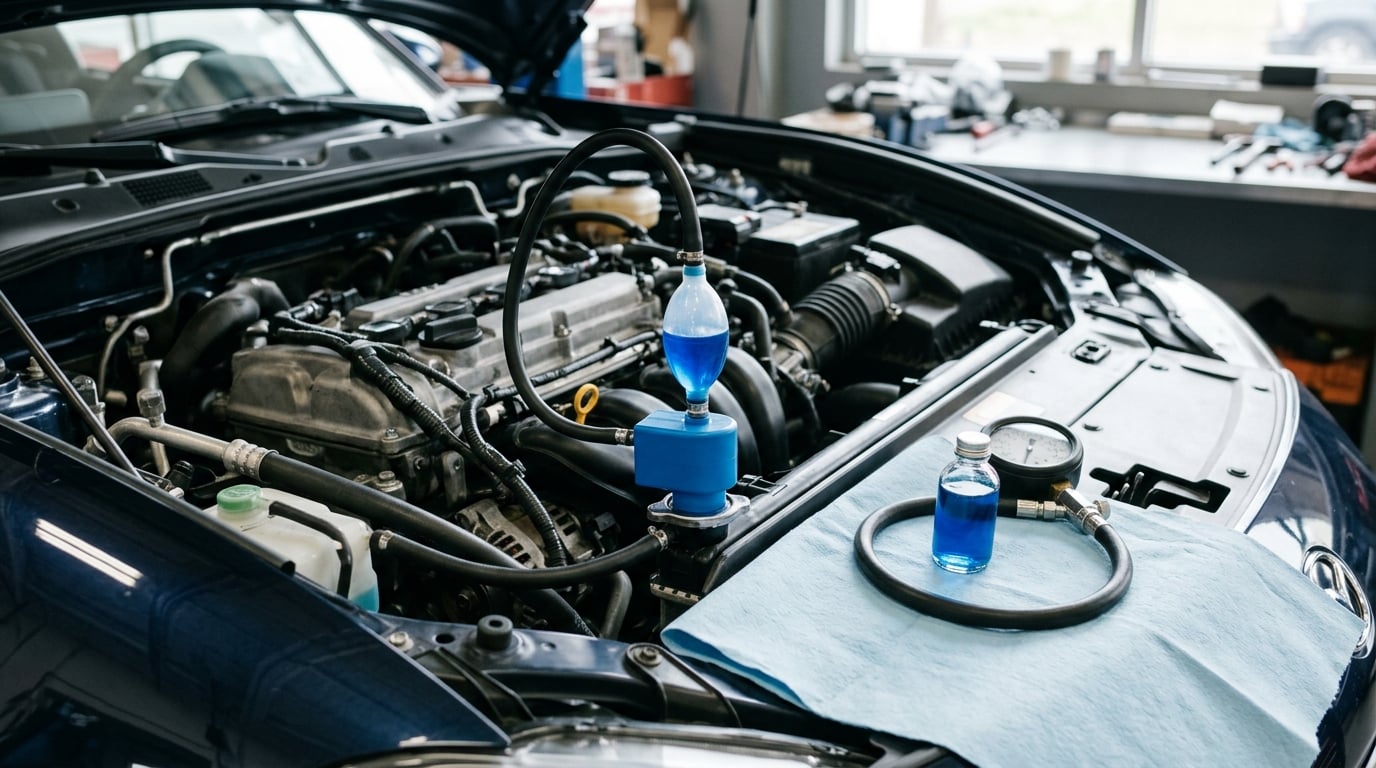
- A combustion leak tester, also called a block tester. A small bottle of dyed test fluid and a hose that screws onto the filler neck. Cheap, and it answers the most common question on this topic.
- A compression gauge and a leak-down tester for the final step. Most people rent these or pay a shop to run them.
- An OBD-II scanner to read misfire codes. A code tells you which cylinder is complaining, which points the leak-down test in the right direction.
Step-by-Step: How to Tell If a Head Gasket Is Blown
1. Check for Overheating and Coolant Loss
Start cold. Look at the coolant level in the reservoir or radiator before you start the car, and look again after the engine has idled for ten minutes and parked for overnight. If the level drops between those two checks and the car is parked on clean dry concrete, coolant is leaving somewhere you cannot see. A gasket that fails between the head and the block does exactly that, and the coolant usually runs down the back of the engine and out the bottom.
Overheating is the symptom people notice first, and it is the least reliable one on its own. A stuck thermostat, a failed radiator fan relay, a plugged radiator, a weak water pump, or a radiator cap that will not hold pressure will all overheat an engine with a perfectly good head gasket. Check that the cooling fans actually come on at temperature before you start suspecting metal.
One more cold-start check worth doing: squeeze the upper radiator hose right after you start the engine. On a healthy car it softens within seconds. If it goes from soft to rock hard almost immediately, combustion pressure is getting into the cooling system, which points at a head gasket or a cracked head.
2. Inspect Coolant for Combustion Gases
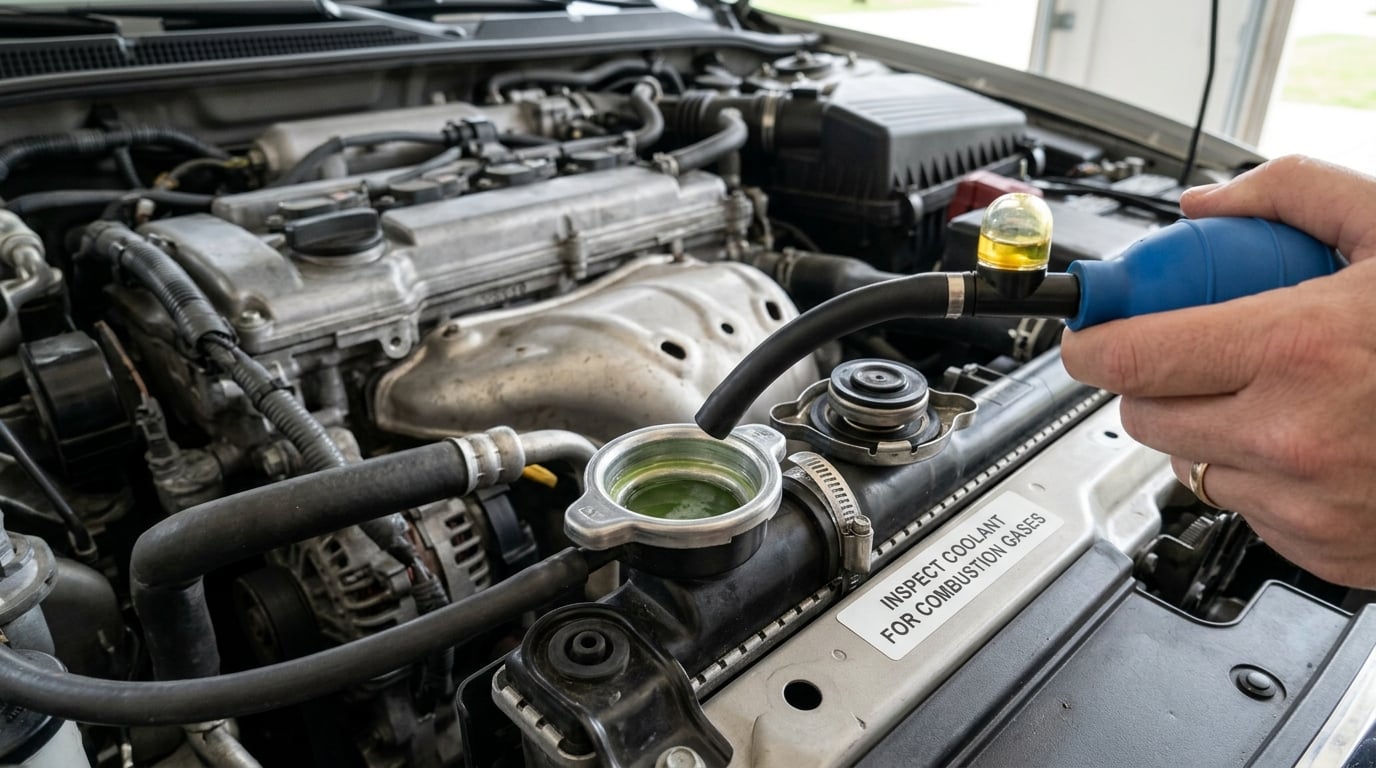
This is the test that settles most arguments. On a cold engine, take the radiator cap off, then squeeze the upper radiator hose a few times to push some coolant up into the filler neck, or run the engine until warm and shut it off. Look at the surface of the coolant sitting in the neck.
Clean coolant is clear and still, sometimes with a faint color. If you see a steady stream of large bubbles, or foam that rises and never settles, combustion gases are entering the cooling system. A small bubble or two from a warm engine is normal, because the system expands and draws air in.
A combustion leak tester turns that observation into proof. Screw the tester hose onto the filler neck, the engine cold and running, and watch the fluid in the bottle. A color change in the fluid means combustion gas is passing through the coolant. A weak change that shows up only when the engine is revved hard usually means a small leak; an immediate strong change means a bigger one. Test fluid also absorbs water and goes bad, so a test that shows nothing on old fluid proves very little. This is the single best value in the whole list of checks, and the same test a shop will run before it quotes you teardown labor.
Also look at the inside of the reservoir and the cap. Thick white or chalky swirls, or gritty brown sludge that was not there last month, are signs that coolant has been boiling in there. A radiator cap that is off the radiator or the wrong type will show pressure and coolant loss that looks identical to a gasket at a glance, so verify the cap while you are here.
3. Look for White Exhaust Smoke and Steam
White smoke means something, but only after the engine is warm. On a cold morning, every gasoline engine puts out a thin wisp of white vapor for the first thirty to sixty seconds while the exhaust pipe warms up and water condenses inside it. That is normal and it means nothing.
What matters is white smoke that thickens after the engine reaches operating temperature, that does not thin out, and that smells sweet. Burning coolant smells like syrup or antifreeze, which is the giveaway. If you have white smoke without that sweet smell, you are looking at fuel, oil, or a non-sealing exhaust joint, not coolant in the cylinders.
Watch for coolant running down the side of the block or dripping from under the exhaust manifold area. On many cars the head gasket is right there, so a wet streak under the manifold on a warm engine is a strong clue. Some cars route the exhaust through the block and the manifold hides the leak completely, which is why a clean engine bay is not proof of anything.
Pull the spark plugs if they are reachable and look at them. A plug that comes out clean and dry in a cylinder that has a misfire code is interesting. A plug that is damp, coated in white powdery residue, or has a rust-colored or yellow tint has been washed by coolant. If the engine is hot, let it cool before you touch the plugs and never drop one into an open cylinder port.
4. Test System Pressure and Look for Leaks
Fill the system cold to the correct level, attach the pressure tester to the radiator neck, and pump it up to the pressure printed on the radiator cap, which is usually around 15 psi but varies by vehicle. Never exceed the cap rating. Watch the gauge for a minute with the engine off and again with the engine running and warm.
A gauge that drops steadily means a leak somewhere in the system, and the pressure tester doubles as a leak detector. Listen along the radiator, hoses, water pump, oil cooler, and every engine seam as you pump it, and look for coolant weeps or a stream at a hose clamp. A hard plastic radiator tank will split near the neck; the plastic end tanks on modern cars are a common failure and the hose that looks fine can be hiding it.
What this test cannot do is point at the head gasket. It tells you the system is not holding pressure. If the pressure holds with no visible leak and the block tester comes back negative, the head gasket is not your first suspect, and you have just saved yourself a very expensive conversation.
5. Perform a Compression or Leak-Down Test
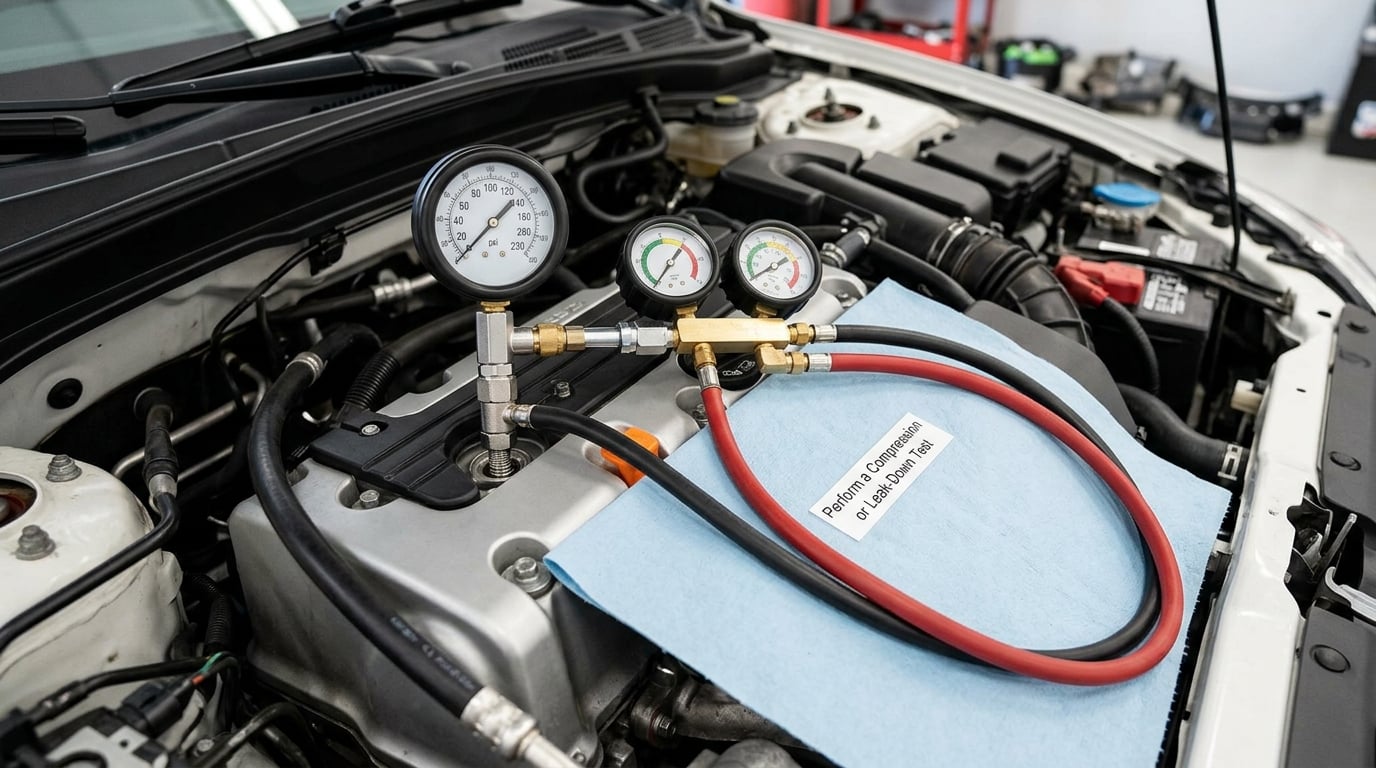
These are the tests that give you numbers, and numbers are what settle a diagnosis. Remove all the spark plugs or injectors so the cylinders can breathe, then crank the engine and read compression on each cylinder in turn. Compare every reading to the others. A difference of more than about ten percent between the highest and lowest cylinder means something is wrong with that cylinder, and the manufacturer’s spec is the reference for what acceptable actually is.
Low compression on two cylinders that sit next to each other is a classic gasket signature, because gas is escaping between them. Low compression on a single cylinder points more toward valves, piston rings, or a stuck ring, which is a different repair entirely.
A leak-down tester squeezes regulated air into one cylinder at a time and tells you how much escapes. Below about ten percent leakage is normal on a healthy engine. Twenty percent or more in one cylinder, with a hissing sound from that cylinder, tells you where to look. Air coming out of the radiator or the filler neck during a leak-down test means combustion gas is escaping through the head gasket into the cooling system. Air coming out of the oil filler or dipstick tube means it is escaping into the crankcase, which is a different leak path with the same repair.
There is a zero-gauge version of this test if you cannot get to a shop. Put clean white rags over the spark plug holes in a cold engine, crank it, then pull the plugs. If coolant spits onto a rag, you have found the cylinder taking in coolant, and you can often smell it as antifreeze as the rag comes out. It is crude and it misses slow leaks, but it costs nothing and it works more often than people expect.
6. Confirm the Diagnosis Before Repairing
Put the results together before you authorize anything. One signal is a guess. A combination is a diagnosis: an unexplained coolant loss plus bubbles in the overflow tank plus a misfire code plus a compression difference in one cylinder is a head gasket failure or a cracked head, and those two share a repair. Coolant loss with a clean pressure test and a negative block test is a loose cap, a hose, or a radiator, and you have a much smaller bill.
Ask the shop for the block tester result and the compression readings in writing before you sign off on a teardown. That is not distrust, it is the standard of proof, and any shop confident in the diagnosis will show you the fluid change and the numbers. If the diagnosis rests on one symptom, get a second opinion before the engine comes apart.
When the head comes off, the machine shop checks the head for flatness, because a warped head will ruin a brand new gasket in a week. Many aluminum heads are out of spec past about 0.002 inch of warp. Head bolts on most modern engines are torque-to-yield, which means they stretch when tightened and are never reused, and reusing them is how the repair fails early. A gasket alone is not a repair. If the head is warped, the block surface is damaged, or the engine took in coolant and dropped the oil pressure, replacing the whole engine can cost less than fixing the head well.
Common Mistakes
Assuming any overheating means a blown head gasket. Overheating is a symptom, not a diagnosis. Thermostats, radiator caps, fans, water pumps, and plugged radiators all do it, and they are all far cheaper. Rule those out before you go looking for a bad gasket.
Replacing the thermostat and celebrating. A new thermostat can make an overheated engine run worse or no different, and now you have a part you did not need and still no diagnosis. A thermostat is a one-minute check on a cold engine anyway, so test it before replacing it.
Ignoring the combustion evidence. Bubbling in the overflow tank and pressure in the cooling system while the engine runs are hard to argue with. A weak engine that drinks coolant and spits bubbles has a much better case for a block test than a hot engine with no leaks, and treating those two situations the same is how a car gets torn down for nothing.
Judging white smoke on a cold start. Condensation clears in about a minute. Judge the smoke after twenty minutes of normal driving, and trust the sweet smell over the color.
Treating creamy residue under the oil cap as proof. Short trips in cold weather leave condensation in the crankcase that looks just like coolant mixing with oil, and it clears after one longer drive. Milky residue on the dipstick, on the underside of the oil cap, or on the oil filler neck is a much better signal.
Continuing to drive a hot car. This is the expensive mistake. A gasket job is a big repair. A gasket job plus a damaged head, contaminated oil, ruined bearings, and a fouled catalytic converter is the whole engine, and you added that last part by driving fifteen more minutes.
Trusting head gasket sealer as a fix. Sealers are for a car you are about to sell or for a very slow external weep. They will not stop a failed gasket under combustion pressure, they gum up the radiator and oil cooler, and the warranty on the bottle is not a warranty on your engine. A parts store employee selling you a bottle is selling you a bottle.
Frequently Asked Questions
Can a head gasket be blown without visible coolant leakage?
Yes, and it is common. Coolant often runs down the back of the engine, out the bottom of the oil pan, or into the oil, leaving no puddle where the car is parked. A slow gasket failure can also push combustion gas into the cooling system without losing enough coolant to see a drop on the dipstick. That is why the block tester and the pressure test matter more than looking under the car.
What are the most common signs of a blown head gasket?
The most common signs are unexplained coolant loss with no visible leak, milky or chocolate-colored oil on the dipstick, thick white exhaust smoke after the engine is warm, a sweet antifreeze smell, an upper radiator hose that hardens seconds after startup, bubbles or foam in the overflow tank, and a check engine light flashing a misfire code. No single sign proves a gasket, so look for two or more together.
Does white exhaust smoke always mean the head gasket is bad?
No. Thin white vapor for the first thirty to sixty seconds of a cold start is normal condensation and means nothing. The smoke that matters is thick, persistent white after the engine reaches operating temperature, and it usually smells sweet like burnt antifreeze. White smoke without that smell is more often oil, unburned fuel, or a leaking exhaust joint. Judge the smoke warm, not cold.
Is it safe to drive if the engine is overheating?
Not if the gauge is pinned past the halfway mark. Pull over, shut the engine off, and let it cool before you open anything. Driving a hot engine with coolant in the cylinders or a warped head can ruin the cylinder head and the oil, which turns a gasket repair into an engine replacement. If it only runs slightly warm and the coolant level is holding, drive it gently to a shop and avoid heavy load and highway speeds.
How do mechanics confirm a head-gasket failure?
A shop normally runs a cooling system pressure test, a combustion leak test on the radiator filler neck, a scan for misfire codes, and a compression or leak-down test. The block tester showing a color change, together with bubbles in the overflow tank and low compression in one cylinder, is what confirms it. Ask for the fluid change and the compression readings before you authorize a teardown.
Can a bad head gasket be repaired or does the engine need replacing?
Most engines can have the head gasket replaced if the head is within flatness spec, the block surface is clean, and the oil was changed after the failure. A warped or cracked head means resurfacing or a machine shop, and reusing torque-to-yield head bolts is never allowed. Replacing the engine becomes the better call when the head is badly damaged, the block is cracked, the oil pressure dropped from coolant in the oil, or the vehicle is not worth the labor.
Start tonight with the free checks: look at the oil, look at the coolant, and look at the exhaust after a warm drive. If those line up, buy a block tester and run it before you call anyone. That one bottle of fluid will tell you whether you are looking at a gasket problem or a radiator cap, and it keeps the decision about tearing down your engine in your hands rather than in a sales office. This whole guide still applies in 2026 as engines get more crowded under the hood.