

A motor oil bottle tells you three separate things: how the oil flows cold and hot, which performance tests it passed, and whether a specific carmaker licensed it. If you know how to read oil bottle labels and certifications, you can match any jug to your owner’s manual in about a minute and stop guessing at the shelf.
Updated for 2026, with the current ILSAC GF-7 and API SQ standards reflected below.
One note before we start. Search results for “oil bottle labels” are crowded with olive and cooking oil, which is a different product with a different label. This guide is about engine oil, the kind that goes in your car’s crankcase.
Most people read the big number on the front and stop. That number is only one third of the decision, and it’s the least restrictive one.
Table of Contents
- What You Need
- Step-by-Step: How to Read Oil Bottle Labels and Certifications
- Step 1: How to Read Oil Bottle Labels and Certifications, Starting With Viscosity
- Step 2: Check the Oil Category and Performance Standard
- Step 3: Decode Certifications and Approval Marks on the Oil Bottle Label
- Step 4: Review Base Oil, Additives, and Claims
- Step 5: Match the Oil Bottle Label to Your BMW or Other Vehicle
- Common Mistakes When You Read Oil Bottle Labels and Certifications
- Frequently Asked Questions
- Conclusion
What You Need
Gather these before you open a bottle or walk into a parts store. The first item is the one that decides everything else.
- The owner’s manual for your vehicle. Most manuals print the oil specification in the maintenance section, sometimes with a page reference on the maintenance chart.
- The oil filler cap on the engine. Many manufacturers mold the required viscosity straight into the cap, and that takes priority over a shop sticker.
- The bottle currently in your engine, or its receipt. Useful for topping off between changes without changing viscosity.
- Your service records. A shop invoice that names the spec and the quantity saves arguments later.
- A clean surface or your phone. Lay the bottle down flat and photograph the back label before you pour anything out.
You do not need any tools, and the whole check takes less time than reading this paragraph twice.
Step-by-Step: How to Read Oil Bottle Labels and Certifications
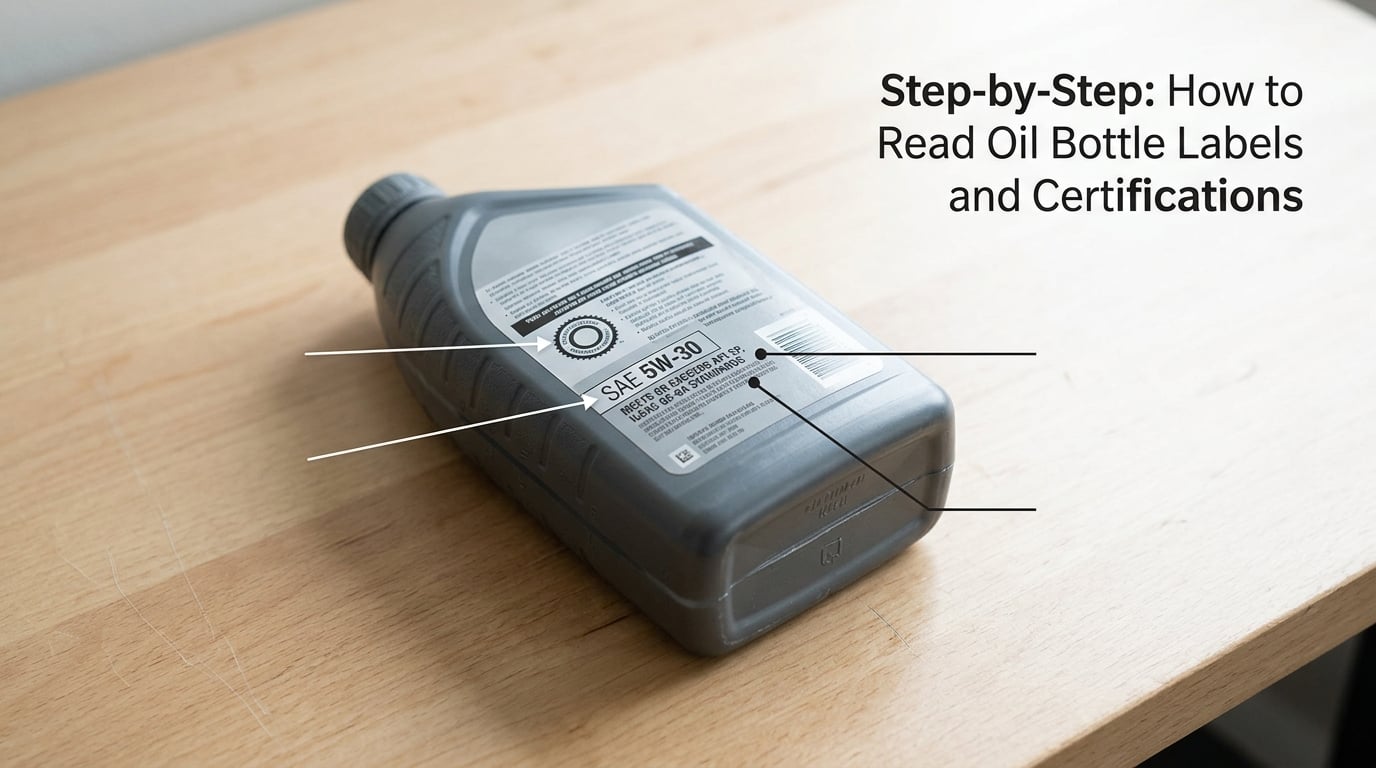
Work through these five steps in order, top of the back label to the bottom of the front label. Skipping ahead to the base oil claim on the front is how people end up with the wrong oil.
Step 1: How to Read Oil Bottle Labels and Certifications, Starting With Viscosity
Find the SAE viscosity grade, printed as something like 5W-30, and read it as two independent numbers from the SAE J300 standard. The number before the W is the cold cranking grade, and the number after the dash is the hot kinematic viscosity measured at 100 degrees Celsius. The W simply means winter.
| SAE grade | Cold cranking at | Low-temperature pumping at | Viscosity at 100C (cSt) | HTHS minimum |
|---|---|---|---|---|
| 0W-16 | -35C | -40C | 6.1 to 8.2 | 2.3 cSt |
| 0W-20 | -35C | -40C | 6.9 to 9.3 | 2.6 cSt |
| 5W-30 | -30C | -35C | 9.3 to 12.5 | 2.9 cSt |
| 5W-40 | -30C | -35C | 12.5 to 16.3 | 2.9 cSt |
| 10W-30 | -25C | -30C | 9.3 to 12.5 | 2.9 cSt |
A lower first number means the oil flows better in cold weather. A lower second number means it is thinner when hot. The 5W-30 on your cap and a 5W-40 in the bottle are not interchangeable, because they are different weights in the same bottle family.
Step 2: Check the Oil Category and Performance Standard
The category is the part that says which engine the oil was actually tested for. On the back of the bottle, inside the API donut, the center letter gives the performance category, and a line just below it reads either “For gasoline engines” or “For diesel engines.”
Gasoline categories run through the letters S, then P, then G. Current gasoline categories are API SP and the newer API SQ. Diesel categories run CK and FA, for example CK-4 and FA-4.
| API category | Introduced | What it added | Status |
|---|---|---|---|
| SM | 2010 | Oxidation and deposits for the era | Obsolete for new engines |
| SN | 2011 | Improved sludge and varnish control | Obsolete for new engines |
| SN Plus | 2018 | Mid-life API SN with extra piston deposit protection | Superseded |
| SP | 2017 | Low-speed pre-ignition and timing chain wear protection for turbo engines | Widely accepted current standard |
| SQ | 2025 | Updates the SP test set and extends wear and deposit testing | Current |
That category is a test result, not a brand promise. A bottle can carry a current category and still be the wrong choice for your car, because a manufacturer specification is stricter than the industry category.
Step 3: Decode Certifications and Approval Marks on the Oil Bottle Label
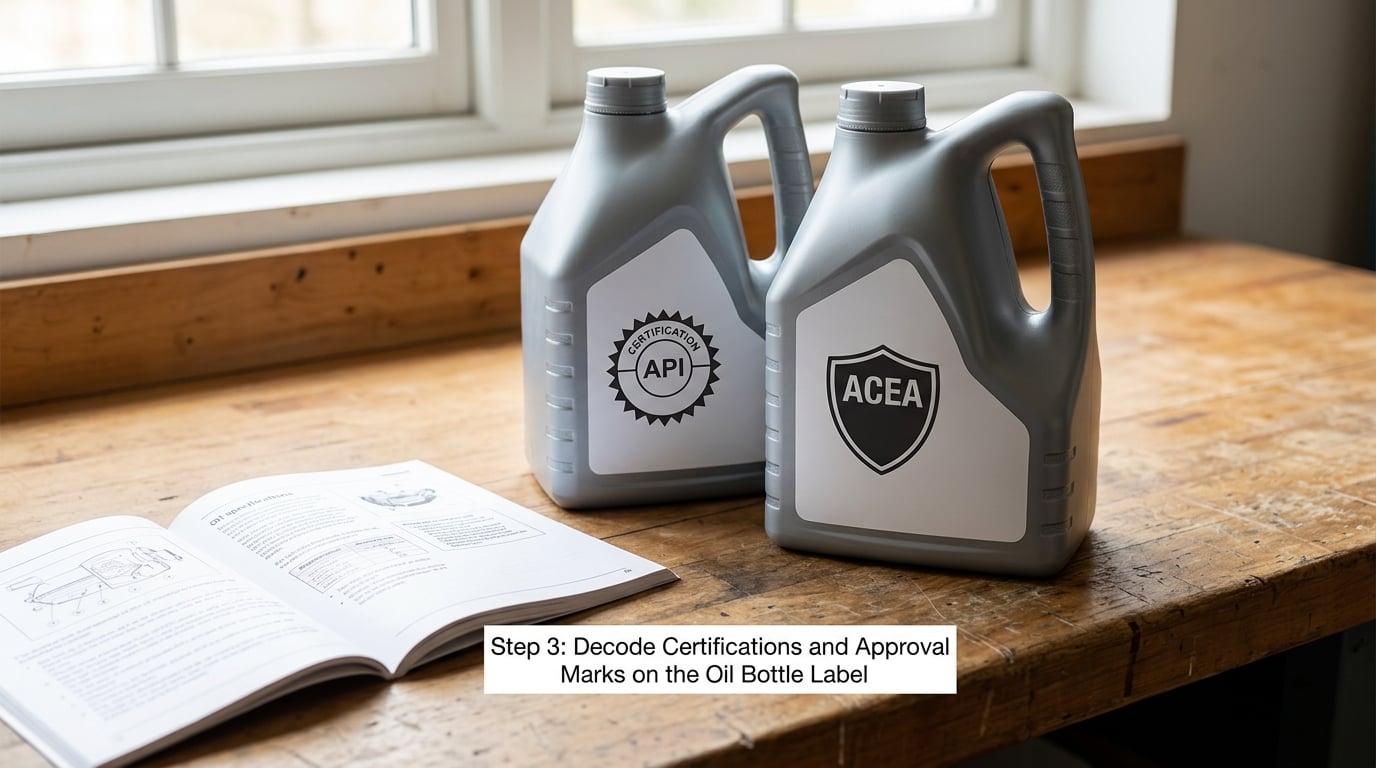
Three separate marks show up on oil packaging, and they are easy to confuse because they are printed in different places. The API donut is on the back of any API-licensed oil. The ILSAC starburst is usually on the front, and the ILSAC shield is a different shape meaning a stricter fuel economy specification.
| Mark | What it certifies | Where it sits |
|---|---|---|
| API donut | Viscosity grade, performance category, and engine type | Back label |
| ILSAC starburst | ILSAC GF-6A or GF-7A gasoline specification | Front label |
| ILSAC shield | ILSAC GF-6B or GF-7B, the lower friction specification used for SAE 0W-16 | Front label |
| Energy Conserving | Meets a fuel economy threshold in the API donut | Back label |
The ILSAC generation matters because the standard changed recently. ILSAC began issuing GF-7A and GF-7B in March 2025, and GF-6A and GF-6B oil became obsolete on October 1, 2026. If your manual still names GF-6A, current GF-7A oil is the intended replacement, and a shop should know that.
Then look for an OEM approval mark, which is the strictest layer and the one a manufacturer will actually defend in a warranty argument.
| Manufacturer | Approval mark | What it means |
|---|---|---|
| General Motors | dexos1 Gen 3 | Current GM gasoline specification, introduced in late 2021; Gen 4 is planned later in the decade |
| Ford | WSS-M2C961-A1 | Ford’s own test program, matched to the specific engine |
| Mercedes-Benz | MB-Approval 229.51 or 229.52 | Low friction or low viscosity MB specification |
| Volkswagen Group | VW 502.00 and 504.00 | 502.00 for petrol, 504.00 for diesel |
| BMW | BMW Longlife 04, 04L or 05 | Oil must stay in spec for long drain intervals |
| ACEA classes | A3, B4, C5 | European categories; A3 for petrol, B4 for diesel, C5 for low friction engines with a particulate filter |
Diesel engines get their own language too. CK-4 and CJ-4 are for engines without a diesel particulate filter, while FA-4 is for engines that have one, and it is not backward compatible with a filter-equipped engine. Low-SAPS and mid-SAPS claims on the label tell you how much sulphated ash, phosphorus and sulphur the oil carries, which is what protects the aftertreatment hardware.
One detail worth knowing: “licensed to” and “meets or exceeds” are not the same claim. A licensed mark means the manufacturer paid to use the program and passed the testing, while a meets claim is a self-declared statement on the label. Licensees also have to maintain a quality-control audit of the licensed plant, which is why oil-watchers on Bob Is The Oil Guy generally put the licensed mark above the self-declared one.
Step 4: Review Base Oil, Additives, and Claims
The front label is mostly marketing, but two words carry real meaning. Full synthetic means the base oil came from one of the higher-conversion groups, usually hydrocracked Group III or Group IV polyalphaolefin. Synthetic blend means a mix, usually Group II and Group III. Mineral means Group I, refined from crude.
Full synthetic is a chemistry claim, not a performance one, and it says nothing about whether the oil meets your specification. Some certified oils are not synthetic at all, and some synthetic oils carry no OEM approval. The claims worth reading closely are the drain interval claims and any statement about turbocharged or LSPI protection, because those tie back to a named test.
Step 5: Match the Oil Bottle Label to Your BMW or Other Vehicle
Now put the label against your manual. Start with the viscosity, then confirm the category, then confirm the OEM approval or the ACEA class your engine needs. Three separate requirements, and matching one says nothing about the other two.
For a BMW, the Longlife class and the approved specification carry the most weight, because the engine depends on oil staying in spec over a long interval. For a GM turbo engine, dexos1 Gen 3 is the specification to look for. For a Volkswagen diesel with a particulate filter, 504.00 and a C5 or low-SAPS oil are the pairing. For a Ford truck, match the WSS-M2C code printed in the manual rather than picking a general specification.
If your manual names a generation that has gone obsolete, use the current equivalent rather than hunting down older bottles of the old standard. If the manual, the filler cap and a windshield sticker all disagree, the manual wins, then the cap, then the sticker.
To check what a shop actually installed, ask for the spec and the part number of the oil they used, then check that part number against the container. Keep the empty bottle or a photo of the label with your service records.
Common Mistakes When You Read Oil Bottle Labels and Certifications
These are the errors that show up over and over, and most of them are quick to fix once you know the label.
- Assuming any 5W-30 works. The grade can be identical across bottles while the category and OEM approval differ completely. Check the spec, not the number.
- Treating a certification as a brand endorsement. API and ILSAC certify performance categories, not specific products. Several brands hold the same license.
- Ignoring the engine type line. FA-4 and CK-4 both say diesel and they are not interchangeable in a filter-equipped engine.
- Reading the bottle instead of the manual. The oil in the engine was chosen by the carmaker, not by whoever topped it off last.
- Misreading the quantity. A 5-quart jug does not mean the engine takes 5 quarts, and a top-off that pushes the level past MAX is as damaging as running low.
- Mixing incompatible oils between changes. A one-quart top-off of a different specification is usually fine, but a full change to a different base chemistry flushes differently and deserves a shorter first interval.
- Believing front-of-bottle design says anything. Colour and bottle shape are branding. A blue jug and a gold jug can hold the same oil, and the same brand’s jugs can hold different oil.
If you want to go further than the label, the manufacturer’s technical data sheet lists base oil group and NOACK volatility, and oilspecifications.org lists the approved products for each certification program.
Frequently Asked Questions
What does the API donut on oil packaging indicate?
The API donut is the circular certification mark printed on the back label of API-licensed oil. Its upper half shows the SAE viscosity grade, such as 5W-30. The center shows the performance category, such as SP or SQ for gasoline engines or CK-4 and FA-4 for diesels. A line below the donut says whether the category applies to gasoline or diesel engines.
What do the numbers on oil bottles mean?
The numbers are the SAE J300 viscosity grade and they describe two different things. The first number, before the W for winter, is how the oil behaves at cold cranking temperatures. The number after the dash is its viscosity at 100C measured in centistokes, and it is also the basis for the HTHS figure that matters for turbocharged engines.
What is better, API SN or SP?
API SP is the better and more current choice for almost any modern gasoline engine. SP added testing for low-speed pre-ignition and timing chain wear, both problems that show up in turbocharged and direct-injection engines. API SN is an older category, acceptable in many engines but no longer the current standard, and it is no longer offered for newer vehicles.
What does ILSAC mean on an oil label, and what is GF-7 oil?
ILSAC stands for the International Lubricant Specification Advisory Committee, a US and Canadian group of automakers that licenses its own oil specifications. GF-7A is the current gasoline specification and GF-7B is its SAE 0W-16 counterpart. ILSAC began issuing GF-7 in March 2025, and GF-6A and GF-6B oil became obsolete on October 1, 2026.
Can I use any oil with the same viscosity as my manual says?
No. Viscosity is only one requirement, and it is the least restrictive. Your manual also names a performance category, and often a manufacturer specification such as dexos1 Gen 3, a WSS-M2C code, MB-Approval, VW 504.00, BMW Longlife or an ACEA class. A bottle can carry the right viscosity and the wrong certification, and that mismatch can trigger variable valve timing codes and emissions problems.
Can I mix oil brands between changes?
A small top-off of a compatible oil between changes is generally safe, provided it meets your manufacturer’s specification and the grades do not differ by more than one weight. When you do a full change, using the same specification and base type as the oil already in the engine keeps the behavior predictable, and flushing the engine with a different chemistry is best given a shorter first service interval.
Conclusion
Start with the manual, not the bottle. Find the oil specification in the maintenance section, note the viscosity, the performance category and any manufacturer approval or ACEA class, then take that list to the shelf and match all three against the label before you buy.
That takes a minute, and it is the difference between oil that meets what your engine was designed around and oil that merely fits.