
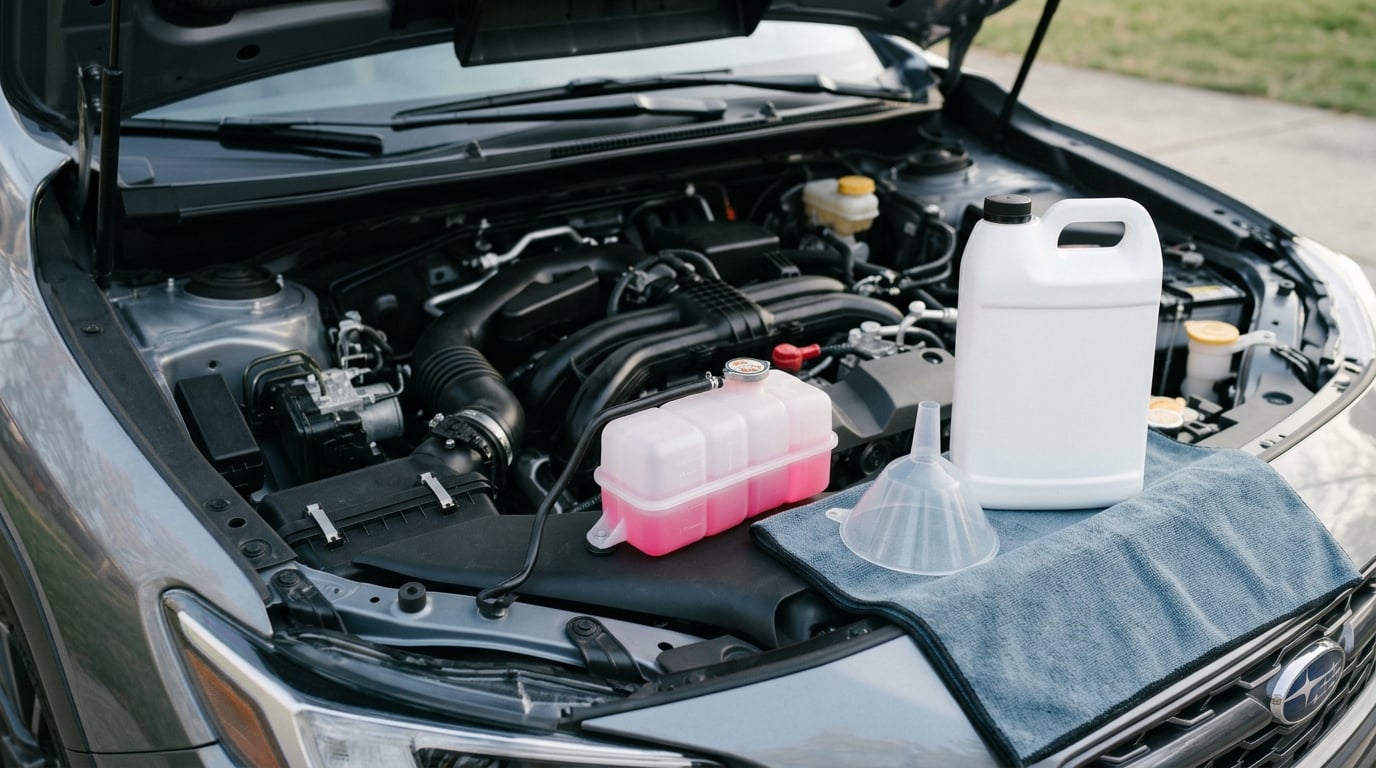
To top off coolant correctly, park the car on level ground, let the engine cool completely, then pour BMW-approved coolant of the correct specification slowly through a clean funnel into the expansion tank until the level reaches the cold MAX mark. Never open the cap on a warm engine, and never fill past MAX.
The whole job takes about fifteen minutes, plus however long you want to let the car sit. Almost every mistake that damages a cooling system comes from rushing that first part.
BMW cooling systems are sealed and pressurised, and most of them hold the coolant in a translucent expansion tank with a separate bleed procedure. That is different from a lot of generic topping-up advice you will find online, which is written for cars that fill straight from the radiator.
Table of Contents
- What You Need
- How to Top Off Coolant Correctly: Step-by-Step
- Common Mistakes
- Frequently Asked Questions
- Can I top off coolant while the engine is warm?
- Should I fill the BMW expansion tank above the MAX mark?
- What happens if I accidentally mix two types of coolant?
- Why does the coolant level keep dropping after topping it up?
- Can I use distilled water to top off BMW coolant?
- How long should the car be left before checking the coolant level again?
- Conclusion
What You Need
The owner’s manual, or the label on the expansion tank cap, tells you the coolant specification your car needs. Find that before anything else. BMW has used different coolant standards over the years, and they are not interchangeable.
Then gather the rest:
- Coolant matching that specification, either premixed at 50/50 or as a concentrate you mix with distilled water.
- A clean container you pour from, plus a clean funnel. A plastic jug you have cut down to makes a decent funnel in a pinch.
- Gloves and a rag or paper towel. Coolant is toxic and it stains everything it touches.
- A flashlight if the tank sits low in the engine bay or behind other components.
The engine must be completely cold before you start, so plan the timing accordingly. On many BMWs the expansion tank is tucked against the firewall or under a tray, so you may need a torch, a trim tool, or simply good reach to get the cap off.
Have a plan for what happens to the coolant you pour in and what spills. Most towns have a coolant collection point or an oil-change shop that takes a jug of it.
How to Top Off Coolant Correctly: Step-by-Step
1. Confirm the Coolant Specification and Park Safely
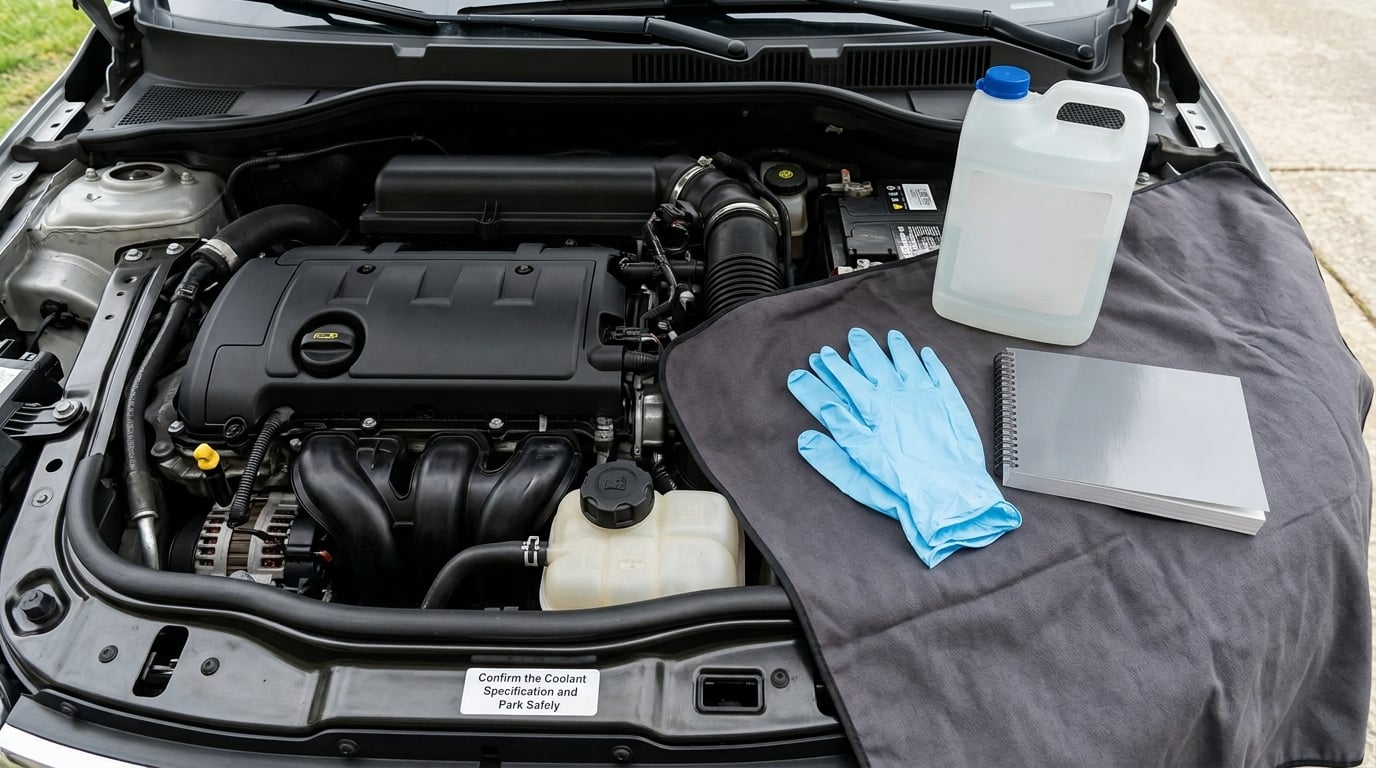
Read the specification on the cap or in the manual first, then buy exactly that. This is the step that separates a top-off from an expensive mistake, because the wrong chemistry in a BMW system can gel, corrode the aluminium, and stick heater cores together.
Park on level, solid ground so you can read the tank accurately. Let the engine cool completely, which on a warm day or after a drive is easily an hour or more. Touch the radiator hose or the top of the engine before you touch the cap. If anything is warm, wait longer.
You have done this part correctly when the engine is cool to the touch, the car is sitting flat, and you can state the required coolant specification out loud.
2. Check the Level Before Adding Coolant
Most BMW expansion tanks are translucent, so look through the tank first and only remove the cap if you actually need to. That avoids opening a system that did not need opening.
The marks you want are the cold MIN and cold MAX lines, usually on the side of the tank. Read the level against those, not against the hot line. Cold marks sit lower because the fluid contracts as it cools.
While you are looking, check the fluid itself. Clean coolant is clear and evenly coloured, whether that is blue, green, or the violet BMW uses in many cars. A rusty film, a brown sludge, a waxy gel, or an oily sheen on the surface all mean something more than a top-off is going on.
Look underneath the car while you are down there. Fresh dampness on the driveway, crystallised residue around a hose clamp, or a crust forming along one hose in an otherwise clean bay are all signs of a small leak that a top-off will not fix.
You have done this part correctly when you know the level relative to the cold marks, the fluid looks clean, and you have decided honestly whether a top-off is even needed.
3. Add the Correct Coolant to the MAX Mark
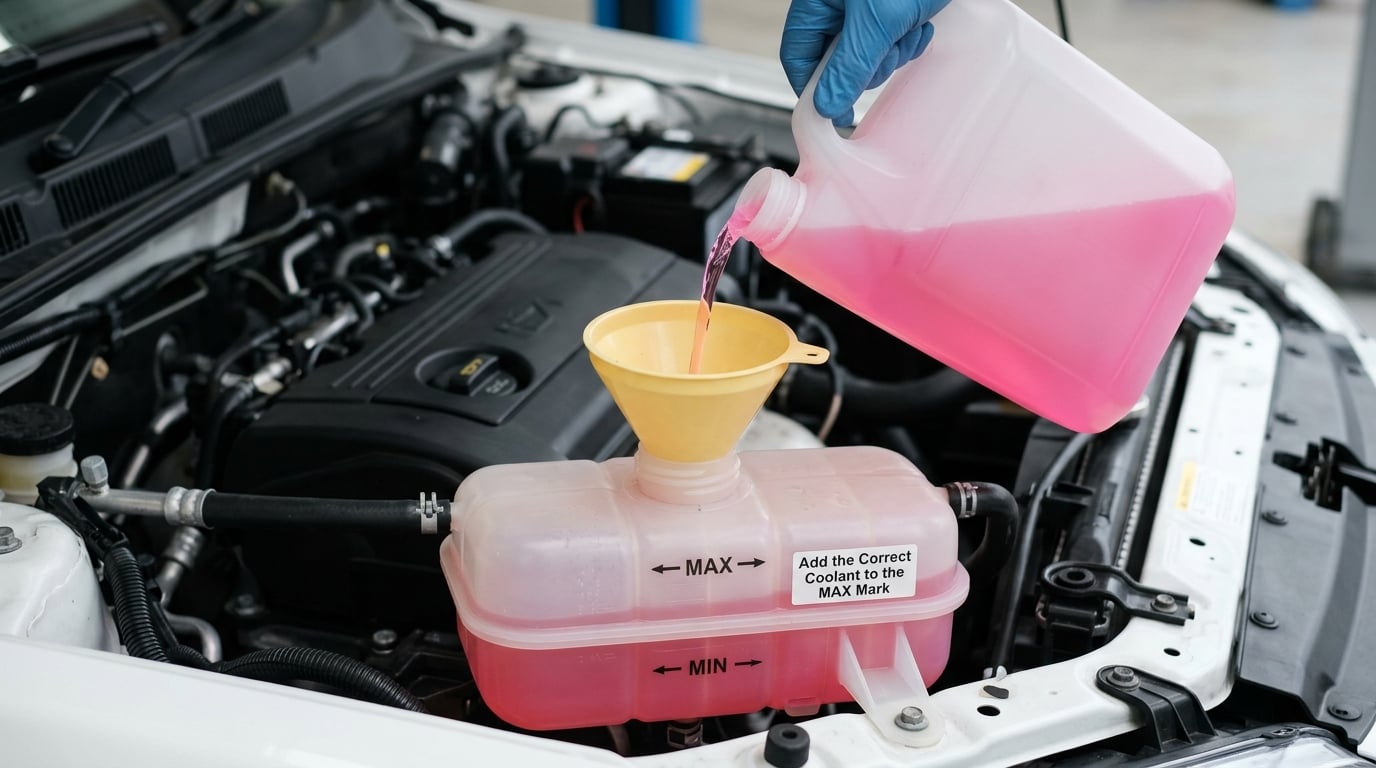
Unscrew the cap slowly and set it somewhere clean. If there is any hiss of residual pressure, stop and let the engine cool further.
Set the funnel in the filler neck and pour slowly, in small amounts. Fast pouring pulls air into the system, and a bubble sitting at the top of the expansion tank will keep the level reading wrong for weeks.
Stop at the cold MAX mark. Coolant expands as it heats, so a tank filled to the top when cold will push the excess out on the first warm drive. If the reservoir looks lower than you expected, the level may be hiding under a plastic baffle, so check the mark moulded into the side rather than the surface appearance.
If your car uses concentrate, mix it 50/50 with distilled water in a clean jug before pouring. Never pour concentrate straight into an empty expansion tank, and never substitute tap water to save a trip. Tap water carries minerals that scale the small passages in a BMW heater core.
You have done this part correctly when the level sits at the cold MAX mark, the stream went in without foaming, and the fluid in the tank is the same colour and chemistry that was already there.
4. Squeeze the Hose, Check for Leaks, and Recheck the Level
Refit the cap hand-tight and start the engine. Watch the temperature gauge stay steady and let the fans cycle on and off a few times, which shows the system is holding pressure.
Open the hood and press the upper radiator hose. It should feel firm and springy. A hose that feels soft, collapsed, or full of bubbles means air is still trapped in the system, which can cause a false reading and erratic heating.
To bleed air on a BMW, run the engine with the heater turned up high, the blower on maximum, and the thermostat fully open. That circulates the fluid through the heater core and pushes trapped air to the bleed screw on the expansion tank, where you open it a fraction of a turn until coolant stops coming and only air comes, then close it. Never do this with a stone-cold engine, because the thermostat will be shut and nothing will move.
Afterwards, run the engine warm, then shut it off and let it cool completely before you recheck the level. Look beneath the car once more for drips. A top-off on a healthy car should produce nothing but a dry, clean bay.
If the level drops back down to MIN within a few days of normal driving, that is not a maintenance item. That is a leak, and it needs diagnosing before you drive the car far.
5. Recycle the Coolant and Recheck When Cold
Never tip coolant onto the ground, into a storm drain, or into the household bin. It is poisonous to pets and children and it is a heavy contaminant in soil and water, so pour any leftover into a sealed container and take it to a collection point or an oil-change shop that accepts it.
Wipe down any spill with a rag rather than rinsing it away, and keep it off the belt, the pulleys, and any hot exhaust parts, because a little ethylene glycol on a belt will destroy the belt very quickly.
Then set your own recheck discipline. Recheck the tank cold after the next full warm-and-cool cycle, and again after a few hundred kilometres of ordinary driving. G35 owners have long described topping to MAX and rechecking a couple of days later as normal settling behaviour, and a small drop over a week is not alarming on an older car with a tired plastic tank.
A steady fall that empties the reservoir in a few days is a different story, and no amount of topping off will change it. Note the date and level each time you check, so you are working from a record rather than a memory when you talk to a shop.
You have done this part correctly when the cap is hand-tight, no residue is crusting around the neck of the tank, the old coolant is contained, and you have a date in mind for the next cold check.
Common Mistakes
Opening the cap on a warm engine. Hot coolant under pressure will erupt and scald. This is the one mistake that puts people in hospital. The fix is simple and non-negotiable: cold engine or no cap.
Filling to the hot MAX line or above. The cold marks are the fill marks. Pasting over the cold MAX because the tank is small makes a permanent overflow mess under the car and can push coolant onto hot exhaust parts.
Using tap water or the wrong specification. Tap water scales the heater core, and mixing chemistries can gel and corrode. Buy the specified coolant and use distilled water for anything mixed from concentrate.
Pouring the whole jug in at once. You will overfill, and you will trap air. Pour in stages, read the level, stop at cold MAX.
Rinsing the tank or dropping debris in it. A grit-free environment matters. Never flush the tank with a garden hose, and set the cap somewhere it cannot fall into the engine bay.
Ignoring a low-coolant warning. A dashboard message or a low-level light is the car telling you it is losing fluid. Drive it straight to a shop rather than topping off and hoping.
Topping off repeatedly without investigating. A top-off is maintenance when a healthy car needs a small adjustment once or twice a year. It is masking a leak when the level returns to MIN within weeks, when the car has no visible puddle, or when the fluid is oily, foaming, or discoloured.
One last honest limit: a top-off cannot tell you whether the loss is coming from a cracked radiator cap, a weeping water pump, a failed plastic tank, a weeping heater core, or a blown head gasket. Diagnosis is separate work, and no amount of care at the filler neck will answer it.
Frequently Asked Questions
Can I top off coolant while the engine is warm?
No. Warm coolant sits under pressure, and loosening the cap releases it as a scalding jet. Let the car sit until the radiator hose, the engine cover, and the coolant cap are all completely cool to the touch, which usually takes at least an hour after a drive. If the car has just overheated, leave it alone and have it checked, because an overheating event is a fault, not a topping-off job.
Should I fill the BMW expansion tank above the MAX mark?
No. Fill to the cold MAX mark and stop. Coolant expands as the engine warms, so a tank filled above the cold mark will push the excess out on the first drive and leave a mess under the car. The hot MAX mark is there for the expansion the system allows at operating temperature, not as a fill target. On many BMWs the tank also sits next to a bleed screw that needs room to bleed without spraying.
What happens if I accidentally mix two types of coolant?
A small accidental mix is unlikely to cause immediate failure, and most long-term cooling systems tolerate a little blending. Some chemistries are not compatible, though, and mixing the wrong pair can produce gel, sludge, and corrosion inside the block and heater core. If you have topped off with the wrong specification, drive the car normally, keep an eye on the temperature gauge, and arrange a proper coolant drain and refill with the correct fluid rather than trying to correct it by adding more of the right stuff.
Why does the coolant level keep dropping after topping it up?
On most cars a small drop over a week or two is normal settling, and topping to the cold MAX line is routine maintenance. A level that returns to MIN within days, or within one long drive, means the system is losing coolant. Common culprits are a cracked radiator cap, a weeping water pump, a failed plastic expansion tank, a slow external leak, or an internal one such as a failing head gasket. Track the dates and levels and take the car in.
Can I use distilled water to top off BMW coolant?
Distilled water is the correct choice whenever you are mixing your own 50/50 from concentrate, and it is the only water you should add routinely. Do not use it to replace lost coolant, because water alone dilutes the mixture and lowers the freeze and boil protection. Add the specified premixed coolant instead. Tap or tap-filtered water is a last-resort emergency measure to get a stranded car moving to a shop, nothing more.
How long should the car be left before checking the coolant level again?
Check once the engine has warmed up and gone fully cold again, which is the only point where the cold marks mean anything. Then check again after a few hundred kilometres of ordinary driving, and once more after a week or so of normal use. The useful record is date, distance, and level. If the tank is at cold MAX today and back near MIN in four days, that pattern is worth showing a technician.
Conclusion
Confirm the coolant specification first. That is the one decision you cannot undo cheaply, and it costs nothing to check before you pour anything.
Then let the engine go completely cold, read the level through the tank against the cold marks, and add the correct coolant slowly through a clean funnel until you reach cold MAX. Refit the cap hand-tight, bleed any trapped air with the engine warm, and let the car cool before you read the level again.
If the level is stable a few hundred kilometres later, you have done the job properly. If it keeps falling, the coolant is oily or discoloured, or the car has been overheating, stop topping off and get the leak diagnosed. The topping up was never the hard part.