
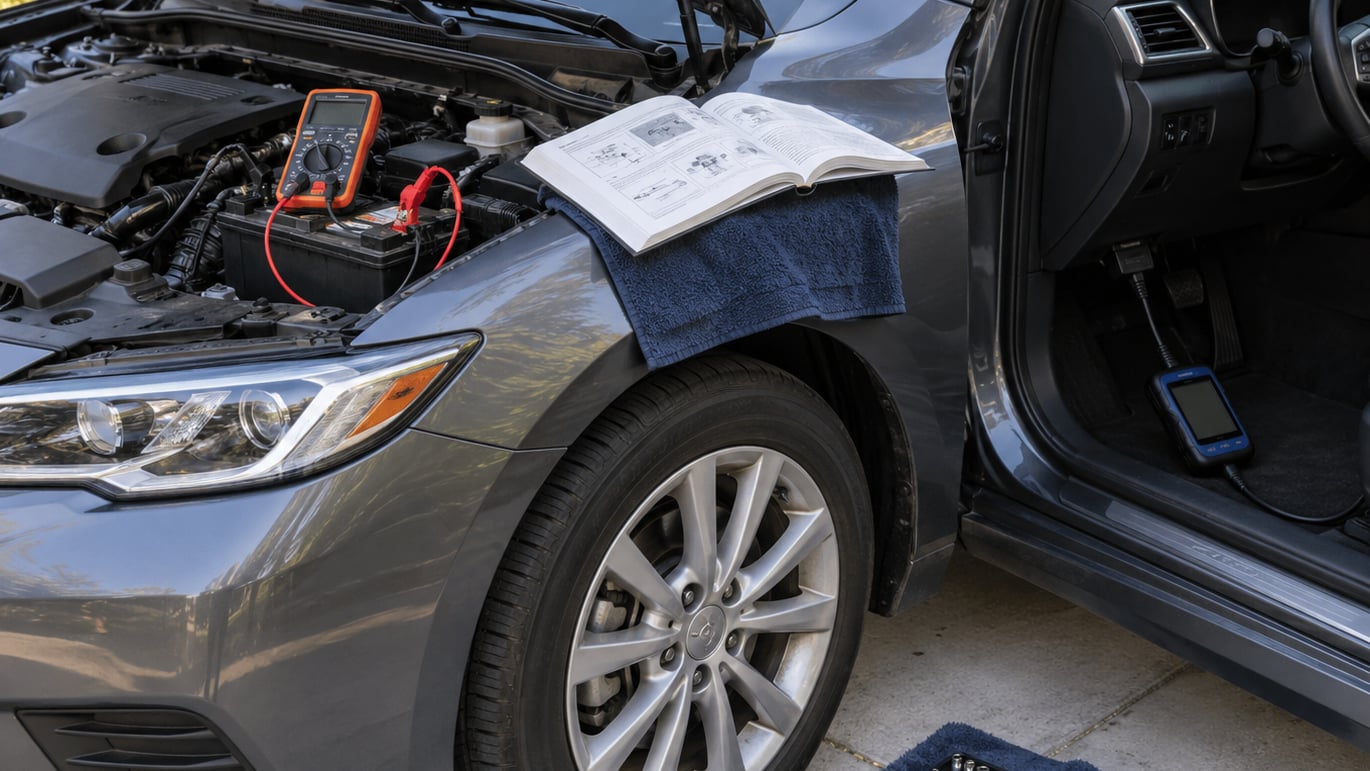
When a car starts then dies immediately, the engine caught on the fuel and spark already in the cylinders, then one system stopped supplying what a running engine needs. Usually that is fuel pressure, an air leak at idle, a lost engine-speed signal, a weak battery connection, or an anti-theft cutout. Most of it is testable in a driveway with hand tools and about an hour, if you work the problem in order instead of swapping parts.
Timing is the fastest clue you have, and it costs nothing. An engine that dies within a second or two points at fuel delivery, immobilizer or a sensor signal. One that dies at idle but revs happily with the pedal held points at a vacuum leak or dirty throttle body. One that runs fifteen or twenty seconds and then quits usually points at idle air control. Write down how long it runs and whether a pedal changes it, because that single note decides which system you open first.
A word on safety before anything else. Do not crank a car in a closed garage, do not keep restarting it until the battery is drained, and do not drive a vehicle that stalls at an intersection. Repeated cranking adds a second fault — a dead battery — that hides the first one. If the engine dies while moving, stop in a safe place with the hazards on and call for a tow.
Table of Contents
- What You Need
- Step-by-Step: Diagnose Why the Car Starts Then Dies Immediately
- 1. Confirm the symptom and check for warning lights
- 2. Check the battery, battery terminals, and ground connections
- 3. Test whether fuel reaches the engine
- 4. Check ignition spark and engine-management signals
- 5. Look for air, vacuum, or unmetered-fuel problems
- 6. Check the immobilizer and anti-theft system
- 7. Inspect sensors, wiring, and mechanical causes
- Common Mistakes
- Replacing parts without a test behind the choice
- Probing ignition systems by hand
- Judging the battery without checking the grounds
- Cranking over and over until you run the battery down
- Installing a new battery without registering it
- Cleaning the throttle body and stopping there
- Guessing at fuel pressure with no gauge
- Frequently Asked Questions
- Why does my car start and then die immediately?
- Can a bad battery make a car start and then stall?
- What does it mean if the engine starts but immediately shuts off?
- Is it safe to drive a car that starts and then dies?
- How do I know if the fuel pump is the problem?
- When should I stop diagnosing and call a mechanic?
- Conclusion
What You Need
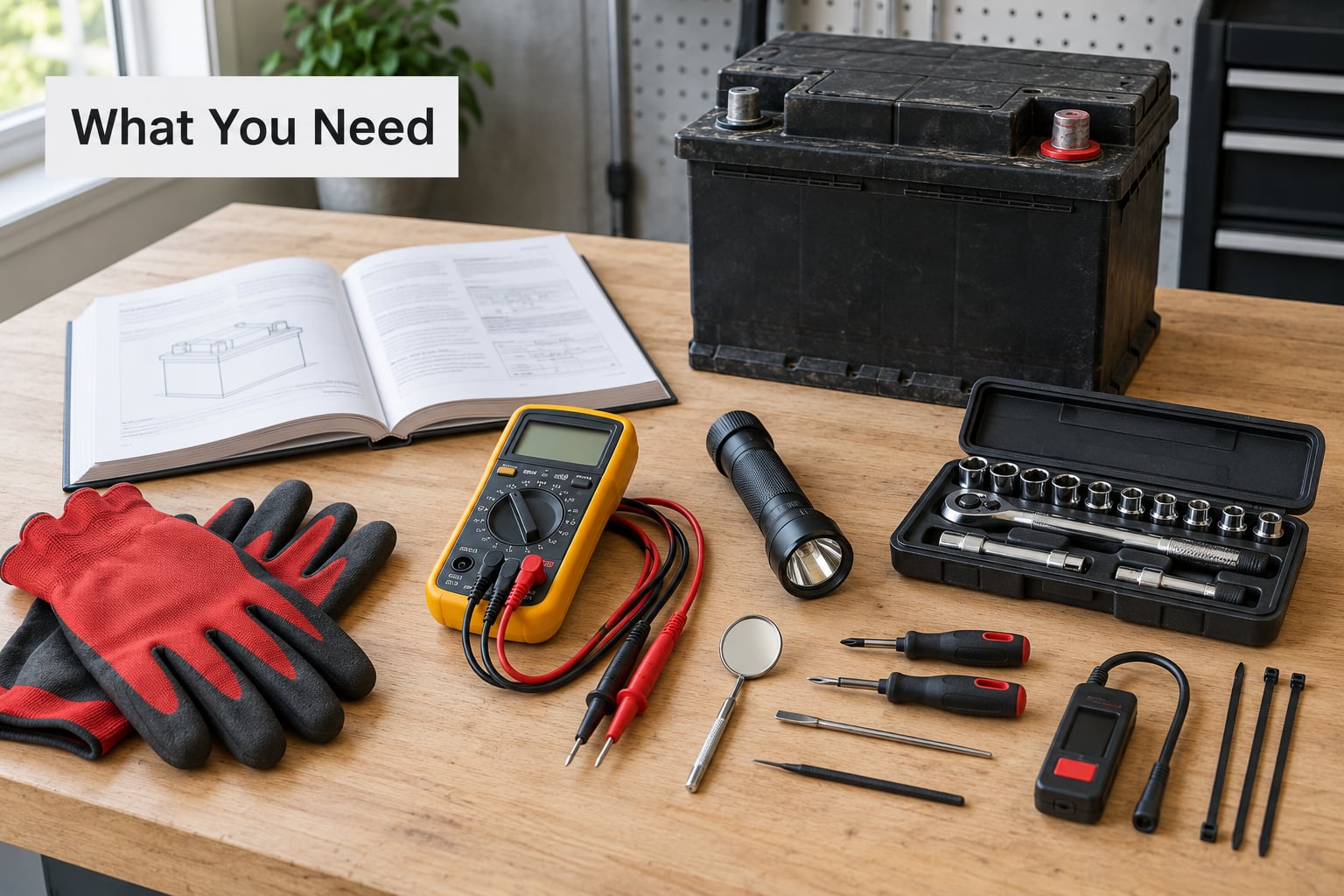
Gather these before you start, because half of all diagnostic time is lost walking back into the house for a tool.
- The owner’s manual for your exact year, make and model. It holds the fuse box layout, relay locations, the fuel pressure specification, and the idle relearn procedure if your vehicle uses one.
- A digital multimeter. You need resting voltage, cranking voltage, and a voltage drop across the starting path. An analogue needle meter works, but a cheap digital one is easier to read in the driveway.
- An OBD-II scanner. The port has been standard in the US since 1996 and sits under the dash on most cars. A bidirectional model that can command an idle relearn is worth the difference if your vehicle requires one after throttle body or MAF service.
- Basic hand tools. A socket set, a ratchet, a wire brush or terminal cleaner, and a small flat screwdriver for the EGR and idle air passages.
- A no-lift work light and jumper cables. Both make the difference between a ten-minute job and a forty-minute one.
- Soapy water or carb cleaner in a spray bottle. This is the cheapest vacuum leak tester in the world and it beats guessing every time.
- Safety glasses and nitrile gloves. Gloves matter most around a fuel rail, where pressurised fuel sits.
One free thing worth knowing: most auto parts stores will test your battery, starter, and alternator at the counter with no charge and no appointment. That test resolves a meaningful share of no-starts for zero dollars, and it takes eight minutes. Do it before you buy anything.
Step-by-Step: Diagnose Why the Car Starts Then Dies Immediately
The symptom looks identical from the driver’s seat no matter which system failed, so the only way through it is to eliminate branches in a fixed order. Use the table below to jump to the branch that matches what you saw, then work the numbered steps in order.
| What you see or hear | Probable cause | The test that confirms it |
|---|---|---|
| Engine fires and dies in one or two seconds, every time | No fuel pressure after the prime, or immobilizer cutout | Listen for the two-second pump prime at key-on; try the spare key |
| Runs only while you hold the accelerator | Vacuum leak, MAF or throttle body fault | Soapy water on intake boots and hoses while idle |
| Runs fifteen to twenty seconds, then quits | Idle air control valve, DISA valve, leaking intake gasket | Smoke test the intake tract; watch idle on a scan tool |
| Dies again soon after a jump start | Charging system, alternator, or loose ground | Measure voltage at the battery with the engine running |
| Dash lights dim noticeably while cranking | Battery, terminals, or ground strap | Cranking voltage below about 9.6V |
| Security or key light flashing on the dash | Transponder key not recognised, immobilizer in set-up mode | Try the second key; count key-on cycles without starting |
| Whistling noise from the intake, dies only when cold | Cracked intake boot or manifold gasket | Spray soapy water on suspect seams at idle |
| Stalls within minutes of refuelling | Vapor canister purge valve or vapor lock | Listen for the purge valve during the first minute after key-on |
| Rough running, shudder, check engine light on | Misfire, spark plug, ignition coil, low compression | Read stored codes, then run a compression test |
| Dies only after the engine is fully warm | Heat-soaked starter relay, failing crank sensor when hot | Note the exact engine temperature at the stall |
1. Confirm the symptom and check for warning lights
Start by recording exactly what the engine does before you touch a single fastener. Does it crank at normal speed, or does it crank slowly and then fire? Does it run for one second, fifteen seconds, or until you touch the brake? Are the headlights still bright at idle, or do they flicker? That last question separates an electrical fault from a fuel or air fault in about three seconds.
Then note the lights. A steady check engine light is one story. No check engine light at all with a car that will not stay running is a different and more interesting story, because many stall faults never set a code. A flashing security or key light points straight at the anti-theft system.
Finally, write down what changed before this started. A refuel, a battery replacement, an alternator swap, a throttle body cleaning, a wash with a pressure hose, or a tank of bad fuel. On r/MechanicAdvice and the model-specific forums, that single question resolves more cases than any other. One owner’s ignition switch was replaced only after a long chain of fuel and battery checks, and the fix came from remembering the car had started dying since new.
2. Check the battery, battery terminals, and ground connections
A car starts then dies immediately more often than people expect because of a corroded terminal or a rotted ground strap. Set the parking brake, pop the hood, and look at the battery posts. Blue-green or white crust on the clamp means resistance, and resistance under starter load is what kills a fast crank followed by a dead engine.
Put your meter on the battery and read resting voltage with the car parked and off. A healthy charged battery sits around 12.6V. Now watch it while the starter turns: the voltage must stay above roughly 9.6V. Below that floor, the battery cannot hold enough voltage for the fuel pump, the coil, and the ECU to keep the engine alive after the crank ends.
Then do a voltage drop test, which catches cables and grounds that look perfect. With the starter cranking, measure between the positive battery post and the positive battery terminal on the starter side of the clamp. Anything over about 0.5V means the cable or clamp is bad. Repeat for the negative side, measuring from the negative post to the engine block. That measures your ground strap, and it is the single most-skipped test on this fault.
Clean both posts with the terminal cleaner, tighten the clamps, and check the engine-to-chassis grounds under the hood and along the door sill. On a battery installed in the trunk or under the seat, follow the ground cable the whole way back. If the car dies again after a recent battery replacement, note that some vehicles require the new battery to be registered to the charging system through a scan tool, or the alternator will overcharge it and kill it again.
3. Test whether fuel reaches the engine
The clearest owner-level fuel test costs nothing: with the ignition on and the engine off, listen near the fuel tank. Most fuel pumps prime for about two seconds when the key is turned. That hum and whirr is the pump running, and hearing it tells you the relay, the fuse, and the pump windings are all working. Silence is the first hard clue that the fuel branch is your problem.
If the pump stays silent, check the fuel pump fuse in the underhood fuse box and then find the relay. On many cars it sits in the engine bay under a cover near the fuse box, and on others it is inside the fuel tank or in the body control module. Press the relay with a fingertip while someone turns the key and listen for a click. r/E30 owners described exactly that test and it is the reason people keep asking for part locations instead of part names.
Hearing a prime does not prove fuel delivery, which is the part most guides get wrong. A pump can prime and then fail to hold rail pressure once the engine is drawing it. A gauge test at the fuel rail is the real answer, and that is a job for a shop with the right equipment unless your vehicle has a test port you already own a gauge for. A clogged fuel filter or a tank sock full of debris produces exactly this symptom: enough residual fuel to fire, not enough to keep running.
One more fuel-specific clue: if the stall starts within a few minutes of refuelling and then clears after the tank is down a quarter, think vapor canister purge valve or vapor lock rather than pump failure. On a cold morning in winter the same valve can stick open and flood the intake. No editorial guide for this query covers it, and it is a cheap valve to look at.
4. Check ignition spark and engine-management signals
An engine that fires briefly has spark, so the ignition system is usually not your first suspect. What matters more is the engine-speed signal, because the fuel injection, the idle control, and much of the throttle logic all depend on the ECU knowing how fast the crank is turning.
Plug in your scanner, watch the live RPM or engine speed data, and crank. If RPM shows a healthy number during cranking and then drops to zero when the engine dies, the crankshaft position sensor and its wiring are working. If RPM shows nothing at all while the engine still fires, you have your answer: a failing crank sensor, a reluctor ring problem, or damaged wiring to it. On r/RX7 threads, resetting the crank angle sensor and checking the mass air flow were both cited as fixes on older cars.
Do not test high-voltage ignition components with a bare hand or an incandescent test light. A wasted spark or coil test light rated for the system is the correct tool, and the manual’s procedure for your vehicle is the authority. If you do go there, hold the coil-on-plug boot with insulated pliers, keep your hands off the metal, and stay clear of the flywheel housing.
Once the engine is running briefly, a scan tool also tells you whether it is misfiring before it dies. Random or cylinder-specific misfire counts alongside a rough idle point to spark plugs, ignition coils, or injectors rather than to the fuel pump relay you were about to replace.
5. Look for air, vacuum, or unmetered-fuel problems
The most telling pattern here is an engine that revs fine but dies the moment you release the throttle. That is what a vacuum leak looks like from the driver’s seat, and it is also the pattern that appears most often in owner write-ups. A mass air flow sensor sees more air than it expects, the ECU leans the mixture out for a load that is not there, and idle falls off a cliff.
Your DIY smoke test costs a spray bottle of soapy water. With the engine idling, spray the seams of the intake boot, the intake manifold, the throttle body gasket, the brake booster hose, the PCV and CCV hoses, and the intake manifold runners one at a time. A leak shows up as the idle changing or the RPM jumping. This is exactly how an owner on e46fanatics found a torn lower intake boot that looked perfect from above, then found a second bad seal behind it once the first was fixed.
Listen too. A high whistling that rises and falls with engine speed is unmetered air. A gurgling or rough idle that settles when you feather the pedal usually means the idle air control valve or a DISA or equivalent intake runner valve is stuck. Clean the throttle body plate and butterfly with carb cleaner, a soft brush, and a lint-free cloth. Clean the MAF element with dedicated sensor cleaner only, never brake cleaner or a rag.
Then do the step most guides skip: the idle relearn. After any throttle body or MAF service, many vehicles need the ECU to relearn closed-loop idle. A two-way OBD-II scanner can command it. Without that step the car often runs fine for a few days and then goes back to dying, and the owner concludes the repair failed. r/Subaru_Outback advice puts the order plainly: clean the intake, throttle body, and MAF, then perform an idle relearn with a two-way scanner.
6. Check the immobilizer and anti-theft system
An immobilizer cuts fuel injection on purpose when the transponder in your key is not read, and the result is an engine that cranks, fires, and dies. So the first thing to look at is the security, key, or theft light on the dash. A steady light means the system is satisfied. A flashing light on a car that starts and stalls usually means the key was not recognised or the immobiliser is still in set-up mode.
Then do the free test that forum users mention more than any other: try the spare key. If the car behaves differently with the second key, the problem is the key or its transponder chip, not the engine. If it dies the same way, you have just eliminated an entire system for the cost of walking to the drawer.
On some vehicles the security light flashes for a few minutes after a battery disconnect, an alarm trigger, or a door being opened with the ignition off, and the engine will not start until the light goes solid. If your car did this right after battery work, leave it alone long enough for the light to settle before you start pulling parts.
7. Inspect sensors, wiring, and mechanical causes
With the softer branches ruled out, look at what actually kills an engine instantly: wiring and sensors. Unclip the connectors on the mass air flow sensor, throttle body, and crank sensor and check for green corrosion, backed-out pins, or terminals that have spread. Follow the loom where it passes through the engine bay for chafing, and look at the intake harness around hot exhaust manifolds. A shorted wire can disable fuel injection instantly without setting a code.
Watch live sensor data while the engine idles before it dies. A mass air flow reading that jumps around wildly, a throttle position reading that does not move smoothly with the pedal, or an oxygen sensor trace that never crosses are all pointing at the part that matters. Owners commonly post codes that name a system rather than a failed part, for example a throttle body complaint that is really a vacuum leak upstream of it.
The last branch is mechanical, and it needs a shop or at least a compression test. Low compression from worn rings, a collapsed valve, or water in the fuel will start and idle badly no matter what you replace. A slipped timing chain or a jumped belt will also run, badly, until the timing is way off. If you are hearing a mechanical clatter at start-up and the previous checks all came back clean, stop and get a compression and timing check rather than buying sensors.
One last electrical branch people forget: the ignition switch itself. It can wear internally, let the starter crank, and then drop the fuel relay contact the moment the engine catches, so the car starts and immediately dies. r/MechanicAdvice has a solved case exactly like this, where the owner had already checked fuses and the battery and replaced the alternator before the switch turned out to be the answer. If everything else checks out, the switch and its wiring deserve a look.
Common Mistakes
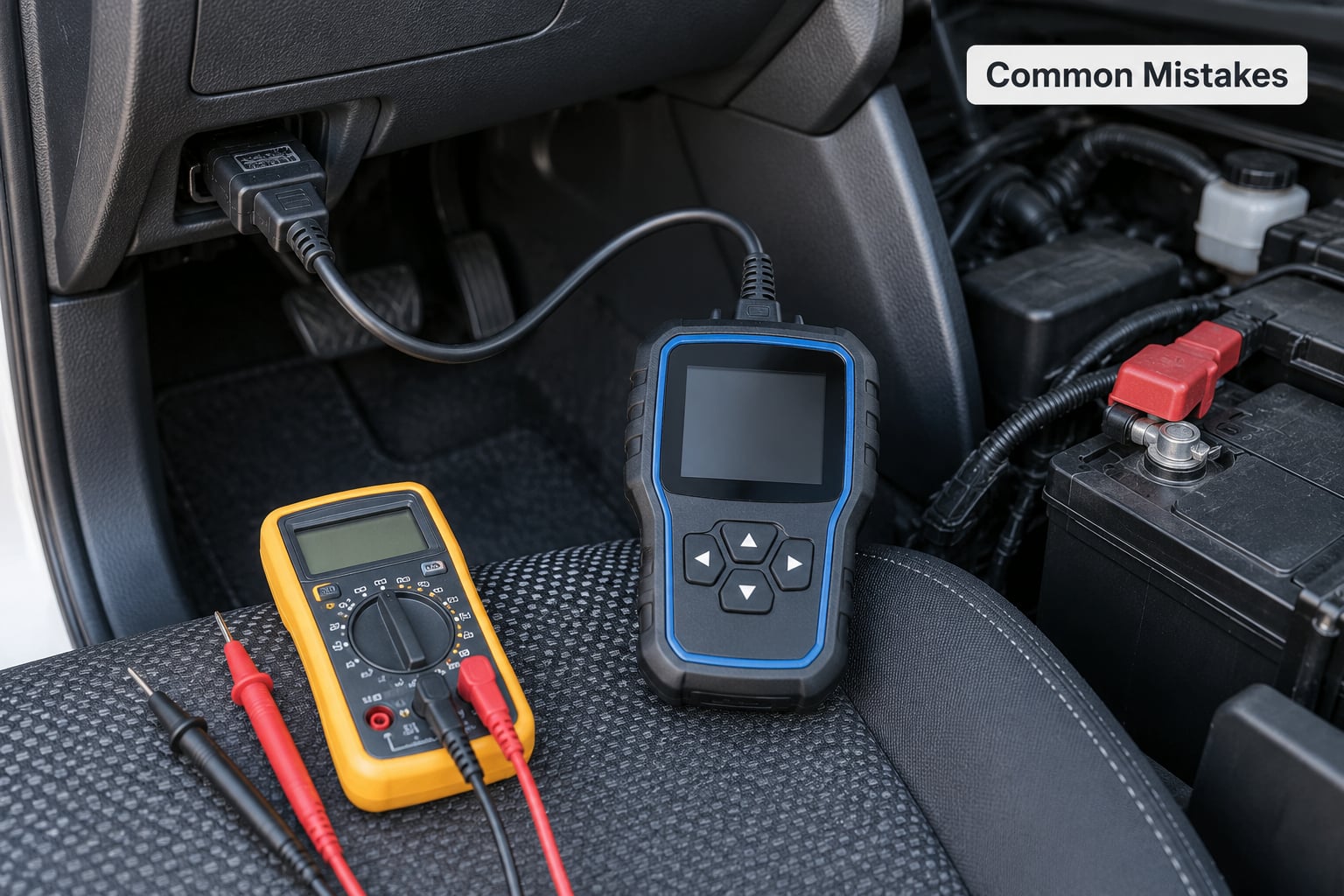
Almost every wasted repair on this fault comes from the same handful of moves. Here they are, with the safer version of each.
Replacing parts without a test behind the choice
The classic pattern runs fuel pump, battery, alternator, throttle body, and the symptom never changes. A test costs an afternoon; four wrong parts cost four times as much. Test the branch, then replace the part.
Probing ignition systems by hand
Touching a coil or plug wire to check for spark puts high current through your hand. Use a spark test light rated for the system and follow your manual’s procedure. The cost of the tool is trivial next to a trip to the emergency room.
Judging the battery without checking the grounds
A voltage reading at the post tells you very little when the ground strap is rotted under the paint. Measure the drop across the starting path and along the ground strap, then clean and tighten before you blame the battery.
Cranking over and over until you run the battery down
Each crank costs you a few percentage points of charge, and a flat battery creates a second symptom that masks the real fault. Three attempts, then stop and charge or jump it. One owner chasing a stall-on-start ended up diagnosing a dead battery instead of a vacuum leak.
Installing a new battery without registering it
Several modern vehicles need a new battery registered to the charging system with a scan tool. Skip it and the alternator can overcharge the new battery, bringing you straight back to the same symptom with a fresh part on the car.
Cleaning the throttle body and stopping there
A clean throttle body changes the idle position the ECU expects. Perform the idle relearn afterwards, otherwise the stall returns and you conclude the cleaning did nothing.
Guessing at fuel pressure with no gauge
Hearing the pump prime tells you it ran, not what pressure it held. A rail pressure gauge on a vehicle with a test port answers the question; without one, this is a shop job rather than a guessing job.
Frequently Asked Questions
Why does my car start and then die immediately?
Because the engine caught on the fuel and spark already sitting in the cylinders, then a system failed to sustain it. Usually that is fuel pressure dropping once the pump has to flow, an air leak that leans the mixture out at idle, a lost crankshaft position signal, a weak battery connection, or an anti-theft cutout. The run time before it dies tells you which one to test first.
Can a bad battery make a car start and then stall?
Yes, especially if the posts or grounds are corroded or the cable ends are loose. Watch the voltage while cranking: it must hold above roughly 9.6V, and a battery sitting at 12.6V at rest can still fail the moment the starter loads it. If the stall returns soon after a jump start, suspect the charging system or an alternator that will not hold output.
What does it mean if the engine starts but immediately shuts off?
It means the parts that catch are working and the parts that sustain are not. An immediate die points at fuel delivery, the immobilizer, or a missing engine-speed signal. An engine that revs but dies at idle points at a vacuum leak or dirty idle air control. Record exactly how long it ran and whether the pedal changed anything before you open a single panel.
Is it safe to drive a car that starts and then dies?
Treat it as not safe to drive until you know why. An engine that stalls at idle can stall at an intersection, and a repeat stall with no fuel or spark can leave you stranded. Do not crank it in a closed garage, limit yourself to three attempts, and tow it if it dies in traffic or stalls while moving. A scan tool reading before a tow is often cheaper than a jump you cannot trust.
How do I know if the fuel pump is the problem?
Listen for the roughly two-second prime when you turn the key to on with the engine off. Silence points at the fuse, the relay, or the pump itself, and you can confirm the relay by pressing it and hearing a click while someone turns the key. Hearing a prime does not prove pressure, so a rail pressure gauge is still the only way to be certain. If the stall follows a refuel, suspect the purge valve instead.
When should I stop diagnosing and call a mechanic?
Stop when the checks need equipment you do not have, such as a rail pressure gauge, a fuel line pressure test, or a compression and timing check. Also stop when you hear mechanical clatter at start-up, when the engine runs but the scan shows severe misfires, or when the wiring under the intake is damaged rather than merely dirty. A shop diagnostic fee buys the gauge, the scanner, and the compression tester in one visit.
Conclusion
If your car starts then dies immediately, start with the free things: clean and tighten the battery terminals and grounds, measure cranking voltage, try the spare key, listen for the two-second fuel pump prime, and scan for codes. Those five checks cost nothing and each one eliminates a whole system.
Then use the timing. A one-second death points at fuel or anti-theft, an idle-only death points at a vacuum leak or idle air control, and a death that follows a jump points at charging. Test the branch the timing points to before you buy anything, and do not crank it again in a closed garage.
Once you are past the free tests, a scan tool with live data and a bidirectional command set is the next sensible purchase, because it covers codes, sensor readings, and the idle relearn in one tool. Past that point — rail pressure, compression, timing, or a wiring fault under the intake — a mechanic with the right gauges will get you there faster than a driveway will. Updated for October 2026.