
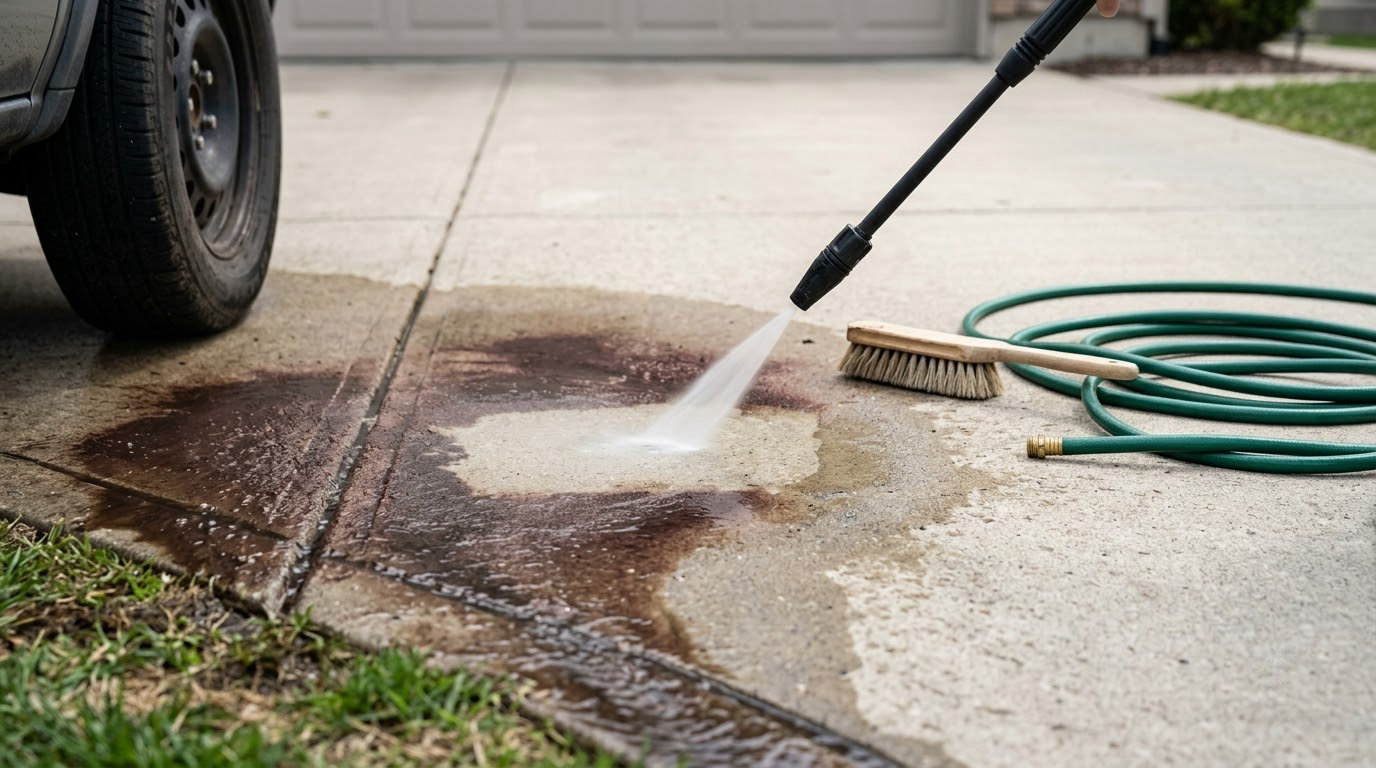
Brake dust comes off a driveway by dissolving the oily binder that glues it to the concrete, then rinsing the loosened iron particles up out of the pores. Scrubbing it dry does the opposite — the metal acts like sandpaper under the bristles and drives itself deeper into the slab — and that single habit is what turns a normal cleanup into a permanent gray stain. On a two-car driveway the whole job takes 30 to 60 minutes with a bucket, a stiff nylon brush and a hose.
Brake dust is the wear product of your brakes: iron oxide shaved off the rotor, blended with carbon from the pad material and bound up in grease. That greasy binder is what makes the dust grip, and it is what a degreaser has to attack first. Water alone just pushes the film around.
Concrete is the other half of the problem. A slab cures for weeks and stays porous for years, with a pockered surface full of open pores and an alkaline pH around 12.5 that grabs oily residue and holds on to it. So the sequence that works is always the same: chemistry to release the binder, gentle agitation to loosen what is still holding, then water to carry it away.
Table of Contents
- What You Need to Clean Brake Dust Off a Driveway
- How to Clean Brake Dust Step by Step
- Common Mistakes to Avoid When Cleaning Brake Dust
- Frequently Asked Questions
- What dissolves brake dust?
- Is brake dust stain permanent on concrete?
- Can I use brake cleaner or WD-40 to clean concrete?
- Will a pressure washer remove brake dust without etching the concrete?
- How do I stop brake dust from staining my driveway again?
- How to clean brake dust off a driveway without a pressure washer?
- Conclusion
What You Need to Clean Brake Dust Off a Driveway
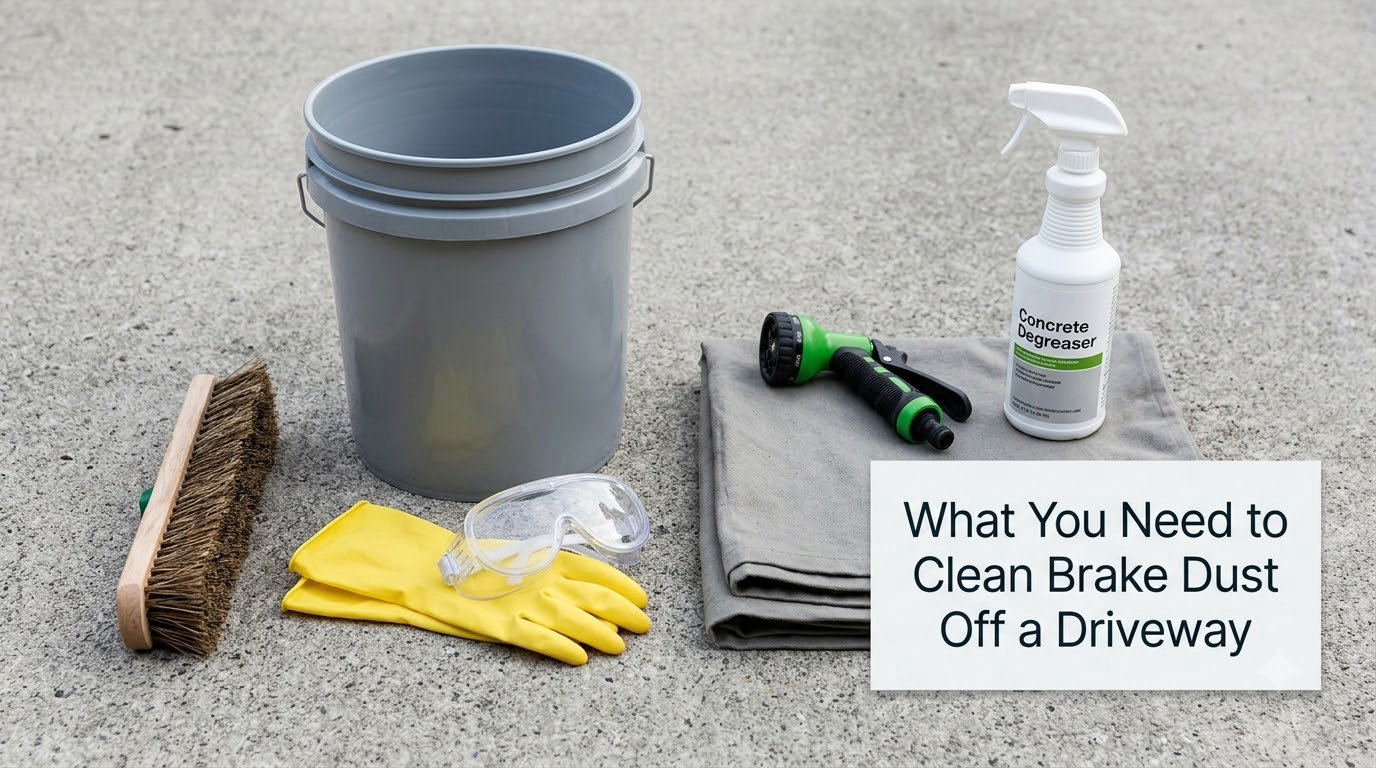
You do not need much, and none of it is exotic. The list below is what covers a standard two-car slab from fresh dust to baked-on black.
- A stiff nylon-bristle brush. Long bristles reach the broom-finish texture. Skip anything with steel wire — it scratches the surface and opens more pores for dust to settle into later.
- A five-gallon bucket, a scrub pad or spare brush, and a garden hose with a spray nozzle. A nozzle you can trigger beats a running hose, because you want to rinse a small section without flooding the whole driveway.
- Rubber or nitrile gloves and safety goggles. Degreasers and acid-based cleaners are not kind to bare skin or eyes. Gloves also stop you from resting a hand on the wet patch and grinding dust in with your palm.
- A pH-neutral concrete and masonry degreaser. Anything labeled for concrete is fine. This is the main chemical that dissolves the binder.
- Iron or fallout remover for the black, baked-on patches. Detailers use these on wheels, and the same chemistry works on the same material sitting in a driveway.
- Absorbent material — old towels, cardboard or a drop cloth — to protect nearby grass, pavers or a painted surface, and to soak up fresh oil or brake fluid drips.
- A stiff broom or push broom to knock loose dust off the slab before any water goes on. Dry sweeping is only safe before the dust has been wet down.
- Optional: a pressure washer with a fan nozzle, and a concrete water sealer for the prevention step at the end.
How to Clean Brake Dust Step by Step
The method you pick depends less on preference than on the surface under the dust. Acid and strong pressure are fine on bare slab and terrible on everything else.
| Surface | Safest approach | Avoid |
|---|---|---|
| Bare concrete | Dish soap for light dust, degreaser with dwell time for dark stains, fan-nozzle pressure wash for baked-on buildup | Undiluted acid, high-pressure turbo nozzles, any pressure on weak or patched slab |
| Sealed or stamped concrete | pH-neutral degreaser, soft brush, gentle rinse. Test an inconspicuous corner first — water beads on sealed slab, soaks in on bare | Acid, bleach, and high pressure, all of which strip the sealer and leave the slab more porous than before |
| Pavers or interlocking block | Dish soap or degreaser, nylon brush, low-pressure rinse | Acid, which etches the face and can break down the polymeric sand between joints |
| Asphalt | Sweep, then soap and a soft brush with a gentle rinse | Pressure washers and acid. Asphalt softens in summer and a zero-degree nozzle will gouge it |
1. Protect the Area and Wet the Dust
Block off anything that should not get wet: a storm drain gets a plastic mat or a wet-vac, nearby plants get a sheet of cardboard, and pets go inside. Brake dust runoff is metal-laden water, and the practical move people in detailing forums land on is to move the car onto the lawn first so the effluent can soak into grass instead of running down the slab into a drain.
Wear gloves and goggles now, not after you have been leaning over the stain for twenty minutes. Then sweep or blow off the loose dust before it gets wet — once it is damp, it stops behaving like dust and starts behaving like grinding compound.
Hose the section down until the water runs clear. The goal is a fully saturated surface, not a puddle. If you own a pressure washer, this is the only step where you can use it freely, and even here keep a fan nozzle 12 inches or more off the concrete on a driveway with patching, spalling or a recent seal coat.
2. Apply a Concrete-Safe Cleaner and Let It Dissolve Brake Dust
This is the step that decides whether the job works. Concrete does not care how much you scrub; it cares whether the binder was dissolved first.
Pour the degreaser into a bucket and dilute it with water following the label, then spread it over the damp section with a mop or a watering can instead of spraying it into the air. Scrubbing the product in immediately throws away the dwell time, and dwell time is where the actual dissolving happens.
Leave it wet for the time on the label, usually 5 to 10 minutes, and keep it wet with a light mist if you are working in heat or wind. Let it dry out completely and you have wasted the treatment — the cleaner re-concentrates on the surface and leaves a film that is harder to remove than the dust was.
For black stains that have been there through a few months, use an iron or fallout remover on those areas instead of, or immediately before, the degreaser. It is tuned for exactly this material. If you have a sealed driveway, spot-test in a corner the way you would with any new chemical and give it a full day to be sure nothing changed.
3. Scrub to Lift Brake Dust Off the Driveway Without Grinding It In
Work in sections roughly the size of a car, starting at the lighter edges and moving toward the dark, concentrated buildup in the middle. If the dust is heavy, rinse and re-treat an area rather than pouring on more product and scrubbing harder — a second dwell cycle with a light scrub beats five minutes of force.
Scrub with the grain of the broom finish, keeping the brush almost flat so the tips do the work, and use steady overlapping strokes instead of short aggressive ones. Let the loosened material sit for a minute before you touch water to it. The grit you are moving is metal, and the goal is to float it to the surface, not to chase it into the next pore.
You will know it is working when the water you mop up runs pale gray instead of black. That is normal, and it is the last point where you can stop and reassess before the rinse. If the runoff is still jet black after a second treatment, the stain has probably been there long enough that it has oxidized into the slab, and pressure is the next rung on the ladder rather than more chemistry.
4. Rinse and Collect the Runoff
Change the water in your bucket often. Dirty rinse water just re-deposits the metal you lifted a minute earlier, which is the second most common reason a clean section gets re-dirtied on the way to the hose.
Rinse from the top of the driveway downward so you are always pushing clean water over dirty, and use enough pressure to move the film without eroding the surface. Then check for the two things that tell you the section is not finished: a rainbow or gray sheen of oil that never rinses away, and dark patches that reappear the moment the slab dries.
Collect what you can. A wet-vac on the dirty pass is worth the setup time if the driveway drains to a lawn, and running the last of it into a storm drain is the move to avoid. If the slab is sloped toward a street, work uphill to downhill and stop the runoff short of the curb.
5. Dry and Prevent Future Buildup
Concrete darkens when wet, so judging the result on a damp slab is how people convince themselves they failed. Let the section dry fully — overnight is the honest test — and then look again. A lot of what looked gray while wet is close to the surrounding slab once the water is gone.
Anything still black after drying is usually a shadow of the original stain: the dust is gone and the slab beneath is discolored. Those areas usually need one more cycle with an iron remover plus pressure rather than a repeat of the same clean.
Prevention is easier than removal, and the routine matters more than the product. Pre-wet the driveway before you touch a soapy wheel, keep the wash water moving instead of letting it sit, and hose the driveway around each tire as soon as the wheels are done — detailers on r/Detailing describe exactly that, rinsing the tire area well right after cleaning each wheel so the water never sits on the concrete. Rinse under the car before you drive off, and clean the wheels off the driveway entirely when the season allows.
A driveway mat or a stack of cardboard under each tire catches what the rinse misses, and a concrete water sealer is the bigger lever. Because the slab is porous, sealing it gives the dust a non-porous surface to sit on so it rinses off instead of bonding; that recommendation comes up again and again in the AutoGeekOnline thread about avoiding brake dust stains. Follow the sealer label for the re-coat interval, and remember that a water seal and a film-forming sealer are not the same product — the film former gives more protection but can turn slick and trap water if applied badly.
Common Mistakes to Avoid When Cleaning Brake Dust
Almost every ruined driveway I have seen came from one of these, and all of them feel productive at the time. The table covers what to stop using, and the notes after it give you the substitute.
| Do not use | Why it fails on concrete | Use instead |
|---|---|---|
| Brake cleaner | It is a powerful solvent, not a concrete product. It etches the alkaline surface, can bleach it lighter, and the stripped spot then holds dust faster than the surrounding slab | A pH-neutral concrete and masonry degreaser, applied wet |
| WD-40 or other oil-based penetrants | It will move some dust, then leave an oily film in the pores that keeps attracting brake dust. The stain returns darker | Degreaser for the removal, then a rinse with a detergent that cuts grease |
| Dry sweeping or dry scrubbing | Metal grit under a dry brush grinds into the pores. This is the mistake that makes a stain look permanent | Wet first, always. Sweep dry only before any water has been applied |
| Undiluted or lightly diluted muriatic acid | Etches and dulls the surface, kills grass at the edges, and leaves a washed-out patch. On sealed slab it strips the sealer | Only as a heavily diluted last resort on bare concrete, with protective gear and a neutralizing rinse |
| Outdoor bleach | It does not dissolve iron, and it damages new concrete, plants and any bare metal nearby | Iron remover for dark stains, degreaser for the binder |
| Steel wire brush | Scratches the surface, exposes fresh pores and makes future buildup easier | Stiff nylon bristles, kept flat and used with steady strokes |
Dry sweeping is the mistake that makes the stain permanent
Brake dust is abrasive metal powder. Rubbed dry across a porous slab, it does what sandpaper does to a finished surface, and the result is a shadow that no amount of degreaser fully pulls out. Wet the concrete first and the same particles float and rinse away. If you only change one habit from this article, make it that one.
Re-soaping the driveway does not stop the dust from setting
A surprising number of people pre-treat the concrete with soap before washing wheels, expecting the dust to be less likely to bond. The binder holding brake dust to the slab is grease, not just dust, and household detergent does not displace it. Pre-wetting is worth doing, but it is protection from the rinse, not a barrier against the stain.
Pressure washing with the wrong nozzle or the wrong distance
The most repeated working answer in the forums is a degreaser plus a gas pressure washer with the most concentrated nozzle, and it does pull stains out. The risk is holding a tight zero-degree turbo jet close to the slab, which etches soft concrete, widens control joints and blows out broom finish. Use a fan nozzle, keep it moving, hold it 12 inches or further out, and work the section you just treated rather than the whole driveway at once. Old slabs, patched areas and anything sealed within the last few months are the ones to be gentle with.
Acid as a first resort
Dilute muriatic acid, used heavily diluted and only on bare concrete, can lift a stain that nothing else touched — and it also etches the whole treated area, dulls the surface, strips sealer and can burn through grass at the edges. Full protective gear, no pets or plants nearby, and a follow-up rinse with a baking soda solution to neutralize the acid. It is the last rung, not the first, and the right answer for a large permanently blackened slab is usually a quote from a pressure washing outfit with a surface cleaner.
Frequently Asked Questions
What dissolves brake dust?
A pH-neutral concrete and masonry degreaser dissolves the oily binder that holds brake dust to concrete. Give it 5 to 10 minutes of wet dwell time before you agitate anything. For stains that have already blackened, an iron or fallout remover targets the metal itself. Water alone only moves the film around, and scrubbing dry drives the particles deeper into the pores.
Is brake dust stain permanent on concrete?
Not usually, and the age of the stain matters far more than the method. Fresh dust lifts with dish soap and a stiff nylon brush. Dust that has oxidized for months becomes iron oxide bonded to the pore walls, and that needs a degreaser plus iron remover, then pressure. What can look permanent is a shadow left after the dust is gone, which stays visible no matter how many times you clean it.
Can I use brake cleaner or WD-40 to clean concrete?
Skip both. Brake cleaner is a harsh solvent that etches and can lighten the alkaline surface, leaving a spot that holds dust faster than before. WD-40 will shift some dust but leaves an oily film in the pores that keeps attracting brake dust, so the stain comes back darker. A concrete-safe degreaser and, for black stains, an iron remover do the job without either side effect.
Will a pressure washer remove brake dust without etching the concrete?
Yes, as long as you use a fan nozzle instead of a zero-degree turbo, keep it 12 inches or more from the slab, and keep it moving. Work the section you just treated rather than the whole driveway. Be gentler on old slabs, patched areas, broom-finish texture and anything sealed in the last few months, all of which can etch or chip under concentrated pressure.
How do I stop brake dust from staining my driveway again?
Attack it during the wash rather than after. Pre-wet the driveway, keep the wash water moving instead of letting it sit, and rinse the concrete around each tire as soon as that wheel is done. Clean the wheels off the driveway when the season allows, and lay down a driveway mat or cardboard under each tire. A concrete water sealer closes the pores so residue rinses off instead of bonding.
How to clean brake dust off a driveway without a pressure washer?
You can, and for anything under a few months old a bucket method works fine. Wet the section, apply a concrete-safe degreaser, let it dwell 5 to 10 minutes without drying, scrub with a stiff nylon brush, and rinse with a triggered hose nozzle. Change the bucket water often. Skip the pressure washer and the stain still comes out; it just takes a second treatment pass.
Conclusion
Start by protecting the area — block the storm drain, move the car onto the grass if you can, and put on gloves — then wet the concrete before anything touches it. Apply a pH-neutral concrete-safe cleaner, give it 5 to 10 minutes of dwell time, scrub gently with a stiff nylon brush, and rinse in controlled passes without sending metal-laden water into a drain. Let the slab dry fully before you judge the result, then seal it and change your wheel-washing routine so the next one is a hose-down instead of a scrub.