
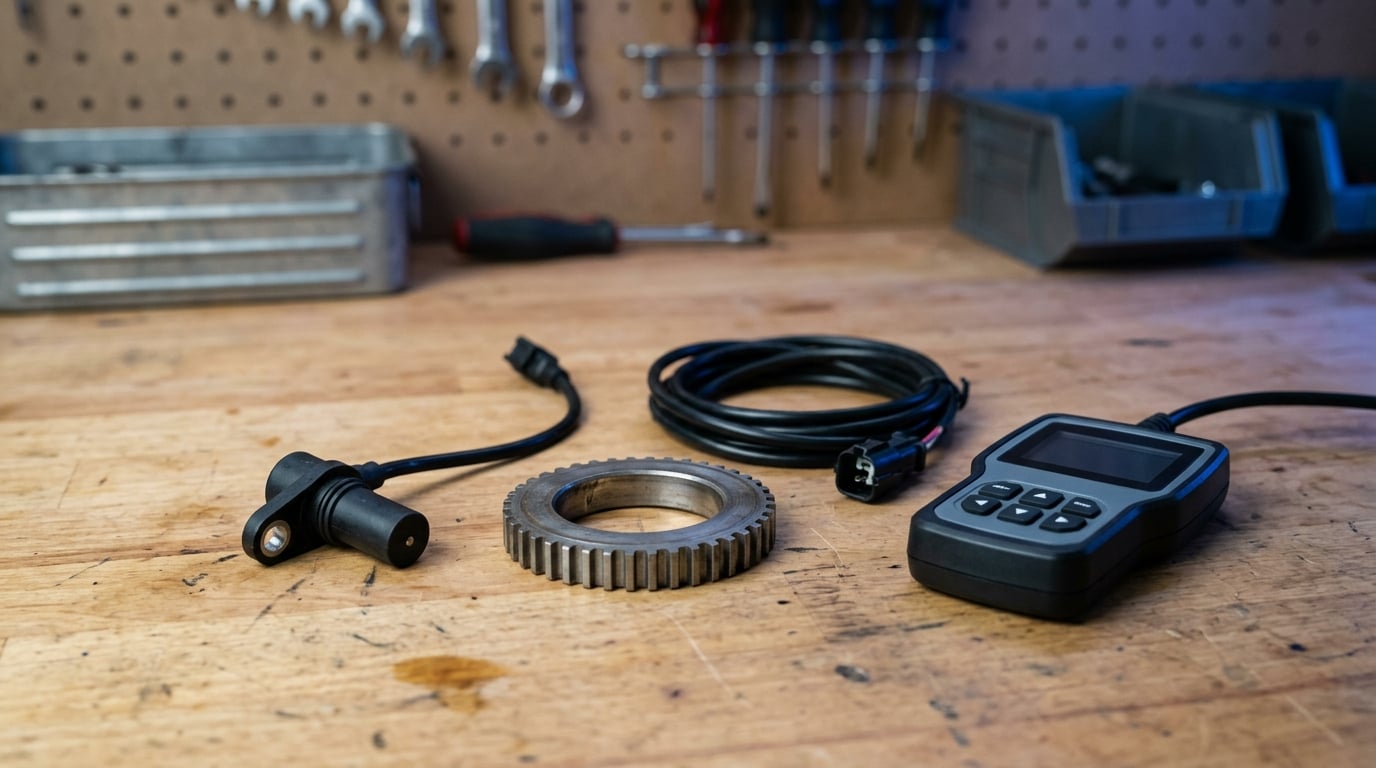
A vehicle speed sensor is a small electronic part that measures how fast the car is moving and reports that number to the computers that run the gauge cluster, the automatic transmission, ABS and traction control. When the signal goes bad, you usually find out through a dead speedometer, an ABS light, or a transmission that shifts like it has no idea how fast you are going.
What is a vehicle speed sensor, exactly, and why does one small part cause so many different warnings? This guide covers where these sensors live, how they work, what fails, and how to test one before you buy a part you may not need.
Last reviewed for 2026. Always follow your owner’s manual and manufacturer service information for your specific vehicle.
Table of Contents
- What Does a Vehicle Speed Sensor Do?
- Where Is the Vehicle Speed Sensor Located?
- How Does a Vehicle Speed Sensor Work?
- What Are the Different Types of Vehicle Speed Sensors?
- What Symptoms Does a Bad Vehicle Speed Sensor Cause?
- What Causes a Vehicle Speed Sensor to Fail?
- How Do You Test a Vehicle Speed Sensor?
- Can You Replace a Vehicle Speed Sensor Yourself?
- Frequently Asked Questions
- What Should You Do First?
What Does a Vehicle Speed Sensor Do?
A vehicle speed sensor (VSS) measures rotational speed at the transmission output shaft and sends that data to the engine, transmission and ABS control computers. It feeds the speedometer, sets automatic shift points, and helps stability systems decide how much each wheel is slipping. Most modern cars have no single VSS at all — they calculate road speed from four wheel speed sensors instead.
Here is what the signal actually controls:
- Speedometer and odometer: The needle and the mileage counter both come from the same speed signal. A very common report is the speedometer, trip meter and average fuel economy all dying at the same moment, which is a useful clue.
- Automatic transmission shift points: The transmission control module needs to know vehicle speed to decide when to shift. A missing signal means shifts are guessed, delayed, or made in emergency mode.
- ABS and stability control: Brake-by-wire ABS needs wheel speed far more often than it needs a transmission-derived speed, so a single fault can set codes in the engine, transmission and ABS modules at the same time.
- Cruise control and driver assistance: Adaptive cruise and some lane-keeping systems refuse to engage without a valid speed signal.
The exact functions vary by model. On many AWD and 4WD vehicles, a transfer case control module also reads speed sensors on the output shafts, so the count of speed sensors on the car can be five or six rather than one.
Where Is the Vehicle Speed Sensor Located?
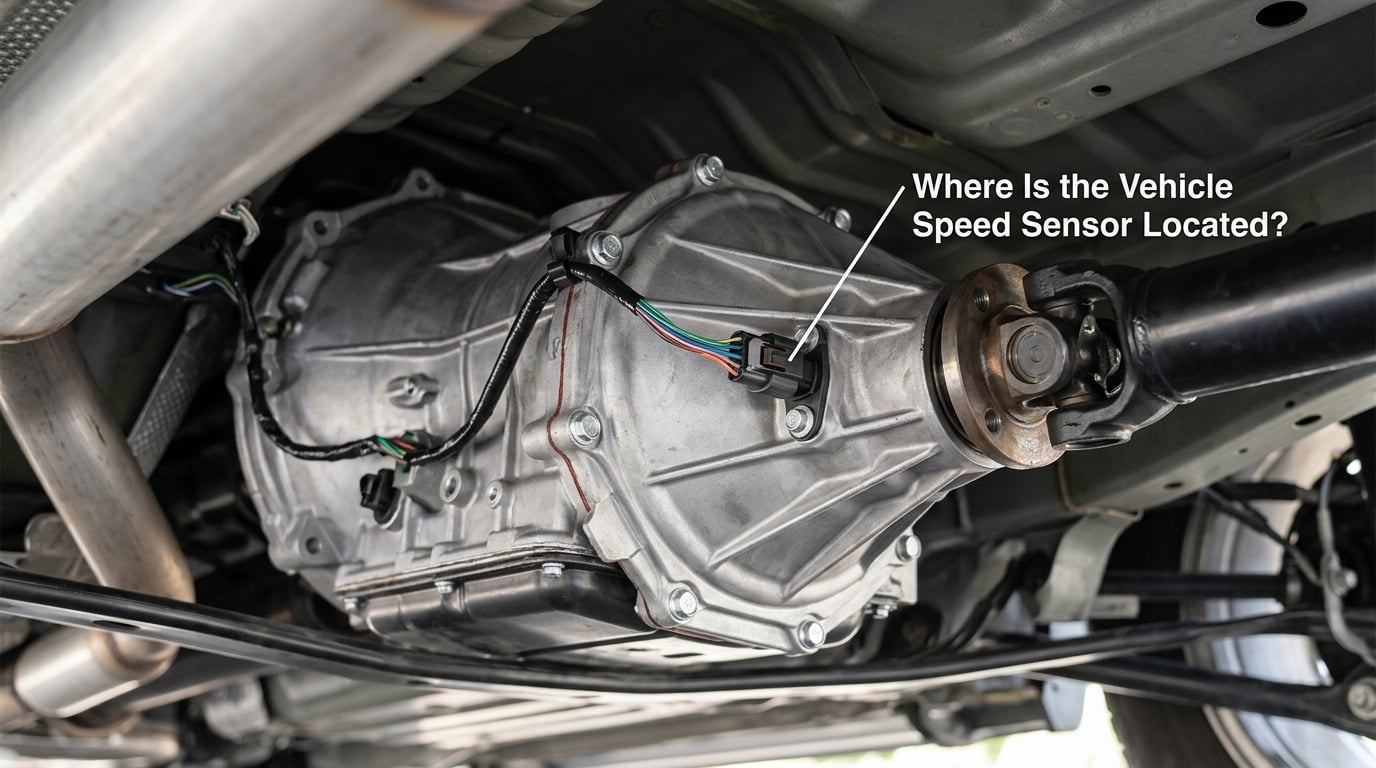
On most cars, the transmission VSS sits on the transmission housing near the output shaft, or on the tailshaft extension where the driveshaft enters the transmission. The wiring connector usually comes through the harness under the car, which is where the connectors get water intrusion and road salt.
Modern cars shift the job to the wheel hubs. Each corner has a sensor reading a toothed ring pressed into the hub or brake rotor, and the ABS module averages all four to get road speed. There is no separate VSS to find, which is the single most common source of confusion on newer vehicles.
| Location | Wheels monitored | Typical applications | Common symptoms when faulty |
|---|---|---|---|
| Transmission output housing | All four, derived | Older two-wheel-drive cars, many pickups and vans with a tailshaft | Speedometer dead, odometer stops, harsh or delayed shifting |
| Tailshaft extension | All four, derived | Rear-wheel-drive vehicles with a separate extension housing | Intermittent over bumps, erratic gauge readings |
| Rear axle or differential housing | Rear axle | Solid rear axles, some older trucks and SUVs | Speedometer jumps, transmission faults, ABS light |
| Each wheel hub or brake rotor | One wheel each | Nearly all modern vehicles with ABS | ABS or ESP warning light, traction control off, one wheel reading zero |
| Transfer case output shafts | Front and rear output | AWD and 4WD trucks and SUVs | Tire wear mismatch, transfer case codes, wrong 4WD engagement |
BMW models often use different arrangements from the rest of the industry, including electronically controlled motors on some steering and axle applications. Identify your car by VIN or by the sensor part number on the housing rather than guessing from a forum post about a different platform.
How Does a Vehicle Speed Sensor Work?
Most speed sensors work by counting teeth. A toothed ring made of magnetic material — called a reluctor ring, tone ring, or tone wheel depending on the manufacturer — is pressed onto or built into the rotating shaft. As the shaft turns, each tooth passes the sensor and disturbs its magnetic field.
A passive sensor, usually a variable reluctance pickup, produces a small alternating voltage with every tooth that passes. The frequency of that voltage climbs with speed: twice the speed, twice the frequency. The control module counts the pulses and converts the frequency into a road-speed reading.
An active sensor works differently. A Hall element senses the magnetic field and its electronics condition that into a clean square wave or PWM signal carrying its own supply and ground, which is why testing one with a resistance meter alone tells you almost nothing.
Two details explain a lot of failures. The air gap between the sensor tip and the target ring is measured in fractions of a millimetre, and a bent or scraped ring changes that gap instantly. Tooth count is a compromise too: more teeth give finer resolution at a crawl but a higher frequency at motorway speed.
How a Vehicle Speed Sensor Communicates With the ECU
The sensor’s signal wire runs to a control module, either the transmission control module or the ABS module, which measures the frequency of the pulses and converts that into a speed value in kilometres per hour or miles per hour. That value is then broadcast across the CAN bus, so the instrument cluster, engine control unit and cruise control all read the same number from the same source.
Because the value is shared, a fault in one wire or connector can light the check engine light, the ABS light and a transmission code at the same time. That is a normal result of the design, not evidence of three separate failures, so expect the same speed sensor code to appear in several modules on one car.
What Are the Different Types of Vehicle Speed Sensors?
Two families do nearly all the work: an output shaft sensor that watches the transmission, and a wheel speed sensor at each hub. Within each family, the electrical design varies, and that is what decides how they fail and how you test them.
| Sensor type | Signal | Strengths | Limitations |
|---|---|---|---|
| Passive variable reluctance (output shaft) | Alternating voltage, frequency rises with speed | Simple, cheap, no power supply needed | Weak signal at very low speed, no direction detection, needs a large air gap tolerance |
| Active Hall effect (output shaft) | Square wave, 5V supply and ground | Accurate near zero speed, strong signal, can detect rotation direction | Needs clean power and ground, fails harder with a shorted or corroded connector |
| Active digital wheel speed sensor | Current-modulated square wave | Very accurate, works at crawling speed, used by nearly all modern ABS systems | Resistance measurement is meaningless; needs live data or a scope to judge |
| Magnetic encoder (some European models) | Multi-track magnetic sensing with internal conditioning | Very high resolution, built-in direction information | Often not serviceable separately, needs a scan tool to verify |
Replacement parts must match the electrical standard and the ABS requirements of the vehicle. A cheap passive sensor wired into a car expecting a powered active sensor will read zero. Verify the part number, connector pin count and any software calibration requirement before you fit anything.
What Symptoms Does a Bad Vehicle Speed Sensor Cause?
Symptoms cluster by which system loses its data. Read the whole list, but remember that almost every one of these signs has other causes, and none of them proves the sensor itself is the failed part.
Instrument cluster symptoms
- Speedometer needle stuck at zero while the car is moving
- Speedometer that flickers, drops out, or reads wrong on hills
- Odometer and trip meter frozen, with the check engine light on
- Distance-to-empty and average fuel economy stuck or resetting on their own
Transmission symptoms
- Harsh shifts, late upshifts, or the transmission hunting between gears
- Shifts that never happen, or a car that feels like it is in the wrong gear
- Emergency mode or limp mode, often with a transmission warning light
ABS and stability control symptoms
- ABS, ESP or ESC warning light with the light on constantly rather than only at startup
- Traction control and hill-descent control switching themselves off
- Cruise control that will not set, or drops out without warning
Tire symptoms
- Uneven or feathering wear across the tire tread, usually on one axle
- One tire wearing much faster than the others, which can follow a long-standing ABS fault
One pattern that comes up repeatedly is simultaneous brake and ABS warnings plus a speedometer that dies above about 30 mph, all traced to a single rear wheel speed sensor. The opposite mistake happens too: swapping a differential speed sensor on a truck and still having a wrong odometer reading, because the real fault was in the tone ring or the wiring. If you see uneven tread, read what is tire feathering and what causes it before ordering a sensor.
What Causes a Vehicle Speed Sensor to Fail?
The sensor itself is the least likely culprit. Work down this list in order.
- Damaged wiring: Chafed insulation where the harness passes over the exhaust or the driveshaft, or where it hangs from a bracket. This is the most common cause of a fault that appears only over bumps or in the rain.
- Corroded connector: Green or white crust on the pins, water pooled in the housing, or a connector that no longer clicks shut. A connector that is not fully seated will still push the sensor into the “failed” list on a scan tool.
- Dirty or damaged target ring: Rust, road salt, magnetic debris, a scraped tone ring, or a ring with a chipped tooth. Fine ferrous filings stick to a reluctor ring remarkably easily.
- Internal sensor failure: The coil or Hall element degrades, usually with age and heat, and the signal drops or goes intermittent.
- Oil or fluid contamination: Transmission fluid or gear oil in the connector, or a leak that gets into the sensor bore.
- Heat and vibration: Sensors sit inches from an exhaust pipe or a transfer case. Constant vibration loosens connectors and cracks solder joints inside the sensor.
- Impact damage: A rock strike, a pothole, or a wheel and tire change done with a hard knock to the hub. A new ABS light right after a tire change is worth checking before anything else.
Just as important is what is not the sensor: a worn wheel bearing with play in it, a bent rim, a brake caliper dragging, a tire with a pressure or balance problem, a failing instrument cluster, a low battery or a CAN bus fault. A code that says “high resistance or open circuit to speed sensor” reports what the module saw, not which part created it, and chasing the sensor on that code alone is how people end up replacing a good part twice.
How Do You Test a Vehicle Speed Sensor?
Testing works best as an escalating ladder, cheapest tools first. Stop at the first step that gives you a clear answer.
1. Read the stored codes. A scan tool tells you which module is complaining. Code P0500 covers the vehicle speed sensor range on most cars, but manufacturer-specific codes carry more detail.
2. Watch live speed data. Most scan tools show real-time wheel speed for all four corners. This is the step that saves the most money, because it separates a dead sensor from a wiring problem in minutes. If you are building a kit, our guide to what tools you need for basic car maintenance covers the scan tool and multimeter basics.
3. Road test and compare. Drive safely on a straight road and watch the four readings against each other and against the speedometer. A reading that drops to zero while the others hold means a sensor or its wiring. All four jumping together in a straight line usually points to a tone ring or an encoder fault instead.
4. Inspect the wiring and connector. Unplug the sensor, look for green crust, bent pins, water, or a connector that does not latch. Flex the harness a few centimetres at a time while watching the live data; an intermittent reading that comes and goes with the flex is a harness problem, not a sensor.
5. Measure only what the manufacturer says to measure. On a passive sensor, a resistance or AC voltage check across the two-wire connector is meaningful. On an active Hall effect sensor, resistance testing tells you nothing useful, and checking supply voltage and ground is the correct move instead.
6. Use a scope when the wiring is good. An oscilloscope shows the waveform, and a square wave that collapses, clips, or drops cycles under acceleration points straight at the sensor. Jumper-wire tests that circulate a fake signal are a common technique on the ABS side of the job, though the wiring has to be cut in the right place for the result to mean anything.
Exact pin assignments, expected voltages, air gap specifications and safety precautions come from the vehicle service manual. Guessing at those on a car with ADAS and radar-linked braking is not worth the gamble.
Can You Replace a Vehicle Speed Sensor Yourself?
Yes, on most vehicles, and a wheel speed sensor at the hub is one of the friendlier jobs in DIY work. A transmission output sensor is more involved because of access and sometimes fluid drainage.
- Identify the exact part. Match the part number, connector shape, and whether the car expects a passive or active sensor.
- Get safe access. Jack the car properly on rated stands or ramps, support the vehicle on axle stands, and never work under a car resting on a jack alone. Expect to remove a wheel, a shield, or the exhaust on some layouts.
- Disconnect the battery. This prevents accidental shorting and stops the memory from being lost while the connector is apart.
- Remove the old sensor. Unplug the connector, release the harness from its clips, and back the sensor out. Keep the mounting hardware and note how the harness was routed.
- Protect the opening. Plug the opening or tape the harness so grit does not fall into the transmission or the wheel hub while the sensor is out.
- Fit the new sensor and route the harness. Do not let the cable touch anything hot or moving. Clip it where the original clipped it, and confirm the connector fully latches.
- Clear the codes and verify. Clear stored codes, then watch live wheel-speed data on a road test to confirm a steady reading from the repaired corner.
Some vehicles need more than that. Air or hydraulic suspension may need to be dropped, some BMW and European models require the new sensor to be taught to the module, and AWD transfer case sensors can mean pulling the transfer case. If the manual says calibration or a scan-tool check is required, skip the DIY route and let a shop handle it.
Frequently Asked Questions
Can a bad vehicle speed sensor cause tire wear?
Yes, indirectly. When an ABS or stability system detects an implausible wheel speed, it disables itself or intervenes unpredictably, and the braking on that corner becomes inconsistent. Driving that way for long enough produces feathering, cupping, or one tire wearing far faster than the others. A worn wheel bearing or a bent rim can cause the same pattern, so confirm the wheel speed data before blaming the sensor.
Is it safe to drive with the ABS or vehicle speed sensor warning on?
You can usually drive to a shop carefully, but you have lost a safety system. ABS, traction control, and stability control will typically switch off or behave unpredictably, and an automatic transmission may run in emergency mode. Stop driving if the brake pedal feels soft, the transmission bangs between gears, or the speedometer shows nothing at highway speed. Towing is the safer choice if those show up.
Can I replace a vehicle speed sensor myself?
On most cars, yes, especially a wheel speed sensor at the hub. You need axle stands, basic hand tools, a scan tool, and the correct part. A transmission output sensor is harder because of access and sometimes fluid drainage. BMW and some European models may require the sensor to be taught to the control module afterwards. Follow the manufacturer service manual rather than a generic video.
How much does it cost to replace a vehicle speed sensor?
Totals vary widely by region, shop, and sensor location, so get a written quote for the part and labor together rather than comparing part prices alone. A hub sensor is usually a short job on an axle stand. A transmission output sensor can mean draining fluid, a lift, and extra access time. Owners regularly complain that the labor figure dwarfs the part, which is why confirming the fault first matters.
Will disconnecting the battery clear a vehicle speed sensor code?
It clears the code, not the fault. The light and stored codes stay off until the module sees the problem again, and a sensor that is genuinely failed will set the same code within a few minutes of driving. A code that never comes back points at a loose connector, damaged wiring, or a real intermittent fault, so write the code down before you disconnect anything.
What Should You Do First?
Get the exact stored codes and the live wheel-speed readings before you buy anything. On most cars, a scan tool and twenty minutes of road testing tell you whether the fault is a sensor, a connector, or a stretch of wiring, and that single step prevents most wasted repairs.
After that, work the cause list in the order above: wiring and connectors first, then the target ring, then the sensor itself. If a component does come out, match the part number and confirm whether the vehicle needs a calibration step afterwards, and make sure fasteners go back to the specified torque with a proper tool, as covered in what a torque angle gauge is used for. Follow the owner’s manual and manufacturer service information for your specific car.