
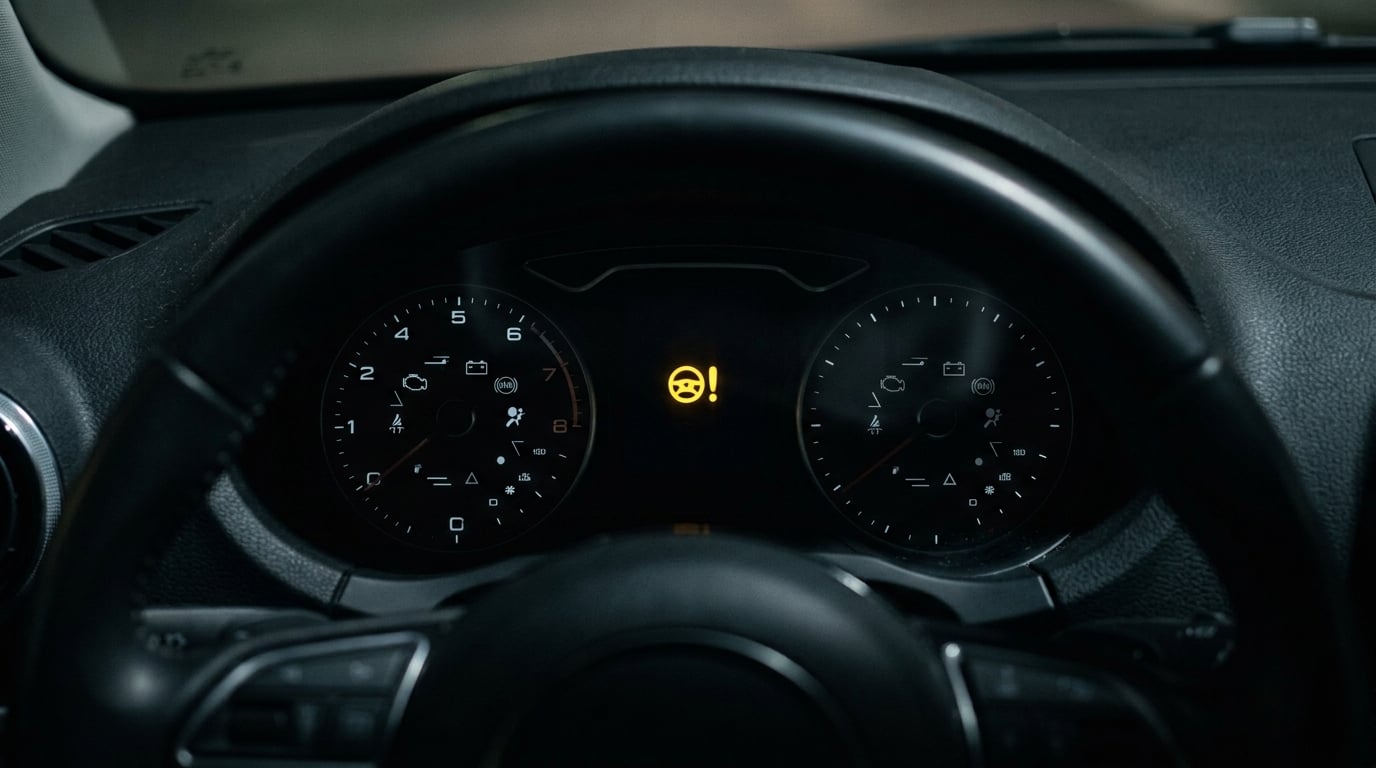
A yellow steering wheel light usually means a stability or traction system has cut in after the car detected wheel slip, uneven grip, or a similar driving condition. On some cars the same icon points at a tire-pressure alert, reduced steering assist, or a brake fault, so the shape of the symbol matters more than the color. Read the icon before you read the color.
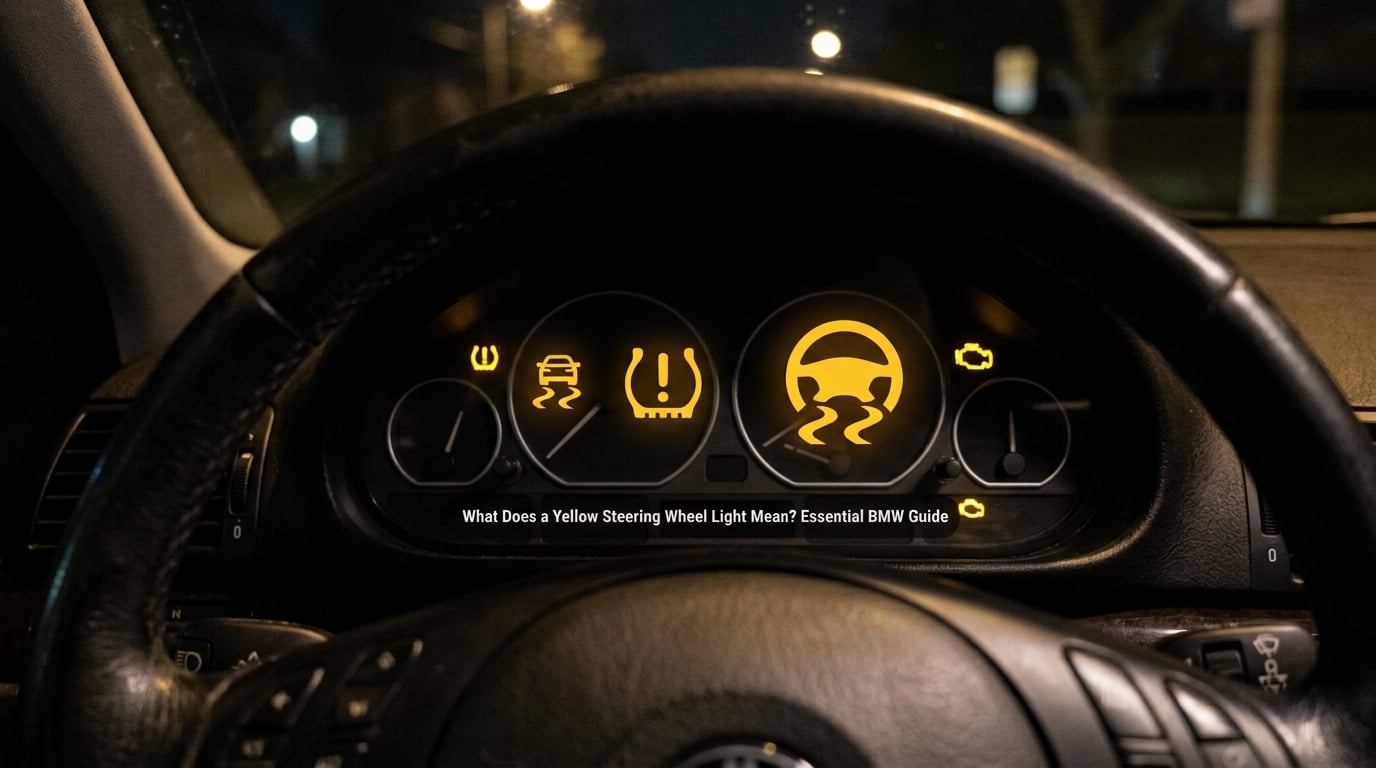
Most drivers who search this end up in one of two camps. One group just drove through a downpour and the light came on for a few seconds and went away. The other group woke up to it in the driveway with no obvious reason. Both are common, and both have a sensible next step.
Before anything else, work out whether you are looking at a steering wheel with a skid mark across it, a steering wheel with an exclamation mark inside it, or a plain steering wheel outline. Those three look similar at a glance in a photograph and mean different things. If you can photograph the cluster and match the icon against your own manual, you will save yourself an expensive guess.
Table of Contents
- Yellow Steering Wheel Warning Meanings at a Glance
- Why Does the Steering Wheel Light Turn Yellow?
- What Should You Do When the Warning Light Comes On?
- What Problems Can Trigger This Dashboard Warning?
- How Can You Tell a Traction Warning From a Tire or Steering Fault?
- Do You Need to Fix the Car Right Away?
- How Do Technicians Diagnose a Yellow Steering Wheel Warning?
- Frequently Asked Questions
- Can I drive with a yellow steering wheel light on?
- Why does the steering wheel light come on during rain or snow?
- Is a yellow steering wheel symbol the same as a low tire-pressure warning?
- Why would a BMW show a yellow steering wheel warning with no obvious problem?
- Does clearing the code turn off the yellow steering wheel light?
- What Should You Do First?
Yellow Steering Wheel Warning Meanings at a Glance
Most dashboards use color to set urgency: green or blue means a system is switched on, yellow or amber means a system needs attention soon, and red means act now. Within that scheme, the shape of the symbol tells you which system is complaining.
| Symbol shape | Usual color | What it means | How urgent | First move |
|---|---|---|---|---|
| Steering wheel with skid marks or a squiggly line through it | Yellow or amber, often flashing briefly | Traction or stability control detected slip and adjusted or reduced a driving aid | Low if it goes away by itself | Slow down, ease off the accelerator, allow the light to self-clear |
| Steering wheel with an exclamation mark inside the rim | Yellow or amber | Tire-pressure monitoring system or steering-assistance fault, depending on the vehicle | Medium, act within days | Check tire pressures cold and read the text messages in the cluster |
| Plain steering wheel outline, no inner symbol | Yellow or amber | Steering assistance reduced or disabled, or a stored steering fault | Medium to high depending on how the car steers | Test the steering at low speed in a safe area |
| Exclamation mark inside a circle or triangle, no steering wheel | Red, sometimes yellow | Brake system or brake fluid problem | High if red | Ease off and stop safely, then check the fluid and braking |
| Tire cross-section with an exclamation mark | Yellow or amber | Tire pressure low, or a tire sensor has failed | Medium | Inflate to the door-jamb value, then recheck cold |
Read the shape column before anything else. A red light on a car built in one decade can carry a different urgency than a red light on a newer cluster, and the same amber icon can mean traction on one model and tire pressure on another.
Why Does the Steering Wheel Light Turn Yellow?
Because a system behind that icon just changed what your car is doing. The stability controller compares what each wheel is doing to what the car is actually doing, and when the two disagree it steps in, sometimes briefly cutting torque or easing off one brake. That intervention lights the amber symbol while it is happening, and many cars cancel the light the moment grip returns.
Picture a wet road on a bend. One tire crosses onto a painted line, grip drops, the car begins to yaw a little, and the controller decides you do not need that much throttle. The amber symbol may appear for a second or two. If you lift off and let the system do its job, it usually cancels and never comes back.
It is also a design choice. A warning that only ever meant bad news would be ignored. Making it a yellow, self-cancelling notice means the driver gets told the assist system stepped in, and gets told when the car is back to normal on its own.
What Does a Yellow Steering Wheel Light Mean on a BMW?
On many BMWs, a yellow steering wheel icon is tied to Dynamic Stability Control rather than to the steering rack itself. Traction, stability control, and related warnings are grouped, and a yellow icon can accompany them on some generations, so the same picture can point to a slip intervention or to a stored fault. The compact image in the instrument cluster, plus any written line beneath it, is what separates the two.
A second BMW-specific wrinkle: some cars display a tire-pressure message alongside the warning rather than a separate symbol, so owners often assume the light is about steering when the cluster is really reporting a pressure problem. Generation and model year matter enough that I would not generalise from one BMW to another.
The owner’s manual that came with the car settles it, and BMW’s own driver documentation lists the symbol set for the model. If the light stays on after the car is parked overnight and the key cycled, a dealer or independent shop with BMW diagnostic access can read the exact fault rather than working from the icon.
What Should You Do When the Warning Light Comes On?
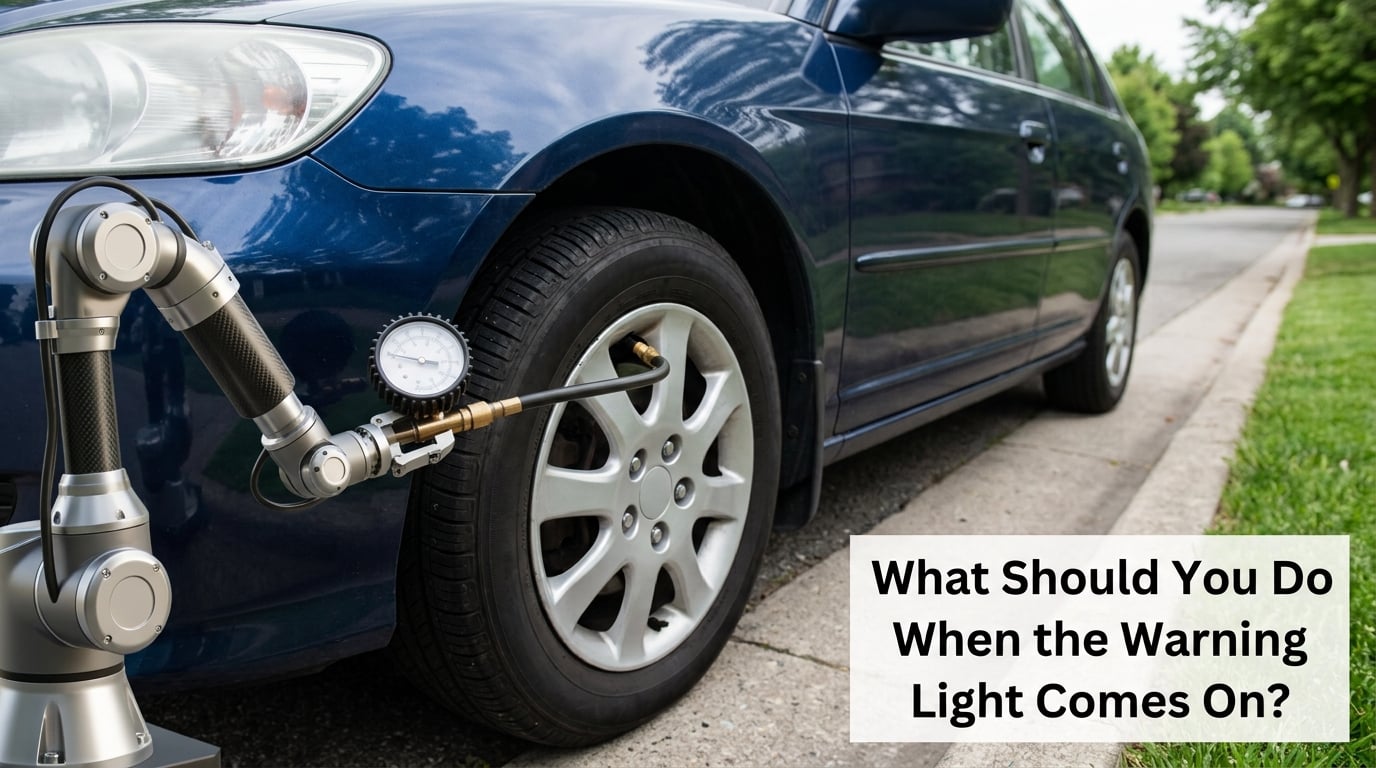
Lift off the accelerator smoothly and straighten the wheel. Avoid hard braking and sudden steering inputs while the light is showing, because a system that is already managing grip does not need help making it worse.
Then find a safe place to stop, level ground, out of traffic, and check the tires before you check anything electronic. Look at the tread for cuts, bulges, embedded debris, and obvious wear on one edge. Tread that looks flat on one side or a tire that has lost pressure since last week is a bigger clue than anything on the screen.
Read the rest of the cluster. Most cars with a color display will print a line of text under the icon naming the system, and that line takes ten seconds and often ends the investigation on the spot.
Finish by following the owner’s manual for that model. If the manual says the light should self-clear after an ignition cycle, turn the ignition off, leave the car, and start it again rather than trying to clear it with the key while the engine is running.
What Problems Can Trigger This Dashboard Warning?
Tires and road grip come first, because they are the cheapest to check and the most common reason the light appears for a moment. A tire with a nail in it, a slow leak, uneven wear, or a sidewall cut gives the controller exactly the kind of data it watches for. Water, oil, gravel, mud, and deep snow do the same thing without any fault at all. Cold weather shrinks pressure overnight, which is why the symbol shows up more often in January than in July.
If you want to understand what a worn tread edge does to grip in cold and slush, our piece on What Is Tire Siping and Does It Help? is worth a few minutes.
Wheel-speed sensors are the second group. One sensor sending a noisy or intermittent reading is enough to upset traction, ABS, and stability control, and the light can arrive alongside ABS and tire-pressure messages. Road salt, a stone chip, a magnet on a brake shoe, or a stretched harness connector at the wheel are all realistic causes. A steering angle sensor that has been knocked out of alignment after a kerb strike, a pothole, or suspension work can produce the same picture.
Brake components matter more than people expect. A sticking caliper, worn pads, or low fluid on a hydraulic system can change how the car behaves enough for the controller to log an event. If the brake warning comes on at the same time, treat the brake as the priority. Our guide to What Causes a Low Brake Fluid Warning Light? Guide covers that side.
Moisture and corrosion come next: connectors under the car, a harness rubbed against a bracket, a flooded footwell after heavy rain, or a battery terminal gone chalky. Water wicking into a connector makes a fault appear in wet weather and disappear when things dry out, which is a useful clue in itself.
Battery and electrical faults sit at the bottom of the list as a cause but at the top as an explanation for a lot of unexplained cases. Low voltage, a failing battery, a failing alternator, or a blown fuse can take out a steering-assist system that has no separate dashboard light of its own. If the car is slow to start, or the lights dim when you turn the key, look at the charging system before you look at the steering.
How Can You Tell a Traction Warning From a Tire or Steering Fault?
Compare the icon before you compare anything else. A steering wheel with skid marks or a squiggly line through it is a traction or stability notice. A steering wheel with an exclamation mark inside the rim is a different symbol on most vehicles. A tire cross-section with an exclamation mark is a pressure alert and looks nothing like a steering wheel at all.
Then ask when it appeared. A light that shows up only mid-corner on a wet road and vanishes when you straighten up is a slip intervention, and there is usually nothing broken. A light that is sitting there at every startup, on a dry road, with no heavy rain, points at a stored fault.
Next, look at the road and the tires. If the light shows every time you brake hard in the rain, or on the same stretch of wet road, you are looking at grip. If it is always there and one tire has a nail in it, that is your answer.
A simple case: a car shows a yellow icon every morning at low speed, and the cluster also prints a tire pressure message. The tire readings reveal one corner down by roughly a quarter of the usual road pressure. That is a tire and puncture problem, not a stability-control fault, and no amount of sensor resetting would touch it. A second car shows the skid-mark steering wheel icon for two seconds on a wet roundabout and never writes a message. That is the system working as intended.
Handling is the tiebreaker. Normal weight, normal effort, light that clears itself means a transient event. Heavy steering at parking speed, a burning smell, or a vibration means something is wrong mechanically and the car needs a proper look.
Do You Need to Fix the Car Right Away?
Usually not immediately, if the light is a brief yellow flicker on a slippery road and the steering feels exactly as it always does. That is an assist intervention, and it is not a defect. Ease up, let the system settle, and keep an eye on it rather than rushing to a shop the same minute.
Book a diagnostic soon rather than later when the light is solid, appears at every start, comes with a tire-pressure message, or arrives alongside ABS, brake, or check-engine messages. Multiple warnings usually mean one underlying sensor or one low battery is talking to several systems, and the cheapest fix in that group is nearly always the first thing you check.
Stop and get the car checked before you drive on if the steering is heavy at low speed, if the assist is gone and the wheel feels like the engine is off, if there is a burning smell, or if the car pulls to one side. Reduced assist at parking speed is the dangerous condition, not motorway cruise, because that is where you need the car to be precise.
If any of that applies, drive slowly to the nearest safe spot and arrange recovery rather than continuing. Roadside assistance or a tow is the sensible call when the car steers unpredictably, and it is far cheaper than a collision or a destroyed tyre.
How Do Technicians Diagnose a Yellow Steering Wheel Warning?
The first step is always a code scan, and on a BMW that means BMW-specific access rather than a generic reader, because the modules involved talk to each other. Stored fault codes turn a guess into a direction, and the code history shows whether the event was a one-off or a repeat.
Next comes a visual inspection: every tire for pressure, tread and sidewall damage, then the underbody for anything hanging low, rubbed, or wet. Technicians pull wheel-speed sensor data while the car is on a roller or with the wheels driven, because a fault that only shows at speed will not show in the driveway.
Sensors, connectors, and modules get tested in that order, followed by a check of battery and charging system voltage. Forcing a reset is the wrong move. Codes get cleared only after the cause is fixed, because clearing first just wipes the evidence and the light comes back with less information for everyone.
Exact test procedures vary by model and year, so a guide written for one generation is a starting point, not a procedure. If you want to work on anything yourself, our What Tools Do You Need for Basic Car Maintenance? piece covers the basic kit that makes a first look worthwhile.
Frequently Asked Questions
Can I drive with a yellow steering wheel light on?
Usually yes, if the light is a brief yellow flicker on a wet or slippery road and the steering feels normal. A self-cancelling traction notice means a stability system adjusted for a moment, not that something is broken. Slow down and let it clear. Stop and arrange help instead if the steering feels heavy at low speed, the assist is gone, you notice a burning smell, or the light stays on at every startup with no message. Those signs mean the car needs a proper diagnosis rather than a longer drive.
Why does the steering wheel light come on during rain or snow?
Because the tires briefly lose grip and the traction or stability system corrects for it. On a wet roundabout, a flooded junction, or packed snow, one wheel can slip while the car is still moving normally from the driver’s seat. The controller steps in and lights the amber symbol while it does. If the light goes away when you slow down and straighten up, that is normal behaviour of the assist system rather than a fault in your car.
Is a yellow steering wheel symbol the same as a low tire-pressure warning?
Not on most vehicles. A low tire-pressure alert uses a tire cross-section with an exclamation mark, while a traction warning uses a steering wheel with skid marks, and a steering wheel with an exclamation mark inside the rim is a third symbol. They can be confused in a photograph, especially on a full-color display. Read the shape carefully, and check whether the cluster also printed a written tire pressure message, since that settles the question immediately.
Why would a BMW show a yellow steering wheel warning with no obvious problem?
On many BMW models that icon belongs to Dynamic Stability Control, so it can reflect a slip intervention rather than a fault in the steering rack. Other common causes include low battery or charging voltage, a disturbed steering angle sensor after suspension or wheel work, a fouled wheel-speed sensor, or low tire pressure reported alongside the icon. Because the meaning shifts between generations, the written message in the cluster and your model manual are more reliable than any general guide, including this one.
Does clearing the code turn off the yellow steering wheel light?
It can, but only if the underlying fault is already fixed or was never real. Codes are cleared after diagnosis, not before, because clearing early wipes the stored freeze-frame data that shows the conditions during the fault. A light that stays off after a code scan and a proper repair is genuine. A light that comes straight back usually means the cause is still there, which on an electric-assist system most often points at battery voltage or a wheel-speed sensor.
What Should You Do First?
Identify the symbol rather than trusting the color. Look for skid marks, an exclamation mark inside the rim, or a plain wheel outline, and check whether the cluster printed a written message underneath.
Slow down smoothly and pull over somewhere safe. Check tire condition and cold pressure, look for anything damaged or embedded, and note whether the steering feels the same as it always does.
If the light clears itself and the car steers normally, keep an eye on it. If it stays on, comes back at every startup, or the steering has changed, book a diagnosis and mention any battery work, jump-start, pothole, or suspension repair that happened before it appeared. That single detail often saves an hour of hunting through unrelated systems.