
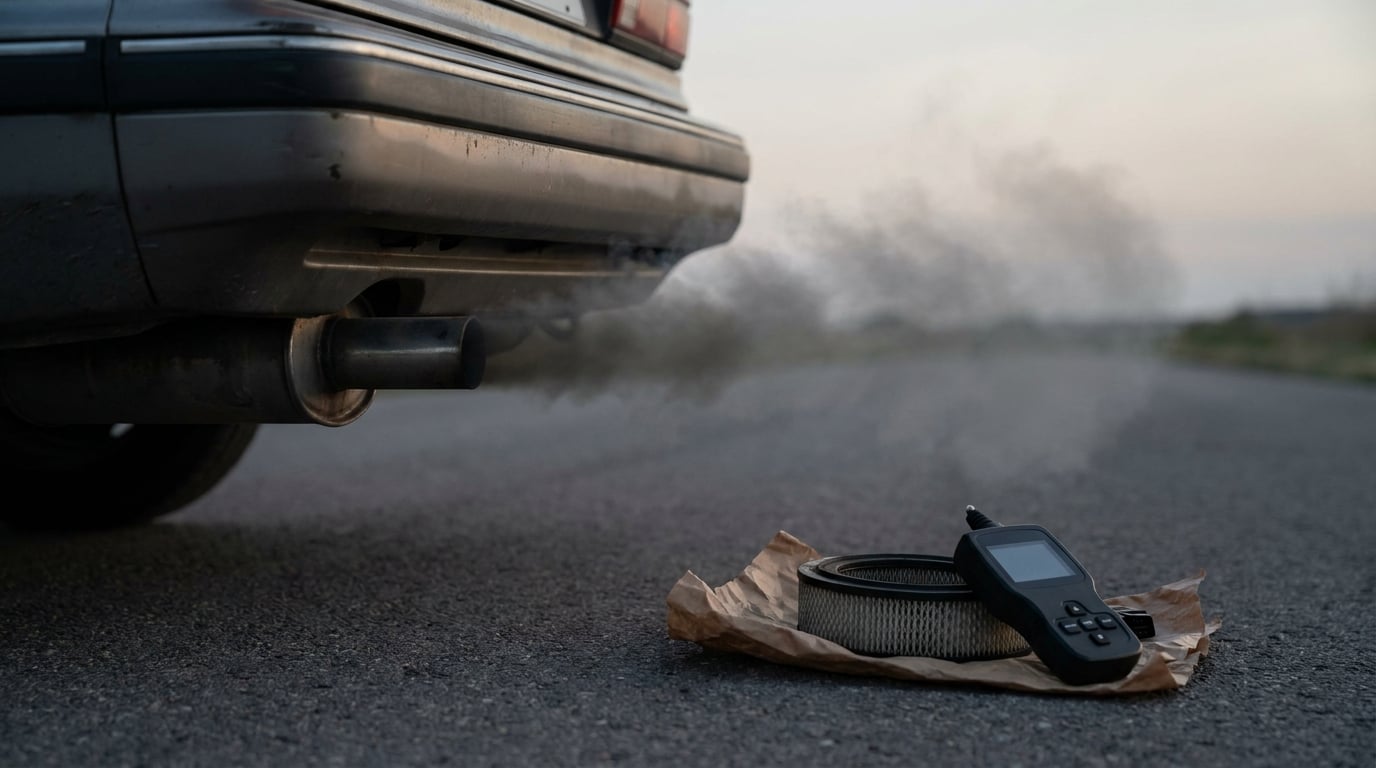
What causes black smoke from the exhaust? It almost always means your engine is running rich: burning more fuel than the incoming air can fully combust, so the leftover fuel leaves the tailpipe as black soot. A thin puff on a cold start is normal enrichment. A plume that follows you down the road is a fault worth chasing.
BMW engines are no different from other petrol or diesel engines here, but the specific faults they develop do come up again and again. Below I walk through what the smoke means, the causes in the order worth checking, and a diagnostic sequence you can run yourself in a driveway before you pay anyone.
Table of Contents
- What Does Black Smoke From the Exhaust Mean?
- What Causes Black Smoke From the Exhaust?
- Clogged or wrongly fitted air filter
- Mass air flow (MAF) and MAP sensor faults
- Oxygen sensor (lambda probe) faults
- Leaking or stuck-open fuel injectors
- EGR valve stuck open or carbon blocked
- Turbocharger faults on diesel engines
- Saturated diesel particulate filter (DPF)
- Oil burning from worn piston rings or valve stem seals
- Smoke that is not coming from the engine at all
- How to Tell Whether It Is Fuel or Oil
- Common Problems in BMW Engines
- How to Diagnose the Problem Safely
- When Is Black Smoke Serious?
- Frequently Asked Questions
- What to Do First
What Does Black Smoke From the Exhaust Mean?
Black smoke is unburned fuel and oil. Combustion needs an air-fuel ratio in a fairly narrow band, and when it goes too rich there is not enough oxygen left to burn all the fuel delivered. The leftovers heat up instead of burning and leave the exhaust as carbon particles, which is exactly what black smoke is.
Colour is a quick severity guide. It is not a diagnosis, but it tells you how fast you need to act.
| Smoke colour | Usual cause | Severity |
|---|---|---|
| White, thin and brief | Condensation from warm water vapour | None |
| White, thick and sweet smelling | Coolant entering the combustion chamber | Stop driving |
| Blue or grey | Oil burning on worn rings or valve stem seals | High |
| Black, thick and fuel smelling | Rich mixture from excess fuel | Medium, fix soon |
| Black, brief on cold start only | Normal cold-start enrichment | None |
One distinction matters more than any other. A brief black puff on a cold start that clears within seconds is the ECU deliberately adding extra fuel so the oil is warm enough to flow and protect the engine. A persistent plume, or smoke that reappears every time you load the engine, is a real fault.
Forums fill up with the same confusion, so it is worth saying plainly: diesels also run richer on cold start. Neither fuel type should produce a steady black plume once the engine is warm.
What Causes Black Smoke From the Exhaust?
Work down this list roughly in order of how often each one turns out to be the culprit. The first three account for most of what I have seen on road-going cars.
Clogged or wrongly fitted air filter
The cheapest cause and the most commonly missed one. A restricted air filter starves the engine of fresh air, so the same fuel load burns rich. A filter fitted upside down, or a performance intake fitted without a proper airflow sensor, does the same thing. Replacing a filter is a five-minute job and I check it before anything else.
Mass air flow (MAF) and MAP sensor faults
The MAF sensor measures how much air is entering; the MAP sensor infers the same thing from pressure. When either one drifts or reports nonsense, the ECU adds fuel against a false reading. Common on older BMW petrol engines with a known weakness in the sensor. Unburned fuel can also wash the sensor clean, which is why cleaning it is sometimes a fix.
Oxygen sensor (lambda probe) faults
The lambda sensor measures what comes out of the exhaust and trims the mixture. An old, lazy or contaminated sensor reports too rich or too lean and the ECU corrects the wrong way. Fault codes P0172 and P0175 are the classic rich-mixture pair, and replacing the sensor is usually quick and cheap compared with the fuel bill it causes.
Leaking or stuck-open fuel injectors
A leaking injector dumps more fuel than the ECU asked for, and an injector stuck open after a failed needle seat does it even at shutoff. On diesels the equivalent is over-fueling from too much rail pressure or poor atomisation. One bad injector can make the whole engine smoke; pull the spark plugs and look for sooting on one cylinder only and you have your answer.
EGR valve stuck open or carbon blocked
The EGR valve feeds a controlled amount of exhaust gas back into the intake to control temperature. Stick it open on a diesel and the engine swallows far more exhaust than intended, soot included. Drivers then see a dark haze at idle and low revs, especially from cold. Short trips make it worse, which is why a long motorway run at steady speed can help clear light carbon build-up.
Turbocharger faults on diesel engines
The turbo supplies most of the air a diesel needs. A failed wastegate actuator, a cracked hose, a slipping shaft or a clogged oil feed starves the engine of boost exactly when you ask for it, and the extra fuel that goes unburned turns into black smoke. Turbo faults are the most expensive common cause, and they often arrive with a hissing noise or a power cut rather than smoke alone.
Saturated diesel particulate filter (DPF)
A DPF traps soot. If regen cycles stop working, or the car lives on short trips where the filter never gets hot, the filter fills up and exhaust gas has nowhere to go. The DPF will not normally vent black smoke to the tailpipe, but a saturated filter raises back pressure and pushes the engine rich, which does. Code P2002 is the one to read.
Oil burning from worn piston rings or valve stem seals
Oil burning produces blue smoke, not black, but heavy oil in the combustion chamber tips the mixture rich enough that it can darken. Worn piston rings, tired valve stem seals or a failed turbo oil seal all feed it. Check the oil level between services; a dipstick that keeps climbing is a clearer sign than anything at the tailpipe.
Smoke that is not coming from the engine at all
Sometimes the black debris blowing out of the tailpipe came from the pipe itself. Water and soot collect in the low bend of a corroded exhaust elbow, then release as a lump on start-up. It looks dramatic and it is harmless. It is also the answer when an older diesel suddenly emits a one-off puff of chunky black stuff on a cold morning and then drives normally.
How to Tell Whether It Is Fuel or Oil
Black is fuel, blue is oil, and the table below is the shortcut. Match what you see and hear against the two columns.
| What you notice | Likely to be | Check next |
|---|---|---|
| Smoke only when accelerating hard | Fuel, under boost or load | Turbo, injectors, MAF, boost pressure |
| Smoke at idle, clears with revs | Fuel | EGR valve, cold-start enrichment if cold only |
| Puff on start, gone in seconds | Normal enrichment | Nothing, unless it happens when warm |
| Strong smell of raw fuel | Fuel | Injectors, air filter, oxygen sensor |
| Blue-grey haze, oil smell | Oil | Piston rings, valve stem seals, turbo seal |
| Oil level drops between services | Oil burning | Turbo oil feed, rings, PCV system |
| Soot blob on start, then normal | Exhaust elbow debris | Nothing, check the pipe clamp and rust |
| Rough idle, stumble, poor economy | Fuel | Fault codes, vacuum leaks, injectors |
| Engine light on, power cut under load | Fuel or turbo | Read codes before touching anything |
Diesels are never meant to run rich once warm. That one fact removes most of the argument you will read online about a diesel that smokes.
Common Problems in BMW Engines
BMW builds share a lot of hardware with the rest of the industry, so the general causes all apply. Some faults simply show up more often on these engines, and model year matters more than badge. Check what your car actually has before buying parts.
Direct injection petrol engines from the 2000s onwards commonly suffer from carbon build-up around the intake valves, because fuel no longer washes the valves clean. Heavy carbon raises the chamber temperature, which is often reported as black smoke under load alongside a misfire. A decarbonising treatment or an intake clean addresses it; the old routine of a long motorway drive only works on light build-up.
Turbocharged diesels in particular need attention to the oil feed lines. A starved turbo journal wears, drips oil into the exhaust and down the pipe, and the resulting smoke can look black at the tailpipe just as easily as it looks blue. Any hiss, whine or sudden power drop under load deserves a look at the oil lines and actuator hoses.
Valve cover oil leaks are extremely common on older BMW petrol engines. The oil runs down the spark plug tubes into the cylinder, so the engine burns its own oil and the tailpipe darkens. The tell is fresh oil around the plug wells or the top of the spark plug boots, often with a rough idle. This one gets ignored for months because the smoke looks mild.
The digital motor electronics (DME), the engine control unit, can also command wrong fueling when a wiring loom problem or water ingress puts its readings out. That is rarer, but it comes with a long list of unrelated codes stored at once, which is the clue that points away from a single sensor and toward the module or its supply.
How to Diagnose the Problem Safely
Read the codes before you remove anything. The single most useful ten minutes of diagnosis costs nothing and saves people from replacing parts at random. Then work through this sequence, and stop if any step needs the engine running hot or a lift.
- Look underneath the car in daylight. Open the oil filler cap on a warm engine and check for a strong fuel smell or oil film around the cap.
- Remove the air filter and look at it. Hold it up to a light; a filter that blocks the light is a restricted filter, and a torn or incorrectly fitted one is a fault.
- Check oil and coolant levels, then look at the dipstick again after a drive.
- Read stored and pending fault codes with an OBD2 scanner, and write the codes down before clearing them.
- With the engine cold, pull the spark plugs on a petrol engine and compare them. Soot on one plug points at that cylinder’s injector.
- Look along the intake hoses for splits, clips missing or a sensor hose disconnected.
- Watch the smoke pattern under controlled conditions: stationary, then gentle acceleration, then a full-throttle run on a quiet road.
OBD2 fault codes worth knowing
| Code | Meaning | Typical direction |
|---|---|---|
| P0171 / P0172 / P0174 | System too lean / too rich | Air filter, MAF, lambda sensor, injectors, fuel pressure |
| P0175 | Excess fuel, rich or lean | Usually a vacuum leak or a fuel delivery problem |
| P0101 / P0102 | Mass air flow circuit | MAF sensor and its wiring |
| P0400-P0405 | EGR flow | EGR valve carbon, actuator, EGR cooler |
| P0299 | Turbocharger underboost | Wastegate actuator, boost hoses, turbo |
| P2002 | DPF efficiency below threshold | Regen failures, short trips, failed EGR |
Once you know the cause, the fix is usually direct. New air filter, new lambda sensor or cleaned MAF, injectors cleaned or replaced, EGR valve cleaned or replaced, wastegate actuator replaced, DPF repaired or replaced once the root cause is fixed. Note that a DPF replacement is wasted money if the EGR or turbo fault that clogged it is still there.
When Is Black Smoke Serious?
Black smoke sits in the middle of the severity scale, not the top. A cold-start puff is nothing. A plume that never clears, paired with a warning light or a drop in power, should be dealt with within days rather than weeks. Left alone it raises fuel consumption, washes oil into the exhaust, clogs the DPF and the catalyst, and eventually fails an emissions test.
Stop and get it checked straight away if you notice any of these:
- An oil pressure warning, or an oil level that keeps climbing
- Coolant disappearing or a sweet smell from the exhaust
- Severe knocking, banging or rattling under load
- Sudden power loss, or the engine going into protection mode
- Overheating, or a temperature warning light
- White smoke mixed in with the black
On legality: exhaust smoke has to be excessive to fail a roadworthiness test, and a car running visibly rich can be failed on emissions. That is a second reason to fix it rather than live with it.
Frequently Asked Questions
Is black smoke from the exhaust always bad?
No. A brief black puff when you first start a cold engine is normal cold-start enrichment, where the ECU adds extra fuel so the oil warms and flows. It clears within seconds and is nothing to worry about. Black smoke that persists once warm, returns every time you accelerate, or comes with a warning light is a genuine rich-mixture or oil-burning fault and should be diagnosed.
Why does my car produce black smoke when I start it?
On a cold start the engine is fed extra fuel on purpose, and incomplete combustion during that first moment leaves soot that puffs out and disappears. A longer-lasting plume on start-up means something is wrong, especially if the smoke is thick, smells strongly of fuel, or the engine is already warm. Check the air filter, injectors and MAF sensor in that case.
What does black smoke mean in a gasoline engine?
On a petrol engine it means the mixture is too rich, so excess fuel burns incompletely and leaves black soot. Usual suspects are a restricted air filter, a MAF or MAP sensor that misreads airflow, a faulty oxygen sensor, or injectors that leak. Black smoke from a petrol car is less common than on a diesel and worth checking sooner, because the engine is usually losing power and economy with it.
Can a dirty air filter cause black exhaust smoke?
Yes, and it is the first thing to check. A clogged filter starves the engine of air, so the same fuel load runs rich and burns incompletely. It is also the cheapest fix, usually just a filter and a few minutes. A filter fitted the wrong way round, or an aftermarket intake fitted without the proper airflow sensor, can produce exactly the same symptom.
Does black smoke mean the catalytic converter is bad?
Not usually, and people often replace the converter when the real fault is upstream. A failed converter is far more often the result of a rich-running engine, with the unburned fuel glazing the ceramic. If you fix the mixture, the converter often recovers. Codes for exhaust efficiency and stored rich-mixture codes are worth reading before you commit to a converter.
Should I keep driving if my BMW is making black smoke?
A short puff on a cold start is fine to drive. Persistent black smoke, especially with a warning light, rough idle or power loss, means you can drive carefully to a workshop but should not continue long-distance until it is looked at. Stop immediately if you get knocking, coolant loss, an oil pressure warning or overheating. Those symptoms can mean engine damage within miles.
What to Do First
Note when the smoke actually appears, because cold-start enrichment and a fault under load point at completely different things. Then pull the air filter, look for leaks under the car, check your oil and coolant, and read the fault codes before you remove anything else.
If the smoke persists once the engine is warm, or comes with a warning light, knocking, coolant loss or a power cut, book a diagnostic with someone who works on your engine type. On a BMW turbo diesel, the turbo oil lines and the EGR deserve a proper look rather than a guess.