
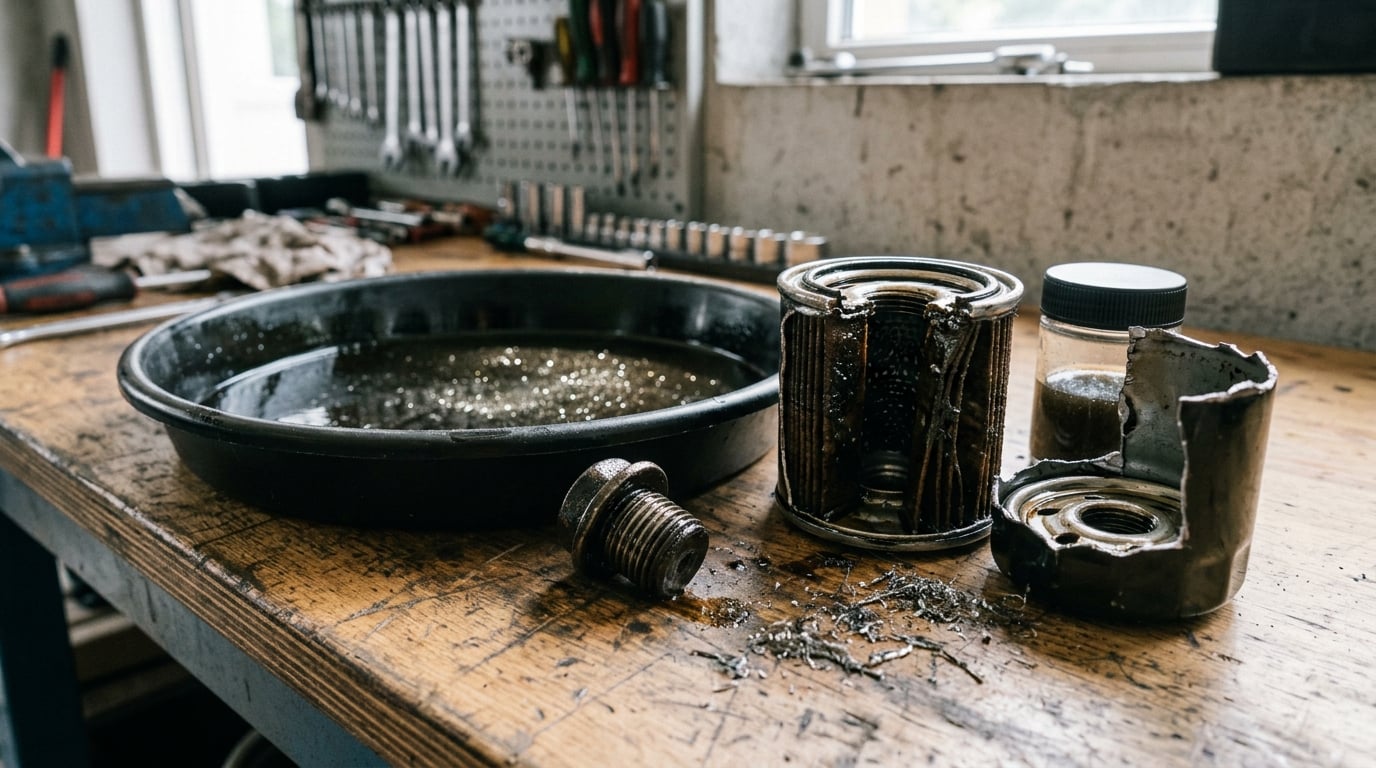
Metal in engine oil means particles of the engine’s own internal components have broken off and are circulating in the lubricant. It is usually wear debris from bearings, cylinder walls, piston rings, camshafts or the valvetrain, and it is either normal break-in on a new engine or a sign of accelerating wear on a used one. Appearance alone will not tell you which.
The panic at the oil change is universal. You pull the drain plug, see glitter in the pan, and the whole engine suddenly sounds expensive. Most of the time that glitter is a handful of particles far smaller than a grain of sand. Occasionally it is a bearing being ground down, and the difference between those two outcomes is what this guide is for.
Table of Contents
- What Does Metal in Engine Oil Mean?
- What Kinds of Metal Can Be Found in Engine Oil?
- What Does Metal in Engine Oil Look Like?
- Is a Little Metal in Engine Oil Normal?
- What Causes Metal in Engine Oil?
- What Does Metal in Engine Oil Mean for Your Engine?
- What Symptoms Appear With Metal in Engine Oil?
- How to Check Whether Metal in Engine Oil Is Serious
- Can You Drive With Metal in Engine Oil?
- How Do You Fix Metal in Engine Oil?
- Metal in Engine Oil: Symptoms and Likely Cause
- Frequently Asked Questions
- Why is there metal in my oil but not in my filter?
- How much metal shavings in oil is normal?
- Is it normal to find metal shavings on the first oil change of a new engine?
- What should I do if I find metal shavings in my oil?
- How do I read an oil analysis report, and what does high iron mean?
- Do I need an engine rebuild for metal in oil?
- What to Do First
What Does Metal in Engine Oil Mean?
An oil film separates every rotating and sliding metal surface inside an engine. When that film thins, breaks down or fails to reach a surface, metal meets metal and sheds material. Those particles are what you find on the drain plug magnet, in the filter, or suspended in the oil on the dipstick.
What it indicates
- Normal microscopic wear that every engine produces as its surfaces rub past each other
- Break-in wear on a new, rebuilt or freshly assembled engine, where wear is elevated and then tapers off
- Loss of lubrication somewhere, whether from low oil level, a failing oil pump, a blocked gallery or the wrong viscosity
- Damage that is actively progressing, such as bearing material, scored cylinder walls or a broken internal part
Common causes
- Worn main or rod bearings shedding their copper-lead-tin overlay
- Damaged valvetrain components, including cam journals, lifters and rocker arms
- Scored cylinder walls or broken piston rings cutting into the bore
- Timing chain, tensioner or guide wear
- Turbocharger bearing or seal failure on a boosted engine
- Debris from the oil filter, an oil additive or a magnet, plus dirt or seal material entering during service
That is the whole list, and it spans everything from completely harmless to a rebuild. Your next move is to narrow it down by what the metal looks like and where it collects.
What Kinds of Metal Can Be Found in Engine Oil?
Different metals come from different components, and each one tells a slightly different story.
Iron (Fe) is by far the most common. Grey to black, magnetic, and it comes from cast iron and steel surfaces: cylinder walls, cam lobes, crank journals, gears and the timing drive. A trace is routine. A rising trend is a story.
Copper (Cu) and lead (Pb) point at the bearing stack. Bearings are built in layers, a lead-bronze or copper-lead-tin sandwich with a soft copper overlay on the outside. A thin sheen of copper colour means the outer layer is rubbing. Bright silver dust instead means the overlay is gone and you are seeing the base alloy, which is a much worse sign.
Aluminium (Al) shows up as fine glitter suspended in the oil, or as light grey chunks. It comes from the block, heads, pistons, intake and exhaust manifolds. Aluminium is not ferromagnetic, so it will not cling to a magnet. Suspension rather than capture is the clue, and the Rennlist forum heuristic that circulates everywhere online says exactly this: stuck to the magnet means steel, glittery in the oil is probably aluminium.
Chromium (Cr) is a hard plating element found in piston ring wear, valve guides and some gears. Small amounts are normal, larger amounts with visible ring fragments are not.
Nickel (Ni) shows up in gear wear and some bearing shells. It is rare, and combined with copper it is a strong bearing signature.
Tin (Sn) is part of the bearing overlay. Tin with copper is a bearing story almost every time.
Silicon (Si) is not metal at all, but it turns up on analysis reports constantly. High silicon means dirt got past the air filter, which is a maintenance problem rather than an engine failure.
What Does Metal in Engine Oil Look Like?
Visual clues are the first thing most people work with, so it is worth knowing what each shape means.
- Fine glitter suspended in the oil, barely visible against a black background: usually aluminium, sometimes a wear additive. Small quantity is common.
- Fine dark dust on the magnet: cast iron and steel wear. On a high-mileage engine this is often just where the engine has got to.
- Flakes: a wider, flatter particle. Ring fragments, cam flakes and bearing overlay material all flake rather than dissolve.
- Long shiny shavings: the shape that makes people call a shop in a panic. Continuous, curled shavings are usually from a scored surface or a damaged bearing.
- Chunks or fragments: something broke. Rare at low mileage without a cause, common on engines that ran dry at some point.
- Black, greasy, magnetic sludge: iron mixed with degraded oil and additive rather than clean wear debris.
None of this is proof. A magnet tells you ferrous from non-ferrous and nothing more. Cutting the filter open shows you how much debris circulated through the whole engine rather than what settled in the sump. A used-oil analysis gives you actual parts per million of each element, which is the only approach that turns a guess into a measurement.
Is a Little Metal in Engine Oil Normal?
A small amount is normal, and pretending otherwise makes people replace healthy engines. An engine is not a sealed bearing-free system. Surfaces rub, clearances settle, and material comes off. Every used car that reaches 150,000 miles has measurable iron in its oil.
Break-in is the clearest case. On a new or rebuilt engine, wear runs high for the first few hundred hours because surfaces are still conforming to each other. Owners of new performance cars routinely find metal at 1,500 to 5,000 miles, and forum consensus is that this is expected as long as it is a fine dust that decreases over the next few changes rather than a steady or growing amount.
Track cars, heavily worked engines and motorsports bikes are a different story again. They generate debris constantly, which is why their owners read quantity and particle size rather than presence.
The severity ladder, roughly from calm to urgent:
- Fine uniform dust on the magnet, no visible particles in the oil, no symptoms: normal. Change the oil and filter, keep the interval.
- Fine glitter in the oil but nothing on the magnet, engine quiet, pressure normal: usually fine, but worth an analysis if it is new to you.
- Visible flakes that do not wash off the magnet, still running smoothly: needs a proper diagnosis, not a guess.
- Long shavings or chunks, or any of the above with noise, low pressure or falling oil level: stop driving that engine.
What Causes Metal in Engine Oil?
Normal wear is the baseline explanation and it is the correct one far more often than owners want to hear. Cam lobes, cylinder walls, crank journals and gear teeth all lose microscopic material over time.
Oil filter and additive residue deserves more attention than it gets. Some filters contain a strong magnet plus a cellulose or synthetic blend designed to hold debris, and that collected material can look alarming when you cut the filter open. Anti-shedding and anti-wear additives work by suspending or forming sacrificial layers, which can leave residue in the sump. A first oil change done with no filter installed, or after an oil change where the filter housing was left empty, also flushes out material that had nowhere else to go.
Worn bearings produce copper, lead and tin. Rod bearings take the hit first because they carry the reciprocating load, and their debris appears as a fine coloured dust in the filter and on the magnet.
Valvetrain wear shows as iron, often with no copper. Camshaft journals, rocker faces, lifters and cam lobes wear, and on some engines the cam runs directly on the journals.
Gasket failure or coolant contamination shows up more as coolant in the oil, a milky emulsion on the dipstick or the filler cap, and sodium and potassium on an analysis report, than as metal. Coolant eating into bearing material is what turns a head gasket problem into a rebuild.
Broken or chewed-through parts are the ones owners never expect: a timing belt roller, a balance shaft sprocket, a water pump pulley. Several forum cases turned out to be parts unrelated to the bearings entirely, and separating those is part of a real diagnosis.
Oil starvation is the cause that matters most. When pressure falls, the film collapses, and the contact that follows produces metal rapidly. A failed oil pump, a collapsed hose, a clogged pickup screen, too low an oil level or a filter fitted without oil in a dry engine all do it.
Dirt ingestion and coolant are contamination rather than wear, and both show up on an analysis even when the pan looks clean.
What Does Metal in Engine Oil Mean for Your Engine?
It matters mostly because of what the debris does next. Metal circulating in the oil behaves like abrasive paste. It is caught by the filter and the drain plug, but the fraction that is too fine to catch keeps recirculating through the pump, the pickup screen and every bearing clearances, and it accelerates the damage that created it.
That is why a small finding found at an oil change is genuinely good news, and the same finding found a year later is a much worse one. The first time, you change the oil and the debris leaves the engine. The second time, it means wear is still producing debris and the film is not holding.
Where the metal is matters too. Debris that is heavy on the drain plug magnet and light in the filter means the engine is producing a lot of material but circulating little, often a sign of low flow or a partially blocked pickup. Debris distributed through the filter tells you metal has been travelling through the entire engine, which points harder at bearings and journals. And a filter that catches a surprising amount while the pan looks clean can mean the engine had a run with a dry or low oil level before you got to it.
What Symptoms Appear With Metal in Engine Oil?
Metal rarely arrives alone. Watch for:
- Knocking, ticking, tapping or a deeper grinding that changes with engine speed and warm-up
- Oil pressure warning light, or a pressure reading that drops at idle when warm
- Low oil level warning, or topping up between changes
- Coolant disappearing without a visible leak, and a milky or emulsified film on the dipstick or oil filler cap
- Overheating, or smoke that is thick, oily or white
- Vibration, misfire, reduced power or a check engine light, especially on a turbocharged engine
A quiet engine with normal oil pressure is real reassurance, but it is not proof. Bearing failure can begin before either changes.
How to Check Whether Metal in Engine Oil Is Serious
Work through this in order, on level ground, with the engine off and cool. Level ground matters, because a tilted car lets the oil and the debris pool in different corners.
- Check the oil level on level ground first. If the level is low, the metal may be the end of a lubrication failure rather than the start of one, and that reframes everything else.
- Look at the drain plug and the magnet. Hold the plug under light and photograph it. Note the colour, whether the particles cling to the magnet, and whether you are seeing dust, flakes, shavings or chunks.
- Cut the oil filter open. A band saw is better than a knife because it shows the debris across the whole element. Compare that with the drain plug: heavy in one and light in the other is a meaningful clue.
- Keep a sample. A jar of oil and a photo of the cut filter are the two things a specialist will ask for, and they are far more useful than a verbal description.
- Check the service history. Oil level, oil change intervals, any recent head gasket work, timing service, and whether the engine has ever run hot or run low on oil. A year overdue for service with a long interval is a different starting point from a car maintained on time.
- Read your driving symptoms honestly. Any noise, any pressure light, any oil consumption, any coolant loss moves this up the urgency list immediately.
- Get a used-oil analysis if the answer is still unclear. Sample the oil hot, before draining, from a consistent location, and record the mileage, hours and what the engine has been doing. Context is part of the result.
- Ask for a compression and leak-down test. A low cylinder points at rings, valves or a scored wall, which tells you whether the teardown question is even open.
That sequence costs an oil change plus a test, and it replaces a week of guessing. If you cannot get a clear answer, a technician who is willing to explain the readings is worth more than the cheapest quote in town.
Can You Drive With Metal in Engine Oil?
Sometimes yes, and the decision is about particle size plus symptoms rather than presence alone.
Driving to a specialist is reasonable when you have a fine dust or light glitter, no fragments, no oil consumption, normal oil pressure, no warning lights and a quiet engine. Keep it to a short trip, drive gently, avoid load and towing, and get it looked at rather than starting a long road trip on it.
Stop driving the car if you see any of these:
- Long shavings, or chunks of any size
- Oil pressure light, or a pressure reading that has dropped
- Knocking, grinding or ticking that gets worse with load or speed
- Overheating, thick smoke, or white smoke from the exhaust
- Rapid oil consumption, or a level that keeps dropping between services
- Metal in the oil of a turbocharged engine, where the turbo is a separate failure point of its own
If several of those are true at once, the safe move is a tow, not a drive. You will not lose anything by towing a healthy engine, and you can lose the engine entirely by finishing that drive.
How Do You Fix Metal in Engine Oil?
The fix follows the source, so it follows the diagnosis. There are three paths.
Service path. If it was old oil, a long interval, a contaminated filter or a bad additive, drain the oil hot, fit a new filter, flush the oil cooler if the vehicle has one, refill with the correct specification and grade, and re-check at the next change. Then compare the next drain. Wear that drops is the answer you wanted.
External part path. If the metal traces to a timing roller, pulley, sprocket, water pump or accessory bracket, replacing that part and a fresh oil service is a genuinely small job. A lot of alarming-looking findings end here, and this is one of the more common outcomes on engines that otherwise sound healthy.
Internal repair path. Bearing material in the oil, persistent iron that is rising between changes, scored bores or a compression problem all mean the engine comes apart. Rod and main bearings, cylinder walls, the oil pump, the timing drive and the valvetrain all get inspected, and the decision becomes whether the engine is worth rebuilding or whether the vehicle is worth replacing. Get the diagnosis first and the estimate after, never the other way round.
Whatever the path, always replace the oil, the filter and any oil cooler that has seen metal, because debris left in the system will keep cutting surfaces in the rebuilt engine too.
Metal in Engine Oil: Symptoms and Likely Cause
| What you see | Where it collects | Likely source | Urgency | Do this next |
|---|---|---|---|---|
| Fine dark dust on the magnet | Drain plug, light in filter | Normal iron wear, cam and cylinder | Low on a high-mileage engine | Oil and filter service, recheck next change |
| Fine glitter in the oil, nothing on the magnet | Suspended in oil, filter | Aluminium wear or additive residue | Low to moderate | Short gentle trip, then get an oil analysis |
| Fine copper or gold coloured dust | Filter and magnet | Bearing overlay beginning to wear | Moderate | Stop driving hard, analysis and compression test |
| Bright silver dust with copper | Filter, oil | Bearing overlay gone, base alloy exposed | High | Stop driving, tow if there is any noise or pressure drop |
| Visible flakes on the magnet | Both | Valvetrain or ring wear, bearing debris | High | Tow to a shop, oil analysis and teardown estimate |
| Long shiny shavings or chunks | Pan and filter | Scored surface, broken part, prior oil starvation | Urgent | Do not run the engine, tow it in |
| Milky residue, coolant in oil, sodium and potassium on analysis | Oil, filter | Gasket or head failure | Urgent | Pressure test and head gasket diagnosis before anything else |
Silicon rather than metal is its own row in the story: high silicon means dirt past the air filter, which is a filter and housing problem, not an engine failure.
Frequently Asked Questions
Why is there metal in my oil but not in my filter?
A few things explain it. Some debris is heavier than others, so larger particles settle in the sump while finer material stays suspended and reaches the filter. If your last service left the filter housing empty or the filter was fitted without oil, the pan holds material that never had anywhere else to go. And some filters hold so much in the element that very little is left loose enough to see. Check both together, and compare rather than relying on either alone.
How much metal shavings in oil is normal?
A fine, uniform dust that clings to the drain plug magnet is normal on most engines, especially with age and mileage. It is also normal and expected during break-in on a new or rebuilt engine, provided the amount decreases at the following oil change. What is not normal is visible flakes, long shiny shavings or chunks, and any of those alongside noise, falling oil level or a low oil pressure reading.
Is it normal to find metal shavings on the first oil change of a new engine?
Usually, yes. During the first few hundred hours the surfaces in a new engine are still bedding into each other, so wear runs higher than it will later and tapers off. A fine dust that decreases over the next two oil changes fits that pattern. Be more cautious if the particles are large, if the engine has low oil pressure, or if this is not the first engine in the vehicle with a similar finding. An analysis confirms it either way.
What should I do if I find metal shavings in my oil?
Photograph the drain plug and keep a sample of the oil, then cut the filter open and compare what it caught. Check the oil level on level ground, and review the service history for long intervals or a head gasket job. If the answer is still unclear, send the oil for used-oil analysis and ask for a compression and leak-down test. Fine dust with a quiet engine and normal pressure means a service and recheck; shavings or chunks mean stop driving.
How do I read an oil analysis report, and what does high iron mean?
High iron points at the iron and steel surfaces: cylinder walls, cam lobes, crank journals, gears and the timing drive. A small absolute number matters far less than the trend, so a rising series across two or three samples is a real signal while a steady low figure is not. Copper, lead and tin together point at bearings. Silicon and sodium mean dirt and coolant rather than wear. The lab or analyst will usually comment on which findings are abnormal for your engine.
Do I need an engine rebuild for metal in oil?
Rarely on the strength of one oil change. Most findings are normal wear or debris from the filter and additive, and an oil and filter service clears them. A rebuild question only becomes real when the metal is bearing material in quantity, when wear keeps rising between services, or when a compression or leak-down test shows a problem. Get the measurement first. Deciding to strip an engine because of glitter in the sump is how healthy engines get thrown away.
What to Do First
So, what does metal in engine oil mean? It means wear debris is circulating, and the job now is to prove which kind. Photograph the drain plug, cut the filter, keep a sample, and get a used-oil analysis before you decide anything.
Fine dust and a quiet engine means an oil service and a recheck at the next change. Shavings, chunks, low pressure or knocking means the engine stops and gets towed. Measure first. Almost everyone who panics at the drain plug turns out to have been fine, and almost everyone who ignored the large pieces was not.