
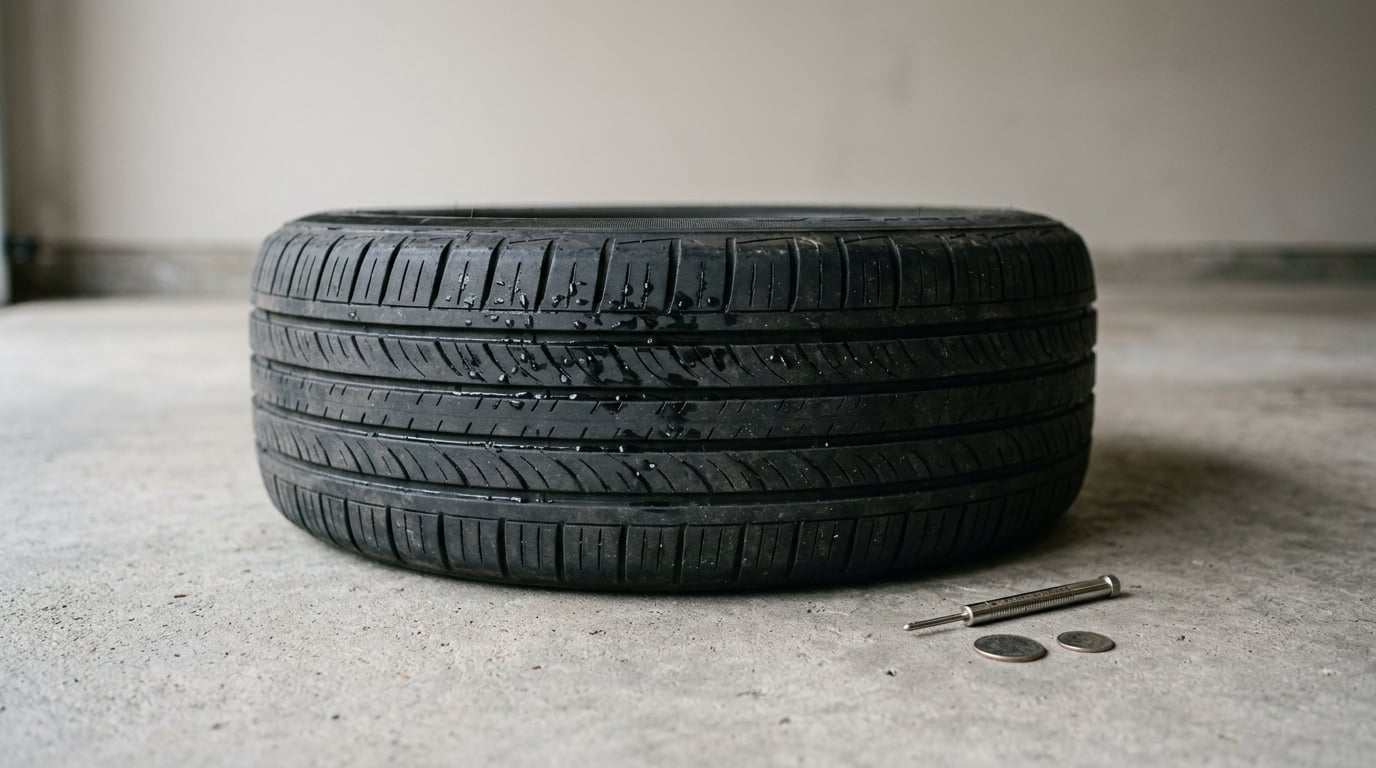
Replace tires at 2/32 inch of tread depth as an absolute legal floor, at 4/32 inch if you drive in rain or spend time on the highway, and at 5/32 to 6/32 inch if you drive in snow. That is the short version of when to replace tires by tread depth, and it takes about 60 seconds with a gauge to confirm where your own set actually stands.
The reason people get stuck is that two different numbers keep coming up. The U.S. Department of Transportation sets 2/32 inch as the legal minimum for passenger tires, and organizations like AAA and tire retailers push 4/32 inch as the point where you lose meaningful wet-weather grip. Both are right, and they answer different questions.
Tread depth is the only tire condition you can check yourself in under a minute, and it is the strongest single predictor of how a tire behaves on a wet road. It also tells you nothing about how old the rubber is, so it has to be read alongside the DOT date code and a look at the sidewalls.
Table of Contents
- When to Replace Tires by Tread Depth
- How to Measure Tread Depth Correctly
- What Tread Depth Numbers Mean
- Why Tire Replacement Should Happen Before the Legal Limit
- Uneven Tread Wear and What It Means
- Should You Replace All Four Tires at Once?
- How to Check Tires Before Buying a Replacement Set
- Frequently Asked Questions
- Can I safely drive with 2/32 inch of tread left?
- What is the minimum tread depth for a car tire in the US?
- Are new tires allowed to have less than 2/32 inch of tread?
- Should winter tires be replaced at the same tread depth as summer tires?
- Do I need to replace all four tires if only one is worn out?
- Can I check tread depth without taking the tire off the car?
- Conclusion
When to Replace Tires by Tread Depth
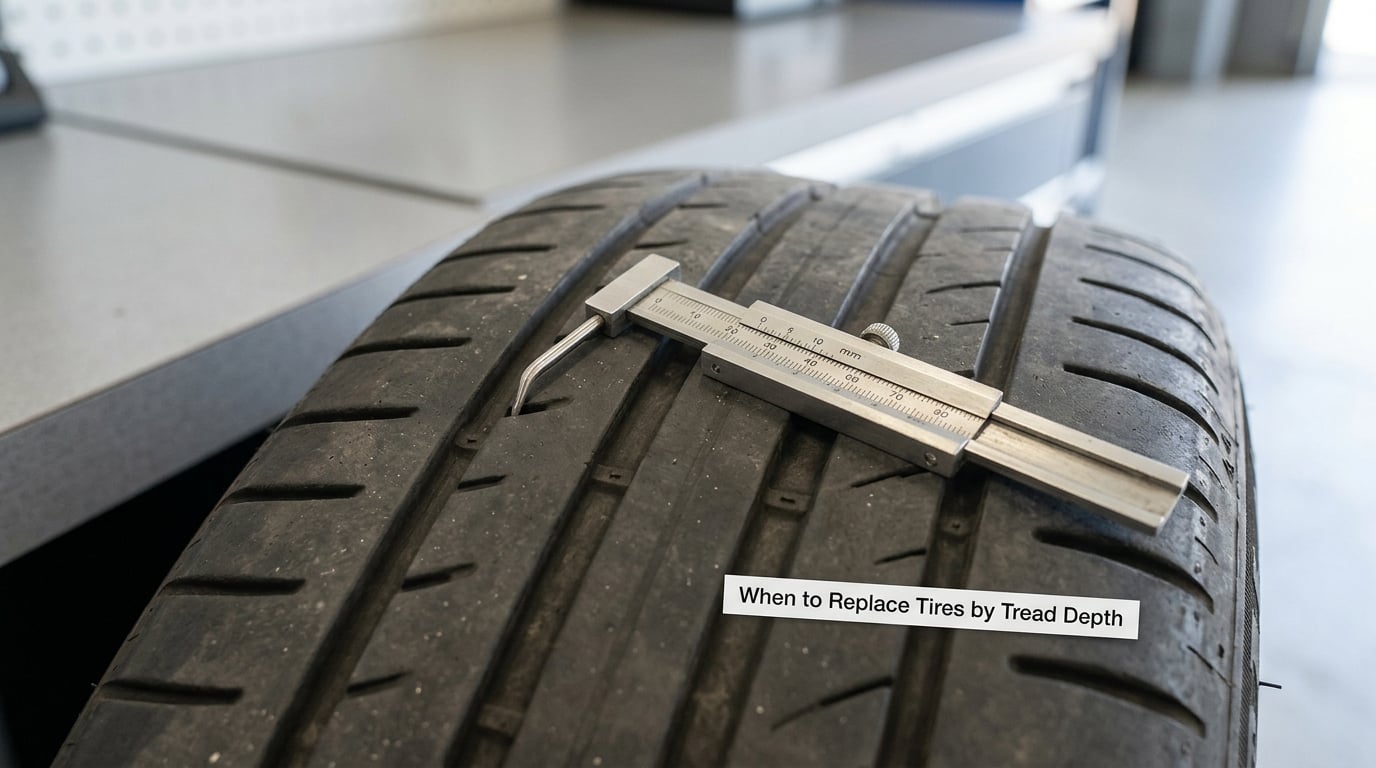
The short answer is 2/32 inch, which is where the molded wear bars become flush with the tread and the tire is finished. Most states make it illegal to drive below that line, and no manufacturer warranty covers a tire used past it.
The useful number is 4/32 inch. That is AAA’s recommended replacement point for wet weather and highway driving, and it is the threshold most tire staff will quote you. Running from 4/32 down to 2/32 feels like free mileage, then it doesn’t.
Where you drive changes the line:
- Highway and rain commuters: plan on replacement at 4/32 inch. Sustained highway speeds put more water through the tread grooves per second than city driving does.
- Snow and ice markets: aim for 5/32 to 6/32 inch. Winter tire guidance pushes well above the legal minimum because the compound is already working near its temperature limit.
- Low-mileage commuters: tread depth rarely becomes the trigger. Age does, which is why the DOT date code matters more than the gauge reading.
- Trailers, RVs and light trucks under load: these carry more sidewall load, so a tire can go below 4/32 and still be holding fine. Check the placard and follow the tire maker’s guidance rather than a rule of thumb.
- Performance and low-profile tires: these start shallower, often around 8/32 inch, so they cross 4/32 sooner in terms of actual mileage. How much tread do new tires have? covers that baseline.
When to replace tires by tread depth regardless of the reading
A depth number is not the only trigger. Replace the tire, even with usable tread, if you find a bulge in the sidewall or tread, a cut that reaches the belts, cracking on the sidewall that looks like spaghetti, cords showing in the groove, or a nail hole larger than 1/4 inch. A tire shop can plug and patch a tread-area puncture under 1/4 inch, but nothing outside that hole is repairable.
The same applies to symptoms: a steady vibration that changes with speed, a hum at highway pace, a tire losing air weekly, or the car pulling to one side. Tire age and expected mileage cover the rest.
How to Measure Tread Depth Correctly
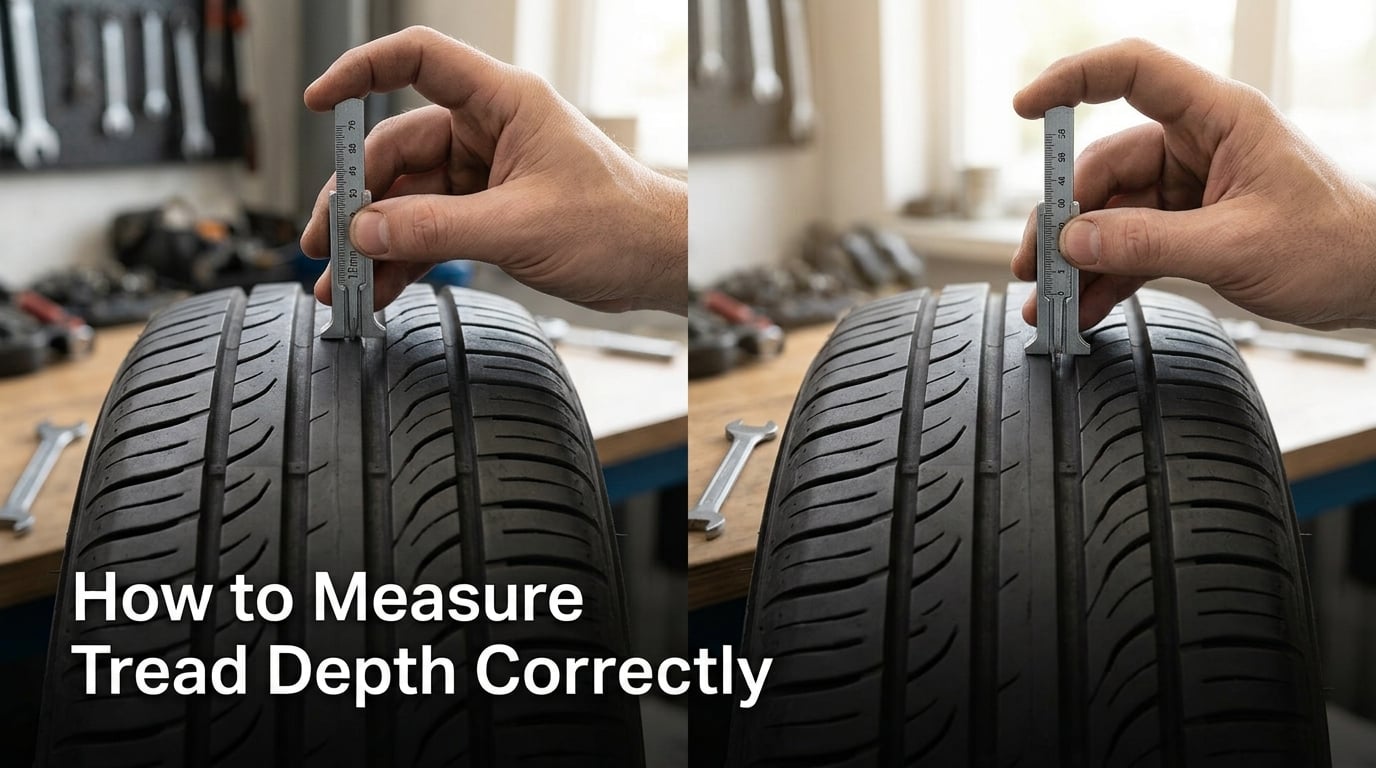
There are three ways to check tread depth, and they are not equally good. The gauge is the accurate one. The quarter is a planning tool. The penny is a pass-or-fail legal check.
Method 1: Tread depth gauge, the accurate read
- Park on level ground and check all four tires. No rotation needed for the reading itself.
- Press the probe bar down into the main center groove and push the shoulders flat against both groove walls until the bar sits level. If the bar rocks, it is not in a clean groove, so move to another spot.
- Read the depth off the plastic gauge at the outer edge of the probe, not the end. The end tapers.
- Take three readings per tire: one in the center groove, one in each shoulder groove, and one near the inner edge on a front-drive car where the inner shoulder wears fastest.
- Write the shallowest reading for that tire down. The lowest number on a tire is the one that counts.
Method 2: Quarter test, the 4/32 planning line
A US quarter is about 1/32 inch thinner than a dime and considerably thicker than a penny. Held on its edge with the flat face angled toward you and the top of the “In God We Trust” visible, it should stand proud of the tread at 4/32 inch. If the top of the quarter clears the rim of the tread, or you can see a sliver of rubber above it, you are under 4/32.
This is the quickest honest way to know you are at the AAA replacement threshold. Few people carry quarters around, which is exactly why nobody uses it at the shop counter.
Method 3: Penny test, the 2/32 legal check
Place a penny into the center groove with Lincoln’s head facing down. You should be able to hide part of the words “In God We Trust” at 2/32 inch. If you see all of “Liberty” across the top of Lincoln’s head, the tire is below the legal minimum.
The honest limitation here matters. The penny test is a binary, 2/32 or not, and it cannot distinguish 5/32 from 2/32. Owners who rely on it alone routinely end up surprised at the shop. Forum threads on tire replacement come back to this again and again: people trust a real gauge reading over a coin or over a verbal assurance that the tires are fine.
Reading the wear bars directly
Every tire has tread wear indicator bars molded into the bottoms of the main grooves, sitting at 2/32 inch. When those bars are level with the surrounding tread, the tire is done. The problem is that you often cannot see them on a worn tire because the surrounding tread has worn down to meet them, which is the point. Look in the center groove and both shoulders, not just one.
What Tread Depth Numbers Mean
Tread depth is measured in 32nds of an inch. A new passenger tire typically arrives at 10/32 to 11/32, light truck and winter tires run deeper still. The table below turns each reading into a decision.
| Tread depth | Quick check | What it means | Action |
|---|---|---|---|
| 10/32 to 11/32 | New tire | Factory baseline for most passenger tires | Nothing. Check the DOT date code now so you know when this set ages out. |
| 8/32 | New performance or low-profile tire | Healthy, but shallow for a winter market | Keep. Recheck before winter if you live where snow is normal. |
| 7/32 | Roughly two-thirds of life gone on a typical car | Comfortable margin for rain and highway | Keep. Start shopping so you are not choosing tires in a downpour. |
| 6/32 | Winter driving comfort zone | Still good traction, and adequate for snow | Keep. Book replacement around 4/32. |
| 5/32 | Upper end of the winter replacement window | Fine for summer, thin for sustained snow or ice | Replace this season if you drive in snow. |
| 4/32 | Quarter stands proud of the tread | AAA’s recommended threshold for wet weather and highway | Replace. This is where most owners should act. |
| 3/32 | Between the penny line and the quarter line | Noticeably less grip in standing water | Replace, and do not put it off until the bars show. |
| 2/32 | Lincoln’s head just hides “In God We Trust”; wear bars flush | Legal minimum, and the end of the tire’s useful life | Replace now. Do not drive on it in rain. |
| Below 2/32 | Penny test fails | Illegal in most states and unsafe in any weather | Do not drive on it. |
The gap between 4/32 and 2/32 is roughly 6,000 to 10,000 miles on a typical commuter car, and that is the window owners keep trying to stretch. Whether that is three months of driving or a full winter depends entirely on your tires and your roads, which is why planning backward from 4/32 is easier than reacting at 2/32.
Why Tire Replacement Should Happen Before the Legal Limit
The wear bars are a legal marker, not a safety one. As tread gets shallow it stops moving water out from under the contact patch, and a tire riding on a film of water instead of a film of rubber loses steering response and braking ability long before it looks bald.
Hydroplaning risk is the part people picture. The more common daily problem is quieter: longer braking distances on a wet road and more swerving to avoid a puddle. Both scale with how much water the grooves can no longer clear, which is why the jump from 4/32 to 2/32 feels bigger than the numbers suggest. Two 32nds is a quarter inch of lost tread, and that quarter inch is what channels the water.
Uneven wear makes all of this worse. A tire with 5/32 on one edge and 2/32 on the other has effectively one good contact line, and no average number describes it.
Where you have no choice: your state’s law, the tire manufacturer’s specifications, and the placard in your door jamb all take precedence over anything in this article. When a reading sits near a threshold, get a second measurement from a tire shop. They do multi-point checks across the full tread width, which is the one thing a coin cannot do.
Uneven Tread Wear and What It Means
The wear pattern tells you what to fix before you spend money on new rubber. If you replace a tire without correcting the cause, the new one wears the same way.
| Wear pattern | Likely cause | What to do |
|---|---|---|
| Feathering: tread blocks ramp high on one side, sharp on the other | Toe alignment off | Alignment first. New tires will feather the same way without it. |
| Fast wear in the center, both edges intact | Overinflation | Set pressure to the door-jamb placard, not the sidewall maximum, and recheck after a month. |
| Fast wear on both outer edges | Underinflation, or worn shocks letting the tire bounce | Correct pressure and check shocks before mounting new tires. |
| Fast wear on one shoulder only | Camber out of spec, sometimes a bent wheel or strut damage | Alignment plus a suspension check. One-sided wear is the most common mystery owners report. |
| Cupping or scalloping: repeating dips across the tread | Worn shock or strut mounts, or an imbalanced wheel | Replace the worn component, then mount. Balancing helps but does not fix a bad shock. |
| Inner shoulder faster on a front-drive car | Normal for that layout, made worse by loose or missing wheel bearings | Expect some inner wear. Confirm the bearings are not the cause. |
| Flat spot across the width | Brake lock-up or an emergency stop | Check brakes and the ABS, then replace that tire. |
Pressure is the one thing you can change this week, and it does more for even wear than any other single habit. Inflate to the number on the door-jamb placard or in the owner’s manual, cold, before driving. The sidewall maximum is a structural limit for the tire, not a daily target, and running to it is a common cause of that center-wear pattern. Seasonal pressure changes are worth a look too, since cold-weather pressure drops on most cars.
Should You Replace All Four Tires at Once?
Matching tires on the rear axle is the standard advice, and the reasoning is stability: a rear axle with more grip resists the tail stepping out when you brake or on a wet lane change. Putting the fresh pair on the rear and moving the older pair forward satisfies that even when the older tires are still usable.
The complication is all-wheel and four-wheel drive. Most AWD manufacturers require all four tires to wear at roughly the same rate and within about 1/4 inch of each other, because the drivetrain sends torque to all four wheels and mismatched grip behaves like a binding differential. Check your owner’s manual for the exact figure before mixing depths.
What that looks like in practice:
- All four at or under 4/32: replace all four. This is the clean case.
- Two at 4/32, two at 7/32, FWD or RWD: new pair on the rear, older pair forward, then rotate on schedule.
- One tire at 4/32 and three at 7/32: this is the situation owners ask about most. On an AWD vehicle, replace all four to stay inside the manufacturer’s tolerance. On a two-wheel-drive car, one is often acceptable if it matches the others within the maker’s guidance and the cause of the fast wear is fixed.
- Spare and stored tires: age them anyway. A tire that sat two years in a garage loses grip even with deep tread.
Temporary spare tires are not a fourth option. They are speed- and distance-limited by design, and mixing one into a driven axle for anything but a short trip to a shop is a bad trade.
How to Check Tires Before Buying a Replacement Set
Stand at the tire rack or work through this list before you commit, because the wrong set shows up as noise, uneven wear, or a blown belt later.
- Tread depth: new passenger tires ship at 10/32 to 11/32. Winter and many light truck tires run deeper. How much tread do new tires have? breaks down the baseline by type.
- Treadwear rating: on the sidewall, for example 180, 200, or 400. Higher numbers are an estimate of how far the tire should last under controlled conditions, not a promise, and heavy vehicles and highway speeds shorten it.
- DOT date code: the last four digits are the week and year of manufacture, so 2223 means week 22 of 2023. Buy tires made within the last year or two and check this against how long tires last in years, since a good tread depth on nine-year-old rubber is still nine-year-old rubber.
- Size: must match the placard in the door jamb exactly, including the aspect ratio. Do not go wider on a stock wheel without checking the clearance at full lock.
- Load and speed ratings: both need to meet or exceed what the placard calls for. A tire rated lower than the vehicle’s load is a downgrade, not a bargain.
- Condition: reject any tire with a code other than “DOT” plus a date, and any tire with a nick in the bead area, since that area cannot be repaired.
- Wheel compatibility: bolt pattern, diameter, offset, and whether the wheel is rated for the tire’s load and speed. If you are also buying wheels, confirm clearance for both the tire and the suspension at full steering lock.
- Type: all-season, winter with the 3PMSF mountain-and-snowflake symbol, or summer. Winter compounds and tread patterns are not substitutes for each other in extreme cold.
Old tires usually get recycled rather than thrown away, and most tire retailers handle that. You can also ask a tire shop what they do with the removed set before you agree to the work.
Frequently Asked Questions
Can I safely drive with 2/32 inch of tread left?
2/32 inch is the legal floor, not a comfortable one. At that depth a tire is at the limit of what the law allows and well past the point of useful wet-weather grip. AAA recommends replacing at 4/32. If you are at 2/32, treat the tires as needing replacement now, keep the car out of heavy rain, and avoid highway speeds until new tires are mounted.
What is the minimum tread depth for a car tire in the US?
The U.S. Department of Transportation sets 2/32 inch as the minimum tread depth for passenger tires, and most states enforce it. Every tire also has molded wear bars sitting at 2/32 inch. Below that, tires are bald and unsafe. Note that a handful of states and some truck and trailer rules differ, so your state vehicle code and the tire placard are the final word.
Are new tires allowed to have less than 2/32 inch of tread?
No. A tire sold with tread below the wear bars is defective and unlawful to sell, so a legitimate new tire always shows at least 2/32 inch. If a shop hands you a tire under that line, do not mount it. New passenger tires normally arrive at 10/32 to 11/32 inch, and winter and light truck tires run deeper still.
Should winter tires be replaced at the same tread depth as summer tires?
No. Winter tire guidance puts the replacement point at 5/32 to 6/32 inch, well above the legal minimum, because the compound is already stiffened by cold temperatures and needs deeper grooves to bite into snow and slush. A winter tire that feels fine at 4/32 can disappoint you in a storm. Summer and all-season tires use the 4/32 wet-weather threshold instead.
Do I need to replace all four tires if only one is worn out?
On an all-wheel or four-wheel drive vehicle, yes. Most AWD manufacturers require all four tires to wear at a similar rate, generally within about 1/4 inch of each other, so replace the full set. On a two-wheel-drive car, one tire can often be replaced if it matches the others within the maker’s guidance, and the underlying cause of the fast wear is corrected.
Can I check tread depth without taking the tire off the car?
Yes, all three DIY methods work on a mounted tire. Slide a tread depth gauge into the center groove and both shoulders, park on level ground, and take the shallowest reading per tire. A quarter tells you about 4/32 inch and a penny about 2/32 inch, though neither gives you a gradient. You only need to remove the wheel to measure a spare or a tire you cannot reach.
Conclusion
Measure all four tires today, in the center groove and both shoulders, and write down the shallowest reading from each one. That single number per tire tells you more than any rule of thumb.
Use 4/32 inch as your planning line for rain and highway driving, 5/32 to 6/32 inch if you drive in snow, and treat 2/32 inch as the absolute end. When the readings are uneven, fix the pressure or alignment cause first or the new tires will wear the same way. Your owner’s manual, the door-jamb placard, and the tire manufacturer always outrank any guide, including this one.