
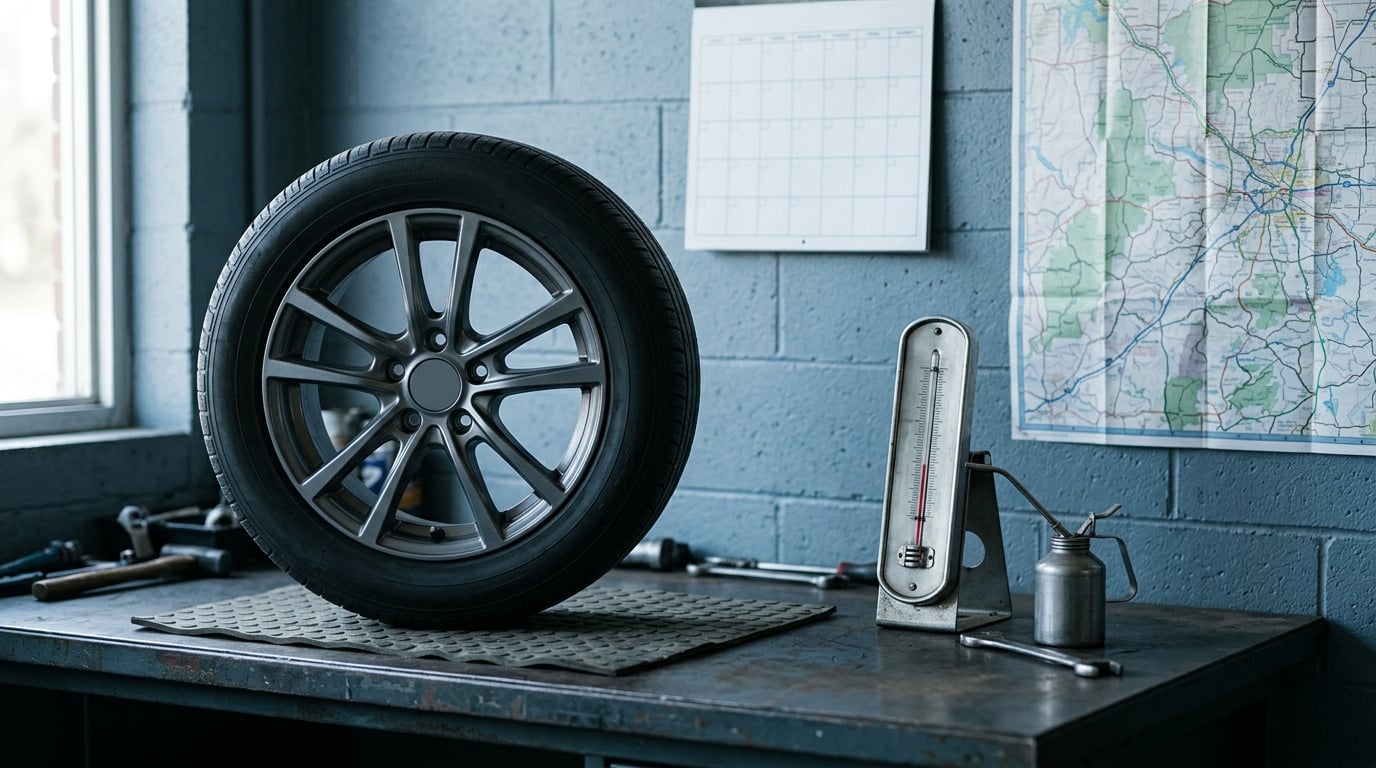
The short answer: know when to install winter tires by temperature, not by date. Swap them when your daytime highs and overnight lows settle at or below 45°F (7°C) for several days running, rather than when the first snowflake lands. Cold pavement is what degrades all-season rubber long before a storm shows up. This guide walks through the threshold, regional US install windows, and the checks to make before you book.
Most of the confusion I see comes from mixing two different questions. One is what your tires can physically do, and the other is what your local winter actually looks like. The 45°F rule answers the first. Your own road pattern answers the second.
Table of Contents
- What Temperature Should Prompt a Winter-Tire Change?
- Should You Install Winter Tires on a Schedule or by Road Conditions?
- How Early Should You Install Winter Tires?
- Do You Need Winter Tires for Every Kind of Winter Driving?
- What About All-Season Tires and Weathered Winters?
- How to Check Tire Size, Speed Rating, and Wheel Compatibility
- Should You Change All Four Tires or Only Two?
- How to Prepare After Installing Winter Tires
- When Should You Remove Winter Tires in Spring?
- Frequently Asked Questions
- What is the best month to install winter tires?
- Do I need winter tires if my city rarely gets heavy snow?
- Are all-season tires good enough for winter?
- Do I need four winter tires on an all-wheel-drive BMW?
- What temperature is too warm for winter tires?
- How often should I check tire pressure after installing winter tires?
- The Bottom Line
What Temperature Should Prompt a Winter-Tire Change?
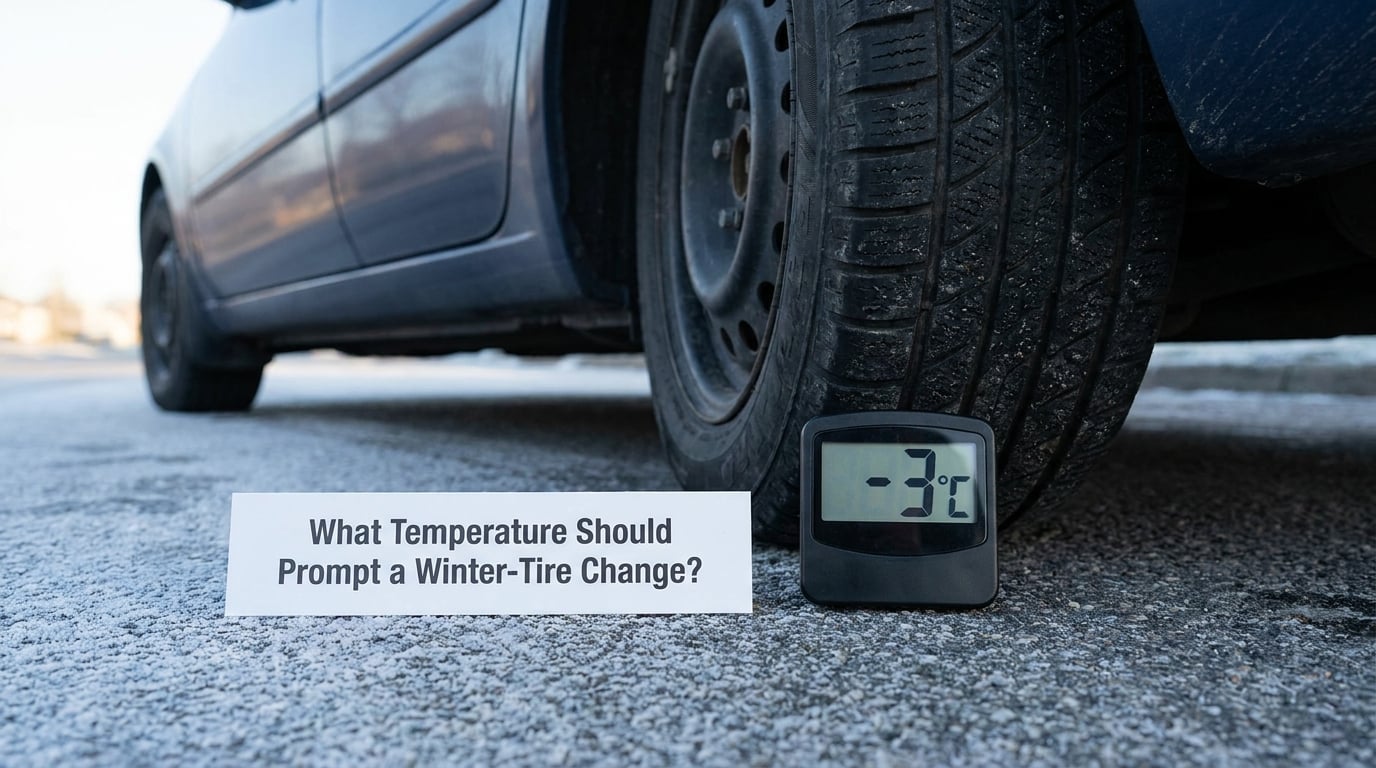
Switch when the forecast keeps temperatures at or under 45°F (7°C) for a stretch, rather than on a single cold morning. One dip to 38°F in the afternoon is not the signal. Five days where the high never passes 48°F and the low sits near freezing is.
The reason comes down to what is happening in the rubber. All-season and summer tire compounds are engineered to stay stiff and stable in heat. As the pavement temperature falls, that same compound loses flexibility, and a stiff tire grips cold asphalt or packed snow far worse than a soft one. Winter compounds are built with higher silica content and dense sipes that keep the contact patch biting as temperatures drop.
The practical effect shows up on dry-looking pavement, not just on days with visible snow. Below roughly 45°F (7°C), braking, cornering, and acceleration all degrade, and so does your ability to clear slush and standing water without hydroplaning.
What the 7-7 rule actually means
The “7-7 rule” is just the metric version of the same threshold: 7°C and 45°F are the same temperature. It is a naming convention rather than a separate standard, but it is worth knowing because tire shops and regional governments both use it when they tell you when winter equipment rules kick in.
Pressure is another reason not to wait. Cold air is denser, so tire pressure drops by roughly 1 psi for every 10°F the temperature falls. A car set to spec pressure on a 70°F day can be a few psi low on a January morning, which softens the sidewall and hurts response.
Regional install windows across the US
These are typical windows, not rules. Your local trend matters more than the calendar, and elevation changes everything.
| Region | Typical window | What to watch |
|---|---|---|
| Upper Midwest and Northeast | Late October to mid-November | Overnight lows hit 30°F before most daytime highs do |
| Rocky Mountain and high desert | Early to late October | Altitude drops temps faster than the calendar suggests |
| Pacific Northwest interior | Late October to early December | Frequent freeze-thaw cycles and shaded rural routes |
| Sierra and mountain passes | September to October | Chain controls can start before any town sees snow |
| Mid-Atlantic and Ohio Valley | Early to mid-November | Sleet and freezing rain often beat accumulation |
| Deep South and Gulf Coast | Rarely | Ice events, not snow depth, are the real risk |
| Hawaii and southern Florida | Not applicable | Temperatures rarely reach the threshold |
Should You Install Winter Tires on a Schedule or by Road Conditions?
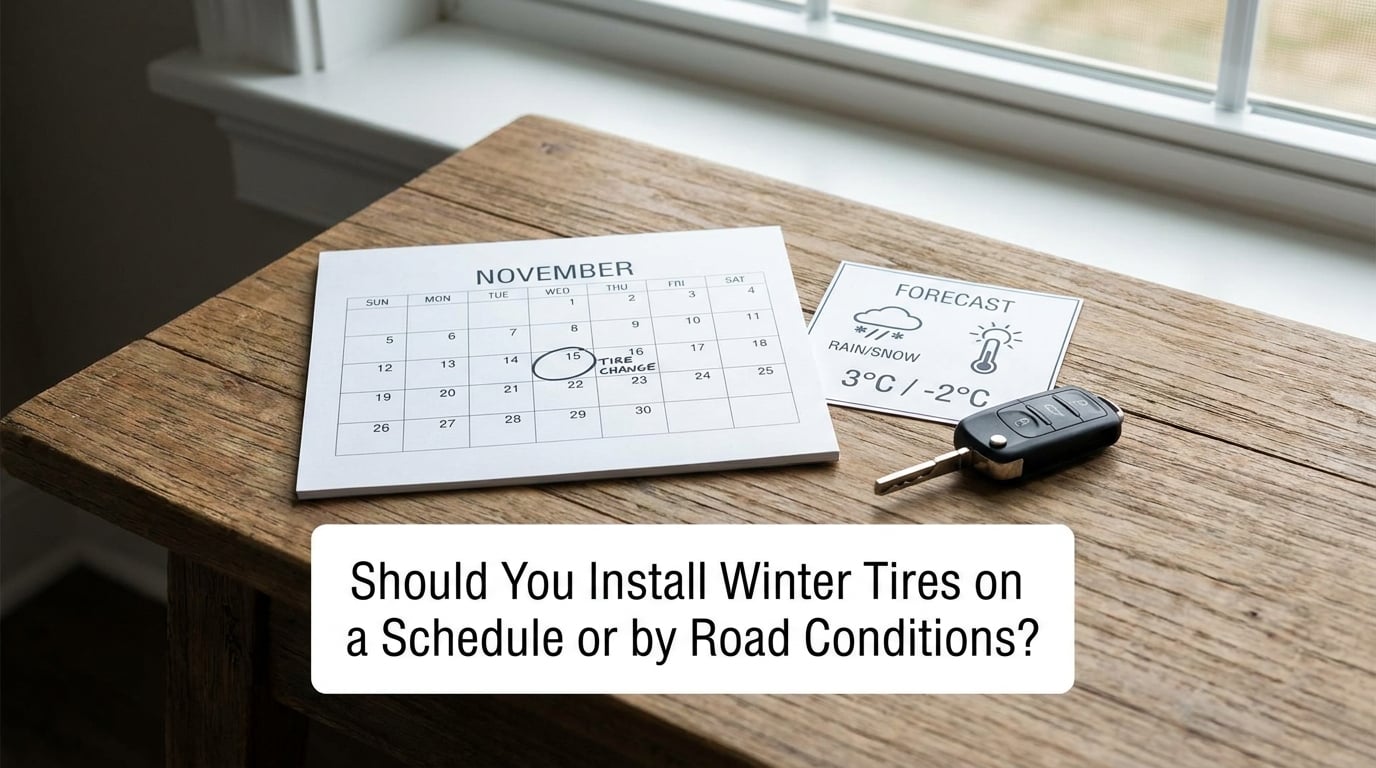
Use temperature as the trigger and the calendar as a planning tool. Booking on a fixed date protects you from a shop backlog, but driving on summer tires through a cold snap because the date has not arrived is the mistake that matters.
There are three ways people decide, and each has a failure mode.
Calendar-based scheduling
Simple and predictable, and it works fine in regions with a consistent winter. It fails in places with a slow cold front that arrives in late December, leaving you on the wrong rubber for three weeks. It also fails in early-October cold snaps in the northern states.
Temperature-based decisions
The most reliable method. Watch the ten-day forecast for a run of days at or below 45°F (7°C) and treat that run as your trigger. The weakness is that a sudden cold snap can outrun a ten-day window entirely, which is why a forecast-based method usually beats a pure threshold.
Forecast and road-condition-based decisions
Combine a five-to-ten-day outlook with what the roads actually look like where you drive. Shaded rural roads, bridge decks, and overpasses freeze first and dry last, so they are your most honest early warning. This is the method I use.
Cold snaps and chain-up controls
Most US states do not require winter tires, but many require traction devices on designated mountain and pass routes. Chain controls in states like California, Colorado, Washington, Utah, and Wyoming are typically posted for commercial vehicles first and can extend to passenger cars at higher chain levels. Check your state Department of Transportation site before a trip into the mountains, and treat a chain-up sign as a reason to have the right equipment fitted even if the pavement looks clear.
How Early Should You Install Winter Tires?
Book the appointment two to three weeks before your local 45°F window opens. Shops fill up fast once the first real cold front moves through, and the weeks right before that are the busiest of the season. Slightly early beats slightly late.
Running a winter tire in 48°F air for a week is not a problem. What wears them out is a full season above 50°F, and a set that was installed too late has already logged hard miles on cold pavement by the time the shop is free.
Use September to inspect the set you are about to mount. Check tread depth with a gauge, look for sidewall cracking or cord exposure, and read the four-digit DOT age code on the sidewall, which gives week and year. Winter compounds age faster than all-season rubber even sitting in a garage, and most passenger tires are considered past their useful service life around ten years from manufacture. Our guide to how to dispose of old tires covers what to do when a set is well past that point.
Do You Need Winter Tires for Every Kind of Winter Driving?
Not every driver needs them, and a few almost always do.
If you drive mostly plowed and salted city streets on a mild schedule, good all-weather tires may be a reasonable answer. If any of the following describes your week, winter tires are worth the money and the changeover.
- Pre-dawn commutes, when pavement stays cold well after sunrise
- Rural, shaded, or unplowed roads, which freeze and dry slowest
- Bridge decks and overpasses, the first surfaces to freeze and the last to thaw
- Mountain passes and designated highway chain routes
- Long highway stretches in winter, where one input error has a long stopping distance behind it
- Towing, or a rear-wheel-drive vehicle in a snowy climate
- High-performance cars, where the summer compound goes stiff quickly and torque-sensitive setups suffer most
- Traveling into colder regions from a milder home climate
The most common mistake is judging your need by snowfall totals rather than by temperature. Salted urban roads get plowed quickly, yet the rubber underneath still stiffens every cold morning.
What About All-Season Tires and Weathered Winters?
All-season tires vary enormously. An M+S marking only promises mud and snow capability, and many cheap M+S designs are closer to a three-season tire. A three-peak mountain snowflake, the symbol that looks like a peak with a snowflake inside it, is the rating tied to cold-weather performance, and that is the one to look for on a sidewall.
All-weather tires carry the snowflake rating and are designed to stay on year-round, which removes the changeover entirely. If you drive moderate miles, mostly on plowed roads, and never see sustained temperatures far below 40°F, they are a defensible single-set choice.
Repeated freeze-thaw cycles complicate the picture. In regions where pavement swings above and below freezing all winter, a tire that is flexible across that whole range has an advantage over a set tuned for one end of the scale. That is the strongest argument for an all-weather or quality three-season tire, and the strongest argument for winter tires is a climate that stays cold.
What you should not do is run genuine winter tires through a full warm season. It is not dangerous, but they wear noticeably faster and you spend money you do not need to.
How to Check Tire Size, Speed Rating, and Wheel Compatibility
Before you order anything, confirm the details that decide whether the set fits.
- Size: read the full size from the driver-side door jamb placard, not from the tire currently on the car. It looks like 225/50R17 98V.
- Load index: the number before the letter. Match or exceed the placard rating, and remember it is per tire.
- Speed rating: the letter at the end. Going faster-rated is fine; going slower-rated than the placard is not.
- Wheel size and offset: confirm the rim width and offset match what the manufacturer specifies, especially if you are changing wheel style.
- TPMS: confirm whether your sensors are banded to the wheel or the tire, since a new wheel may need new sensors or a relearn.
- Staggered fitment: on some performance vehicles, front and rear tires differ in size or compound. Match the pattern.
Your owner’s manual is the source of truth for all of this, and the tire placard on the jamb is where the numbers live. Our winter tire pressure guide covers how to set cold pressures correctly on a freshly mounted set.
Should You Change All Four Tires or Only Two?
Four, if you can. A matching set keeps handling predictable, and a vehicle that accelerates hard or corners hard punishes a split-compound setup more than most drivers expect.
If two is all you are fitting, they go on the drive axle. On front-wheel-drive and all-wheel-drive vehicles, that means the front pair. On rear-wheel-drive, the rear pair, because that is where the traction actually has to come from.
On an all-wheel-drive BMW or similar performance-oriented vehicle, this matters most. AWD sends power to all four wheels, but the front tires still do the steering and the rears still have to put that power down. Two winter tires on the rear of an all-wheel-drive car can make winter driving less stable than four summer tires. If budget forces a two-tire change, keep the pair on the axle that puts power to the road.
How to Prepare After Installing Winter Tires
Do these five things before you drive off, and you will catch almost any problem at the counter instead of on the highway.
- Set cold pressures. Ask for the placard pressure, and remember cold readings are the only accurate ones. Re-check within a few days, because pressure continues to settle as the tire cools fully.
- Have the fasteners torqued to spec. A torque wrench matters here, and the star pattern prevents the wheel from working loose. Re-torque after about 50 to 100 miles if the vehicle manual calls for it.
- Confirm the TPMS is reading. No warning light, and the shop should verify each sensor registers.
- Look at tread depth across all four. A winter set worn to the wear bars is a winter set that will not survive the season.
- Take a short test drive. On a quiet street, check for vibration, pulling to one side, or a change in steering feel. Any of those means go back.
Unbalanced wheels and worn components show up differently on winter rubber, so if the car feels different than it did on the old set, say something before you drive it home.
When Should You Remove Winter Tires in Spring?
Take them off when your local forecast holds above 45°F (7°C) consistently, using the same threshold in reverse. Wait for a stable warming trend rather than one 60°F weekend, because a cold spell after a premature swap sends you straight back to the shop.
Winter tires are the wrong choice on hot, dry pavement in two ways: they generate more heat, which shortens their life, and their softer compound wears faster. Running them a couple of weeks into a warm spell costs you very little.
While the set is off, check tread depth and the age code again before storing it, and follow our guide to storing tires over the summer. Inflating stored tires to protect them from flat-spotting, keeping them out of direct sunlight, and stacking them loosely rather than against a wall all help.
Frequently Asked Questions
What is the best month to install winter tires?
There is no single best month, because timing follows temperature. Northern US drivers usually fit winter tires from late October to mid-November, mountain states from early October, and the Pacific Northwest interior from late October into early December. Use 45°F (7°C) as your actual trigger and book the appointment two to three weeks before that window opens.
Do I need winter tires if my city rarely gets heavy snow?
Often you do, because snow depth is the wrong measure. If your daytime highs sit at or below 45°F (7°C) for weeks, all-season rubber is stiff and the gap in braking shows up on dry cold pavement too. Pre-dawn commuters, rural routes, bridge-heavy commutes, and highway drivers should make the switch even in a city that rarely accumulates much snow.
Are all-season tires good enough for winter?
Some are, and many are not. An M+S marking only promises mud and snow capability, while a three-peak mountain snowflake symbol is the rating tied to cold-weather performance. If you stay on all-season tires, look for the snowflake rating, keep cold pressures accurate, and accept longer braking distances below freezing. If the temperature regularly falls well under 45°F (7°C), winter tires are the safer choice.
Do I need four winter tires on an all-wheel-drive BMW?
Yes, and this is where all-wheel drive is most often misunderstood. AWD sends power to every wheel, but the front tires still steer and the rear tires still have to put that power down. A pair of winter tires on the rear axle alone can make winter driving less stable than four summer tires. If you can only afford two, fit them to the drive axle and keep them matched.
What temperature is too warm for winter tires?
Sustained temperatures above 45°F (7°C) are where winter tires stop making sense, and extended running above 50°F wears them noticeably faster. A brief warm spell will not ruin a set. If you are worried you are early, remember that a week in mild weather costs a small amount of tread, while driving a cold snap on stiff all-season rubber is a real safety cost. Slightly early beats slightly late.
How often should I check tire pressure after installing winter tires?
Check them cold within a few days of installation, then once a month through the season and before any long drive. Pressure falls by roughly 1 psi for every 10°F the temperature drops, so a set mounted in mild weather will read several psi low on a cold morning. If a tire loses more than a pound or two per month with no visible leak, have the shop check for a slow leak.
The Bottom Line
When to install winter tires has a simple answer: when your local forecast settles at or below 45°F (7°C) and stays there, which in most of the northern US means late October through November and earlier in the mountains. Book the shop two to three weeks ahead, check the set and its DOT age code in September, and confirm size, load index, and speed rating against your door jamb placard before ordering.